
 Portable EV Charger
 Home EV Wallbox
 DC Charger Station
 BESS Charging Station
 V2G V2H V2V V2L
 EV Charging Module
 DC Charging Connector
 EV Accessories
Europe is becoming the most important testing ground for global V2G standardization and policy reform. Starting from January 8, 2026, all newly opened public charging stations in the European Union must comply with the ISO15118 series of vehicle station communication standards; By January 1, 2027, the ISO 15118-20 bidirectional charging standard will come into effect for private and semi public charging stations, laying the technical foundation for large-scale V2G interconnection within the European Union. At the same time, German car companies, power grid companies, and energy retailers have jointly formed a voluntary alliance for two-way charging and submitted regulatory revision suggestions to the German Federal Network Administration BNetzA, promoting the cancellation of two-way charging dual grid fees, accelerating the popularization of smart meters, and clearing institutional barriers to the commercialization of V2G.
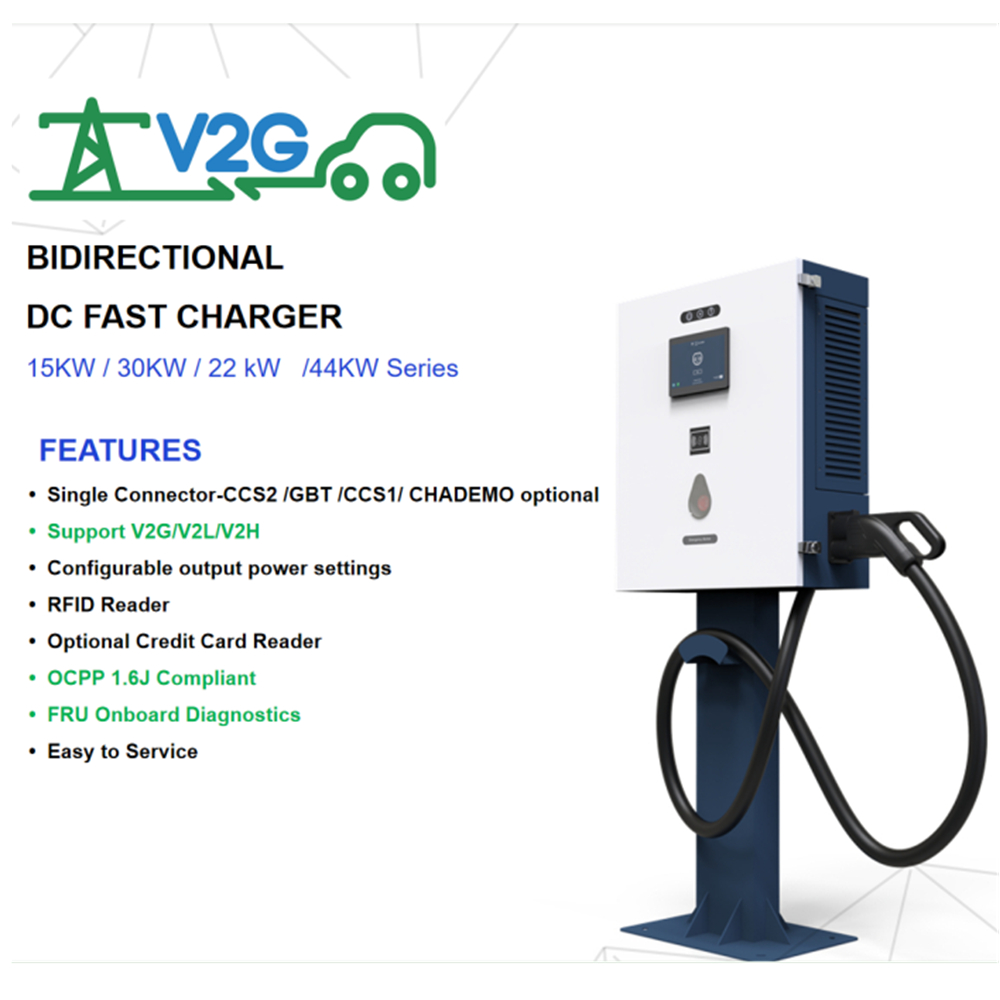
This series of policies and standard actions from Europe is not just a small-scale adjustment of regional markets, but is reshaping the global car network interaction industry landscape. The European V2G roadmap will affect Chinese car companies’ overseas expansion, domestic V2G standard development, and global charging pile industry chain technology iteration. Understanding the logic behind the European V2G policy game can help to see the development direction of the global two-way charging industry in the next 3 to 5 years.
Why ISO15118 Matters?
Many readers may wonder what the ISO15118 standard is and why it is considered the foundation for V2G scaling by the industry. ISO15118 is an international standard for digital communication between vehicle stations, commonly known as the plug and play communication protocol. Simply put, after the vehicle is connected to the charging station, the vehicle and the charging station can automatically complete identity authentication, power metering, and encrypted data exchange. The ISO15118-20 subset specifically defines bidirectional charging and discharging communication rules to achieve safe and reliable data exchange when vehicles transmit power in reverse to the grid. If there is no unified communication standard, different brands of vehicles and charging stations cannot communicate with each other, and each V2G solution needs to be customized and docked separately, which is extremely expensive and cannot be replicated on a large scale.
Before the EU introduced mandatory standards, V2G pilots in various European countries were in a fragmented state. Small scale commercial V2G services have emerged in the Netherlands, the United Kingdom, and France; In previous regulations in Germany, if a vehicle discharges into the power grid, it will be subject to repeated grid usage fees, that is, dual charging and dual transmission and distribution electricity fees, directly compressing the revenue space of V2G projects and making it difficult for commercial projects to make profits. By the end of 2025, Germany will complete regulatory adjustments and eliminate dual grid fees in the context of bidirectional charging. This is a landmark policy breakthrough for the German V2G industry and will also open up profit opportunities for subsequent commercial projects.
In May 2026, a joint report was released by the EU expert group and the German initiated Bi directional Charging Voluntary Alliance, proposing a complete set of reform suggestions to simplify the data exchange mechanism for flexible resources and open up market channels for distributed resources such as electric vehicles, household energy storage, and heat pumps to participate in grid regulation. This report is supported by the European Union’s Transport and Energy directorates, and brings together representatives from European car companies, grid operators, energy retailers, and aggregators to jointly discuss and form a consensus direction reached by all parties in the European industrial chain. The report proposes that the participation of distributed flexible resources in power grid peak shaving and congestion management requires the establishment of a clear revenue payment mechanism, while coordinating with transmission system operators TSO and distribution system operators DSO to avoid local voltage limit issues in low-voltage distribution networks caused by large-scale V2G scheduling.
European V2G industry promotion route: first unify standards, then reform market rules
The development path of V2G in Europe can be clearly divided into three stages.
- Stage 1: Pilot verification (2018-2024). The Netherlands, the United Kingdom, France, and Germany carried out pilot projects to verify technology and accumulate real operating data.
- Stage 2: Standard implementation and institutional reform (2026-2027). Enforcement of ISO15118 to unify underlying protocols and revision of electricity regulations.
- Stage 3: Large-scale commercialization (After 2028). Projects rely on electricity spot price differences and auxiliary service income to achieve self-generation.
The policy game of the German Industry Alliance
Comparison of Global V2G Market Patterns
The global market has formed three distinct routes:
- European route: Standard-driven and electricity market reform.
- Australian route: Spot electricity price signal-driven.
- China route: Multi-scenario pilot parallel route.
Opportunities and Challenges for China
Opportunities: Domestic manufacturers possess mature bidirectional charging hardware; car companies have accumulated safety control experience; virtual power plant platforms can adopt European scheduling frameworks.
Challenges: Increased compliance costs (ISO15118 testing, GDPR); intensifying local competition; stricter distribution network security responsibilities.
Prediction of Future Global V2G Industry Trends
- Standardization is an irreversible trend.
- Value shifting from peak-valley arbitrage to grid ancillary services.
- Business models shifting to multi-resource collaborative aggregation.
- Car companies evolving from manufacturers to energy service participants.
Post time: Sep-29-2026
