
 Portable EV Charger
 Home EV Wallbox
 DC Charger Station
 BESS Charging Station
 V2G V2H V2V V2L
 EV Charging Module
 DC Charging Connector
 EV Accessories

Driven by the ’2030 Vision’, Saudi Arabia’s electric vehicle and charging infrastructure is experiencing explosive growth. EVIQ (a joint venture between Saudi Public Investment Fund PIF and Saudi Electricity Company SEC) plans to deploy 5000+fast charging stations and 1000 charging hubs by 2030; The SEC also announced the construction of 3500 new charging points by the end of 2025. The number of EV registrations will increase by 425% between 2021 and 2023 (from 375 to over 12000).
But the larger the market, the higher the compliance threshold. This article systematically breaks down the complete details of Saudi Arabia’s charging pile certification, helping overseas enterprises to clear mines in advance.
Regulatory Framework: Who is in charge?
The core organization responsible for compliance of electric vehicles and charging equipment in Saudi Arabia is SASO (Saudi Standards, Metrology and Quality Organization). All charging equipment entering the Saudi market must be registered and certified through the SALEEM SABER electronic compliance assessment system.
Approved on October 3, 2024 and released on January 3, 2025, it not only regulates the entire vehicle but also establishes a standard system for charging infrastructure and equipment.
“Approval of Electric Vehicle Chargers and Accessories” Issuing compliance certificates is expected to take approximately 15 working days.
First obtain the Product Conformity Certificate (PC, valid for 1 year), and then apply for the Shipment Conformity Certificate (SC, single time valid) before each batch of shipment, all processed through saber.sa.
Key points: SASO is the organization for regulations, while SABER is the platform for registration. The two are not interchangeable. The CE mark, manufacturer’s self declaration, and non accredited laboratory report cannot replace SASO CoC.
Standard List: Match Products by Product
Saudi Arabia matches IEC/SASO/GSO series standards according to product types. Below are the three mandatory categories:
- ① SASO IEC 61851-1:2018 (General Requirements)
- ② SASO GSO IEC 61851-23:2019 (DC Charging Stations)
- ③ SASO IEC 61851-24:2014 (Digital Communication)
- ④ SASO IEC 61851-21-1:2018 (EMC for Vehicle)
- ⑤ SASO IEC 61851-21-2:2018 (EMC for Off Board)
- ① SASO GSO IEC 60228:2014 (Insulated Conductors)
- ② SASO GSO IEC 60245-4:2014 (Rubber insulated cables)
- ③ SASO IEC 62893-1:2019 (General Requirements)
- ④ SASO IEC 62893-2:2019 (Test Methods)
- ⑤ SASO IEC 62893-3:2019 (Cables for AC charging)
- ① SASO GSO IEC 62196-1:2015 (General requirements)
- ② SASO GSO IEC 62196-2:2019 (Type 2 Dimensional)
- ③ SASO GSO IEC 62196-3:2018 (CCS2/CHAdeMO)
- ④ SASO GSO IEC 60309-1:2000 (Industrial plugs)
- ⑤ SASO 2203:2018 (Household Plug Safety)
Comparison between China and Saudi Arabia
Many believe ‘if the domestic CCC passes, Saudi Arabia can sell’ – this is a major misconception.
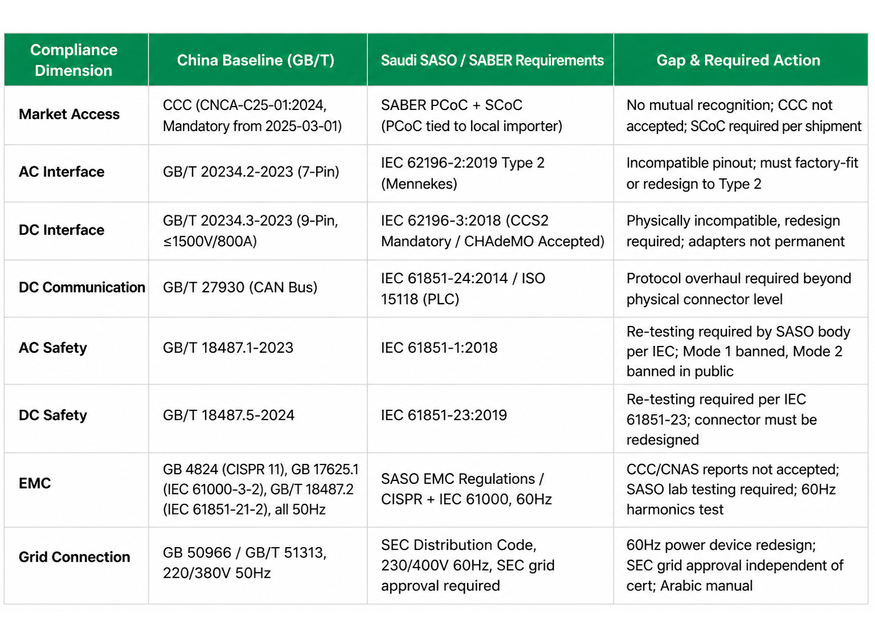
- Interface physical incompatibility: GB/T 20234 is geometrically different from IEC 62196 Type 2/CCS2. Public infrastructure must be equipped with Type 2/CCS2 at the factory.
- 60Hz grid frequency: Saudi power grid operates at 230/400V 60Hz. Inductors, transformers, and firmware must be revalidated to avoid overheating.
- SABER has no mutual recognition: CCC and CNAS reports are not accepted; must be retested by SASO accredited institutions.
Mode Red Line: Mode 1/2 Prohibited
Mode 1: Completely prohibited. Cannot be imported.
Mode 2: Private only. Prohibited in public places. Must comply with SASO IEC 60309 and leakage protection requirements.
Mode 3/Mode 4: Compliance Baseline. Public facing services must start with these modes.
DC Fast Charging and EMC Special Project
Entering DC fast charging expands standards to SASO GSO IEC 61851-23 and -24. Note that 61851-21-2 (off board charging systems EMC) is often overlooked by cross-border suppliers but is critical for site owners.
Environmental adaptation: high temperature, sand and dust, Arabic language tags
Outdoor equipment needs focused evaluation on heat dissipation, fan reliability, and sealing due to Saudi’s extreme heat.
IP6X dust sealing is essential. The Saudi power grid is approximately 127V/220V (some 220V/60Hz).
Nameplates and manuals must be in Arabic or English/Arabic bilingual with QR codes for traceability.
Certification process: PC → SC full steps
Step 2: Prepare documents (SDoC, CB reports, drawings, Arabic manuals).
Step 3: ShenPC (Product Certificate) – Valid for 1 year.
Step 4: Shen SC (Shipping Certificate) – Required for each shipment.
Step 5: Grid approval – Separate path for large-scale projects.
- ✔ Choose the right mode: Public stations only use Mode 3/4.
- ✔ Lock standards: Specific SASO/GSO/IEC standards by product category.
- ✔ Original certificate: Must cover specific models and off-board EMC.
- ✔ Adaptation: High temp dissipation, IP protection, and Arabic labels.
- ✔ Pre-process: First PC, then SC. No CoC = No customs clearance.
Post time: Nov-10-2026
