 Portable EV Charger
 Home EV Wallbox
 DC Charger Station
 BESS Charging Station
 V2G V2H V2V V2L
 EV Charging Module
 DC Charging Connector
 EV Accessories

Driven by the ’2030 Vision’, Saudi Arabia’s electric vehicle and charging infrastructure is experiencing explosive growth. EVIQ (a joint venture between Saudi Public Investment Fund PIF and Saudi Electricity Company SEC) plans to deploy 5000+fast charging stations and 1000 charging hubs by 2030; The SEC also announced the construction of 3500 new charging points by the end of 2025. The number of EV registrations will increase by 425% between 2021 and 2023 (from 375 to over 12000).
Regulatory Framework: Who is in charge?
The core organization responsible for compliance of electric vehicles and charging equipment in Saudi Arabia is SASO (Saudi Standards, Metrology and Quality Organization). All charging equipment entering the Saudi market must be registered and certified through the SALEEM SABER electronic compliance assessment system.
Constrained by the Third Edition of the Technical Regulations for Electric Vehicles
Approved on October 3, 2024 and released on January 3, 2025, it not only regulates the entire vehicle but also establishes a standard system for charging infrastructure and equipment.
SASO special service has been launched
“Approval of Electric Vehicle Chargers and Accessories” Issuing compliance certificates to manufacturers and suppliers is expected to take approximately 15 working days for official processing.
Two step certificate replacement: PC and SC
First obtain the product conformity certificate (PC, valid for 1 year), and then apply for the shipment conformity certificate (SC, single time valid) before each batch of shipment, all processed through saber.sa.
Key points – SASO is the organization responsible for formulating technical regulations and conformity assessment systems, while SABER is the electronic platform for registration, certification, and shipment verification. The two are not interchangeable: first conduct compliance evaluation according to SASO regulations, and then renew the certificate and clear customs on the SABER platform. The CE mark, manufacturer’s self declaration, and non accredited laboratory report cannot replace SASO CoC.
Standard List: Match Products by Product
Saudi Arabia does not test according to “one SASO standard”, but matches IEC/SASO/GSO series standards according to product types. SASO has officially released a mandatory standard list by product category (as shown in the original image in this article). Below are three categories of charging stations/charging cables/connectors/plugs and sockets listed one by one, with the year version based on the official list:
Electric vehicle charging station
- ① SASO IEC 61851-1:2018
- ② SASO GSO IEC 61851-23:2019
- ③ SASO IEC 61851-24:2014
- ④ SASO IEC 61851-21-1:2018
- ⑤ SASO IEC 61851-21-2:2018
Electric vehicle charging cable
- ① SASO GSO IEC 60228:2014
- ② SASO GSO IEC 60245-4:2014
- ③ SASO IEC 62893-1:2019
- ④ SASO IEC 62893-2:2019
- ⑤ SASO IEC 62893-3:2019
Charging connector/plug socket
- ① SASO GSO IEC 62196-1:2015
- ② SASO GSO IEC 62196-2:2019
- ③ SASO GSO IEC 62196-3:2018
- ④ SASO GSO IEC 60309-1:2000
- ⑤ SASO 2203:2018 (Household)
Key Reminder
When communicating, it is essential to have the supplier list in writing the certificates that are included with the goods and cover the specific models reported, and indicate the applicable off board EMC standards. Simply stating ‘compliant with IEC 61851-1′ does not necessarily equate to the compliance documents required for customs clearance in Saudi Arabia.
Comparison between China and Saudi Arabia
Many manufacturers believe that ‘if the domestic CCC passes, Saudi Arabia can sell’ – this is the biggest misconception when going global. Below, we will compare the 8 key dimensions one by one:
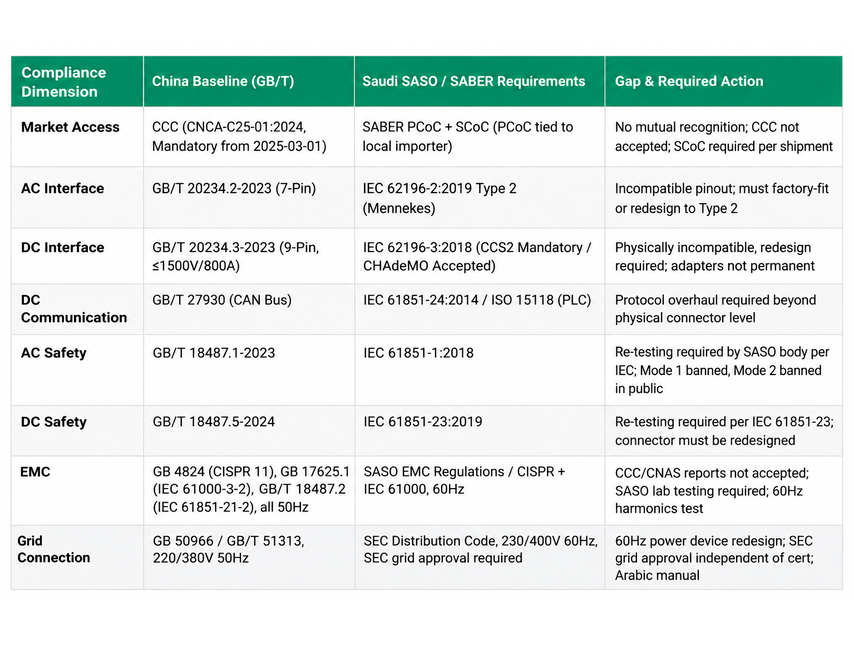
charging stations
Three ‘fatal gaps’: hardware level, not file level
① Interface physical incompatibility
GB/T 20234 is geometrically completely different from IEC 62196-2:2019 Type 2 and IEC 62196-3:2018 (CCS2/CHAdeMO). Public infrastructure must be equipped with Type 2/CCS2 at the factory.
② 60Hz grid frequency
Chinese equipment is designed at 50Hz. The Saudi SEC grid operates at 230/400V 60Hz. Components must be revalidated at 60Hz to avoid overheating.
③ SABER has no mutual recognition
CCC and CNAS reports are not accepted by SASO; It must be retested by SASO accredited institutions and applied for PCoC mainly by Saudi importers.
Mode Red Line: Mode 1/2 Prohibition
IEC 61851-1 defines four charging modes. Saudi regulations have imposed clear restrictions on two types:
Mode 1: Completely prohibited
Directly connected to ordinary sockets without dedicated protection/communication, cannot be imported.
Mode 2: Private only
Portable cables with IC-CPD are prohibited in public places; must meet SASO IEC 60309 requirements.
Mode 3/Mode 4: Compliance Baseline
Mode 3 (AC) and Mode 4 (DC) are the baselines for public charging services.
Using “sockets+cables” as a solution is the primary reason for project delays and budget overruns.
DC Fast Charging and EMC
SASO GSO IEC 61851-23/24: Safety and digital communication requirements for DC stations.
EMC Confusion: 21-1 is for on-board chargers; 21-2 is for off-board systems (the relevant item for site owners).
The power module and high-voltage circuit of DC fast charging are the hardest hit areas for certification and rectification.
Environmental Adaptation
Temperature: focus on evaluating heat dissipation and fan reliability under high-temperature operation.
Protection: IP6X dust and sand sealing is critical in dusty environments.
Labeling: Nameplate and manual must be in Arabic or English Arabic bilingual.
Certification Process: PC → SC Full Steps
Strategic suggestion: First establish an international testing foundation (IEC 61851/62196), then transfer CB reports to multiple countries to avoid repeated testing.
Practical Checklist for Going Abroad
Choose Mode
Public: Mode 3/4 only
Mode 1: Prohibited
Lock Standards
Match by category
SASO/GSO/IEC
Original Certs
Confirm specific models
& Off-board EMC
Adaptation
High Temp / IP
Arabic Labels
Pre-process
PC first, then SC
No CoC = No Entry
Post time: Nov-24-2026