
 Portable EV Charger
 Home EV Wallbox
 DC Charger Station
 BESS Charging Station
 V2G V2H V2V V2L
 EV Charging Module
 DC Charging Connector
 EV Accessories

Overview of the Five Major Standards
The global electric vehicle charging standards are showing a pattern of regional fragmentation: China leads GB/T, Europe leads CCS2, Japan adheres to CHAdeMO, and North America is fiercely competing between CCS1 and NACS.
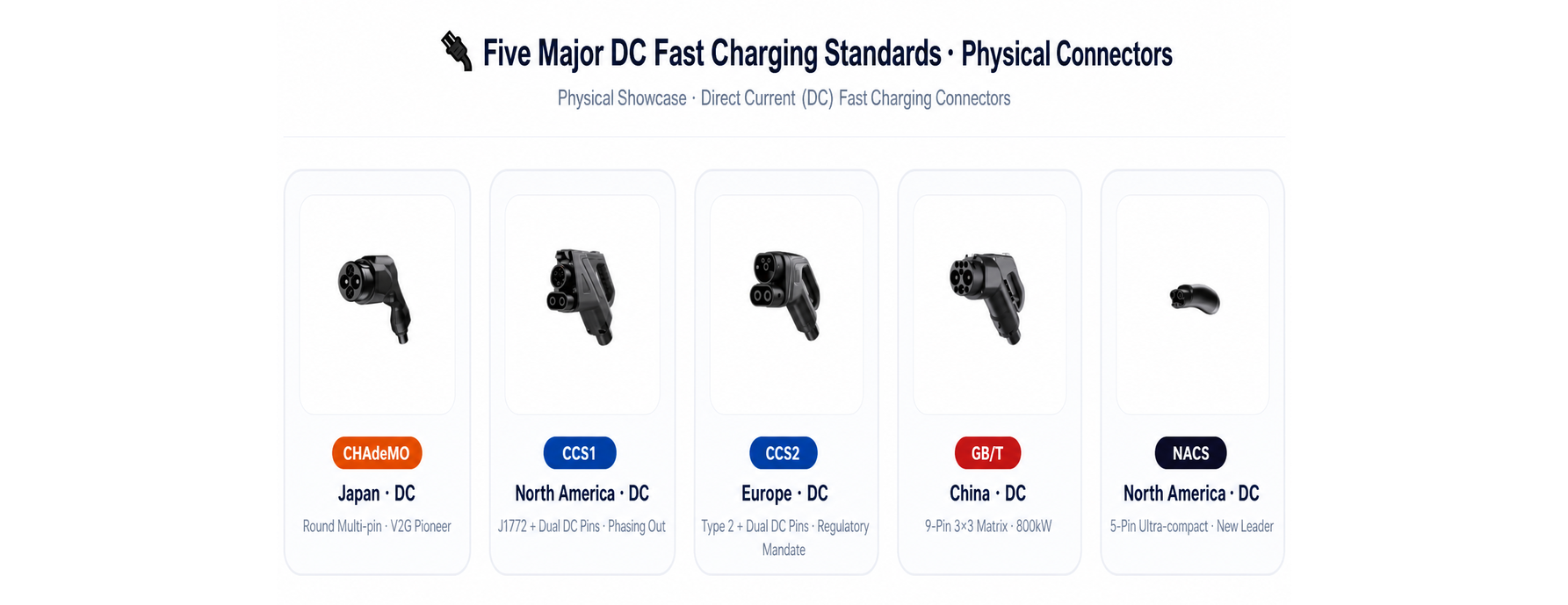
GB/T – Chinese National Standard
Development history: GB/T 20234 is a national standard for conductive charging connection devices for electric vehicles in China, first published in 2006. The first revised version was launched in 2011, which stipulated that the rated DC voltage should not exceed 1000V and the rated current should not exceed 400A.
In December 2015, the National Standards Committee released the GB/T 20234-2015 trilogy (General Requirements, AC Interface, DC Interface). Thanks to the 2015 version of the standard, also known as the old national standard, almost all new energy vehicles and public DC charging piles in China have adopted a unified charging interface, completely solving the chaotic situation of “thousands of piles and thousands of faces” in the early days.
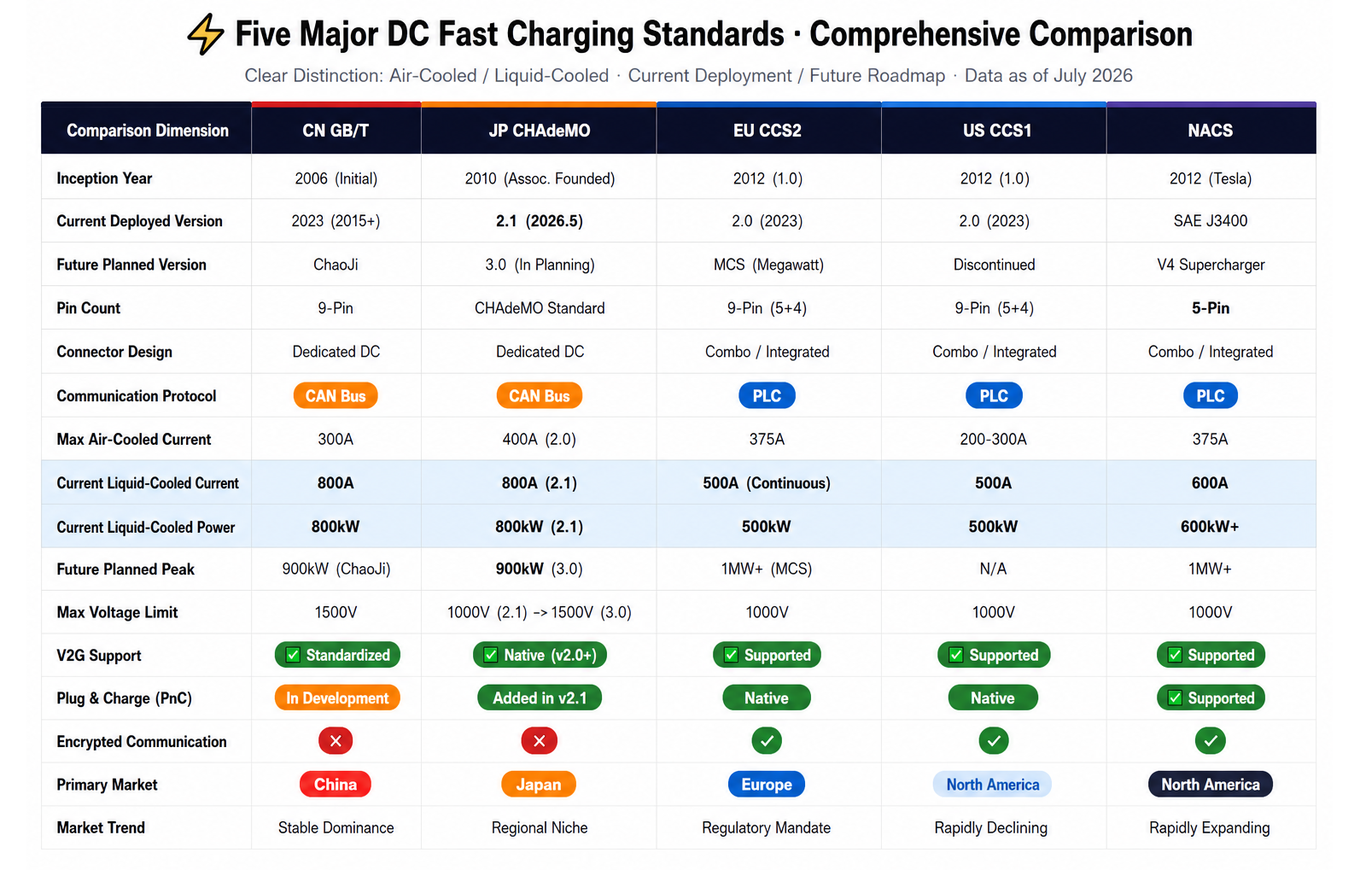
In September 2023, the Ministry of Industry and Information Technology released GB/T 20234.1-2023 and GB/T 20234.3-2023, which is a huge technological leap forward. The new standard significantly increases the maximum charging current from 250A to 800A and the charging power to 800kW, while ensuring the physical compatibility of the new and old charging interfaces. In addition, the new standard officially adds technical requirements for high-power charging such as active liquid cooling and temperature monitoring.
- • Interface design: DC 9-core independent interface (separate from AC 7-core)
- • Communication method: CAN bus (based on GB/T 27930 protocol)
- • Current maximum current (air-cooled): 300A
- • Current maximum current (liquid cooled): 800A
CHAdeMO – Representative of Japanese Technology Flow
Development history: CHAdeMO Association was established in 2010, initiated by five major Japanese car manufacturers including Toyota, Nissan, Mitsubishi, and Tokyo Electric Power Company. Its name comes from the Japanese phrase “O cha demo ikaga desuka” (how about drinking a cup of tea), meaning “charging time is as short as a tea break”.
The iteration path of the protocol version is very clear:
- Version 1.0 (2010): Rated at 62.5kW (500V/125A), it solves the problem of “with or without” fast charging for electric vehicles.
- Version 1.2 (2018): Upgraded to 200kW, catching up with the pace of Europe.
- Version 2.0 (2020): Supports 400kW (1000V/400A) and introduces V2G (vehicle to grid) bidirectional charging and discharging function.
- Version 2.1 (2026): Increases charging power to 800kW (800A) through optimized control and heat dissipation.
- Version 3.0 (Planning): “ChaoJi” interface solution, target power 900kW/1500V.
- • Interface design: Independent DC interface, unique circular multi pin connector
- • Communication method: CAN bus (strong noise resistance)
- • Current maximum landing power: 800kW
- • Peak Future Plan (Version 3.0): 900kW
CCS2- European Unification Plan
Development history: The Combined Charging System (CCS) was jointly developed by ACEA and SAE. Its design philosophy is “One interface leads the world” – adding two DC high voltage pins below the standard Type 2 AC interface.
The CCS 2.0 version released in 2023 is a major upgrade with power over 500kW. In “boost mode”, power approaches 1MW. The European Union has mandated that all newly launched M1 electric vehicles adopt the CCS2 standard.
- • Interface design: AC+DC integration (top 5-pin AC+bottom 2-pin DC)
- • Communication mode: PLC power line communication (ISO 15118)
- • Rated current: 500A (continuous) / 700-800A (boost)
- • Current maximum power: 500kW (standard boost can reach 1MW)
CCS1- North America’s Old Dream of the Former Dynasty
Development history: CCS1 is based on the Type 1 AC interface (SAE J1772). Since 2023, local giants such as Ford and GM have announced the abandonment of CCS1 in favor of Tesla’s NACS. Currently, CCS1 is rapidly being marginalized in North America.
- • Interface design: J1772 AC port + DC extension below
- • Liquid cooling current: 500A
- • Current maximum power: approximately 350kW-500kW
- • Market trend: Rapid shrinkage, will be replaced by NACS
NACS – Tesla’s Dimension Reduction Strike
Development history: Initially developed by Tesla, the North American Charging Standard (NACS) was opened up in 2022. SAE International standardized it as SAE J3400. Major manufacturers including Ford, GM, Rivian, Volvo, and Mercedes-Benz have announced native adoption of NACS from 2025.
- • Interface design: 5-pin ultra compact AC/DC integration
- • Communication method: PLC (compatible with CCS system)
- • Liquid cooling current: 600A (V4 overcharge pile)
- • Maximum voltage: 1000V
- • Market Trends: North America is absolutely dominant
Post time: Oct-27-2026
