 Portable EV Charger
 Home EV Wallbox
 DC Charger Station
 BESS Charging Station
 V2G V2H V2V V2L
 EV Charging Module
 DC Charging Connector
 EV Accessories

Executive Summary
Thailand has established the most systematic EV charging regulatory framework in Southeast Asia and will rapidly shift from “voluntary certification” to “mandatory control” in 2024-2026. Here are the 6 most memorable conclusions.
Regulatory and Institutional Map
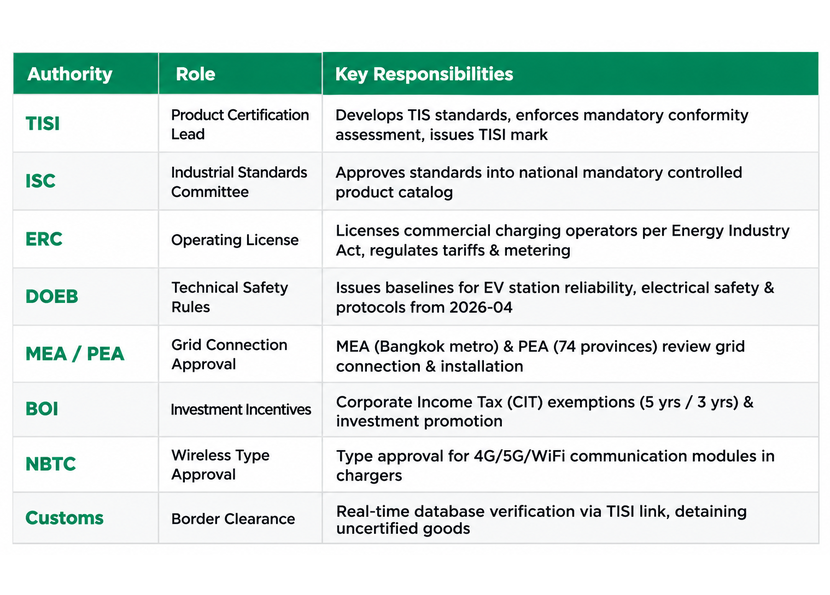
Three levels must be distinguished: TISI management of “products”, ERC management of “operation and sales of electricity”, and MEA/PEA management of “grid access and installation” – all three must be met separately.
Standard Matrix (TIS ↔ IEC alignment)
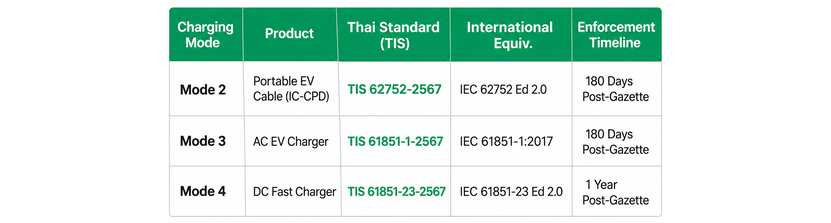
- Coverage ≤ 1000V AC/1500V DC;
- Prohibit charging in Mode 1;
- Limit Mode 2/3 current and plug;
- The user manual must include Thai language;
- Simultaneously abolish the old standards TIS 61851-1-2560 and TIS 61851-22-2560.
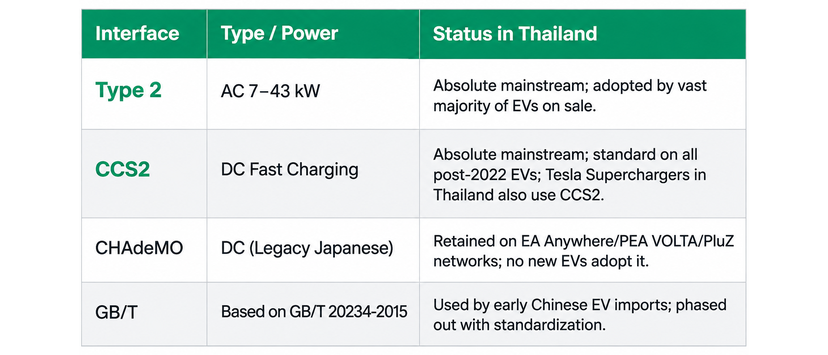
Detailed information on each dimension
4.1 TISI Mandatory Certification System
Belonging to the Ministry of Industry; The mandatory list is approved by the Industrial Standards Committee and TISI implements conformity assessment. Covering all EVSEs (Mode 2/3/4) of M/N road EVs. Assessment dimensions: insulation withstand voltage, leakage protection, emergency stop, high temperature protection, IP dust and waterproof EMC; Suitable for 220V/50Hz+Type 2.
4.2 Adopting International Common Standards
Thai TIS is equivalent to the IEC series: 61851, 62196, 62752, 62311, 62477. Alignment but not identical: Local differences such as tropical climate adaptation, Thai manual, and disabling Mode 1 need to be verified separately.
CB to TISI conversion is feasible: Existing IEC/CB reports can reduce testing, but cannot replace TISI differential testing and local audits.
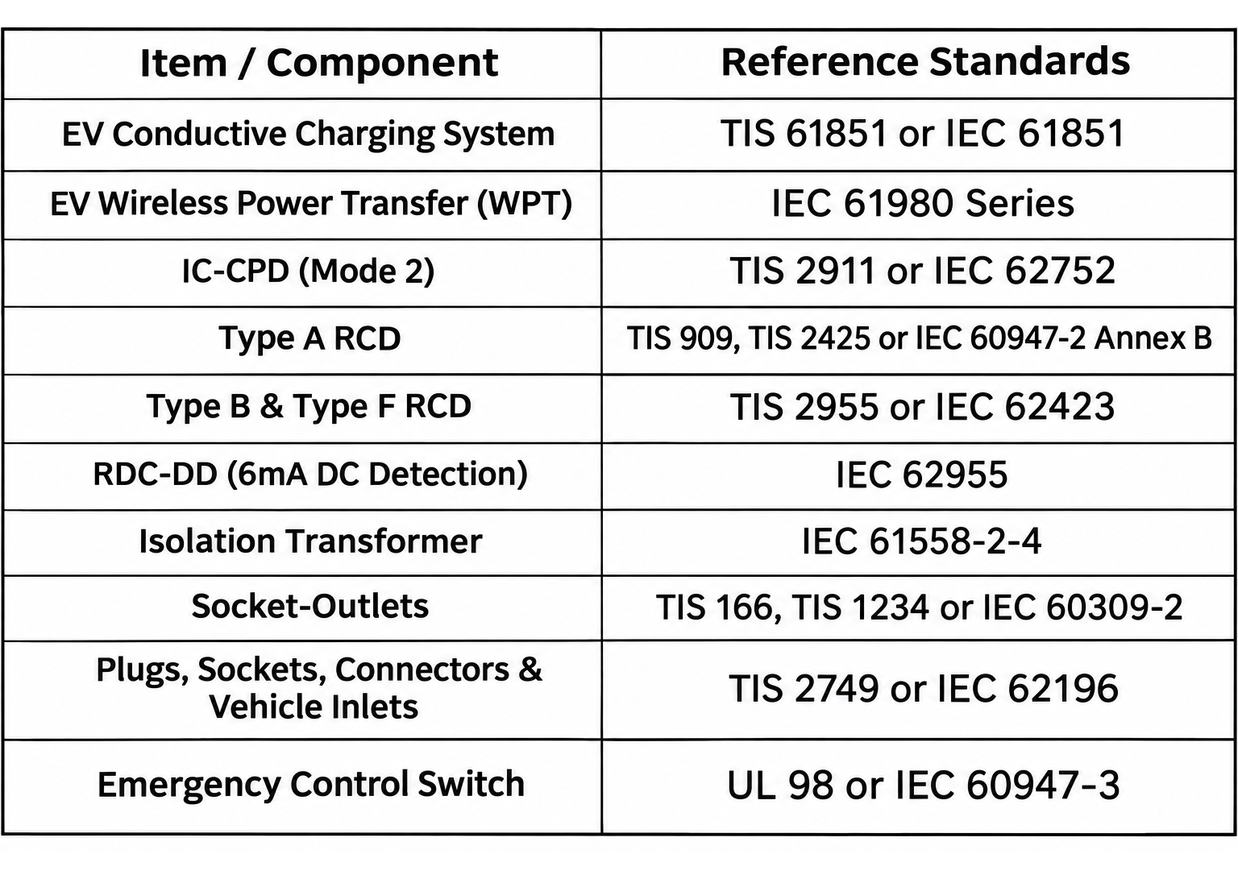
4.3 Charging Communication Protocol
OCPP: Pile backend communication; PEA/MEA has been listed as a mandatory requirement for grid connection; Public piles generally require OCPP 1.6J and reserve 2.0.1 for upgrade. ISO 15118: Vehicle pile high-level communication, plug and charge V2G; DOEB 2026 specification promotes adoption.
NBTC: Wireless modules must pass Thai radio certification; Payment must support PromptPay. There is currently no nationwide roaming network; The government plans to pilot EV Data Standard+roaming hub by the end of 2026/early 2027.
4.4 ERC Charging Service Supervision and Operating License
According to the Energy Industry Law BE 2550 (2007). ≥ 1000 kVA requires application for an electricity distribution license; Exemption for<1000 kVA or internal use, but reporting is required. Cost: one-time 50000 THB+annual fee of 0.10 satang/kWh; Approval takes about 2 months.
4.5 Certification process and technical requirements
Process: Confirm mandatory scope → Determine Thai applicant → Prepare materials → Send samples for testing → Factory audit → Certificate issuance. Cycle: 4-8 months. Core tests: insulation, leakage, emergency stop, IP, tropical environment (salt spray 72h, UV 1000h). Local Diff: Oil resistance of rubber handle for charging gun.
4.6 Import Access and Market Requirements
Compulsory TISI certificate required for customs clearance; Unlicensed results in detention and fines up to 500,000 THB. Applicant must be a Thai registered entity. TISI certificate is the key defense basis under Consumer Protection Law.
4.7 Thailand EV Policy and Incentives
30@30 Strategy: ZEV production ≥ 30% by 2030. EV3.5: Subsidy 50k-100k THB; 2% consumption tax. BOI: CIT exemption for 3-5 years for charging infrastructure. Target 12,000 DC fast chargers by 2030.
4.8 Safety and Installation Standards
DOEB 2026-04: 2-hour fire compartment, Type B RCD. Grid connection: MEA/PEA requires site plans and TIS specs. Labeling: EV label controlled (2026-03-21). Intelligent charging included in 2026 standards.
Key Timeline
Dec 27, 2024: Three charging TIS standards released
Sep 19, 2025: WTO notification G/TBT/N/THA/789
Mar 21, 2026: EV listed as “label controlled product”
Jul 21, 2026: 5 new mandatory EV standards approved
Jun 2027: (Proposed) Portable cable + household AC mandatory
Jan 2028: (Proposed) Public DC fast charging mandatory
Manufacturer/Exporter Action List
Post time: Nov-24-2026