
 Portable EV Charger
 Home EV Wallbox
 DC Charger Station
 BESS Charging Station
 V2G V2H V2V V2L
 EV Charging Module
 DC Charging Connector
 EV Accessories

Compliance Alert 2026
In July 2026, Thailand officially included charging stations in mandatory certification – going abroad to Thailand, compliance is no longer an option.
Executive Summary
Thailand has established the most systematic EV charging regulatory framework in Southeast Asia and will rapidly shift from “voluntary certification” to “mandatory control” in 2024-2026. Here are the 6 most memorable conclusions.
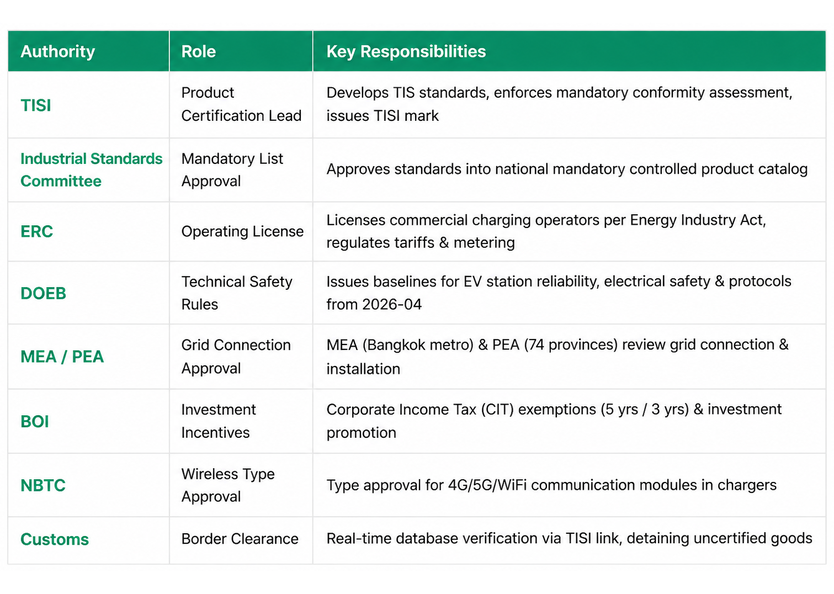
Regulatory and Institutional Map
Standard Matrix (TIS ↔ IEC alignment)
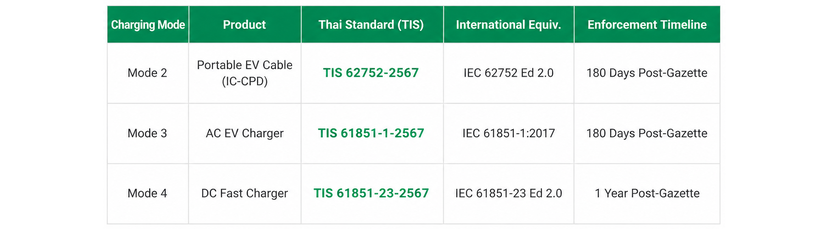
TIS 61851-1-2567 Localization Key Points: Coverage ≤ 1000V AC/1500V DC; Prohibit charging in Mode 1; Limit Mode 2/3 current and plug; The user manual must include Thai language; Simultaneously abolish the old standards TIS 61851-1-2560 and TIS 61851-22-2560.
Connector system (derived from IEC 62196)
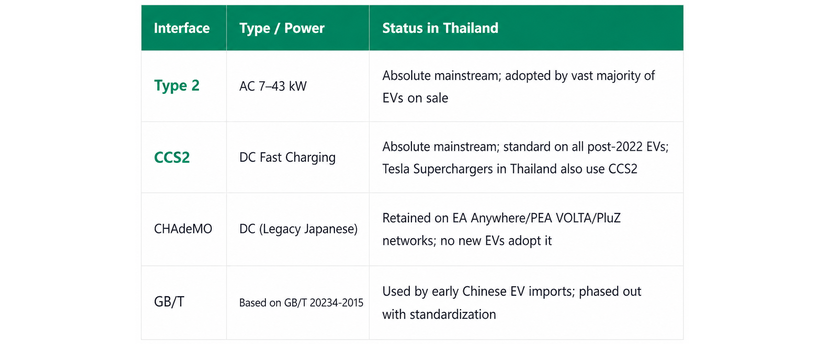
Detailed information on each dimension
4.1 TISI Mandatory Certification System
Belonging to the Ministry of Industry; The mandatory list is approved by the Industrial Standards Committee and TISI implements conformity assessment. Covering all EVSEs (Mode 2/3/4) of M/N road EVs. Assessment dimensions: insulation withstand voltage, leakage protection, emergency stop, high temperature protection, IP dust and waterproof EMC; Suitable for 220V/50Hz+Type 2.
Key milestones: Release of three standards on December 27, 2024 → WTO Notification G/TBT/N/THA/789 on September 19, 2025 → Inclusion of three charging devices under mandatory control on July 21, 2026 → Consultation on draft mandatory regulations on October 5, 2026.
4.2 Adopting International Common Standards
Thai TIS is equivalent to the IEC series: 61851, 62196, 62752, 62311, 62477. Alignment but not identical: Local differences such as tropical climate adaptation, Thai manual, and disabling Mode 1 need to be verified separately.
CB to TISI conversion is feasible: Existing IEC/CB reports can reduce testing, but cannot replace TISI differential testing and local audits.
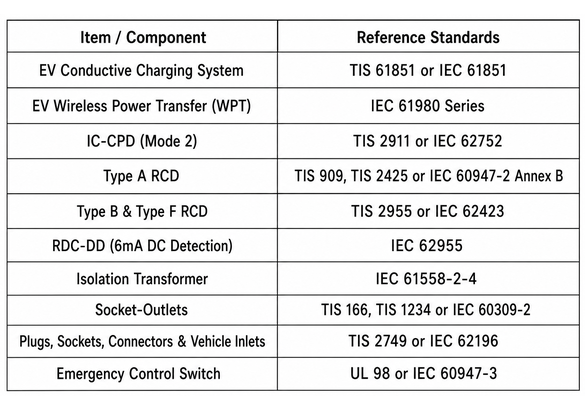
4.3 Charging Communication Protocol
- OCPP: Pile backend communication; PEA/MEA has been listed as a mandatory requirement for grid connection; Public piles generally require OCPP 1.6J and reserve 2.0.1 for upgrade.
- ISO 15118: Vehicle pile high-level communication, plug and charge V2G; DOEB 2026 specification promotes adoption.
- NBTC: Wireless modules must pass Thai radio certification; Payment must support PromptPay.
- Roaming: There is currently no nationwide roaming network; The government plans to pilot EV Data Standard+roaming hub by the end of 2026/early 2027.
4.4 ERC Charging Service Supervision and Operating License
According to the Energy Industry Law BE 2550 (2007). ≥ 1000 kVA requires application for an electricity distribution license; Exemption for <1000 kVA or internal use, but reporting is required.
Cost: one-time 50000 THB+annual fee of 0.10 satang/kWh; Approval takes about 2 months.
4.5 Certification process and technical requirements
Process: Confirm mandatory scope → Determine Thai applicant → Prepare materials → Send samples for testing → Factory audit → Certificate issuance → (Supervise and audit every 3 years). Cycle: Typically 4-8 months (6-12 months for charging guns).
Core tests: insulation/dielectric strength, leakage/over temperature/over-current protection, grounding continuity, emergency stop EMC、IP; Tropical environment (salt spray for 72 hours, UV for 1000 hours, -40~85 ℃); Material flame retardant UL94 V-0.
Difference in Thailand: Oil resistance of rubber handle for charging gun (IRM 903, 70 ℃ 168h).
4.6 Import Access and Market Requirements
Compulsory TISI certificate is required for customs clearance/listing/sales; Unlicensed customs detention, e-commerce delisting, and a maximum fine of 500000 Thai baht. The applicant must be a registered entity within Thailand; Suggest setting up a local Thai company and authorized representative for filing.
The consequences of non-compliance far exceed delisting: consumers have no fault in claiming compensation (Article 11 of Thailand’s Consumer Protection Law), and TISI certificate is the key defense basis.
4.7 Thailand EV Policy and Incentives
30@30: The proportion of ZEV production in 2030 is ≥ 30%. EV3.5 (2024-2027): Passenger car subsidy of 50000-100000 THB; 2% consumption tax; CBU import tariffs can be reduced by up to 40%.
BOI charging infrastructure incentive: CIT exemption for power stations with ≥ 40 guns (including ≥ 10 DC) for 5 years; 16-40 guns for 3 years. Target 12000 DC fast chargers by 2030.
4.8 Safety and Installation Standards
DOEB 2026-04 specification: Indoor must have a 2-hour fire compartment and manual emergency stop; Type B RCD+surge protection. MEA/PEA grid connection approval requires submission of site plan, electrical single line diagram, and TIS certification specifications; Household frequent electricity meter expansion (15 (45) A → 30 (100) A); PEA 2024 cancels the second meter policy.
Key Timeline
Dec 27, 2024: Three charging TIS standards released.
Sep 19, 2025: TISI notified WTO of G/TBT/N/THA/789.
Mar 21, 2026: EV listed as “label controlled product”.
Jul 21, 2026: 5 new mandatory EV standards approved.
June 2027 (Proposed): Portable cable + household AC mandatory implementation.
Jan 2028 (Proposed): Public DC fast charging mandatory.
Manufacturer/Exporter Action List
Main sources of information
Post time: Nov-10-2026
