 Portable EV Charger
 Home EV Wallbox
 DC Charger Station
 BESS Charging Station
 V2G V2H V2V V2L
 EV Charging Module
 DC Charging Connector
 EV Accessories

In the previous article, we briefly introduced the specific development of the Japanese charging pile market and summarized four major characteristics: small quantity, low power, long service life, and unreasonable distribution, which have brought poor charging experience to users and directly affected the purchasing decisions of potential users.
The Japanese government has started to make up for this by introducing a series of incentive measures to promote the infrastructure construction and iteration of charging stations. The plan is to increase the number of charging stations tenfold to 300,000 by 2030.
The large-scale growth of the Japanese charging pile market is undoubtedly a good expansion opportunity for domestic pile companies. Therefore, we will continue to introduce the entry threshold for the Japanese charging pile market – CHAdeMO certification.
Background
CHAdeMO, This word looks and sounds awkward at first glance, making people wonder if it was directly translated from Japanese to English.
Actually, CHAdeMO is an abbreviation for French “CHArge de MOve” (mobile charging). The reason for borrowing from French is that the pronunciation of “CHArge de MOve” perfectly matches a daily Japanese greeting: “「お茶でもいかがですか?」?”, meaning “Would you like a cup of tea. The symbolism it represents is that drinking a cup of tea charges the battery, which is so comfortable and convenient.
In 2010, Japanese car manufacturers, including Toyota, Nissan, Mitsubishi, and Tokyo Electric Power Company, established the Japan Electric Vehicle Fast Charging Association to seize the opportunity in the development of electric vehicles. They named it the CHAdeMO Association and were the first to release the world’s first mature DC fast charging CHAdeMO standard. Two years earlier than the European DC fast charging communication standard DIN 70121, it was incorporated into the charging interface of many electric vehicles and widely used worldwide, gaining immense popularity.
Therefore, CHAdeMO is both the name of DC charging technology (CHAdeMO fast charging) and the name of the organization responsible for developing this technology (CHAdeMO Association).
However, the CHAdeMO standard got up early and rushed for a late episode.
The comprehensive implementation of any DC fast charging standard requires electric vehicles as pioneers. The development of electric vehicles in Japan has been too slow, investing too much research and development resources in HEV hybrid vehicles (such as Toyota’s twin engine models), and then directly betting on hydrogen fuel cell vehicles. From 2010 to 2020, Japan made almost no progress in pure electric vehicles, missing the golden decade of early development.
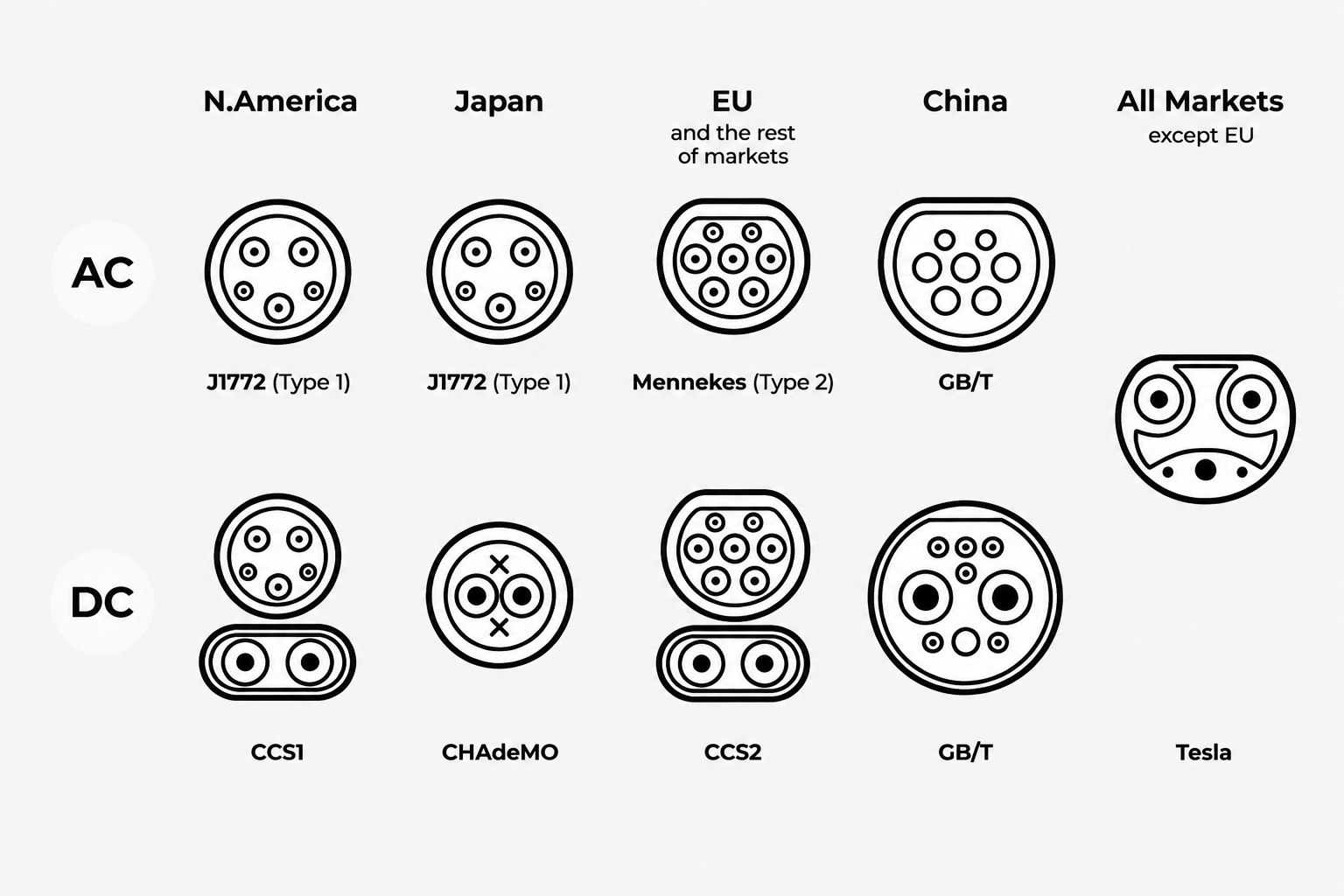
In the past decade, the European charging alliance Chargein has launched CCS (Combined Charging System), China has introduced the GB series, and North America is dominated by Tesla NACS.
Faced with the “encirclement” of the three major charging interfaces, the countries and models supported by Japan’s CHAdeMO interface are becoming fewer and fewer. So far, except for the United States and a few sporadic countries with a small number of charging piles supporting CHAdeMO, basically only Japan is still using it.
The CHAdeMO interface is not only user-friendly, but also physically difficult to use. The cables and plugs are extremely bulky, like antiques from the last century, with too many wiring harnesses inside the interfaces, which is not conducive to manufacturers reducing costs and optimizing the internal space of the cables.
Process
It’s not easy for charging stations with CHAdeMO interfaces to comply with the certification of the CHAdeMO Association, as niche is niche and not easy to use.
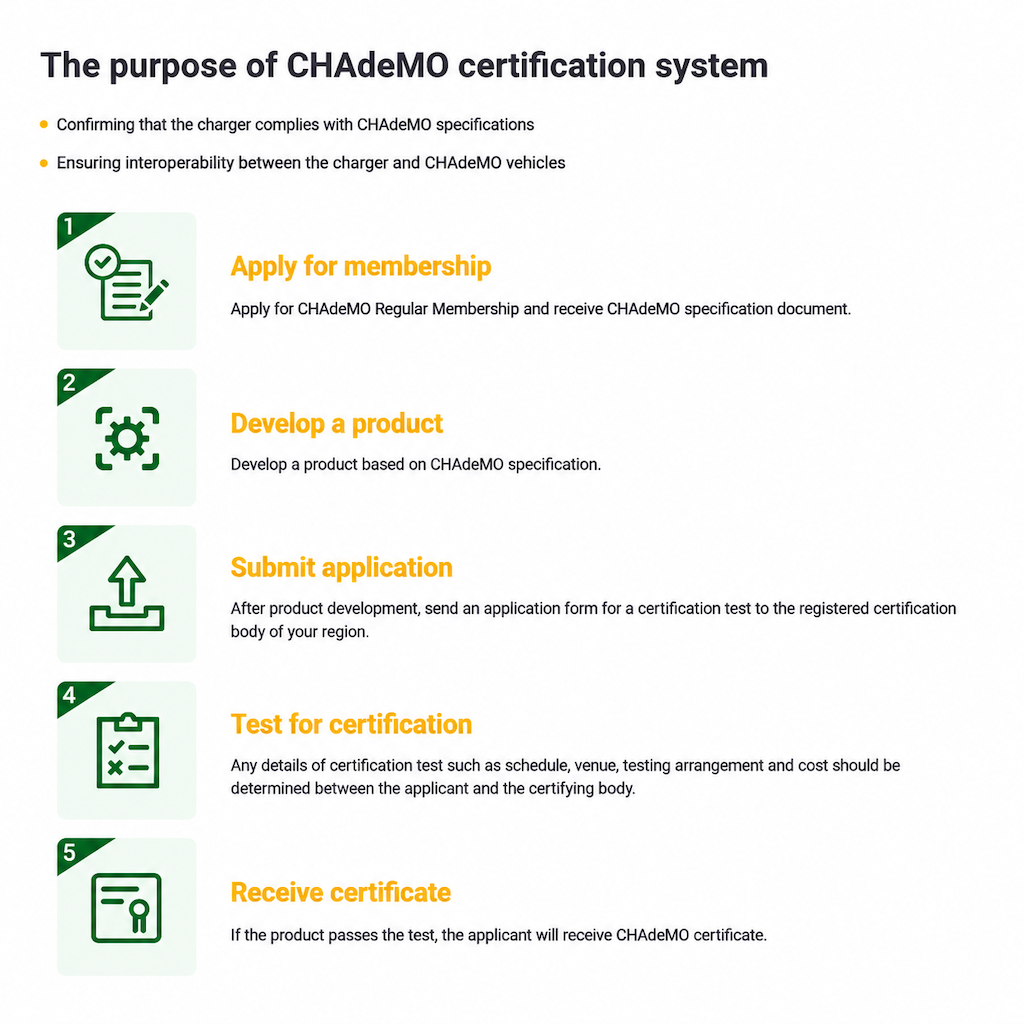
The official website of CHAdeMO Association lists five steps to obtain CHAdeMO certification:
- 1. Apply for membership to become a member
- 2. Develop a product
- 3. Submit Application
- 4. Test for certification
- 5. Receive certificate to obtain the certificate
Firstly, becoming a member of CHAdeMO in Japan is not just about submitting information and registering, you need to pay a membership fee. The certification manufacturer needs to pay 4000 euros (equivalent to 32000 yuan) annually.
The reason for charging membership fees, as explained by the CHAdeMO Association, is to join the association’s working group and contribute to the development of the CHAdeMO protocol; Faster access to the latest news, technological updates, and other industry trends of the association; Obtain exhibition and exchange opportunities organized by CHAdeMO Association to increase product exposure; You can also receive technical support from the CHAdeMO expert team when encountering problems during development.
Anyway, whether you’re willing to spend money or think it’s worth it, 4000 euros is a ticket to CHAdeMO certification. Just like 260 yuan to enter Sam’s supermarket. After paying the money, you can get the application form and design and development materials, and just go to the factory to make the product.
Testing
The difficulty of CHAdeMO authentication is that the testing meets the requirements of CHAdeMO. The main tests consist of three parts, namely:
Before confirming the testing, it is necessary to confirm the supported standard versions. Currently, the mainstream Japanese CHAdeMO certified version is 2.0.2. Version 2.0.3 has been released with only minor changes. The 3.0 version, on the other hand, is based on the ChaoJi standard developed by China, with a lighter interface and greater power support. However, due to the limited stock market of electric vehicles in Japan, the 3.0 version interface is only used in a small scope and has not been rolled out.
We will focus on introducing the requirements of CHAdeMO 2.0.2.
The full name is Technical Specifications of Quick Charger for Electric Vehicles. The core content includes three parts:
Part 1 Standard specification: defines basic requirements such as structure, electrical safety, gun seat, etc.
Part 2 Extended specification: defines special needs like high current and high voltage.
Part 3 Compatibility: defines mandatory requirements for charger-vehicle compatibility.
Testing Standards (Chapter 4 – 33 Sub-chapters):
Check
After the testing is completed, the next step is CHAdeMO Association accreditation and inspection.
In the past few years, obtaining recognition from the CHAdeMO Association for Japanese benchmark piles in China was particularly troublesome. The entire pile needed to be sent to Japan for testing, or CHAdeMO Association had to send engineers to inspect the site in China. Either way, it was a significant expense and could be easily spent in the millions.
“The manager of the overseas department of a leading enterprise complained roast after selling piles for several years, the certification fee was not earned back. After tinkering for half a day, it was a waste of time to keep Xiaotian busy.”
It is estimated that the CHAdeMO Association also realized that the threshold for doing so was too high and not conducive to brand building, so they opened up third-party institutions for testing and certification, calling it Certification Bodies. At present, mainstream UL, TUV South Germany, and DeKai enterprises have certification qualifications, and domestic CCIC can also inspect test data and products, which can save expensive international logistics costs and long communication cycles.
After completing all the programs, you will receive a certificate issued by the CHAdeMO Association, and the products that have passed will be listed on the CHAdeMO official website. At present, there are many machines made by Delta, with a total of four models. Of course, the overall power is less than 100kW, which cannot be considered as true fast charging.
After completing the above steps, CHAdeMO authentication is officially concluded.
So, do you think it’s the Japanese CHAdeMO certification that’s troublesome, or the European CE or American UL certification that’s troublesome?
Post time: Nov-23-2026