
 Portable EV Charger
 Home EV Wallbox
 DC Charger Station
 BESS Charging Station
 V2G V2H V2V V2L
 EV Charging Module
 DC Charging Connector
 EV Accessories

On the instruction manual of the charging station, more and more words such as “supports ISO 15118-2, can upgrade to ISO 15118-20″ are appearing. Many buyers treat it as a regular firmware version number, thinking that it will be available later via OTA.
But the truth is: from -2 to -20, it is not a small version iteration, but an intergenerational transition of charging communication protocol from the “first generation” to the “second generation”. It determines whether your pile can perform bidirectional charging and discharging, wireless charging, and withstand future compliance audits. This article will use a table and five breakdowns to clarify this boundary line.
Standard Family Panorama: First, see who is in the “front and rear versions”
ISO 15118 is not an isolated document, but a complete set of “Road Vehicles Vehicle Network Communication Interface” standard family (V2G CI). The commonly compared ‘before and after versions’ refer to two generations of application layer protocols: the first generation 15118-2 released in 2014 and the second generation 15118-20 released in 2022. In addition, there are several members of this family who each perform their duties.
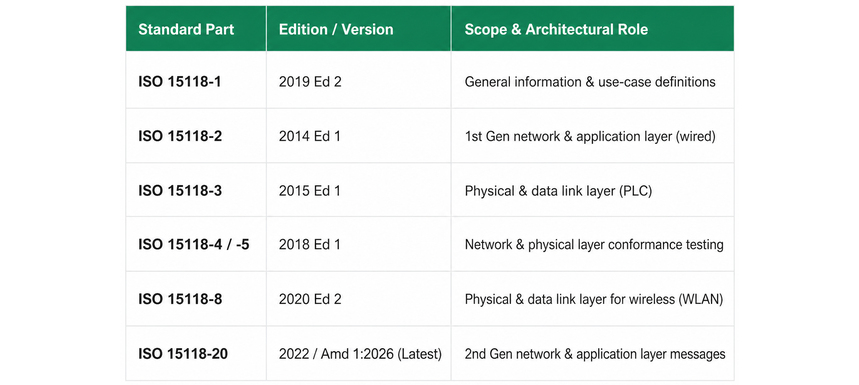
Notice: Starting from January 1, 2027, all newly built or renovated public and private charging stations within the European Union must support the ISO 15118-20 standard, including the secure TLS 1.3 communication protocol, advanced plug and play functionality, and V2G readiness capability.
Understanding the Intergenerational Differences between -2 and -20 in a Table
Putting two generations of protocols on the same table will make the differences very intuitive. The most critical dimensions – bidirectional, secure, controlled, compatible – almost every one of them is a structural rewrite rather than a patch.
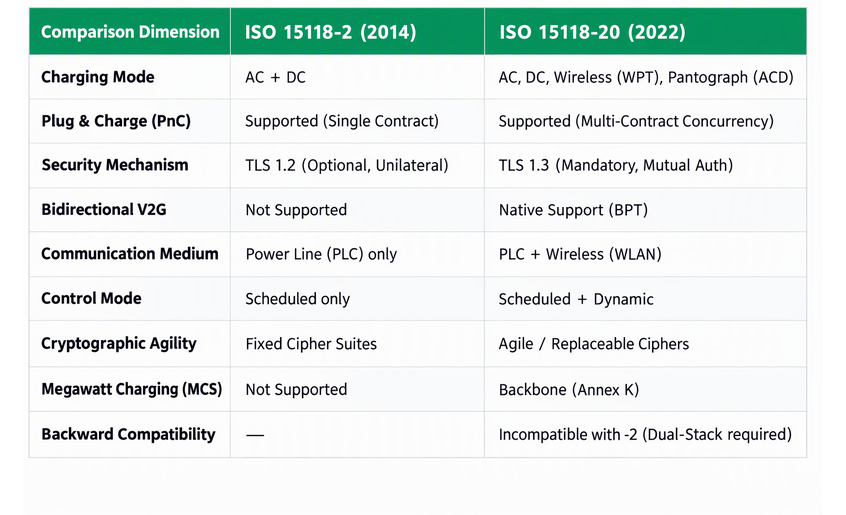
The two protocols are incompatible with each other: in order to serve two generations of vehicles simultaneously, the station must run dual protocol stacks and negotiate versions at the beginning of each session. This means that the hardware capabilities of “support -2 piles” and “support -20 piles” are not the same thing.
Five key upgrades, dismantled one by one
If you only remember one sentence, it would be: -2 treat the car as a ‘power load’, -20 treat the car as a ‘mobile energy storage’. Let’s take a closer look at these five most decisive upgrades.
① Native Bidirectional Charging (BPT): The Most Revolutionary Point
The energy flow of 2 is unidirectional – it can only go from the power grid to the vehicle. -20 has redesigned the entire message set to allow vehicles to discharge in reverse. It defines V2G (vehicle to network), V2H (vehicle to home), V2B (vehicle to building), and supports both AC and DC bidirectional communication.
Two new parameters have been added technically: BPTChannel (single/dual meter metering architecture) and GeneratiorMode (follower or grid type power supply). Explain clearly whether to charge now or release, how much to release, and whether to follow the source or build a network source. Combining AC/DC/wireless and automatic connection, bidirectional, -20 defines a matrix of up to 12 service modes.
② Mandatory TLS 1.3 mutual authentication+encryption agility
-TLS for 2 is “optional” and “one-way”: the vehicle verifies the stake, but the stake does not necessarily verify the vehicle. -Set TLS 1.3 as mandatory, and both parties must mutually verify the certificate chain. The reason is very practical: once energy can flow in reverse, ‘who can command the car to discharge’ has escalated from a billing issue to a safety issue.
Simultaneously introducing Crypto Agility: If the algorithms used today are compromised, they can be replaced without compromising interoperability. This is also one of the root causes of the larger size of the -20 certificate (up to about 1600 bytes), which puts higher requirements on the security chip at the pile end.
③ Simultaneous presentation of multiple contracts+dynamic control mode
-Each session only has one contract certificate; -20 allows one car to carry multiple contracts (such as company and individual) at the same time, and the pile end automatically selects the most suitable one based on the rate and roaming agreement, leaving the driver completely unaware throughout the entire process.
The control mode also adds a Dynamic feature: the control of the charging rate is completely handed over to the station or backend, and the station directly issues a hard power set point, which the vehicle unconditionally executes. This is crucial for scenarios such as orderly charging of fleets and demand response that can be adjusted at any time.
④ Wireless Charging (WPT) and Automatic Connection Device (ACD)
-For the first time, wireless charging communication (based on WLAN pairing and precise positioning) and pantograph automatic connection have been included in the standard, covering automation scenarios such as buses and heavy trucks – parking and charging without the need for plugging or unplugging, pushing the “plug and charge” experience to a new height.
⑤ Communication backbone for megawatt level charging (MCS)
-20 is the communication backbone of a megawatt level charging system (MCS), supporting high-power data exchange up to approximately 3.75 megawatts, aimed at heavy-duty trucks, ships, and even electric aircraft. It extends the word ‘charging’ from passenger cars to the entire map of transportation electrification.
Among the five upgrades, bidirectional charging (BPT) is the watershed, while the other four revolve around it.
Finally: Countdown to Regulations and Your Selection
This is not a purely technical issue, but a procurement node with clear legal red lines. The EU’s Alternative Fuel Infrastructure Regulation (AFIR, Regulation 2023/1804) has turned standards into hard constraints:
All newly established public communication charging stations in the European Union must support ISO 15118-2.
All newly established public and private charging stations (AC, DC) in the European Union must support ISO 15118-20.
When it comes to procurement and selection, three suggestions are worth remembering:
- 1. -20 is not a firmware upgrade for -2. Larger certificates, mandatory TLS 1.3, and bidirectional message processing require stronger SECC processors and memory. Pure-2 hardware cannot be upgraded to -20 by software and requires dual stack firmware.
- 2. When purchasing, it is explicitly required to have “ISO 15118-20-ready” and request a consistency test report or CharIN test report, without assuming “future upgrades”.
- 3. The backend requires OCPP 2.1 (IEC 63584) to run compliant plug and play charging; The old OCPP 1.6 does not support certificate exchange and cannot pass the AFIR audit.
Step on Pit Tips: The hardware that claims to support ISO 15118 but cannot provide a conformity test report is the most prone to crashing – verbal support does not equal compliance and cannot pass AFIR audits.
Post time: Nov-10-2026
