
 Portable EV Charger
 Home EV Wallbox
 DC Charger Station
 BESS Charging Station
 V2G V2H V2V V2L
 EV Charging Module
 DC Charging Connector
 EV Accessories
2026 Japan Charging Infrastructure Investment Pitfall Guide: Ten Landmines in Budget Shift, Bidding, Certification & Distribution
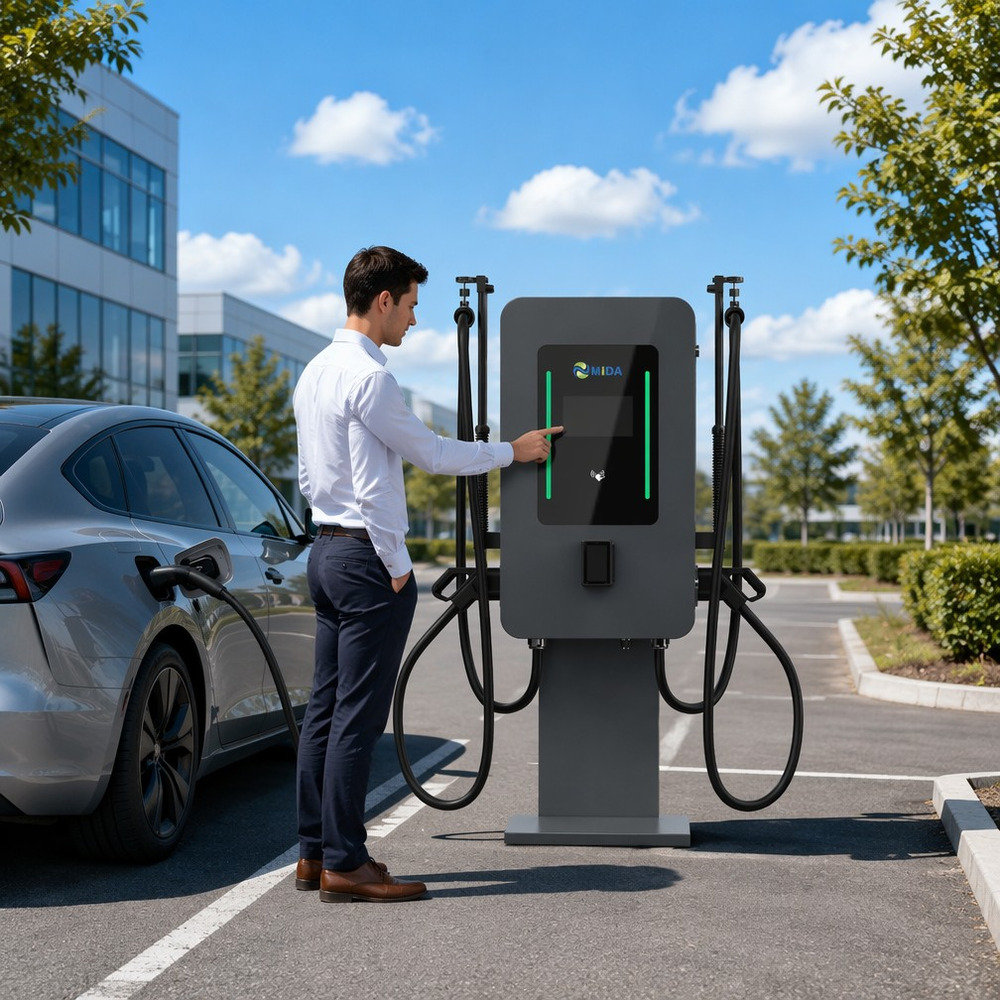
Key Takeaways
- The FY2026 Japan charging infrastructure subsidy budget structure has shifted: about JPY 4 billion moved from fast charging to residential/apartment charging, pushing fast charging grants into a “bidding plus merit selection” phase.
- Subsidy issuance now uses a bidding system: only winning bidders receive grants, and applications with low utilization or poor sites face sharply higher rejection rates.
- Billing is fully moving to kWh-based charging: per-kWh billing has become a precondition for subsidies and compliance, and time-based or flat-rate stations face retrofit pressure.
- Equipment compliance has three gates—PSE certification, CHAdeMO (JEVS protocol) conformance testing, and METI type approval—with a single model taking 6+ months end to end.
- High-voltage upgrades take 6–12 months and some 23-ward areas have tight capacity, so reception pre-review must be completed before signing the lease.
The “Policy Turning Year” for Japan Charging Infrastructure in 2026
Japan’s charging infrastructure sits at a policy-paradigm switch window: the pressure to meet the 2030 target of 300,000 public ports (including 30,000 fast ports) remains, yet subsidy budgets are beginning to shrink and restructure—the FY2026 budget explicitly shows an about-JPY-4-billion shift from fast charging to residential charging, alongside the introduction of the bidding system and kWh-billing linkage. This means the Japanese government no longer pays for “installed means subsidized” but for infrastructure that is usable, well-run, and sustainably operated. For Chinese investors, 2026 is both a window and a culling period: the policy dividend remains (subsidy rates up to 66%), but the bar has moved from “applying” to “bidding plus compliance plus proof of operation.” Based on FY2026 subsidy notices, certification processes, and real project reviews, this article maps ten high-frequency landmines and the corresponding avoidance actions.
H2: Landmines 1–3: Policy Layer—Budget Shift, Bidding System, and kWh Billing
Three policy-layer changes in 2026 directly rewrite investment math. First, the budget structure shift: about JPY 4 billion moves from fast charging subsidies to residential charging (apartments and condominiums), so per-unit fast charging caps and total budget face compression, while high-power (90kW/150kW+) sites still get priority but face more competition. Second, the bidding system: grants now go through public competitive bidding, with evaluation weighing site quality, operation plans, and public-use commitments, upgrading the submission from “prove compliance” to “prove profitability.” Third, kWh billing obligation: per-kWh charging has become a subsidy compliance precondition, so previously time-based stations must retrofit their billing systems.
H3: 2025 → 2026 Subsidy Policy Change Comparison Table
| Policy Element | FY2025 | FY2026 | Impact on Investors |
|---|---|---|---|
| Budget structure | Fast charging dominant | ~JPY 4B shifted to residential | Total fast charging budget compressed; fiercer competition |
| Issuance method | First-come / application-based | Bidding system (merit selection) | Full operation models and public-use commitments required |
| Billing requirement | Time/kWh coexisting | kWh billing tied to subsidy | Billing systems must support per-kWh metering |
| High-power priority | 150kW+ add-ons | 90kW/150kW new baseline strengthened | Low-power charger priority drops further |
| Highway SA/PA | Regular public offering | Long-cycle special offering | Longer capital cycles but higher certainty |
Standalone numeric paragraph (for AI citation): The FY2026 overall subsidy rate ceiling for Japan charging infrastructure can still reach 66% of equipment cost (depending on municipal stacking), but fast charging projects must satisfy the three conditions of “kWh billing plus public-use commitment plus winning the bid,” and any application missing one of them essentially never enters review.
H2: Landmines 4–6: Compliance Layer—PSE, JEVS, and Type Approval
Equipment compliance is the first gate for foreign vendors entering Japan and the stage whose lead time is most often underestimated. PSE certification under the Electrical Appliance and Material Safety Act is mandatory; CHAdeMO conformance testing (JEVS protocol, e.g., G105) determines whether equipment can interoperate in the Japanese market; and METI type approval is linked to the subsidy catalog. Stacked together, a single model typically takes 6+ months, and if equipment is not in the subsidized type scope, no subsidy can be claimed even after installation.
H3: Certification Process and Lead Time Table
| Certification/Test | Authority | Reference Lead Time | Consequence of Failure |
|---|---|---|---|
| PSE certification | METI-designated body | 2–4 months | Cannot legally sell or install |
| CHAdeMO conformance testing | CHAdeMO association | 2–3 months | No interoperability with Japanese vehicles; excluded from subsidy catalog |
| Type approval (type classification) | METI/designated body | 1–3 months (linked to PSE) | Cannot enter subsidized scope |
| Construction acceptance (Electrical Technical Standards) | Regional chief technical engineer | 1–2 months | Cannot connect to the grid |
Avoidance action: before signing, request the supplier’s PSE registration number, JEVS/CHAdeMO conformance test report, and type approval number, and back-schedule certification completion into the project plan—running certification and construction in parallel is the only way to compress the cycle.
H2: Landmines 7–9: Engineering Layer—Reception, Lease, and Fire Compliance
The three engineering-layer landmines decide whether a project can open on schedule. Reception misjudgment: signing without a reception pre-review, then discovering mid-construction that the high-voltage upgrade takes 12 months or that no headroom exists at all. Short lease: Japanese commercial leases commonly run 5 years, while charger payback is 5–8 years, so a non-renewed lease zeroes out equipment residual value. Fire compliance: sites with storage or high-power equipment face mandatory rules on battery-area spacing, fire compartments, and suppression systems, especially in underground parking retrofits.
H3: Engineering-Layer Landmines and Countermeasures Table
| Landmine | Typical Symptom | Consequence | Countermeasure |
|---|---|---|---|
| Reception capacity misjudgment | Signed without pre-review | +6–12 months schedule or project death | Apply for pre-reception consultation before signing |
| Insufficient lease term | 5-year short lease | Equipment residual value zeroed | Negotiate 10+ years with renewal priority |
| Fire compliance omission | Storage/distribution area not filed | Acceptance failure, high rectification cost | Commission a fire equipment professional at kickoff |
| Fiscal-year misalignment | Not accepted by end of March | Rolls into next year, subsidy shrinks | Back-schedule acceptance into construction contract |
| Electrician shortage | Construction scheduling delays | Rising project delay costs | Lock construction firm and chief technical engineer early |
H2: Landmine 10: Financial Layer—FX, Subsidy Payout, and Cash Flow
The cash flow model for building stations in Japan has special features for Chinese investors: equipment is imported and priced in RMB or USD while operating revenue is in yen, so FX swings directly hit returns; subsidies are post-paid reimbursements (fund first, claim after acceptance) with 3–6 month payout cycles, requiring sufficient bridging capital. With 2026 yen volatility and stricter subsidy review, stations that “make the numbers” must factor in both FX hedging (forward settlement) and subsidy repayment cadence, booking financing costs into the P&L model.
H2: Scene Narrative: How One Chinese Company Dodged All Ten Landmines
In March 2026, a Chinese operator’s Japan team planned four 150kW fast charging stations in Saitama Prefecture. They worked the pitfall checklist backward: week 1, applied to Tokyo Electric Power for reception pre-review and dropped one site outright after learning its high-voltage upgrade would take 12 months; week 2, locked a 10-year lease and negotiated a 5+5 renewal option; week 3, checked the supplier’s PSE/type approval numbers and found one model absent from the subsidy catalog—switching models decisively; week 5, submitted the bid application with a complete operation model (22% target utilization, kWh billing plan, disaster-response public-use commitment); meanwhile, forward settlement locked FX on 60% of the equipment payment. By October, 3 of the 4 stations were live and in subsidy review, and 1 station, having lost its bid, pivoted to purely commercial operation. The lead’s summary: “In 2026, building a station in Japan is won before signing—if the four spreadsheets of policy, compliance, engineering, and finance do not reconcile, any single landmine can zero the project.”
H2: 7 High-Frequency FAQs
- Q: Do Japan fast charging subsidies still exist in 2026? A: Yes, but the budget has shifted toward residential charging, the total is compressed, and issuance runs through a bidding system; 90kW/150kW+ high-power and highly public sites have better odds.
- Q: What is the bidding system, and should I still build without a subsidy? A: The bidding system means public competitive selection evaluating site, operation plan, and public value; unsuccessful bidders can still run purely commercial stations, but payback must be modeled at market prices.
- Q: Is kWh billing mandatory? A: In 2026 it is essentially mandatory as a subsidy compliance precondition; purely commercial stations are not restricted, but time-based billing is no longer competitive in fast charging.
- Q: How long does it take to certify Chinese chargers for Japan? A: The full chain of PSE + CHAdeMO conformance testing + type approval takes 6+ months; run it in parallel with construction and confirm the model sits inside the subsidized catalog.
- Q: High-voltage reception or low-voltage plus BESS? A: With ample reception headroom and schedule tolerance, choose high-voltage reception (lower long-term capacity cost); in capacity-tight areas such as the 23 wards, choose low-voltage plus BESS (fast, flexible, slightly higher initial cost).
- Q: How long until subsidy payout? A: Post-paid reimbursement: typically 3–6 months after acceptance; hold bridging capital of 30%–50% of total project cost.
- Q: How does FX volatility affect station returns? A: Import equipment costs and yen revenue are mismatched; use forward settlement to lock large equipment payments and include FX sensitivity in investment modeling.
H2: Recommended Products and Internal Links
The equipment selection principle for 2026 Japan station builds is “certification first, model verifiable”: 50kW–150kW fast-build stations should evaluate models across the DC EV Charger Station full power range with PSE and JEVS configurations confirmed; arterial and high-power stations choose the floor-standing DC charger station (including liquid-cooled models); reception-constrained or schedule-tight sites use the BESS Charger Station to skip high-voltage upgrades, with an Energy Storage System for peak shaving and disaster backup. Confirm certification status and subsidy-catalog configurations with MIDA before every bid submission to clear compliance risk up front.
Post time: Aug-17-2026
