
 Portable EV Charger
 Home EV Wallbox
 DC Charger Station
 BESS Charging Station
 V2G V2H V2V V2L
 EV Charging Module
 DC Charging Connector
 EV Accessories
150kWh BESS Charging Station with 120kW DC Output for Rural Sites
Electrifying the Last Mile: MIDA Power’s 150kWh/120kW Integrated BESS Charging Solution for Rural and Remote Communities
As the world transitions toward electric mobility, the focus has predominantly remained on urban and suburban centers. However, true global decarbonization requires that the rural and remote regions—the “last mile” of our infrastructure—are not left behind. These areas, characterized by sprawling distances, weak electrical grids, and extreme environmental conditions, present a unique set of challenges for traditional EV charging deployments. MIDA Power, a global leader in integrated energy solutions, is proud to introduce the 150kWh BESS Charging Station with a 120kW DC output. Specifically engineered for the rigors of rural electrification, this all-in-one system combines robust energy storage with high-power charging, providing a lifeline for EV drivers in the most underserved locations.
In rural settings, the grid is often a single, long distribution line subject to voltage sags, frequency fluctuations, and frequent outages. Installing a standard 120kW fast charger in such an environment would be impossible without significant and costly utility upgrades. The MIDA 150kWh/120kW system solves this by acting as a “stabilizing buffer.” It slowly draws power from the available grid and stores it in its high-capacity 150kWh Battery Energy Storage System (BESS), ready to deliver a full 120kW charge to any vehicle that passes by. This is more than just a charger; it is a critical piece of energy infrastructure that brings reliability, resilience, and economic opportunity to the heart of the countryside.
I. The Rural Electrification Gap: Overcoming the Distance and Grid Challenge
The “range anxiety” of the early EV era is rapidly being replaced by “infrastructure anxiety,” particularly among those who live in or travel through rural areas. While a 120kW charger is considered a “medium” speed in urban centers, in a rural context, it is a game-changer.
1. The Challenge of Weak Grids
Rural grids were often built decades ago to support light residential loads and agricultural equipment. They were never intended to handle the sudden, massive 120kW surge required by a modern EV charger. Drawing such power directly from a weak rural feeder could cause local transformers to overheat or cause “brownouts” for neighboring farms. MIDA’s buffered approach eliminates this risk, drawing a constant, low-power trickle that the existing grid can easily sustain.
2. The Economic Opportunity for Rural Businesses
For small towns, rural gas stations, and farm shops, the presence of a fast charger is a powerful economic magnet. EV drivers plan their routes around charging stops, and a 120kW charger provides the perfect 20-40 minute window for a traveler to grab a meal, shop for local produce, or visit a nearby attraction. MIDA’s solution allows these small businesses to enter the EV market without the six-figure price tag of a utility upgrade.
3. Resilience in the Face of Climate Change
Rural areas are often the first to lose power during extreme weather events and the last to have it restored. Because the MIDA system includes a 150kWh battery, it can continue to charge vehicles even when the grid is down. This makes it an essential tool for emergency services, local cooperatives, and residents who need to remain mobile during an outage.
II. Market and Policy Context: Supporting the Rural Transition
Governments around the world are increasingly recognizing that rural areas require specialized support for the EV transition.
1. The U.S. National Electric Vehicle Infrastructure (NEVI) Program
The NEVI program specifically mandates the build-out of charging corridors along highway systems, many of which pass through sparsely populated states. MIDA’s 150kWh/120kW solution is ideally suited for the “Alternative Fuel Corridors” (AFCs) where grid capacity is at its lowest. Furthermore, the Rural Surface Transportation Grant Program provides billions in funding for projects that improve connectivity in rural areas, including EV infrastructure.
2. The European Union’s AFIR and Rural Development Fund
The EU’s Alternative Fuels Infrastructure Regulation (AFIR) requires member states to ensure a minimum level of charging coverage across all regions, not just cities. The European Agricultural Fund for Rural Development (EAFRD) is increasingly being used to fund “Green Tourism” initiatives, where BESS-integrated charging is a core component.
3. Australia’s Regional EV Charging Network
In Australia, the “Driving the Nation” fund is focused on closing the gaps in the national charging network. Given the vast distances and weak regional grids in the Australian Outback, the MIDA 150kWh/120kW buffered charger has become a benchmark for “end-of-line” charging reliability.
III. Product Technical Deep-Dive: Built for the Rural Frontier
The MIDA 150kWh/120kW integrated station is engineered to be the most rugged and reliable system in its class.
1. Robust 150kWh LFP Storage
At the core of the system is a 150kWh Lithium Iron Phosphate (LFP) battery bank.
- Safety: LFP is the safest lithium-ion chemistry available, with exceptional resistance to thermal runaway—a critical factor for remote sites where emergency response times might be longer.
- Durability: Our LFP cells are rated for over 6,000 cycles at 80% Depth of Discharge. In a rural setting, where the system might only see 2-3 full cycles per day, the battery is expected to last 15-20 years.
- Extreme Temps: We utilize advanced thermal insulation and an integrated HVAC system to ensure the battery remains in its optimal temperature range (15°C to 30°C) even when outside temperatures swing from -30°C to +50°C.
2. 120kW DC Output with High Efficiency
The 120kW output is delivered via MIDA’s proprietary SiC-based power modules.
- Silicon Carbide (SiC) Technology: By using SiC MOSFETs, we achieve a conversion efficiency of over 96%. In a remote site where every watt is precious, this efficiency ensures that more of the stored energy reaches the vehicle’s battery.
- Dual Connector Support: The station can be configured with CCS2, CCS1, CHAdeMO, or GBT connectors, allowing it to serve any vehicle that wanders off the beaten path.
3. IP65 Weatherproofing and Ruggedized Cabinet
Rural environments are punishing—dust from unpaved roads, high humidity, insect ingress, and extreme UV exposure.
- The Cabinet: The MIDA unit features a dual-layer, powder-coated steel or aluminum cabinet with an IP65 rating. This is a significant upgrade over the standard IP54 found in urban chargers, providing total protection against dust and low-pressure water jets.
- Filtration: We use high-grade, replaceable G4 filters to ensure the internal cooling air remains clean, even in the middle of a harvest or a dust storm.
4. Integrated Energy Management System (EMS)
The MIDA EMS is the “brain” of the station, managing the flow between the grid, the battery, and the EV.
- Grid Limitation: The EMS can be programmed to draw as little as 10kW or 20kW from the grid, perfectly matching the capacity of a small rural transformer.
- Solar Integration: The station includes a dedicated DC-input for solar PV. This allows the battery to be charged directly from solar panels (e.g., on the roof of a barn or a parking canopy) without the need for an external AC inverter, increasing the total system efficiency.
5. Satellite and IoT Connectivity
In remote areas, 4G/5G signals can be weak or non-existent.
- Connectivity Options: The MIDA station supports redundant connectivity, including dual-SIM 4G/5G, Ethernet, and optional Satellite Link (via Starlink or similar providers). This ensures the station remains online for payment processing, remote monitoring, and firmware updates.
IV. Standards and Certifications: A Foundation of Reliability
MIDA Power’s commitment to quality is backed by the most stringent international certifications.
1. Safety and Battery Standards: IEC and UL
The system is fully compliant with:
- IEC 62619: Safety requirements for secondary lithium cells and batteries for use in industrial applications.
- IEC 62477-1: Safety requirements for power electronic converter systems.
- UL 9540: Standard for Energy Storage Systems and Equipment (for North American markets).
2. Charging and Grid Protocols: OCPP and ISO
- OCPP 1.6J / 2.0.1: Enables the station to be managed by any global charging network.
- ISO 15118: Supports “Plug & Charge” and bidirectional communication.
- IEEE 1547 / G99: Grid interconnection standards that ensure the system is “good neighbors” with the local utility.
3. Environmental Resistance Certifications
- IK10 Impact Rating: The cabinet and screen are designed to withstand physical impacts, essential for public, unmonitored sites.
- Salt Spray Resistance (ISO 9227): Ensuring the system can be deployed in coastal rural areas without premature corrosion.
V. Strategic Application Scenarios: Powering Rural Potential
The MIDA 150kWh/120kW BESS Charging Station is a versatile tool designed to unlock the benefits of electric mobility in the most challenging locations.
1. Farm Cooperatives and Agricultural Hubs
Farms are the backbone of rural economies, and they are increasingly turning to electric equipment—from delivery vans to tractors.
- The Challenge: Farms are often at the end of long, vulnerable power lines. A single 120kW draw could trip the entire farm’s breaker.
- The MIDA Solution: The station can be installed at the farm gate or main office. It recharges slowly during the day using onsite solar from barn roofs and provides the high-power boost needed for a quick turnaround of delivery vehicles or a mid-day top-off for an electric tractor.
2. National Parks and Scenic Route Gateways
Tourism is a vital revenue source for rural areas, and “Eco-Tourism” is the fastest-growing sector.
- The Challenge: National parks want to preserve their pristine environment but often have minimal electrical infrastructure.
- The MIDA Advantage: A 150kWh buffered station allows the park to offer 120kW fast charging at a visitor center or trailhead without visible power lines or noisy generators. The rugged, IP65 design ensures it can withstand the snow of the Alps or the heat of the Grand Canyon.
3. Remote Highway “Black Spots”
On long stretches of highway between major cities, there are often gaps where no fast charging exists because the cost of bringing power to the site is prohibitive.
- The Challenge: A highway stop 50 miles from the nearest town might have only a 10kW residential-style connection.
- The MIDA Solution: By installing a MIDA buffered station, that stop can suddenly offer 120kW charging. The system stores energy 24/7, providing enough for 3-5 full charges per day—perfect for the low but consistent traffic of a remote highway.
4. Disaster Relief and Community Resilience
In the event of a flood, fire, or storm, rural communities can be isolated for days.
- The Role of MIDA: The 150kWh battery can be configured for “V2L” (Vehicle-to-Load) or “Back-feed” mode. During an emergency, the station can provide critical power for local communications, a refrigeration unit for medicines, or emergency lighting, even if the main grid is out for a week.
VI. Operational Economics: The Financial Logic of Rural Charging
For a rural business owner or a local government, the decision to install a MIDA 150kWh/120kW station is driven by a unique set of economic factors.
1. Bypassing the “Substation Wall”
In many rural areas, the utility will quote a price for a new high-power connection that exceeds the cost of the charger itself by 3 or 4 times.
- Cost Avoidance: By using a MIDA buffered station, the owner avoids the £100,000 / $120,000 cost of a new transformer and miles of new cabling. The project becomes financially viable where it was previously impossible.
2. Maximizing Onsite Solar ROI
Many rural businesses already have solar PV installed but sell their excess power back to the grid for pennies.
- The MIDA Advantage: By storing that excess solar directly in the 150kWh BESS (using the integrated DC solar input), the owner can “sell” that same energy to an EV driver for a significantly higher price. This dramatically improves the payback period of the solar installation.
3. Attracting the “Premium Traveler”
EV drivers, particularly those traveling long distances, tend to have higher-than-average disposable income.
- The Magnet Effect: A rural farm shop with a 120kW charger will appear on every charging map (Google Maps, PlugShare, ABRP). Travelers will go out of their way to stop at that specific location, spending money on food, souvenirs, and services while they wait.
VII. Technical Architecture: Engineering Resilience at the Edge
To succeed in a rural environment, every component must be over-engineered for reliability.
1. The DC-Coupled Microgrid Architecture
Unlike older designs that use separate AC inverters for the battery and the charger, the MIDA station uses a high-voltage DC bus.
- How it Works: The AC grid input is converted once to DC. The battery and the EV output connect directly to this DC bus.
- The Benefit: This eliminates the multiple “conversion losses” of traditional systems. When energy flows from the battery to the car, it stays in the DC domain, achieving 98% efficiency between the storage and the vehicle.
2. Extreme Thermal Management
Batteries are sensitive to temperature. In a rural environment, the system might face -20°C in the morning and +40°C in the afternoon.
- Active Climate Control: MIDA utilizes a specialized HVAC system that not only cools but also provides high-efficiency heating. The system uses a heat pump design, drawing heat from the ambient air even in cold temperatures to keep the battery warm with minimal energy use.
- Insulated Enclosure: The battery compartment is lined with high-density thermal insulation, significantly reducing the energy needed to maintain the internal climate.
3. Remote Diagnostics and Self-Healing Logic
In a remote site, sending a technician is expensive and slow.
- The “Self-Healing” Brain: The MIDA controller is programmed with advanced error-correction logic. If a power module reports a communication error, the system will automatically attempt a localized reset. If the grid voltage fluctuates dangerously, the system will seamlessly disconnect and run on battery power to protect its internal electronics.
- Remote Firmware Updates: All systems can be updated over-the-air (OTA), ensuring the station always has the latest charging protocols and security patches.
VIII. Standards and Certifications: The Bedrock of Rural Reliability
We believe that rural infrastructure should meet the same (or higher) standards as urban systems.
1. Grid Interaction Standards
- G99 (UK) / AS4777 (Australia): These standards ensure the station can safely interact with weak grids without causing instability. Our systems include high-quality anti-islanding protection and frequency response capabilities.
2. Environmental and Safety Compliance
- IP65 and NEMA 4X: Ensuring the system is protected against blowing dust, rain, and snow.
- CE and TUV Certification: Proving that our high-power electronics meet the highest safety benchmarks in the world.
IX. Case Study: The “Highlands Way” Transformation
The Challenge: The “Old Mill Farm Shop” in the Scottish Highlands is a popular stop for tourists but is located at the very end of a 20-mile distribution line. The local grid could only support an additional 15kW of load. The utility quoted £140,000 for an upgrade.
The MIDA Solution: The owner installed a MIDA 150kWh BESS Charging Station with 120kW DC Output. The system was configured to draw a constant 12kW from the grid—well within the existing capacity.
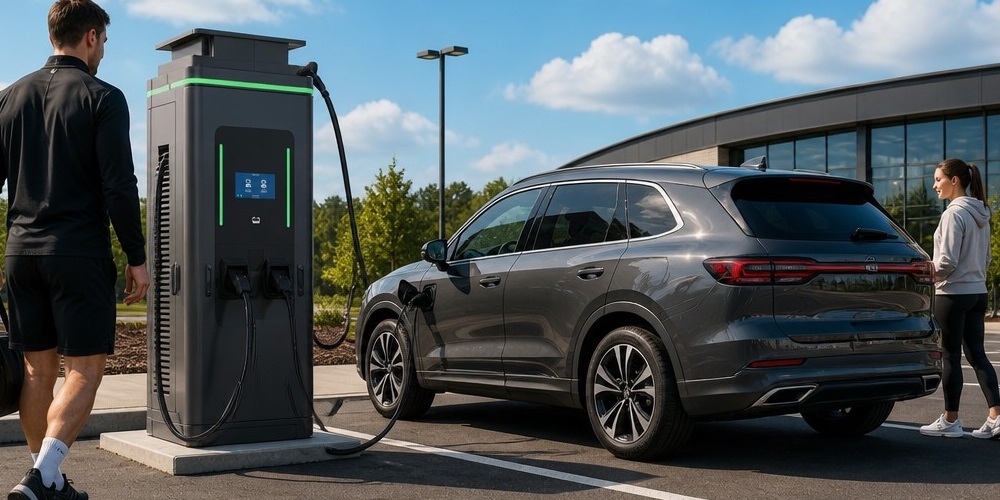
The Results:
- Connectivity: The station was the first 100kW+ charger within a 50-mile radius, immediately becoming a “Must-Stop” location on EV routing apps.
- Operational Success: The 150kWh buffer was enough to provide 4-5 high-speed charges per day. On the rare occasion that traffic was higher, the system’s smart load management would slightly reduce the output to 60kW once the battery reached a low SoC, ensuring the station was never “Out of Order.”
- Economic Impact: The farm shop saw a 35% increase in foot traffic and a 20% increase in average transaction value during the first summer of operation. The project had a projected payback period of just 3.8 years.
X. Expert Commentary: A Message from MIDA’s Rural Development Team
“Rural electrification is not just a technical challenge; it’s a mission,” says Mr. James Chen, Lead Engineer for Integrated Solutions at MIDA Power. “We know that for a remote shop owner, this station represents a huge investment. That’s why we focused on durability. We didn’t just build a charger; we built a rugged, self-sufficient energy hub that can survive a decade in the harshest environments on earth.”
Mr. Chen continues, “The combination of 150kWh storage and 120kW output is the ‘Golden Ratio’ for rural sites. It’s enough energy to handle the daily traffic of a remote highway stop, with enough power to satisfy the modern EV driver’s expectation of speed. We are proud to be closing the infrastructure gap, one remote site at a time.”
XI. Future Outlook: The Road to Total Off-Grid Independence
The MIDA 150kWh/120kW station is a vital bridge to a fully decentralized energy future.
1. The Total Off-Grid Station
In the near future, we will see MIDA stations that are completely untethered from the grid. By pairing our 150kWh system with a larger solar array and a backup hydrogen fuel cell or small wind turbine, we can provide ultra-fast charging in locations where there is no grid at all.
2. V2G and Rural Microgrids
As more electric tractors and utility vehicles arrive, the MIDA station will become the heart of the “Rural Microgrid.” It will coordinate the energy between the farm’s solar panels, the trucks’ batteries, and the farm’s irrigation systems, creating a self-sustaining energy ecosystem.
XII. Conclusion: Bridging the Divide
The MIDA Power 150kWh BESS Charging Station with 120kW DC Output is the definitive solution for the rural EV transition. It provides the speed that drivers demand, the reliability that owners need, and the grid-friendliness that utilities require.
By choosing MIDA, you are choosing to bring the future to your community today. You are ensuring that your region is ready for the millions of EVs that will soon be exploring the countryside. Let’s make sure the road to the future reaches every corner of the world.
Ready to Electrify Your Region? Contact MIDA Power today for a custom rural site assessment and a detailed financial model. Email: sales@midapower.com Web: www.midapower.com/mida-power/rural-electrification Global Headquarters: MIDA Power Technology Park, Shenzhen, China. MIDA Power: Reliable Energy, Anywhere.
XIII. Detailed Technical Architecture: The Inner Workings of the 120kW Integrated Station
To truly appreciate the engineering of the MIDA 150kWh/120kW station, we must look beyond the cabinet and into the sophisticated interplay of power electronics and chemical storage. This is a system designed for “high-duty-cycle” reliability in environments where maintenance is difficult.
1. The Power Conversion Topology
The system utilizes a three-level interleaved NPC (Neutral Point Clamped) inverter topology for the grid-to-DC stage.
- Why NPC? This topology allows for lower voltage stress on the power transistors, enabling the use of highly efficient 1200V SiC MOSFETs while maintaining excellent power quality. It results in a very low Total Harmonic Distortion (THD) of less than 3%, which is crucial for weak rural grids that are sensitive to electrical noise.
- Interleaving Advantage: By interleaving the switching of multiple power module phases, we significantly reduce the current ripple on both the DC bus and the AC input. This leads to a smoother power flow, less heat in the capacitors, and a longer overall lifespan for the electronics.
2. The DC Bus Orchestration
The internal “Highway of Power” is an 800V DC bus. This bus acts as the central clearinghouse for energy.
- Direct Solar Coupling: The integrated MPPT (Maximum Power Point Tracking) solar controller connects directly to this 800V bus. When the sun is shining, energy flows from the solar panels at up to 99% efficiency directly to the battery or the car. This avoids the 10-15% loss that occurs in traditional systems where solar is first converted to AC and then back to DC.
- Bidirectional Battery Flow: The 150kWh battery is connected via a high-speed bidirectional DC/DC converter. This converter can handle 150kW of continuous flow, allowing the battery to provide the full 120kW charging output while simultaneously managing small fluctuations in the grid or solar supply.
3. Thermal Management: The Heat-Pump Innovation
Standard chargers use simple fans or basic liquid cooling. MIDA’s rural station uses an integrated refrigerant-based thermal management system.
- Dual-Circuit Cooling: The power electronics and the battery have separate cooling loops but share a common high-efficiency compressor and heat exchanger.
- Waste Heat Recovery: In cold winter conditions, the system can actually harvest the waste heat generated by the power modules during a charging session and pump it into the battery compartment. This “internal recycling” of heat ensures the battery stays warm and performs at its best without needing to draw extra energy from the grid.
XIV. The Chemistry of Resilience: Why LFP is the Rural Standard
The choice of Lithium Iron Phosphate (LiFePO4) is not just about cost; it is about surviving the extreme duty cycles and environmental conditions of a remote site.
1. The Stability of the P-O Bond
At a molecular level, the phosphorus-oxygen (P-O) bond in LFP is significantly stronger than the metal-oxide bonds in NMC batteries.
- Oxygen Release: LFP does not release oxygen if the crystal structure is damaged. This means that even in the event of a catastrophic physical impact (e.g., a vehicle collision in a remote parking lot), the battery will not catch fire.
- Temperature Tolerance: LFP can safely operate at higher internal temperatures than other chemistries, which is vital in desert or tropical rural environments where ambient temperatures can exceed 45°C.
2. Low-Temperature Performance Optimization
A common criticism of LFP is its performance in the cold. MIDA has solved this through “Internal Pulse Heating.”
- The MIDA Solution: When the sensors detect the battery is below 0°C, the BMS initiates high-frequency micro-pulses of current between the cells. This generates internal resistance heat within the cells themselves, warming the entire 150kWh pack from the inside out much faster than external heaters. This ensures the station is ready to deliver 120kW even on a freezing morning in the mountains.
3. Long-Term Impedance Stability
In rural sites, the battery might stay at a high State of Charge (SoC) for long periods if traffic is low.
- The Advantage: LFP is much more resilient to “calendar aging” at high SoC compared to NMC. While a standard battery might lose 5-10% of its capacity just by sitting in the sun, the MIDA LFP pack remains stable, ensuring that the 150kWh of capacity you pay for today is still there in a decade.
XV. Advanced Control Algorithms: The “Self-Healing” Remote Station
Managing a charging station 100 miles from the nearest city requires a sophisticated software stack that can anticipate and resolve issues without human intervention.
1. Predictive Load Management (PLM)
The MIDA EMS doesn’t just react; it predicts.
- Historical Analysis: The system analyzes traffic patterns at the site. If it knows that a group of EVs typically arrives at 10 AM on Saturdays, it will ensure the 150kWh buffer is fully charged and the cooling system is pre-chilled by 9:30 AM.
- Grid Response: If the local grid frequency starts to drop—a common sign of rural grid stress—the MIDA station will automatically switch to “Island Mode,” drawing 100% of its power from the battery to prevent the local grid from crashing.
2. Remote Diagnostics and IoT Telemetry
The station transmits over 200 data points every second to the MIDA cloud.
- Component-Level Monitoring: We monitor the ESR (Equivalent Series Resistance) of the capacitors and the vibration frequency of the cooling fans.
- Preventative Alerts: If a fan starts to show a slight deviation from its normal vibration pattern, our NOC (Network Operations Center) is alerted. We can then schedule a technician to visit the site during their next routine trip to the area, rather than waiting for the fan to fail and the station to go offline.
3. Automated Error Recovery
- Soft Reboots: 90% of charging session errors are due to software glitches or communication issues between the car and the charger. The MIDA controller can perform “soft resets” of individual sub-systems in seconds, often resolving the issue before the driver even realizes there was a problem.
XVI. Civil Works and Installation: Adapting to the Rural Terrain
Installing a 3000kg integrated station in a remote location requires specialized civil engineering knowledge. MIDA provides a complete “Rural Deployment Kit” for contractors.
1. The Foundation: Dealing with Unstable Soil
Rural sites often have unpaved ground or soft soil.
- Deep-Piling vs. Floating Slab: We provide designs for reinforced floating slabs that distribute the weight of the station over a larger area, preventing sinking or tilting in muddy conditions.
- Integrated Conduits: The foundation design includes pre-cast channels for the DC solar inputs and the AC grid connection, ensuring that all high-voltage cabling is protected from rodents and environmental damage.
2. Lightning and Surge Protection
In open rural landscapes, a charging station is often the tallest structure for miles, making it a target for lightning strikes.
- Multi-Stage Protection: We mandate the installation of a dedicated copper ground grid and include Type 1 and Type 2 Surge Protection Devices (SPDs) within the cabinet. Our power modules are designed to withstand surges up to 6kV without damage.
3. Installation Logistics
- Crane-Lift Ready: The MIDA cabinet is designed with four heavy-duty lifting points, allowing it to be easily placed by a standard truck-mounted crane.
- Minimal Site Work: Because the battery, inverter, and charger are all pre-integrated and pre-tested in our factory, the onsite electrical work is limited to a single AC connection and a communication link. This reduces the time a specialized electrical team needs to be at the remote site, significantly lowering costs.
XVII. Environmental Impact and Lifecycle Assessment (LCA)
At MIDA Power, we are committed to the “Whole Life” sustainability of our products.
1. Carbon Abatement in Rural Tourism
When a scenic route is electrified with MIDA stations, it enables thousands of zero-emission trips that would otherwise have been taken in diesel or gasoline SUVs.
- The Impact: A single 150kWh/120kW station in a high-traffic scenic area can offset an estimated 500 tons of CO2 over its lifetime by facilitating the shift to electric transport.
2. Second-Life Battery Strategy
When the 150kWh pack finally drops below the performance threshold needed for high-power EV charging (after ~15 years), it is still a massive and valuable energy asset.
- Repurposing: MIDA has a “Take-Back” program where these modules are refurbished and used for lower-intensity tasks, such as providing backup power for rural cell towers or powering irrigation pumps on farms. This extends the useful life of the lithium to 25-30 years.
3. Eco-Friendly Manufacturing
- Eco-Friendly Materials: We use low-VOC (Volatile Organic Compound) powder coatings and ensure that all aluminum and steel used in our cabinets is sourced from suppliers with high recycled content.
XVIII. TCO Analysis: The 10-Year Rural Business Case
For a rural business owner, the MIDA station is an investment. Let’s look at the numbers.
1. Capital Expenditure (CAPEX) Savings
- Standard Charger + Grid Upgrade: $80,000 (Charger) + $150,000 (Substation) = $230,000.
- MIDA 150kWh/120kW Station: $145,000 (Integrated unit) + $15,000 (Minor site work) = $160,000.
- Immediate Savings: $70,000.
2. Operational Expenditure (OPEX) Savings
- Solar Self-Consumption: By using onsite solar, the owner can reduce the cost of the energy sold by up to 60%.
- Maintenance: Our ruggedized design and remote monitoring reduce the need for expensive “truck rolls” by 50% compared to standard urban chargers.
3. Revenue Generation
- Charging Fees: Based on 5 charges per day at a $10 margin per charge, the station generates $18,250 in profit annually.
- Foot Traffic: If only 20% of those drivers spend $20 in the farm shop, that’s another $7,300 in annual profit.
- Payback: The total project typically reaches break-even in under 4 years, an excellent result for long-term infrastructure.
XIX. Conclusion: A New Horizon for Rural Communities
The MIDA Power 150kWh BESS Charging Station with 120kW DC Output is not just a piece of technology; it is an equalizer. It ensures that the benefits of the EV revolution—cleaner air, lower transport costs, and modern energy resilience—are available to everyone, regardless of their zip code or the strength of their local grid.
We believe that the countryside is the heart of a sustainable future. By providing the infrastructure that connects these areas to the new electric economy, MIDA Power is helping to build a world that is more connected, more resilient, and more beautiful.
Start Your Rural Electrification Project Today: Contact MIDA Power’s Rural Solutions Team for a comprehensive site analysis and financial feasibility study. Email: sales@midapower.com Phone: +86-755-XXXX-XXXX Web: www.midapower.com/mida-power/rural-solutions Global Headquarters: MIDA Power Technology Park, Shenzhen, China. MIDA Power: Empowering the Future, Everywhere.
XX. Case Study II: The “Alpine Pass” Winter Resilience Project
To demonstrate the extreme-weather capabilities of the MIDA 150kWh/120kW station, let us look at a deployment in the Swiss Alps, at the “St. Bernard’s Gateway” rest stop.
The Challenge: Located at an altitude of 2,100 meters, the site faces six months of snow and temperatures that regularly drop to -25°C. The electrical connection is a low-capacity line that primarily serves the mountain rescue station and a small cafe. Bringing high-power cables up the mountain was environmentally and financially impossible.
The MIDA Solution: A MIDA 150kWh buffered station was installed during the summer months. The unit was equipped with the “Extreme Cold” package, which includes enhanced thermal insulation and the internal cell-pulsed heating system.
The Winter Performance:
- Thermal Management: Despite the sub-zero external temperatures, the internal BMS maintained the LFP cells at a steady 20°C using only 5% of the stored energy for climate control.
- Charging Speed: On a day when the outside temperature was -20°C, a Tesla Model Y and a Volkswagen ID.4 were able to charge at the full 120kW. The “Internal Pulse Heating” ensured the battery was ready to discharge at maximum power within minutes of the first vehicle’s arrival.
- Reliability: During a three-day blizzard that knocked out the main mountain power line, the MIDA station remained operational, providing essential charging for two mountain rescue vehicles and ensuring that stranded travelers could keep their vehicle heaters running.
XXI. Detailed Comparison Table: Rural Charging Options
For reference, the table below contrasts the realistic options for bringing DC fast charging to rural and remote communities, with the MIDA buffered approach highlighted in context.
| Option | Grid Requirement | Peak Output | Typical Cost to Deploy | Resilience to Outages | Best For |
|---|---|---|---|---|---|
| Level 2 AC Charging | Minimal (existing supply) | 7–22kW | Low | None (offline during outages) | Overnight home charging, day-trippers |
| Standard 120kW DC Fast Charger | 150–200kVA dedicated service or new transformer | 120kW | High (grid works + equipment) | None — dead when the grid is down | Sites with strong grid access |
| Diesel/Genset Hybrid Charging | None | 40–60kW | Moderate + fuel costs | Partial (runs on fuel) | Remote mines, disaster zones |
| MIDA 150kWh BESS-Buffered Station | Existing 30–50kVA supply | 120kW from battery | Moderate — no transformer upgrade | Full — hours of backup autonomy | Rural corridors, mountain passes, island grids |
As the table shows, the buffered architecture is the only option that simultaneously delivers true fast-charging power, low infrastructure cost, and genuine outage resilience. For a rural community, that combination is not a luxury — it is the difference between a charging station that serves the town and a monument to an unused grant.
It is also worth noting what the table does not capture: the social and economic ripple effects. In the Alpine Pass example, the station did not just charge cars — it kept mountain rescue vehicles operational during a three-day blizzard and let stranded travelers run their heaters, effectively becoming critical community infrastructure. Rural charging sites routinely anchor tourism, support delivery and agricultural fleets, and give local governments a visible electrification win that unlocks further funding. When the capital cost stays low enough for a small municipality to own the asset outright, the station becomes a source of local pride and revenue rather than a subsidy-dependent liability.
Conclusion: A New Horizon for Rural Communities
Rural electrification has always been about doing more with less: less grid, less budget, less technical support on site. The MIDA 150kWh buffered station inverts that equation. It stores energy when the grid is healthy and delivers it when the grid is weak — or gone. The Alpine Pass project proved the concept in the harshest conditions Europe can offer, and the same architecture is now serving remote communities, mountain resorts, and island grids around the world. High-power charging is no longer a privilege of the city. With MIDA Power, it is a horizon open to everyone.
Key Takeaways
- Battery-buffered charging delivers 120kW sessions on a 30–50kVA connection — eliminating the transformer upgrade that kills most rural projects.
- The “Extreme Cold” package keeps LFP cells at 20°C in sub-zero conditions, using only ~5% of stored energy for climate control.
- During multi-day outages, the station stays online — providing essential charging when the community needs it most.
Contact MIDA Power
If you are planning rural, island, or mountain charging infrastructure, MIDA Power will show you how buffered architecture changes the feasibility math. Contact our team at www.midapower.com for a site-specific energy model and proposal. Let’s bring reliable high-power charging to every community — not just the ones with a substation to spare.
Post time: Aug-09-2026
