
 Portable EV Charger
 Home EV Wallbox
 DC Charger Station
 BESS Charging Station
 V2G V2H V2V V2L
 EV Charging Module
 DC Charging Connector
 EV Accessories
Quick Answer
For next-generation EV charging infrastructure, a Battery Energy Storage System (BESS) outperforms traditional grid connections in most real-world deployments. A BESS paired with DC fast chargers cuts peak demand charges by 40–60%, allows sites to deploy 120kW–360kW of charging power on a limited grid feed, and typically delivers a payback period of 3–5 years. Traditional grid upgrades remain the better choice only where utility upgrade costs are low, permit lead times are short, and site loads are highly predictable. In practice, the strongest architecture for 2026 and beyond is a hybrid one: grid supply, BESS buffering, and smart energy management working together to minimize operating cost per kWh delivered.
Introduction: The EV Charging Infrastructure Bottleneck
The electric vehicle market is compounding at a rate that public and private charging networks are struggling to match. According to the International Energy Agency, global EV sales exceeded 17 million units in 2025, and the charging infrastructure required to support them must scale at an even faster pace. Yet the single largest obstacle to deploying new charging sites is rarely the charger hardware itself — it is the electricity supply.
Most commercial sites simply do not have enough spare transformer capacity to run multiple high-power DC fast chargers. A single 120kW charger can demand more power than an entire small office building. When a site operator applies for a grid connection upgrade, they routinely face three problems: high utility upgrade costs (often US$50,000–$200,000), long lead times (6–18 months), and demand charges that can make a charging site unprofitable from day one. This is the infrastructure bottleneck that Battery Energy Storage Systems were designed to break.
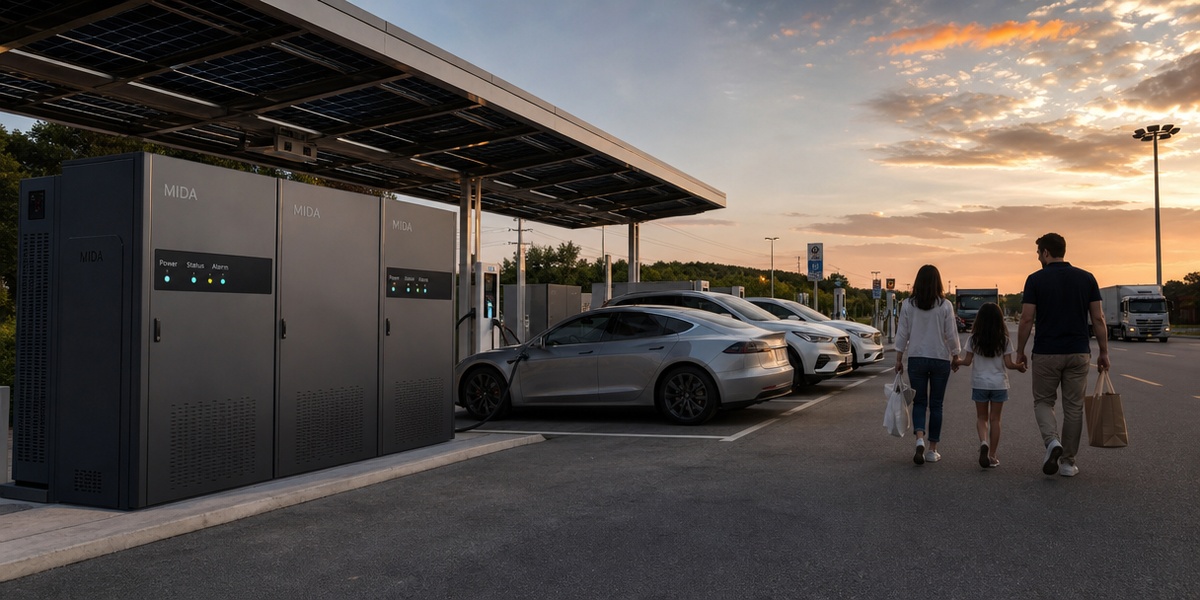
MIDA Power 120kW/215kWh BESS Charging Hub — high-power DC fast charging on a limited grid feed.
What Is a Battery Energy Storage System (BESS)?
A Battery Energy Storage System for EV charging is a complete, integrated package that typically contains three elements: lithium iron phosphate (LFP) battery cells, a bidirectional power conversion system (PCS), and an energy management system (EMS). The BESS charges from the grid during off-peak hours when electricity is cheap, then discharges to the EV chargers during peak demand, flattening the site’s load curve.
In the context of EV charging infrastructure, a BESS does three jobs simultaneously:
- Power buffering: It lets operators run high-power chargers (120kW, 240kW, or more) on a grid connection that would otherwise only support 30–60kW, because the battery absorbs the peak.
- Cost arbitrage: It shifts energy consumption from peak tariff periods to off-peak periods, directly reducing energy and demand charges.
- Resilience: It keeps chargers online during grid outages or brownouts, protecting uptime for fleet operators.
Modern BESS units such as the MIDA Power 215kWh series use LFP chemistry, which offers more than 6,000 charge cycles and a 15-year design life, making them a capital asset rather than a consumable.
BESS vs. Traditional Grid: Head-to-Head Comparison
| Dimension | Traditional Grid Connection | Grid + BESS |
|---|---|---|
| Upfront infrastructure cost | US$50,000–$200,000 for transformer/feeder upgrades | US$60,000–$120,000 for a 215kWh BESS, often no grid upgrade needed |
| Deployment lead time | 6–18 months (utility engineering, permits) | 4–8 weeks (BESS is a factory-integrated product) |
| Demand charge exposure | Full — peak load billed at utility rates | Reduced 40–60% via peak shaving |
| Energy cost per kWh | Fully dependent on time-of-use tariffs | Lowered by charging the battery off-peak |
| Scalability | Each expansion requires another utility request | Add battery modules as utilization grows |
| Resilience during outages | None — chargers go dark with the grid | Battery continues to feed chargers |
| Best fit | Low-cost, fast utility upgrades; predictable base loads | Scarce transformer capacity, high peak tariffs, fast deployment needs |
Peak Shaving: The Economics That Decide the Winner
For most charging site operators, the single largest controllable cost is the demand charge — a fee based on the highest 15-minute average power draw in a billing month. A site running a 120kW fast charger can easily register a 120kW+ monthly peak, and utilities in regions such as California, Germany, and Australia charge US$10–$25 per kW of demand. At $15/kW, a single 120kW charger adds US$1,800 to the monthly bill before a single kWh is metered.
A BESS changes this calculation completely. The EMS software forecasts the site load, charges the battery when load is low, and discharges during the 15-minute peak windows. The result is a flattened demand profile — often reducing the billed peak by 40–60%. On a site with four 120kW chargers, peak shaving alone can save US$4,000–$9,000 per month, which alone can pay for the BESS in 3–4 years.
ROI Analysis: BESS vs. Grid Upgrade
The financial case for grid plus BESS versus a pure grid upgrade can be summarized in three scenarios:
- Scenario A — Urban highway site, 4 x 120kW chargers: Grid upgrade cost $180,000, lead time 14 months, demand charges continue at full rate. Payback of the site is driven entirely by utilization.
- Scenario B — Same site with 215kWh BESS: BESS cost $90,000, no grid upgrade required, demand charges cut 50%, and energy is purchased off-peak. Total capex is lower and monthly opex is meaningfully lower; the BESS pays back in 3.5 years and keeps generating savings for its 15-year life.
- Scenario C — Hybrid: A modest grid upgrade plus a BESS delivers the fastest deployment window with the lowest risk, ideal for fleets with hard launch deadlines.
Independent analyses consistently show that once utilization exceeds 3–4 charging sessions per day per stall, the BESS configuration beats the grid-only configuration on total cost of ownership. Below that utilization, a simple grid connection is usually sufficient — which is why the decision ultimately comes down to projected site throughput.
Technical Integration: How BESS and EV Chargers Work Together
Integrating a BESS with EV chargers is not a simple plug-and-play exercise; it requires coordinated control. The key components of a successful integration are:
- DC or AC coupling: In AC-coupled systems, the BESS and chargers connect to a shared AC bus and the PCS manages the power flow. In DC-coupled systems, the battery feeds the DC bus directly, eliminating conversion losses. For charging hubs, AC coupling is simpler to retrofit, while DC coupling offers up to 3% higher round-trip efficiency.
- Energy Management System (EMS): The EMS orchestrates load forecasting, tariff schedules, and charger priority. MIDA Power chargers integrate with third-party EMS platforms via OCPP 1.6J/2.0.1, allowing the BESS to release power in under 20 milliseconds when a new charging session starts.
- Solar integration: When a site adds rooftop or canopy PV, the BESS becomes the buffer between solar generation and charging demand, enabling true solar-plus-storage charging with up to 60% renewable self-consumption.
- Safety and compliance: Modern BESS enclosures are rated IP54+ with UL 9540A-tested battery packs, integrated fire suppression, and thermal management that keeps cells within their optimal 15–35°C window even in extreme climates.
MIDA Power: BESS-Integrated Charging Solutions
MIDA Power manufactures a complete line of BESS-integrated EV charging systems engineered for commercial deployment. The 120kW/215kWh BESS Charging Hub combines dual-port DC fast charging with an integrated 215kWh LFP battery, allowing a site to deliver sustained 120kW output on a 60kW grid feed — halving both the infrastructure cost and the demand charge. For fleet depots and highway corridors, the 160kW/313kWh configuration extends peak-shaving capacity to multi-vehicle sessions.
All MIDA systems share a modular design philosophy: the battery modules, PCS, and charger power modules are field-swappable, and every unit ships with OCPP 1.6J/2.0.1 communication, ISO 15118 plug-and-charge readiness, and remote firmware management. Site assessment, grid-application support, and commissioning are handled end-to-end by the MIDA engineering team, so operators go from signed contract to charging vehicles in weeks, not months.
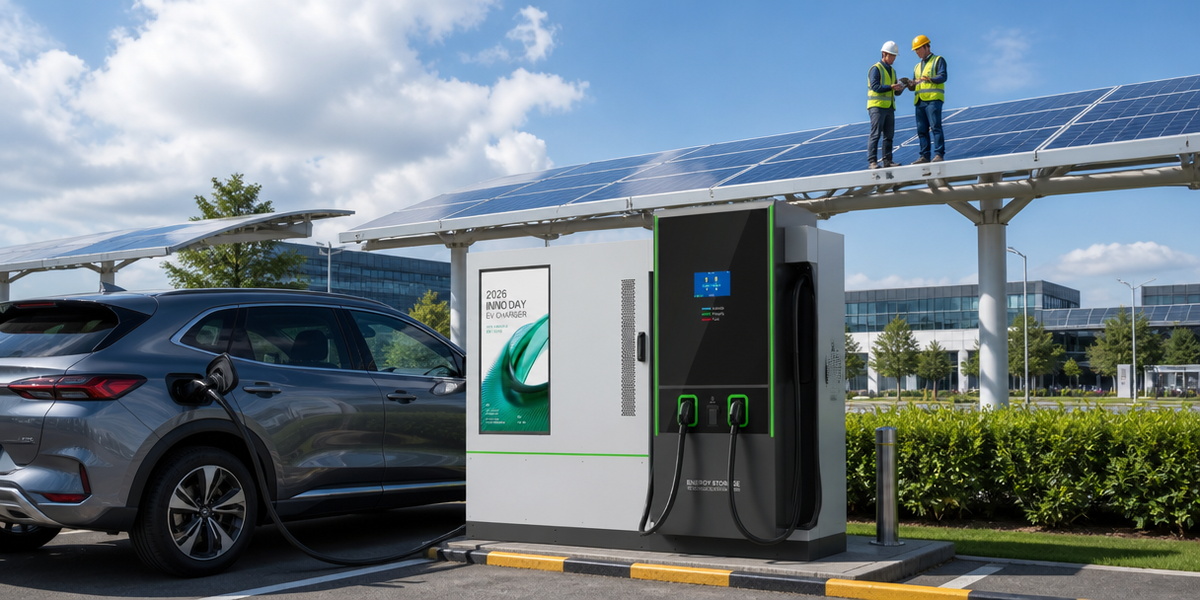
MIDA Power Solar Storage Integrated Charging System — PV, battery storage, and EV charging in one platform.
Selection Matrix: Which Solution Fits Your Site?
| Site Profile | Recommended Architecture | Rationale |
|---|---|---|
| Highway fast-charging corridor, scarce transformer capacity | Grid + 215kWh–313kWh BESS | Fastest deployment; peak shaving protects margins at high utilization |
| Urban retail/destination charging, moderate utilization | Grid + 100–215kWh BESS | Demand charge reduction is the primary payback driver |
| Fleet depot with overnight charging and solar roof | PV + BESS + chargers (DC-coupled) | Maximizes renewable self-consumption and energy cost savings |
| Site with cheap, fast utility upgrade and low tariff spread | Traditional grid connection | BESS payback is weak when demand charges and peak tariffs are low |
FAQ
Q How long does a BESS take to pay for itself at a charging site?
In most commercial scenarios, a BESS at an EV charging site achieves payback in 3–5 years, driven primarily by demand charge reduction and off-peak energy arbitrage. Sites with high utilization and high peak tariffs reach the lower end of that range.
Q Can a BESS power chargers during a blackout?
Yes. A 215kWh BESS can deliver roughly 40–60 full charging sessions at 20–40kWh per session during a grid outage, depending on the discharge rate limit of the PCS. For critical fleet operations, this resilience alone justifies the investment.
Q Is a BESS allowed to be installed alongside public chargers?
In most jurisdictions, yes. BESS units are classified as energy storage equipment and require standard electrical permitting, fire-code compliance (e.g., UL 9540A / NFPA 855), and, in some regions, grid interconnection agreements for export. MIDA Power provides all documentation required for local approval.
Q What is the typical lifespan of a BESS?
LFP-based systems are rated for 6,000+ cycles or 15 years. With one full cycle per day at a charging site, that translates to roughly 16 years of operation, after which the battery retains 80% of its original capacity.
Q Does adding a BESS increase the electricity bill?
No — the opposite. The BESS charges during off-peak hours and discharges during peak hours, lowering both energy costs (arbitrage) and demand charges (peak shaving). Total metered consumption is slightly higher due to round-trip losses (typically 8–12%), but the bill impact is strongly positive because of tariff structure.
Conclusion: Grid vs. BESS — The Verdict
The choice between BESS and traditional grid for next-generation EV charging infrastructure is not a binary one. The data is clear: where transformer capacity is scarce, where demand charges bite, or where speed-to-market matters, grid plus BESS wins on cost, time, and resilience. Where utility upgrades are cheap and loads are predictable, a conventional connection remains pragmatic. The winning playbook for 2026 is to evaluate each site against its utilization forecast, tariff structure, and grid constraints — then let the numbers choose.
MIDA Power helps operators run that analysis free of charge. Request a site assessment and BESS ROI model from the MIDA Power engineering team, or browse the BESS charging product range to find the right configuration for your next site.
Contact MIDA Sales: sales@midapower.com
Post time: Aug-14-2026
