
 Portable EV Charger
 Home EV Wallbox
 DC Charger Station
 BESS Charging Station
 V2G V2H V2V V2L
 EV Charging Module
 DC Charging Connector
 EV Accessories
The Strategic Imperative of High-Power EV Charging Infrastructure: A Comprehensive Guide to Maximizing Commercial Throughput, Enhancing User Experience, Ensuring Grid Stability, and Future-Proofing Electric Vehicle Ecosystems for Global Sustainability
Introduction: The EV Revolution and the Infrastructure Bottleneck
The global transition to electric mobility is no longer a peripheral trend but a central pillar of the global decarbonization strategy. As internal combustion engine (ICE) vehicles are phased out in favor of battery electric vehicles (BEVs), the focus has shifted from vehicle availability to infrastructure adequacy. While early adopters were content with slow, overnight charging at home, the mass-market transition requires a charging experience that mimics the convenience of traditional refueling. This is where high-power EV charging (HPC) becomes indispensable.
High-power charging, typically defined as DC fast charging with outputs exceeding 150kW and reaching up to 350kW or 400kW, represents the frontier of EV infrastructure. It is not merely a luxury for high-end vehicles; it is a fundamental requirement for the viability of long-distance travel, commercial fleet operations, and urban mobility. The “infrastructure bottleneck”—the gap between the rapid growth of EV sales and the slower deployment of high-speed charging—threatens to stall the momentum of the green transition.
Choosing a high-power EV charger is a strategic decision that affects every stakeholder in the ecosystem. For the EV driver, it means the difference between a 15-minute coffee break and a two-hour wait. For the business owner, it dictates the turnover rate of charging bays and the potential for secondary revenue. For the grid operator, it presents both a challenge in peak load management and an opportunity for intelligent energy distribution. This article provides an exhaustive analysis of why high-power charging is the only logical path forward for serious investors, businesses, and policymakers.
Chapter 1: The Physics of High-Power Charging: Voltages, Currents, and Thermal Management
To understand the necessity of high-power charging, one must first grasp the underlying physics that govern the transfer of energy from the grid to the vehicle’s battery pack. Charging speed is essentially a function of power (P = V x I), where V is voltage and I is current. In the early days of EVs, 400V architectures were standard, limiting the charging power due to the physical constraints of the cables and the heat generated by high currents.
1.1 The Shift to 800V Architecture
The transition from 400V to 800V systems is a game-changer for high-power charging. By doubling the voltage, manufacturers can deliver the same amount of power with half the current. This reduces the heat generated by electrical resistance (P = I²R), allowing for thinner, lighter, and more flexible charging cables. More importantly, it enables charging speeds that were previously impossible without causing significant thermal stress to the battery cells. High-power chargers must be capable of supporting these higher voltage ranges to be truly future-proof.
1.2 Thermal Management Challenges
As charging power increases, thermal management becomes the primary engineering challenge. Both the charger and the vehicle must handle the heat generated during the rapid movement of lithium ions. Modern high-power chargers utilize liquid-cooled cables and connectors to prevent overheating at the point of contact. Within the vehicle, advanced cooling systems circulate coolant through the battery pack to maintain an optimal temperature range (typically 25°C to 45°C). Failure to manage heat results in “thermal throttling,” where the charging speed is drastically reduced to protect the battery, negating the benefits of a high-power station.
1.3 The Charging Curve and C-Rates
It is a common misconception that an EV will charge at its peak rated power throughout the entire session. The charging curve dictates how the power intake varies as the state of charge (SoC) increases. Typically, power is highest between 10% and 60% SoC and tapers off significantly as the battery approaches 100% to avoid chemical damage. High-power chargers provide the necessary “overhead” to ensure that the vehicle can maximize its intake during that critical middle window, delivering the most miles in the shortest amount of time.
Chapter 2: Impact on User Experience: Reducing Range Anxiety and Charging Friction
User experience (UX) is the most critical factor in the widespread adoption of electric vehicles. For the average consumer, the transition from gasoline to electricity involves a significant psychological shift. High-power charging is the most effective tool for minimizing this friction and eliminating “range anxiety”—the fear that a vehicle will run out of power before reaching its destination.
2.1 Time as the Ultimate Commodity
In the modern economy, time is the most valuable resource. The primary complaint against EVs has historically been the length of time required for charging compared to the three-minute gasoline fill-up. High-power chargers (250kW+) can add 200 kilometers of range in as little as 10 minutes. This level of performance transforms charging from a primary activity (something you plan your day around) into a background task (something that happens while you grab a coffee or use the restroom).
2.2 Seamless Integration and Reliability
High-power charging stations are often the flagship installations of charging networks, receiving the highest levels of maintenance and technological integration. Features such as “Plug & Charge” (ISO 15118), which allows the vehicle to automatically authenticate and start charging without a mobile app or RFID card, are becoming standard on high-power units. This reduction in “friction points” is essential for making the EV experience superior to the ICE experience, rather than just an equivalent alternative.
2.3 Psychological Comfort and Route Planning
Knowing that high-power chargers are available along a travel corridor provides drivers with the confidence to undertake long journeys. Modern navigation systems integrate real-time data from these chargers, allowing for dynamic route planning that accounts for weather, topography, and charger availability. A network of reliable high-power chargers acts as a safety net, ensuring that even if a driver deviates from their plan, a quick “splash and dash” charge is always within reach.
Chapter 3: Commercial Throughput Maximization: Why Fast Charging is a Business Imperative
For businesses operating charging stations—whether they are dedicated charging hubs, retail locations, or motorway service areas—the primary economic metric is “throughput.” Throughput refers to the total amount of energy delivered and the number of vehicles serviced within a given time frame. High-power charging is the engine that drives this metric to its theoretical limit.
3.1 The Economics of Space and Time
A charging bay is a piece of real estate. Like any other commercial asset, its value is determined by its utilization rate and the revenue it generates per hour. A standard 50kW charger might take 60 to 90 minutes to provide a meaningful charge to a modern long-range EV. During that time, the bay is occupied and unavailable to other customers. In contrast, a 350kW charger can service three to four vehicles in the same time frame. Even if the capital expenditure (CapEx) for high-power equipment is higher, the potential for increased transaction volume often results in a much faster return on investment (ROI).
3.2 Servicing the “Charging Desert” Demand
As the density of EVs increases, the demand for charging will inevitably outstrip supply in high-traffic areas. Locations that offer high-power charging become magnets for drivers, creating a competitive advantage. In commercial real estate, this is known as a “destination driver.” A driver is far more likely to choose a supermarket, restaurant, or shopping mall that offers a 20-minute rapid charge over one that offers a slow 7kW AC connection, which would require them to stay for hours to gain any significant range.
3.3 Scaling for Heavy-Duty and Commercial Fleets
High-power charging is not just for passenger cars. The electrification of logistics, delivery vans, and heavy-duty trucks is dependent on ultra-fast charging infrastructure. A delivery truck cannot afford to sit idle for four hours during a shift. Megawatt Charging Systems (MCS) are already being developed to provide over 1,000kW of power for Class 8 trucks. By investing in high-power architecture today, businesses position themselves to capture the burgeoning commercial fleet market, where reliability and speed are the only things that matter.
Chapter 4: Correlation Analysis: Charging Time vs. Commercial Conversion Rates in Retail and Hospitality
A critical, yet often overlooked, aspect of the EV charging business model is the relationship between the time a driver spends at a site and their spending behavior in the surrounding ecosystem. This “dwell time” must be optimized to maximize commercial conversion rates without causing congestion.
4.1 The “Goldilocks Zone” of Dwell Time
Data from retail-integrated charging stations suggests that there is a “sweet spot” for charging duration. If charging is too slow (AC charging), the driver may feel tethered and frustrated, or they may leave the vehicle and wander far from the commercial point of interest. If charging is ultra-fast (under 5 minutes), the driver may not even leave their vehicle. High-power DC charging (150kW-350kW) typically results in a 15-to-30-minute stay—the “Goldilocks Zone.” This is precisely the amount of time needed for a customer to enter a convenience store, buy a snack, or browse a retail outlet, leading to higher “basket sizes” and conversion rates.
4.2 Cross-Selling and Loyalty Programs
High-power charging stations provide a unique opportunity for data-driven marketing. By integrating the charging app with the retailer’s loyalty program, businesses can offer targeted discounts or coupons that are valid only during the charging session. For example, a 15-minute fast charge can be accompanied by a notification: “Get a 20% discount on a coffee and sandwich while you wait.” The correlation between high-power availability and increased foot traffic is well-documented; sites with fast chargers report up to a 25% increase in secondary sales compared to sites without them.
4.3 Quantifying the Opportunity Cost
The opportunity cost of slow charging is the lost revenue from customers who chose a faster location. In a competitive market, drivers use apps like PlugShare or Google Maps to filter by charging speed. If your site does not appear in the “150kW+” filter, you are invisible to the most lucrative segment of the market—drivers who are traveling long distances and have a high propensity to spend during their stops.
Chapter 5: Grid-Friendly High-Power Charging Architecture: V2G, Microgrids, and Storage
One of the primary concerns cited by skeptics of high-power charging is the impact on the electrical grid. A single 350kW charger draws as much power as a small apartment building. When multiplied across a charging hub with 10 or 20 bays, the peak demand can be enormous. However, modern engineering has turned this challenge into a solution through “grid-friendly” architecture.
5.1 Buffer Storage: The Battery-to-Battery Approach
To mitigate the impact on the local transformer, many high-power charging stations now incorporate stationary energy storage systems (ESS). These large battery banks are charged slowly from the grid during off-peak hours and then discharge rapidly to support high-power charging sessions during peak times. This “peak shaving” technique reduces the need for expensive grid upgrades and allows high-power charging to be deployed in areas where the existing infrastructure is weak.
5.2 Vehicle-to-Grid (V2G) and Bi-Directional Charging
High-power chargers are increasingly being designed with bi-directional capabilities. In a V2G ecosystem, the EV is not just a consumer of energy but a mobile storage unit. During periods of grid instability or high demand, the high-power charger can draw energy back from the vehicle (with the owner’s permission) to stabilize the frequency or provide power to the local site. While V2G is currently more common in AC settings, high-power DC V2X (Vehicle-to-Everything) is the next frontier, allowing massive amounts of energy to be moved in seconds to balance the grid.
5.3 Microgrids and On-Site Renewable Integration
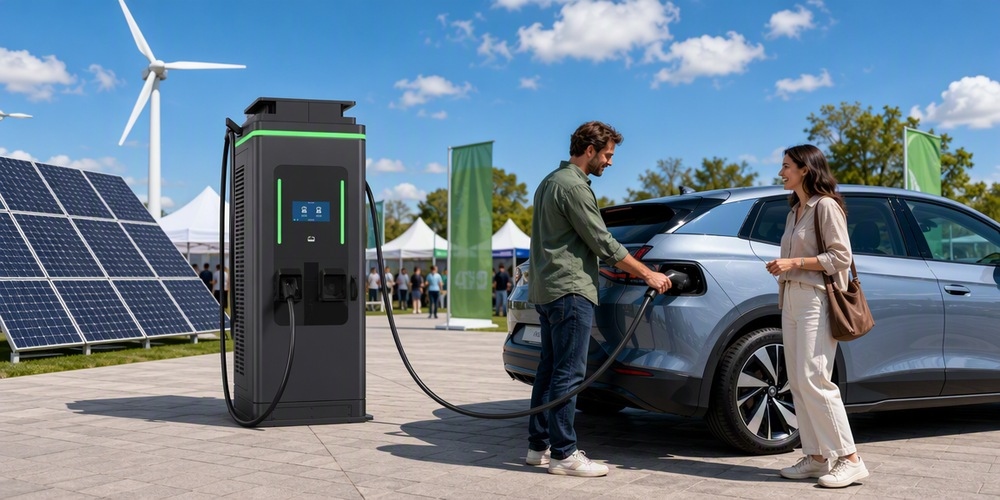
The ultimate grid-friendly architecture is the self-sustaining microgrid. By combining solar canopies, stationary storage, and high-power chargers, a charging hub can operate largely independently of the central grid. This not only reduces operating costs but also provides a “green” charging experience that resonates with eco-conscious consumers. The high-power charger acts as the intelligent hub that manages the flow of electricity between the sun, the storage battery, the grid, and the vehicle.
Chapter 6: Smart Load Management and Dynamic Power Allocation
As the number of high-power charging bays at a single location grows, the total connected load can easily exceed several megawatts. Managed without intelligence, this would lead to tripped circuit breakers and inefficient use of the available electrical capacity. Smart Load Management (SLM) is the technological solution that ensures every vehicle gets the maximum possible power without overloading the system.
6.1 Dynamic Power Sharing
Traditional chargers often have a fixed power output per connector. If a charger has two 150kW cables, but only one is in use, the other 150kW of capacity sits idle. Modern high-power systems use dynamic power sharing. Through a centralized power cabinet and a series of satellite dispensers, the system can allocate the total pool of power to where it is needed most. If one car can only accept 50kW, the remaining 250kW of a 300kW cabinet can be routed to the second car, ensuring that no kilowatt-hour is wasted.
6.2 Priority-Based Charging Algorithms
In a commercial or fleet environment, not all charging sessions are of equal priority. Smart load management allows for the implementation of priority-based algorithms. For example, a delivery van scheduled to depart in 20 minutes can be given priority over a staff vehicle that will be parked for eight hours. This level of granular control is only possible with high-power DC chargers that are connected to a robust back-end software platform via protocols like OCPP (Open Charge Point Protocol).
6.3 Responding to Grid Signals (Demand Response)
High-power chargers are “flexible loads.” This means they can participate in demand response programs. When the grid is stressed, the charging network operator can remotely reduce the power output of all chargers by a small percentage (e.g., from 350kW to 300kW). This reduction is barely noticeable to the individual user but, when aggregated across thousands of chargers, provides a massive “virtual power plant” effect that helps prevent blackouts and reduces the reliance on fossil-fuel-based “peaker” plants.
Chapter 7: Future-Proofing: Compatibility with 800V Systems and Next-Gen Batteries
The most significant risk in infrastructure investment is obsolescence. In the rapidly evolving EV market, a charger installed today must remain relevant for at least a decade. High-power chargers are, by definition, the most future-proof assets in the charging ecosystem.
7.1 Supporting the 800V Revolution
As mentioned in Chapter 1, the industry is moving toward 800V architectures. While most current EVs (like the Tesla Model 3 or Ford Mustang Mach-E) use 400V systems, high-end models like the Porsche Taycan, Audi e-tron GT, and Hyundai Ioniq 5 already utilize 800V. In the coming years, even entry-level EVs will likely adopt this standard to enable faster charging. A high-power charger with a wide voltage range (e.g., 150V to 1000V) can serve both current and future vehicles, ensuring that the equipment does not become a “stranded asset.”
7.2 Preparing for Solid-State and Silicon-Anode Batteries
The next generation of battery chemistry, including solid-state batteries and silicon-dominant anodes, will be capable of accepting much higher C-rates (the ratio of charging power to battery capacity). Some prototypes are already demonstrating 0-80% charge times in under 10 minutes. Only high-power charging stations with 350kW to 400kW of output will be able to unlock the full potential of these next-gen batteries. Investing in anything less is essentially betting against the progress of battery science.
7.3 Modular Hardware Architecture
Top-tier high-power chargers are designed with modularity in mind. Instead of a single, monolithic power unit, they use a series of power modules (e.g., 30kW or 50kW each). If a business starts with a 150kW requirement, they can install a cabinet with three modules. As demand grows and vehicle capabilities increase, they can simply plug in additional modules to upgrade the site to 300kW or more without the need for extensive civil works or replacing the entire unit.
Chapter 8: Multi-Terminal Collaborative Charging Ecosystems: Integrating Home, Work, and Public Charging
The future of EV charging is not isolated silos of infrastructure but a “Multi-Terminal Collaborative Ecosystem.” In this model, high-power charging serves as the critical “hub” that connects home, workplace, and destination charging into a single, seamless user journey.
8.1 The “Hub and Spoke” Model of Infrastructure
In this ecosystem, slow AC chargers (Level 2) at home and work act as the “spokes,” providing the base load of energy for daily commuting. High-power chargers act as the “hubs,” located at strategic junctions to provide rapid energy injections for long-distance travel or for those without access to home charging (e.g., apartment dwellers). The synergy between these terminals is managed through a single user account and app, allowing for unified billing and data tracking.
8.2 Interoperability and Roaming
For a collaborative ecosystem to work, interoperability is non-negotiable. High-power chargers must support international standards and roaming agreements (OCPI). This allows a driver from one network to use another network’s high-power charger without needing multiple apps or accounts. This “borderless” charging experience is essential for the commercial success of charging networks and for the convenience of the global traveler.
8.3 Data Synergy: The Vehicle-as-a-Sensor
Modern high-power chargers are data-rich environments. They communicate extensively with the vehicle’s Battery Management System (BMS). This data—ranging from state-of-health (SoH) to average energy consumption—can be fed back into the ecosystem to provide personalized recommendations. For example, the system could suggest the optimal time and location for the next high-power charge based on the driver’s calendar and the vehicle’s current performance metrics.
Chapter 9: Long-Term Brand Equity: How Charging Infrastructure Defines Corporate Sustainability
In the 21st century, a company’s commitment to sustainability is a key driver of brand value and investor confidence. High-power charging infrastructure is a highly visible, tangible manifestation of that commitment.
9.1 Infrastructure as a “Green Flag”
For corporations, installing high-power chargers at headquarters, retail sites, or logistics hubs serves as a powerful “green flag” to customers, employees, and the public. It signals that the company is not just talking about the environment but is actively investing in the physical foundation of a low-carbon future. This enhances brand equity and can be a deciding factor for talent acquisition and customer loyalty, especially among the younger, eco-conscious demographic.
9.2 ESG Reporting and Regulatory Compliance
Environmental, Social, and Governance (ESG) criteria are increasingly used by institutional investors to assess company risk and performance. The deployment of high-power charging infrastructure directly contributes to “Scope 3″ emissions reductions (indirect emissions from the value chain). Furthermore, as governments around the world introduce mandates for EV charger installation in new commercial buildings, early adoption of high-power technology ensures compliance and avoids the future costs of retrofitting.
9.3 The “Premiumization” of the Charging Experience
Just as premium gasoline brands once competed on quality and additives, charging networks now compete on speed, reliability, and amenities. By offering high-power charging, a brand positions itself at the “premium” end of the market. This association with cutting-edge technology and luxury-level convenience translates into a stronger brand identity and the ability to command a premium for the service provided.
Chapter 10: The Role of AI and Machine Learning in High-Power Charging Optimization
The management of high-power charging networks is moving beyond simple rules-based logic into the realm of Artificial Intelligence (AI) and Machine Learning (ML). These technologies are essential for managing the complexity of megawatt-scale infrastructure.
10.1 Predictive Maintenance and Fault Detection
High-power chargers are complex machines with many moving parts (pumps for liquid cooling, contactors, power modules). AI algorithms can analyze the telemetry data from thousands of chargers in real-time to identify patterns that precede a failure. For example, a slight increase in the temperature of a connector during a 350kW session might indicate a failing cooling pump. By dispatching a technician before the unit actually breaks, operators can maintain the “99.9% uptime” that high-power charging customers expect.
10.2 Price Optimization and Dynamic Tariffs
AI can also be used to optimize the pricing of high-power charging sessions. By analyzing factors such as current grid prices, local demand, weather (which affects EV range), and the occupancy of nearby chargers, the system can implement dynamic pricing. This encourages drivers to charge during off-peak times or at underutilized stations, smoothing out the load on the grid and maximizing the operator’s profit margins.
10.3 Personalized User Recommendations
Machine learning models can learn the habits of individual EV drivers. If the system knows that a specific driver usually stops at a certain motorway junction on Friday afternoons, it can proactively reserve a high-power charging bay or offer a discount to ensure the driver chooses its network. This level of personalization is a powerful tool for customer retention in an increasingly competitive market.
Chapter 11: Total Cost of Ownership (TCO) Analysis: High-Power vs. Standard Charging Solutions
A common barrier to the adoption of high-power charging is the higher upfront cost. However, a comprehensive Total Cost of Ownership (TCO) analysis reveals that the long-term economics of high-power charging are often superior to cheaper, lower-power alternatives.
11.1 CapEx vs. OpEx: The Long View
The Capital Expenditure (CapEx) for a 350kW charger can be three to five times higher than for a 50kW unit. This includes the equipment cost, the required grid connection (which may involve a new transformer), and the specialized installation. However, the Operational Expenditure (OpEx) per kilowatt-hour delivered is often lower for high-power units because they can service more vehicles in a day. The higher turnover rate translates to a lower “cost per transaction,” making the business more profitable over a five-to-ten-year horizon.
11.2 Reduced Land and Civil Works Costs
To deliver the same amount of total energy, you would need several 50kW chargers for every one 350kW charger. This means more parking spaces, more concrete, more cabling, and more maintenance points. In urban areas where land is expensive, the “energy density” of high-power charging is a massive advantage. You can deliver more energy in a smaller footprint, reducing the land lease costs and the complexity of the site layout.
11.3 Avoiding the “Rip and Replace” Cycle
The cheapest charger to install is the one you only have to install once. Operators who installed 50kW chargers five years ago are now finding that their equipment is insufficient for modern long-range EVs and 800V architectures. They are now facing the high cost of removing the old units and upgrading the infrastructure. By investing in high-power equipment from the start, operators avoid this “rip and replace” cycle and ensure their investment remains productive for the full lifespan of the equipment.
Chapter 12: Regional Case Studies: Success Stories in High-Power Charging Deployment
To illustrate the practical benefits of high-power charging, let us look at how different regions are successfully deploying this technology.
12.1 The European “Corridor” Model
Europe has led the way in high-power charging through initiatives like IONITY—a joint venture between major car manufacturers. By focusing on high-traffic motorways and installing hubs with at least six 350kW chargers every 120 kilometers, IONITY has effectively enabled cross-continental EV travel. Their success demonstrates that when the infrastructure is reliable and fast, consumers are willing to pay a premium for the service.
12.2 China’s Urban “Supercharging” Hubs
In China, the focus has been on dense urban environments where apartment dwellers lack home charging. Companies like NIO and XPeng, along with state-owned utilities, have built massive “supercharging hubs” in city centers. These hubs use 480kW chargers that can add range faster than a driver can finish a quick lunch. This has been a key factor in the rapid electrification of the taxi and ride-sharing fleets in cities like Shenzhen and Shanghai.
12.3 North America’s Transition to NACS
The North American market is currently undergoing a massive shift as most manufacturers have announced a transition to the North American Charging Standard (NACS), popularized by Tesla. This transition is being accompanied by a wave of federal funding (NEVI program) aimed at installing 150kW+ chargers every 50 miles along major highways. The integration of high-power hardware with a unified connector standard is expected to trigger a new wave of EV adoption in the US and Canada.
Chapter 13: Technical Specifications and Standards: A Deep Dive into CCS, NACS, and ChaoJi
The technical landscape of high-power charging is defined by a set of competing and evolving standards. Understanding these is crucial for anyone involved in the design or procurement of charging equipment.
13.1 Combined Charging System (CCS)
CCS (Type 1 in North America, Type 2 in Europe) has been the global standard for DC fast charging for over a decade. It uses a single port for both AC and DC charging. High-power CCS connectors now support up to 500 Amps with liquid cooling, enabling power levels up to 400kW. Its robustness and widespread support make it a safe bet for most international markets.
13.2 North American Charging Standard (NACS)
NACS, originally a proprietary Tesla design, has recently been opened to the industry. Its primary advantage is its compact size and the fact that it handles both AC and DC through the same pins without the need for the bulky bottom section found on CCS1. As more manufacturers adopt NACS, high-power chargers in North America will increasingly need to be “dual-protocol,” offering both CCS and NACS connectors.
13.3 ChaoJi: The Next-Gen Global Standard
ChaoJi is a collaborative effort between China and Japan to create a single, ultra-high-power charging standard. It is designed to support up to 900kW (1500V and 600A), making it suitable for everything from passenger cars to heavy-duty trucks and even electric aircraft. ChaoJi represents the “future-proof” ideal, with backward compatibility for older standards and a focus on safety and extreme power density.
Chapter 14: Conclusion: The Strategic Path Forward for Charging Network Operators
The transition to high-power EV charging is no longer a matter of “if” but “when.” For charging network operators, businesses, and government agencies, the time to act is now.
14.1 Summary of Key Advantages
High-power charging delivers a superior user experience, maximizes commercial throughput, ensures future-proofing against battery and vehicle advances, and provides a platform for grid stability and brand building. It is the only infrastructure category that can meet the needs of the next hundred million EV drivers.
14.2 Recommendations for Implementation
Start with a modular approach: choose hardware that can be easily upgraded as demand grows. Prioritize locations with high dwell-time potential or strategic transit importance. Invest in robust back-end software that utilizes AI for maintenance and load management. Most importantly, focus on the user: a charging station is not just a piece of industrial equipment; it is a service touchpoint that defines the driver’s relationship with electric mobility.
14.3 The Final Word
The road to a sustainable, electrified future is paved with high-power chargers. By choosing to invest in these advanced systems today, we are not just building a business; we are building the foundation of a cleaner, faster, and more efficient global transportation system. The high-power revolution is here—be sure your infrastructure is ready to lead it.
Chapter 15: Safety Protocols and Regulatory Compliance in High-Voltage Environments
Operating at power levels of 350kW and above involves managing voltages that can exceed 1000V DC. This presents a unique set of safety challenges that must be addressed through rigorous engineering and adherence to international standards.
15.1 Insulation Monitoring and Ground Fault Protection
In a high-power DC system, the vehicle and the charger are galvanically isolated from the grid. However, a breakdown in insulation anywhere in the system could lead to a dangerous electrical shock. High-power chargers are equipped with sophisticated Insulation Monitoring Devices (IMDs) that constantly measure the resistance between the DC conductors and the earth. If the resistance falls below a certain threshold, the system immediately shuts down the power flow in milliseconds. This is a critical safety layer that protects both the user and the equipment.
15.2 Arc Flash Protection and Fire Suppression
The high current levels associated with ultra-fast charging (up to 500A or more) carry the risk of arc flashes—explosive releases of energy caused by electrical faults. Modern charger cabinets are designed with arc-resistant enclosures that direct the energy away from anyone standing nearby. Additionally, some high-density charging hubs are now being equipped with localized fire suppression systems, specifically designed to handle lithium-ion battery fires, which can be extremely difficult to extinguish using traditional methods.
15.3 Electromagnetic Compatibility (EMC)
High-power switching in DC chargers can generate significant electromagnetic interference (EMI). This can interfere with other electronic devices, from heart pacemakers to local telecommunications equipment. High-power chargers must undergo rigorous EMC testing to ensure that their shielding and filtering are sufficient to keep EMI within legal limits (e.g., CISPR 25 or IEC 61851 standards). This is particularly important for chargers installed in hospital parking lots or near sensitive laboratory equipment.
Chapter 16: The Psychology of EV Adoption: Overcoming the “Refueling Habit”
One of the biggest obstacles to EV adoption is the “Refueling Habit”—the deeply ingrained behavior of waiting until a fuel tank is empty and then searching for a gas station. High-power charging is the bridge that allows users to transition from this “empty-to-full” mentality to a “charging-as-needed” lifestyle.
16.1 The “Top-Up” Mentality vs. the “Big Fill”
In the ICE world, you fill up and drive until you are nearly empty. In the EV world, especially with high-power charging, the strategy shifts. Drivers learn to “top-up” their battery whenever they stop for a short break. A 10-minute high-power charge while grabbing a coffee can add 100 miles of range, which is often more than enough to reach the next stop or get the driver home for the night. The “top-up” habit turns a 45-minute chore into a five-minute errand, and it is precisely this psychological shift that high-power charging enables. When refueling time approaches the time of a coffee break, the driver no longer plans their life around the charge—the charge simply happens in the background of life.
This reframing has a measurable effect on behavior. Surveys of ultra-fast charging networks consistently show that drivers who use 150kW+ chargers charge more frequently but in shorter sessions, keep their batteries in a higher state of charge on average, and report significantly lower range anxiety than drivers limited to 50kW hardware. In other words, speed does not just save time—it rewires the driver’s mental model of the vehicle from “a car with a fragile battery” to “a car that is always ready.”
16.2 Range Anxiety and the “Buffer Battery”
Range anxiety persists in the EV world for one simple reason: uncertainty. A driver who knows a 10-minute charge adds 100 miles of range behaves very differently from one who fears a dead charger at the destination. High-power networks attack this uncertainty from both directions:
- Predictability: A dense network of high-power chargers guarantees that a charging opportunity is never more than a few minutes away, so the driver never needs to carry a large psychological “safety buffer” of reserve range.
- Redundancy: Multiple stalls at each site mean the fear of “all chargers occupied or broken” fades. When drivers trust the network, they run their batteries lower and drive more, increasing both EV adoption and total electricity demand.
The business implication is direct: utilization rises when drivers trust the network. A station that consistently delivers advertised power builds a loyal user base; a station that derates or fails builds avoidance. High-power charging is therefore not just an engineering investment—it is a trust-building investment.
16.3 Habit Formation: The Role of Predictability and Rewards
Behavioral economics teaches that habits form when a cue leads reliably to a reward. Charging networks that design for habit formation win the market:
- Consistent Cues: Identical site layouts, clear signage, and predictable stall placement reduce the cognitive load of using a new station.
- Immediate Rewards: Real-time status apps, loyalty points, and “fast lane” pricing make the top-up feel rewarding rather than obligatory.
- Frictionless Payment: Plug & Charge (ISO 15118) removes the payment step entirely, making a 10-minute top-up feel closer to parking than to refueling.
Conclusion: Speed Converts Skeptics
Overcoming the refueling habit is the final psychological barrier to mass EV adoption, and high-power charging is the tool that dismantles it. Once a driver experiences a 10-minute, 200-mile top-up, the internal combustion paradigm—the detour, the line, the 5-minute nozzle handling—looks antiquated. Networks that make this experience predictable, fast, and frictionless do not just serve demand; they create it.
Key Takeaways
- The “top-up” mentality, enabled by high-power charging, is the behavioral bridge to mass EV adoption.
- Charging speed reduces range anxiety by making range a renewable resource rather than a fixed budget.
- Trust (delivered power, network density, stall redundancy) is the currency that drives utilization.
- Habit-forming design—consistent layouts, fast payment, instant rewards—turns first-time users into regulars.
Contact MIDA Power designs DC fast chargers—from 60kW fleet units to 600kW liquid-cooled superchargers—around the session experience that converts drivers: consistent power delivery, ISO 15118 Plug & Charge support, and OCPP-compliant software that integrates with any loyalty or roaming platform. Contact us to discuss how our hardware can support your network’s adoption strategy.
Post time: Aug-09-2026
