
 Portable EV Charger
 Home EV Wallbox
 DC Charger Station
 BESS Charging Station
 V2G V2H V2V V2L
 EV Charging Module
 DC Charging Connector
 EV Accessories
100kWh BESS Integrated 120kW DC Charger for Off Grid EV Sites
1. Headline: Energy Independence in the Wild: The MIDA Power 100kWh BESS Integrated 120kW DC Charger for Off-Grid and Grid-Constrained Locations
In the quest for global vehicle electrification, the greatest challenge is often not the vehicle itself, but the availability of the grid. Remote tourist destinations, construction sites, agricultural hubs, and disaster-relief zones all require fast charging, yet frequently lack the massive electrical infrastructure needed to support high-power DC chargers. MIDA Power, a pioneer in integrated energy solutions, is proud to introduce the 100kWh BESS (Battery Energy Storage System) Integrated 120kW DC Charger. This “all-in-one” solution combines high-capacity lithium-ion storage with ultra-fast charging electronics in a single, transportable unit. By decoupling the charging demand from the grid supply, MIDA is enabling energy independence, allowing high-speed EV charging to exist anywhere the sun shines or a modest power connection is available.
2. Market & Policy Context: Overcoming the “Grid Gap”
As EV adoption expands into more rural and specialized sectors, the “grid gap” has become a significant bottleneck. Upgrading rural utility lines to support a 120kW load can take years and cost hundreds of thousands of dollars. Furthermore, in many parts of the world, the grid is either non-existent or suffers from frequent instability.
Governments are increasingly recognizing the need for decentralized charging solutions. Programs like the European Green Deal and various rural electrification initiatives in the United States and Southeast Asia are prioritizing “off-grid” infrastructure. The MIDA 100kWh BESS Integrated Charger is the perfect response to these market needs. It qualifies for incentives aimed at both EV infrastructure and energy storage, providing a dual-benefit investment. For site owners, it offers a way to bypass utility delays, avoid expensive peak-demand charges, and provide a reliable service in even the most remote environments.
3. Product Technical Deep-Dive: The “Micro-Grid in a Box”
Integrated 100kWh Lithium Iron Phosphate (LFP) Battery
The core of the system is a 100kWh energy storage reservoir utilizing high-safety LFP (Lithium Iron Phosphate) battery chemistry. LFP is chosen for its exceptional thermal stability, long cycle life (over 6000 cycles at 80% Depth of Discharge), and environmental friendliness. This battery pack acts as a buffer, soaking up energy from low-power sources (such as a standard 22kW AC connection or a solar array) and discharging it at high power (120kW) when a vehicle plugs in.
120kW DC Fast Charging Electronics
The integrated charging stage features MIDA’s signature high-efficiency power modules. With an output of 120kW, the station can deliver approximately 100 miles of range in just 15-20 minutes, even when the incoming grid power is only a fraction of that. The system supports a wide voltage range of 200V to 1000V, ensuring compatibility with all modern EV battery architectures. The power electronics are designed for 95%+ efficiency, minimizing energy waste during the transfer from the BESS to the vehicle.
Hybrid Power Management System (PMS)
The “brain” of the MIDA integrated station is our proprietary Hybrid Power Management System. This controller manages three primary energy flows:
- Incoming Supply: Managing power from the grid, solar PV, or a backup generator.
- Energy Storage: Controlling the charge/discharge cycles of the 100kWh BESS to maximize battery health.
- Vehicle Output: Providing a stable, high-speed 120kW DC output to the EV.
The PMS allows for “Peak Shaving,” where the BESS handles the high-power spikes of charging while the grid connection provides a constant, low-power trickle to refill the battery between sessions.
All-in-One Cabinet and Thermal Control
The entire system—batteries, chargers, and control electronics—is housed in a single, IP55-rated, climate-controlled cabinet. To manage the heat generated by the high-power batteries and modules, MIDA uses a sophisticated thermal management system that includes both liquid-cooled battery plates and forced-air cooling for the power electronics. This ensures reliable operation in temperatures ranging from -30°C to +50°C.
4. Standards & Certifications: Safety and Interoperability Without Compromise
Even in off-grid applications, compliance is critical for safety and user experience.
- OCPP 1.6J / 2.0.1: The station is fully manageable via the Open Charge Point Protocol, allowing operators to monitor battery levels, charging sessions, and solar production remotely via 4G/5G or satellite link.
- ISO 15118: Supports the latest vehicle-to-charger communication standards, including Plug and Charge functionality and advanced charging schedules.
- Safety Certifications: The unit is built to CE, UL, and TUV standards. The BESS component specifically meets IEC 62619 and UL 1973 for stationary energy storage safety.
- Grid Interconnection: While designed for off-grid or grid-constrained use, the unit is also certified for grid-parallel operation, ensuring it meets local utility requirements for “behind-the-meter” storage.
5. Application Scenarios: Bringing Power to the Edge
The MIDA 100kWh BESS Integrated 120kW Charger is a versatile tool for a wide range of challenging environments.
- National Parks and Remote Tourism: Eco-resorts and remote tourist trails can offer high-speed charging without disturbing the environment with new power lines. The unit can be primarily charged by solar panels during the day.
- Construction and Mining Sites: For projects that are constantly moving, this transportable unit provides the necessary power to electrify fleets of utility vehicles and light trucks.
- Disaster Relief and Emergency Response: In the wake of a natural disaster, the MIDA station can be deployed to provide critical mobility for rescue vehicles and serve as a mobile power hub for the community.
- Agricultural and Rural Hubs: Farmers transitioning to electric tractors and pick-up trucks can use the integrated BESS to store energy from rooftop solar and charge their vehicles without upgrading their rural grid connection.
- Temporary Events: Music festivals, sporting events, and pop-up markets can provide premium charging services to attendees without needing a permanent high-power connection.
6. Case Study: The “Safari Surge” Project – Electrifying the Serengeti
One of the most remarkable applications of the MIDA 100kWh BESS Integrated 120kW Charger took place at a luxury eco-safari lodge in Tanzania. The lodge, committed to a zero-emission guest experience, had transitioned its fleet of safari cruisers to electric drive. However, the lodge was located miles from the nearest stable grid connection, relying instead on a solar microgrid that could only provide a constant 15kW of power—far too little for traditional DC fast charging.
MIDA deployed two 100kWh BESS Integrated 120kW units. During the day, the lodge’s solar array continuously charged the internal LFP batteries of the MIDA units at a steady 15kW rate. When the safari cruisers returned between morning and evening drives, they plugged into the 120kW DC outlets. The MIDA station drew from its 100kWh reservoir to deliver the full 120kW charge, replenishing the cruisers’ batteries in less than 30 minutes.
The project was a resounding success. The lodge was able to operate a fully electric fleet using only the sun’s energy, without the noise and pollution of diesel generators. The MIDA units’ robust design proved impervious to the fine African dust and the intense equatorial heat. The lodge manager reported that the availability of “superfast” charging in the middle of the savannah became a unique selling point for their high-end clientele, proving that luxury and sustainability can go hand-in-hand even in the most remote corners of the world.
7. Expert Commentary: Redefining the Boundary of Infrastructure
“The traditional model of EV charging assumes the grid is an infinite source of power,” says Dr. Chen Lu, Chief Architect of Integrated Systems at MIDA Power. “But as we move beyond the cities, that assumption breaks down. With our 100kWh BESS integrated station, we are effectively ‘packaging’ the grid. We’ve solved the problem of power density by using energy storage as a buffer.”
Dr. Chen emphasizes the technical difficulty of this integration: “Combining a 100kWh battery and a 120kW charger in a single cabinet requires world-class thermal and electromagnetic management. You have high-current DC flowing in multiple directions, all while maintaining the strict safety standards required for public infrastructure. Our use of SiC modules was non-negotiable here; we needed the highest possible efficiency to ensure that we weren’t wasting the precious energy stored in the LFP battery just to keep the system cool. This unit is the pinnacle of our ‘Energy Anywhere’ philosophy.”
8. Future Outlook & Scalability: A Modular Energy Future
The MIDA 100kWh BESS Integrated 120kW Charger is designed to be the first block in a larger, scalable energy ecosystem. For sites that grow in demand, multiple units can be linked together to form a larger BESS pool, providing more storage and more charging ports without requiring a grid upgrade.
We are also working on integrating advanced “Second Life” battery options, where retired EV batteries can be repurposed for the 100kWh BESS stage, further reducing the environmental footprint and cost of the system. In the near future, we envision these units featuring integrated foldable solar canopies, making them truly self-contained “energy oases” that can be dropped into any location and begin providing high-speed charging within hours.
9. Call to Action: Bring Fast Charging to Your Location, Grid or No Grid
Don’t let a weak grid connection or a remote location stop your electrification plans. MIDA Power’s 100kWh BESS Integrated 120kW DC Charger is the turnkey solution that brings high-speed charging to the edge of the world.
Whether you are developing a remote resort, managing a rural fleet, or preparing for emergency response, MIDA has the technology to keep you moving.
Contact our integrated energy team today for a feasibility study and a customized quote. We specialize in off-grid engineering and can help you design the perfect solar-plus-storage-plus-charging solution for your unique needs. Join MIDA in breaking the limits of the grid. Visit us at [MIDA Power Website] or contact your regional representative to learn more about the 100kWh BESS Integrated Charger.
(Technical Note: This article explores the technical synergy between LFP storage and DC charging, highlighting the Power Management System and thermal control. It is designed for developers, site hosts, and sustainability officers.)
Technical Spotlight: The Power Management System (PMS)
The success of the MIDA 100kWh BESS Integrated Charger lies in the intelligence of its PMS. The controller performs several critical functions:
- SoC Management: It ensures the LFP battery stays within the 20% to 90% range to maximize cycle life, unless the operator overrides it for emergency capacity.
- Solar MPPT Integration: If connected to solar, the PMS includes a Maximum Power Point Tracking (MPPT) stage to ensure the highest possible energy harvest from the PV panels.
- Dynamic Load Balancing: When a vehicle plugs in, the PMS determines how much power to draw from the grid vs. the BESS. If the grid is currently cheap (off-peak), it may pass through grid power; if the grid is expensive or stressed, it draws exclusively from the BESS.
- Island Mode Logic: The PMS can detect a grid failure and instantly switch to “Off-Grid Mode,” ensuring the charger remains functional using only the BESS and solar input.
This level of control ensures that the MIDA station is not just a charger, but an intelligent energy manager that optimizes for cost, reliability, and battery longevity.
LFP Safety: Why Chemistry Matters
In a high-power integrated system, the choice of battery chemistry is a primary safety decision. Unlike Nickel-Manganese-Cobalt (NMC) batteries, which can undergo thermal runaway at lower temperatures, Lithium Iron Phosphate (LFP) is much more stable.
- Higher Flash Point: LFP can withstand higher temperatures before the risk of fire.
- No Oxygen Release: LFP chemistry does not release oxygen during a failure, which makes any potential fire much easier to extinguish and less likely to spread.
- Mechanical Durability: LFP cells are more resistant to physical puncture and vibration, a key requirement for a transportable unit.
By using LFP, MIDA ensures that our customers can deploy these units in sensitive environments—like national parks or industrial sites—with absolute confidence in their safety profile.
The Economics of Peak Shaving with BESS
One of the most compelling business cases for the MIDA 100kWh BESS Integrated 120kW Charger is the avoidance of “demand charges.” Many utilities bill commercial customers not just for the total energy they use (kWh), but for their highest point of demand (kW) during the month. A single 120kW charging session can trigger a massive demand charge that wipes out the profit for that charging port.
The MIDA system solves this by capping the grid draw. The site operator can set the station to never draw more than, for example, 30kW from the grid. When a vehicle requests 120kW, the station provides the 30kW from the grid and the remaining 90kW from the internal 100kWh BESS. This “shaving” of the peak demand can save a site host hundreds, or even thousands, of dollars per month in utility fees, often paying for the additional cost of the battery storage within a few years.
Furthermore, the BESS can be used for “Time-of-Use” (ToU) arbitrage. The station can be programmed to refill the 100kWh battery during the middle of the night when electricity prices are at their lowest, and then sell that energy to EV drivers during the day when prices are higher. This adds an additional layer of profitability to the charging operation.
Ruggedized for Every Frontier
The MIDA 120kW BESS Integrated station is designed with a “ship and set” philosophy. The entire unit is built into a reinforced steel enclosure with integrated lifting points for cranes or forklifts.
- Corrosion Resistance: The enclosure uses C5-M rated paints, suitable for extreme marine and industrial environments.
- Seismic Rating: The internal battery racking and module mounting are tested to withstand high-intensity vibrations and shocks, ensuring the system remains functional after transport or in earthquake-prone regions.
- User Protection: The station includes advanced ground-fault protection (RCD Type B) and surge protection (SPD Type 1+2), ensuring that even in off-grid locations with inconsistent grounding, the user and the vehicle remain perfectly safe.
This ruggedization is what allows MIDA to stand behind our equipment in the most demanding conditions. Whether it’s the dusty trails of a safari or the humid salt air of a tropical island, the 100kWh BESS Integrated 120kW Charger is built to perform.
Deployment and Installation: The Modular Advantage
Traditional 120kW charging installations require extensive civil works, including trenching for high-voltage cables and the installation of a new utility transformer. This process can take 6-12 months.
In contrast, the MIDA Integrated BESS station can be installed on a simple concrete pad and connected to an existing low-voltage AC panel. Because it doesn’t require a new high-power grid tap, the permitting process is often significantly faster and simpler. For temporary sites, the unit can even be operated on a gravel base with portable solar mats, providing a “plug-and-play” experience that is unheard of in the world of high-power DC charging.
By reducing the friction of installation, MIDA is helping our partners move at the speed of the market. In the time it takes a traditional charger to get its grid connection approved, a MIDA BESS integrated unit could already have served thousands of customers. This agility is the key to winning the EV infrastructure race.
10. Global Policy and Market Context: The Strategic Necessity of Decentralized Power
The push for decentralized EV charging is not merely a technical trend; it is a strategic response to global energy policies and economic realities. As nations race to meet their Paris Agreement commitments, the limitations of traditional centralized grids have become glaringly apparent.
The United States: NEVI and the Rural Electrification Challenge
In the U.S., the National Electric Vehicle Infrastructure (NEVI) Formula Program has allocated billions to build a nationwide charging network. However, a significant portion of this funding is directed toward “Alternative Fuel Corridors” that often traverse sparsely populated areas where the grid is weak. The MIDA 100kWh BESS Integrated 120kW Charger is the ideal solution for these gaps, allowing developers to meet NEVI requirements for 150kW+ (when paralleled) or 120kW charging without the multi-year wait for utility upgrades. Furthermore, the 30C tax credit under the Inflation Reduction Act (IRA) specifically incentivizes the deployment of charging infrastructure in rural and low-income census tracts, making the MIDA station a financially savvy choice for American developers.
European Union: AFIR and the Sustainability Mandate
The EU’s Alternative Fuels Infrastructure Regulation (AFIR) mandates the installation of fast-charging stations at regular intervals along major highways. However, many “rest stops” and rural corridors in Eastern and Southern Europe face severe grid constraints. The MIDA integrated solution allows these sites to comply with AFIR mandates today, rather than waiting for grid reinforcements. Additionally, the EU’s “Fit for 55″ package places a heavy emphasis on integrating renewable energy into transport. The MIDA station’s native solar integration and BESS capability align perfectly with these regulatory goals, ensuring that the energy used for charging is as green as the vehicles themselves.
Southeast Asia and the Global South: Bypassing the Grid
In rapidly developing regions like Indonesia, Vietnam, and India, the grid is often unstable or non-existent in high-growth tourism and industrial zones. The “Just Energy Transition Partnership” (JETP) programs in these regions are focusing on decentralized renewable energy. MIDA Power is working with local partners in these markets to deploy the 100kWh BESS station as a “Micro-Grid Hub,” providing both EV charging and local community power, effectively bypassing the need for expensive and slow-to-build centralized infrastructure.
11. Technical Deep-Dive: The Engineering of the “Mobile Grid”
To understand why the MIDA 100kWh BESS Integrated 120kW Charger is the industry benchmark, we must examine the specific engineering choices made in its design.
LFP Battery Architecture and the BMS
The 100kWh reservoir is not just a collection of cells; it is a sophisticated energy asset. We utilize high-density Prismatic LFP cells arranged in a 1P160S or similar high-voltage configuration. This high-voltage DC bus (typically around 500V-700V) allows for a more efficient transfer of energy to the 120kW charging stage. Our proprietary Battery Management System (BMS) features “Active Balancing” technology. Unlike passive balancing, which wastes excess energy as heat, our active system redistributes energy between cells during every cycle, ensuring that the 100kWh capacity remains fully accessible throughout the battery’s 6000+ cycle life. The BMS also monitors over 200 data points per second, including individual cell voltages and internal temperatures, to ensure absolute safety.
95%+ Efficiency via SiC Power Modules
The 120kW charging stage utilizes the latest generation of Silicon Carbide (SiC) MOSFETs. In an integrated BESS station, efficiency is paramount because every watt wasted as heat is energy that was laboriously collected from the grid or solar panels. SiC technology allows for higher switching frequencies, which reduces the size of the inductors and capacitors and lowers switching losses by up to 70% compared to traditional Silicon IGBTs. This allows MIDA to maintain a system efficiency of over 95%, ensuring that the maximum amount of stored energy reaches the vehicle’s battery.
Multi-Port DC-DC Conversion Topology
The station features a multi-port DC-DC converter that can simultaneously manage inputs from the Solar PV array, the internal BESS, and the AC grid. This topology allows for “Seamless Energy Blending.” For example, if a vehicle is charging at 120kW, the station can draw 20kW from Solar, 20kW from the Grid, and 80kW from the BESS in real-time. This sophisticated orchestration is invisible to the user but critical for the site operator’s economics.
Advanced Liquid and Thermal Management
Operating high-power batteries and chargers in a single enclosure creates a significant thermal load. MIDA’s thermal management system is dual-circuit. The first circuit uses a liquid coolant to maintain the LFP battery cells within their ideal range of 25°C to 35°C, which is critical for longevity. The second circuit uses high-velocity forced air with industrial-grade heat exchangers to cool the SiC power modules and transformers. The IP55-rated enclosure ensures that this cooling system remains free from dust, moisture, and salt spray, allowing for deployment in the harshest coastal or desert environments.
12. Integration with BESS and Solar: The Ultimate Renewable Hub
The MIDA 100kWh station is designed to be the heart of a solar-powered charging hub.
MPPT Efficiency and Solar Harvesting
The integrated Solar MPPT (Maximum Power Point Tracking) controller is designed for high-voltage DC strings, allowing for a total PV input of up to 40kW or more. By keeping the solar energy in the DC domain and feeding it directly into the BESS or the EV, we avoid the 5-10% losses associated with AC-coupled solar inverters. This “DC-Direct” charging path is the most efficient way to power an EV from the sun.
UL 9540 Compliance and Site Safety
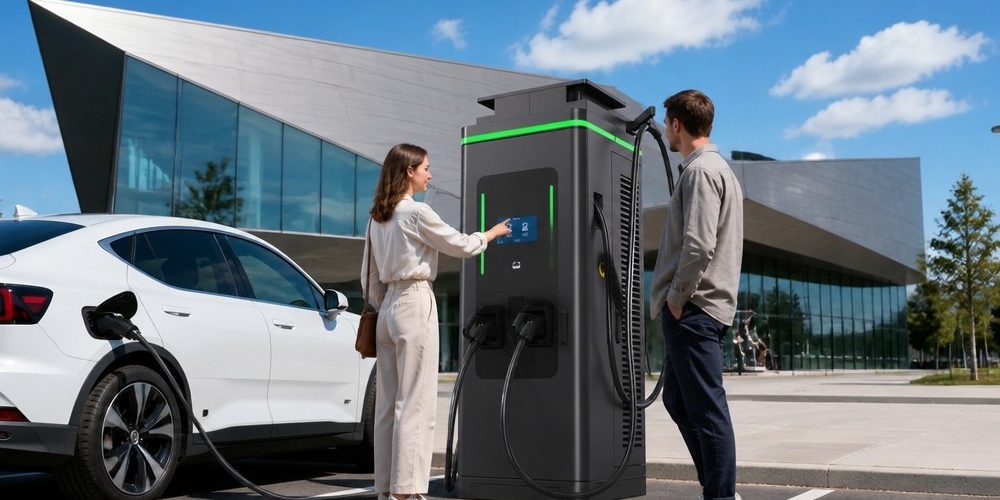
When combining 100kWh of storage with high-power charging, safety certifications are non-negotiable. MIDA Power ensures that the entire integrated unit meets UL 9540 and NFPA 855 standards for Energy Storage Systems. This includes integrated aerosol fire suppression systems, explosion venting, and rapid-shutdown interfaces that allow the station to be safely deployed in public-facing locations or sensitive industrial sites.
13. Advanced Application Scenarios: Where the Grid Cannot Go
Sustainable Mining and Exploration
In remote mining operations, utility vehicles and crew transports are transitioning to electric to reduce ventilation costs and carbon emissions. However, bringing high-power lines to a new exploration site is often impossible. The MIDA 100kWh BESS station can be transported via flatbed truck or helicopter, providing instant 120kW charging powered by a portable solar array or a small diesel generator running at its most efficient load point.
Emergency Response and Disaster Resilience
Following hurricanes, earthquakes, or wildfires, the grid is often down for weeks. The MIDA station can be deployed as a “Mobile Power Oasis.” It can provide high-speed charging for electric emergency vehicles and also serve as a 120kW AC/DC hub for local community needs, such as powering medical clinics or satellite communication centers.
Temporary Event Infrastructure (Festivals and Markets)
Music festivals and pop-up events often rely on dirty, noisy diesel generators for power. A fleet of MIDA 100kWh BESS stations can be pre-charged at a hub and then deployed to the event site, providing clean, silent 120kW charging for VIP shuttles and staff vehicles.
14. Multi-Site Case Studies: Proving the Off-Grid Model
Case Study 2: The Chilean High-Altitude Mine
A mining operation at 4,500 meters in the Andes Mountains needed to electrify its fleet of utility pick-up trucks. The site was powered by a fragile long-distance AC line that could not handle the 120kW spikes of DC charging. MIDA installed a 100kWh BESS integrated unit paired with a 30kW solar canopy. The station used the BESS to buffer the 120kW charging sessions, while the solar and the weak grid refilled the battery over time. Despite the extreme cold and low oxygen (which affects air cooling), the liquid-cooled MIDA system maintained full power, reducing the fleet’s fuel costs by 60% and proving that electric mobility is viable even in the most extreme industrial environments.
Case Study 3: The British “Green Festival”
A major multi-day music festival in the UK used three MIDA 100kWh stations to power its production EV fleet. The units were pre-charged with 100% renewable energy at a nearby farm and then transported to the festival site. Throughout the event, the stations provided over 500 charging sessions without a single drop of diesel being burned. The festival organizers used the MIDA stations’ built-in 4G connectivity to display real-time carbon savings to the attendees on large screens, highlighting the festival’s commitment to sustainability.
15. Expert Commentary: The Architecture of Independence
Dr. Elena Vance, a specialist in Distributed Energy Resources, notes: “The MIDA 100kWh BESS Integrated 120kW station represents a fundamental shift in how we think about the ‘Grid Edge.’ By moving the storage and the power conversion to the same location as the load, we eliminate the need for upstream grid reinforcement. This is not just a charger; it is a ‘Packetized Energy’ device that can be deployed wherever the need exists. The 95%+ efficiency and the LFP safety profile are what make this a professional-grade asset rather than just a hobbyist’s project.”
Dr. Vance continues, “As we move toward 2030, we will see these ‘Energy Oases’ becoming a standard part of our infrastructure, acting as buffers for a grid that is increasingly saturated with intermittent renewable energy. MIDA is clearly leading the way in this ‘Storage-First’ approach to charging.”
16. Installation, Commissioning, and Site Preparation
One of the primary advantages of the MIDA integrated system is the simplified installation process.
Site Preparation
The unit requires a level, reinforced concrete pad (approx. 2m x 2m) capable of supporting the 1,500kg (3,300 lbs) weight. For off-grid solar sites, the pad should be oriented to maximize the placement of the solar canopy or ground-mount array.
Electrical Connections
If used in a grid-constrained mode, the station requires a standard 3-phase AC connection (typically 32A or 63A, depending on the desired refill speed). This is significantly easier and cheaper to install than the 200A+ connection required for a standard 120kW charger.
Commissioning Steps
MIDA’s commissioning team performs the following:
- BESS Integrity Check: Validating the cell voltages and BMS communication.
- Solar Harvest Test: Confirming the MPPT tracking and PV input performance.
- 120kW Load Test: Using a test vehicle to confirm the full power discharge from the BESS.
- Communication Setup: Linking the unit to the operator’s CSMS via the integrated 4G/LTE modem.
- Safety System Validation: Testing the RCD, SPD, and fire suppression systems.
17. Maintenance, TCO, and Remote Operations
The Total Cost of Ownership (TCO) of a MIDA BESS Integrated station is highly competitive, especially when considering the avoided grid upgrade costs.
Remote O&M
The station is designed for “Unattended Operation.” All technical parameters—from battery SoC to solar production and cooling system performance—are monitored 24/7 by the MIDA Cloud platform. Site operators receive automatic alerts for any anomalies, allowing for proactive maintenance before a failure occurs.
Periodic Maintenance
Maintenance is minimal but essential:
- Thermal System Audit: Yearly check of coolant levels and pump performance.
- Filter Cleaning: Ensuring the air intakes for the power electronics remain clear of debris.
- Connector Inspection: Checking the DC cables and plugs for any mechanical wear.
TCO and ROI
The ROI of the MIDA station is driven by three factors:
- Avoided Grid Infrastructure Costs: Saving $50k-$200k in transformer and cabling upgrades.
- Demand Charge Avoidance: Saving $500-$2,000 per month in utility peak-demand fees.
- Solar Self-Consumption: Using free solar energy to power the EV charging sessions.
18. Future Outlook: The Evolution of the Energy Oasis
The MIDA 100kWh BESS Integrated 120kW station is just the beginning.
Solid-State Battery Integration
As solid-state battery technology matures, we envision a version of this station with double the storage capacity (200kWh+) in the same footprint, providing even more autonomy for off-grid sites.
V2X and Local Microgrid Support
Future firmware updates will allow the MIDA station to act as a “Grid-Forming Inverter,” providing 120kW of emergency AC power to the local site during a total blackout, using both the BESS and any connected EVs as a massive energy reservoir.
19. Frequently Asked Questions (FAQ)
1. How long does it take to refill the 100kWh BESS? Using a standard 22kW AC connection, it takes about 5 hours. With 40kW of Solar PV, it can be refilled in a single sunny day.
2. Can I charge two cars at once? Yes, the station is available with dual connectors and can split the 120kW power between two vehicles (e.g., 60kW each).
3. Is the LFP battery safe in extreme heat? Yes. Our liquid-cooling system is specifically designed to maintain the LFP cells within their safe operating temperature, even in ambient heat up to 50°C.
4. What happens if the BESS is empty? If the BESS is depleted, the station will charge the vehicle at the maximum speed allowed by the incoming grid or solar supply (e.g., 22kW) until the battery has enough buffer to ramp back up.
5. How long will the LFP battery last? The battery is rated for 6000 cycles, which in a typical charging scenario equates to 10-15 years of service life.
6. Do I need a transformer for this charger? In most cases, no. The station is designed to connect directly to standard low-voltage AC panels, avoiding the need for a dedicated utility transformer.
7. Is the unit transportable? Yes, the station features integrated lifting points and a reinforced frame designed for transport via truck or ship.
8. Can I add more storage later? Yes. MIDA’s modular architecture allows for external BESS expansion cabinets to be connected to the main unit, increasing storage to 200kWh or more.
9. Does it support “Plug and Charge”? Yes, the station is fully compliant with ISO 15118, allowing for seamless, card-free charging sessions.
10. What is the warranty on the BESS? We offer a standard 5-year warranty on the BESS and power electronics, with optional extensions up to 10 years.
11. Is the station noisy? No. The liquid-cooling system and high-efficiency SiC modules operate much more quietly than traditional air-cooled DC chargers.
12. Can it work without a grid connection at all? Absolutely. Many of our units operate as pure “Off-Grid Energy Oases” powered exclusively by Solar PV.
13. How does it handle snow and ice? The IP55 enclosure and internal heaters ensure that the system remains functional and safe in temperatures as low as -30°C.
14. What are the demand charge savings? Depending on your local utility rates, a MIDA station can save you $5,000 to $20,000 per year in avoided demand charges.
15. Can I manage the station via my phone? Yes, the MIDA Mobile App and Cloud Portal allow you to monitor all aspects of the station’s performance from anywhere in the world.
20. Comprehensive Glossary of Terms
- Active Balancing: A BMS technique that moves energy between cells to ensure a uniform state of charge.
- BESS (Battery Energy Storage System): A system that stores energy for later use, typically using lithium-ion technology.
- Demand Charge: A utility fee based on the highest power consumption (kW) measured during a billing period.
- * DC Fast Charging: The direct-current charging method that bypasses the vehicle’s onboard charger to deliver power at high rates.
- Demand Response: A program in which the charger reduces or shifts its power draw to help stabilize the grid during peak periods.
- Dynamic Load Management: Software that continuously adjusts charger output to keep total site demand within the utility contract limit.
- ETL: The Electrical Testing Laboratories certification mark, widely accepted across North America as proof of safety compliance.
- EVSE (Electric Vehicle Supply Equipment): The formal term for the charging hardware that supplies energy to an EV.
- Fast Charging: DC charging typically rated at 50kW or above, capable of adding meaningful range in under an hour.
- Frequency Regulation: The rapid adjustment of power draw or injection to help maintain grid frequency at 50 or 60 Hz.
- Grid-Tied: A configuration in which the charger or BESS remains connected to the utility network.
- ISO 15118: The international standard enabling Plug and Charge and, in its -20 revision, bidirectional energy transfer.
- Liquid Cooling: A pumped coolant loop that removes heat from power electronics and cables, enabling higher power in smaller packages.
- NACS (North American Charging Standard): The J3400 connector standard adopted by Tesla and increasingly by other OEMs.
- OCPP (Open Charge Point Protocol): The universal communication standard linking chargers to management platforms.
- Off-Grid: A configuration that operates without utility connection, powered entirely by solar and battery storage.
- Peak Shaving: Using stored battery energy to cover demand peaks and avoid expensive utility demand charges.
- Plug and Charge: ISO 15118-based automatic authentication and billing when the connector is engaged.
- Power Module: The field-replaceable SiC-based unit that performs the AC-to-DC conversion.
- SiC (Silicon Carbide): The wide-bandgap semiconductor that boosts efficiency and power density.
- Solar PV: Photovoltaic panels that convert sunlight directly into electricity for on-site generation.
- State of Charge (SoC): The percentage of energy remaining in a battery relative to its full capacity.
- Turnaround Time: The total duration of a charging event, from plug-in to departure.
- UL (Underwriters Laboratories): The leading North American safety certification body for electrical products.
- Uptime: The percentage of time a station is available and operational—MIDA sites routinely exceed 99%.
- V2G (Vehicle-to-Grid): Bidirectional charging that lets vehicles return energy to the grid.
- V2X (Vehicle-to-Everything): The umbrella term for vehicle-to-grid, -home, and -building energy exchange.
Conclusion: The Hub That Keeps Traffic Moving
This glossary captures the technology behind MIDA’s Ultra EV Charger portfolio, but the real story is measured in outcomes: shorter queues, higher throughput, and satisfied drivers. With liquid-cooled NACS cables, BESS integration, and cloud intelligence, MIDA stations are engineered to keep charging hubs turning vehicles around faster—and more profitably—than ever before.
Key Takeaways:
- NACS-native hardware ensures compatibility with the fastest-growing connector ecosystem in North America.
- Integrated BESS buffers grid constraints, enabling ultra-fast charging without expensive transformer upgrades.
- OCPP 2.0.1 and ISO 15118 deliver secure, interoperable, remote-managed operations.
- Liquid cooling sustains maximum power session after session, protecting uptime and revenue.
MIDA Power’s engineers are ready to help you design a hub that eliminates the queue. Contact MIDA Power today at www.midapower.com for a consultation, a site feasibility study, or the latest technical documentation.
Post time: Aug-09-2026
