
 Portable EV Charger
 Home EV Wallbox
 DC Charger Station
 BESS Charging Station
 V2G V2H V2V V2L
 EV Charging Module
 DC Charging Connector
 EV Accessories
Many practitioners and new energy vehicle owners only know how to insert a gun to start charging, but they are not aware of the rigorous and orderly “dialogue process” between electric vehicles and fast charging stations. ISO 15118, as the international mainstream protocol for vehicle charging station interaction, will be disassembled into the complete sequence flowchart to illustrate the entire process steps.
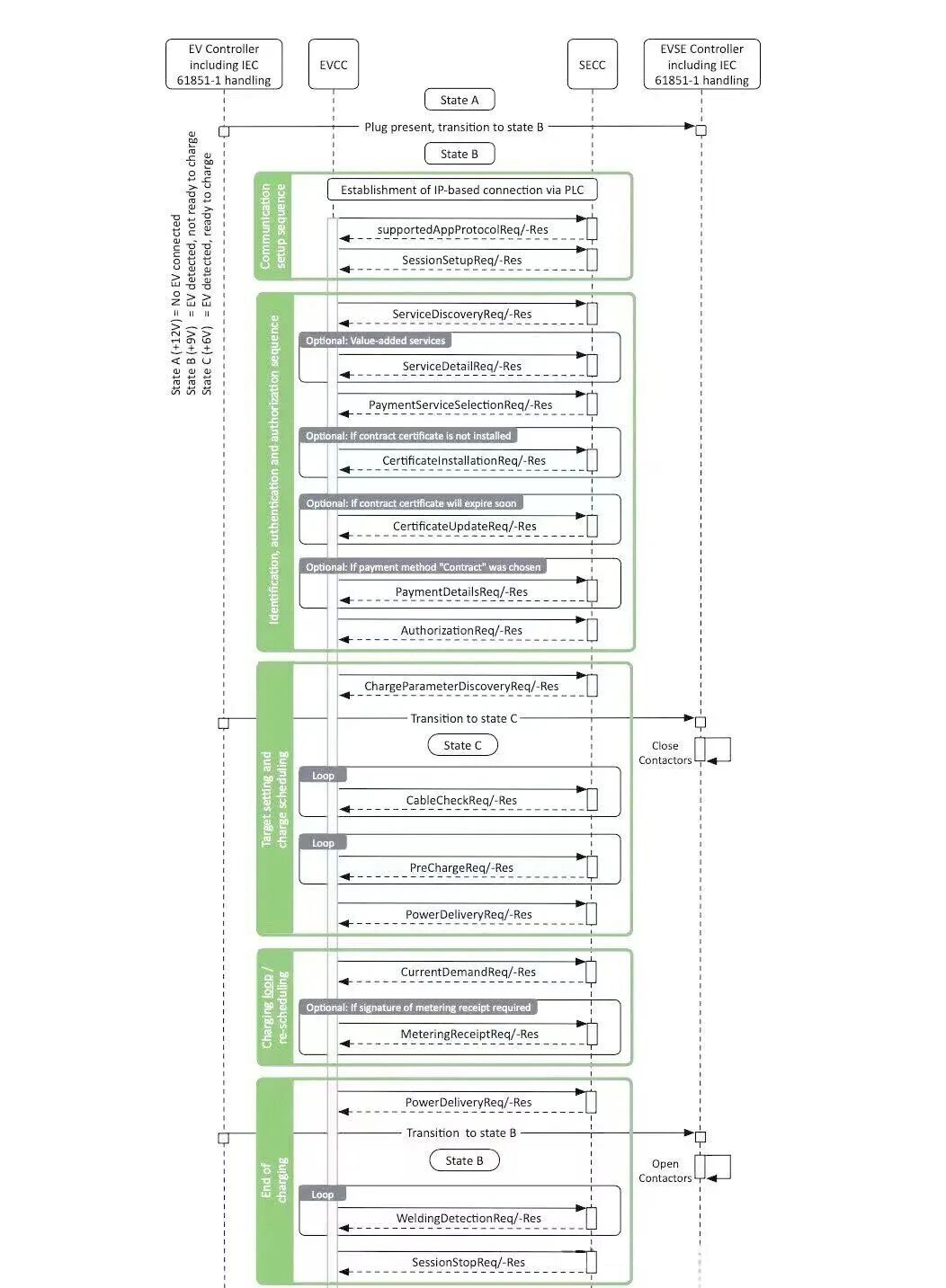
1、 Basic concept: Two core interactive subjects
- EVCC (Vehicle Communication Controller): Installed inside new energy vehicles, it serves as the communication window for the vehicle
- SECC (Charging Station Communication Controller): The main control unit at the DC fast charging station end
The two rely on power line carrier PLC to build a network channel, complete all message interactions, and realize the entire process of handshake, authentication, power on, charging, and power-off.
2、 Definition of Three Hardware States (State A/B/C)
Stage 1: Trigger by inserting the gun and establish a PLC communication link
- Insert the charging gun into the vehicle interface, the hardware detection plug is in place, and the system switches from State A to State B
- EVCC and SECC establish IP communication channels through PLC power line carrier
- Two handshake message
(1) SupportedAppProtocolReq Res: Both parties compare and negotiate compatible ISO15118 protocol versions
(2) . SessionSetup Req Res: Create a dedicated communication session for this charging session
Stage 2: Identity authentication, service selection, payment authorization
After the session is successfully created, it enters the authentication link, and all optional process flowcharts have been marked:
- ServiceDiscovery: Vehicle end obtains a list of all charging services and value-added services supported by charging stations
- ServiceDetail: Retrieve detailed parameters of the selected service
- Payment Service Selection: Select a payment scheme (scan code payment/contract certificate payment without feeling)
- Optional branches: Contract certificate not yet installed → Certificate Installation Req/Res Install paid certificate | Certificate is about to expire → Certificate Update Req/Res Update Certificate
- Payment Details Req Res: Upload payment account and certificate information
- AuthorityReq Res: verifies the charging station’s authorization, passes the authentication, and allows the charging configuration to be enabled
Stage 3: Charging parameter issuance, high-voltage power on pre check, switching to State C
- ChargeGameterDiscoveryReq/Res The vehicle BMS reports all charging constraint parameters such as the highest voltage, peak current, and upper limit of charging SOC of the battery
- After completing the parameter interaction, the device officially jumps to State C and prepares to start high voltage
- Two loop safety pre checks: ① CableCheckReq Res: Loop checks the insulation performance of charging cables and gun heads to identify leakage faults. ② PreChargeReq Res: Pre charge process, slowly raise the voltage at the pile end, buffer the surge current, and protect the high-voltage components in the vehicle.
- Send an electrical command under PowerDeliveryReq Res, close the high-voltage main contactor at the charging station, and connect the high-voltage circuit.
Stage 4: Continuous cyclic charging, dynamically adjusting charging power
Continuous cyclic message exchange throughout the charging process:
- CurrentDemandReq Res: The vehicle provides real-time feedback on the current charging current required by the battery; Charging pile Follow the demand, dynamically adjust the output power, and adapt to the power attenuation after battery temperature rise and SOC increase.
- MeteringReceiptReq Res: The optional process which involves exchanging meter measurement receipts and synchronizing charging power data for billing and voucher retention.
Stage 5: Charging termination, safe power off, contactor adhesion detection
- The battery is fully charged/the user manually stops charging, sends a PowerDeliveryReq Res to stop power transmission, and the device returns to State B.
- Disconnect the high-voltage main contactor from the charging station and cut off the high-voltage output.
- WeldDetectionReq Res performs cyclic detection of high-voltage contacts and checks for welding adhesion of contactors. This step is the most important safety checkpoint before pulling out the gun to prevent high voltage pulling.
- SessionStopReq Res closes this charging session, and the complete fast charging communication process officially ends.
Summary of the ISO15118 Process:
Insertion gun wake-up → PLC communication handshake → payment authentication → high-voltage cable pre check → dynamic charging → power-off adhesion detection.
Each request response message is a layer of security protection. This protocol is also the underlying core of future contactless charging, automatic parking charging, and V2G vehicle to grid power transmission.
Post time: Sep-29-2026
