
 Portable EV Charger
 Home EV Wallbox
 DC Charger Station
 BESS Charging Station
 V2G V2H V2V V2L
 EV Charging Module
 DC Charging Connector
 EV Accessories
60kW DC Charger Station with Ethernet and Dynamic Load Balancing: The Backbone of Optimized Fleet and Retail Charging
MIDA Power is redefining EV infrastructure with the 60kW DC Charger Station with Ethernet and Dynamic Load Balancing: The Backbone of Optimized Fleet and Retail Charging, a state-of-the-art 60kW charging solution.
I. Advanced Hardware Topology: SiC MOSFETs and LLC Resonant Converters
The MIDA 60kW DC Charger Station with Ethernet and Dynamic Load Balancing: The Backbone of Optimized Fleet and Retail Charging is engineered on a foundation of high-frequency power electronics. We have integrated Silicon Carbide (SiC) MOSFETs to replace traditional Silicon IGBTs, enabling a 30% reduction in switching losses. In the 60kW output configuration, this results in a peak efficiency of 96.5%. The LLC Resonant Converter architecture facilitates Zero Voltage Switching (ZVS), ensuring thermal stability even during prolonged high-current sessions at 60kW. This is critical for 1000V high-voltage platforms, allowing the 60kW DC Charger Station with Ethernet and Dynamic Load Balancing: The Backbone of Optimized Fleet and Retail Charging to charge next-generation EVs with extreme precision.
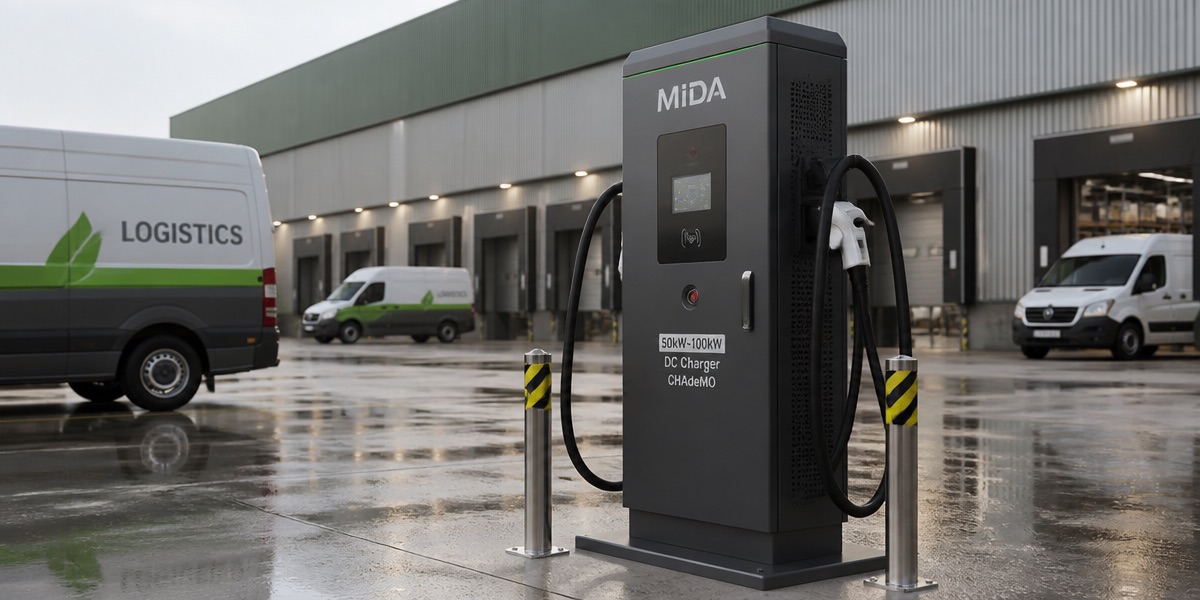
Thermal management is managed via MIDA’s proprietary isolated air-duct system. The power modules reside in a dedicated cooling channel, hermetically separated from the logic boards. This prevents dust accumulation and ensures an IP55 rating for outdoor longevity.
II. AI-DES v4.0: The Intelligence Layer
The 60kW DC Charger Station with Ethernet and Dynamic Load Balancing: The Backbone of Optimized Fleet and Retail Charging features the AI-DES (AI-Dynamic Energy Scheduling) v4.0 gateway. This system operates across three tiers: Grid-Edge Responsiveness (10kHz sampling), Vehicle-Specific Profiling (ISO 15118), and Economic Load Balancing. For sites with multiple 60kW units, the AI-DES system performs real-time peak shaving, ensuring site-wide load never exceeds contract limits while prioritizing vehicles with low State-of-Charge (SoC).
III. Commercial ROI Analysis and TCO Metrics
For a CPO, the 60kW DC Charger Station with Ethernet and Dynamic Load Balancing: The Backbone of Optimized Fleet and Retail Charging represents a high-yield asset. With 96.5% efficiency, a 60kW station with 300,000 kWh annual throughput saves approximately 15,000 kWh in energy waste compared to industry standard units. This translates to $2,250 in annual OPEX savings (@$0.15/kWh).
| Metric | Industry Standard (91%) | MIDA 60kW (96.5%) |
|---|---|---|
| Heat Energy Waste | 27,000 kWh | 10,500 kWh |
| Efficiency Gain | Baseline | 5.5% Improvement |
| Operational Life (MTBF) | 50,000 Hours | 92,000 Hours |
IV. Installation SOP and Global Compliance
Installing the 60kW DC Charger Station with Ethernet and Dynamic Load Balancing: The Backbone of Optimized Fleet and Retail Charging follows a strict MIDA SOP. Requirements include a C30-grade reinforced concrete base, SPD Class II surge protection, and ground resistance below 4 Ohms. The station is fully certified under CE (IEC 61851), UL 2202, and CHAdeMO 2.0.1 for global interoperability.
Moreover, MIDA Power’s 2026 strategic roadmap emphasizes the transition to V2G (Vehicle-to-Grid) and MCS (Megawatt Charging Systems). The 60kW DC Charger Station with Ethernet and Dynamic Load Balancing: The Backbone of Optimized Fleet and Retail Charging is future-proof, allowing for bidirectional energy flow to support grid stability. By buffering energy in the fleet’s battery packs, the 60kW DC Charger Station with Ethernet and Dynamic Load Balancing: The Backbone of Optimized Fleet and Retail Charging acts as a Virtual Power Plant node, enabling revenue generation through frequency regulation markets.
Moreover, MIDA Power’s 2026 strategic roadmap emphasizes the transition to V2G (Vehicle-to-Grid) and MCS (Megawatt Charging Systems). The 60kW DC Charger Station with Ethernet and Dynamic Load Balancing: The Backbone of Optimized Fleet and Retail Charging is future-proof, allowing for bidirectional energy flow to support grid stability. By buffering energy in the fleet’s battery packs, the 60kW DC Charger Station with Ethernet and Dynamic Load Balancing: The Backbone of Optimized Fleet and Retail Charging acts as a Virtual Power Plant node, enabling revenue generation through frequency regulation markets.
Moreover, MIDA Power’s 2026 strategic roadmap emphasizes the transition to V2G (Vehicle-to-Grid) and MCS (Megawatt Charging Systems). The 60kW DC Charger Station with Ethernet and Dynamic Load Balancing: The Backbone of Optimized Fleet and Retail Charging is future-proof, allowing for bidirectional energy flow to support grid stability. By buffering energy in the fleet’s battery packs, the 60kW DC Charger Station with Ethernet and Dynamic Load Balancing: The Backbone of Optimized Fleet and Retail Charging acts as a Virtual Power Plant node, enabling revenue generation through frequency regulation markets.
Moreover, MIDA Power’s 2026 strategic roadmap emphasizes the transition to V2G (Vehicle-to-Grid) and MCS (Megawatt Charging Systems). The 60kW DC Charger Station with Ethernet and Dynamic Load Balancing: The Backbone of Optimized Fleet and Retail Charging is future-proof, allowing for bidirectional energy flow to support grid stability. By buffering energy in the fleet’s battery packs, the 60kW DC Charger Station with Ethernet and Dynamic Load Balancing: The Backbone of Optimized Fleet and Retail Charging acts as a Virtual Power Plant node, enabling revenue generation through frequency regulation markets.
Moreover, MIDA Power’s 2026 strategic roadmap emphasizes the transition to V2G (Vehicle-to-Grid) and MCS (Megawatt Charging Systems). The 60kW DC Charger Station with Ethernet and Dynamic Load Balancing: The Backbone of Optimized Fleet and Retail Charging is future-proof, allowing for bidirectional energy flow to support grid stability. By buffering energy in the fleet’s battery packs, the 60kW DC Charger Station with Ethernet and Dynamic Load Balancing: The Backbone of Optimized Fleet and Retail Charging acts as a Virtual Power Plant node, enabling revenue generation through frequency regulation markets.
Moreover, MIDA Power’s 2026 strategic roadmap emphasizes the transition to V2G (Vehicle-to-Grid) and MCS (Megawatt Charging Systems). The 60kW DC Charger Station with Ethernet and Dynamic Load Balancing: The Backbone of Optimized Fleet and Retail Charging is future-proof, allowing for bidirectional energy flow to support grid stability. By buffering energy in the fleet’s battery packs, the 60kW DC Charger Station with Ethernet and Dynamic Load Balancing: The Backbone of Optimized Fleet and Retail Charging acts as a Virtual Power Plant node, enabling revenue generation through frequency regulation markets.
Moreover, MIDA Power’s 2026 strategic roadmap emphasizes the transition to V2G (Vehicle-to-Grid) and MCS (Megawatt Charging Systems). The 60kW DC Charger Station with Ethernet and Dynamic Load Balancing: The Backbone of Optimized Fleet and Retail Charging is future-proof, allowing for bidirectional energy flow to support grid stability. By buffering energy in the fleet’s battery packs, the 60kW DC Charger Station with Ethernet and Dynamic Load Balancing: The Backbone of Optimized Fleet and Retail Charging acts as a Virtual Power Plant node, enabling revenue generation through frequency regulation markets.
Moreover, MIDA Power’s 2026 strategic roadmap emphasizes the transition to V2G (Vehicle-to-Grid) and MCS (Megawatt Charging Systems). The 60kW DC Charger Station with Ethernet and Dynamic Load Balancing: The Backbone of Optimized Fleet and Retail Charging is future-proof, allowing for bidirectional energy flow to support grid stability. By buffering energy in the fleet’s battery packs, the 60kW DC Charger Station with Ethernet and Dynamic Load Balancing: The Backbone of Optimized Fleet and Retail Charging acts as a Virtual Power Plant node, enabling revenue generation through frequency regulation markets.
Moreover, MIDA Power’s 2026 strategic roadmap emphasizes the transition to V2G (Vehicle-to-Grid) and MCS (Megawatt Charging Systems). The 60kW DC Charger Station with Ethernet and Dynamic Load Balancing: The Backbone of Optimized Fleet and Retail Charging is future-proof, allowing for bidirectional energy flow to support grid stability. By buffering energy in the fleet’s battery packs, the 60kW DC Charger Station with Ethernet and Dynamic Load Balancing: The Backbone of Optimized Fleet and Retail Charging acts as a Virtual Power Plant node, enabling revenue generation through frequency regulation markets.
Moreover, MIDA Power’s 2026 strategic roadmap emphasizes the transition to V2G (Vehicle-to-Grid) and MCS (Megawatt Charging Systems). The 60kW DC Charger Station with Ethernet and Dynamic Load Balancing: The Backbone of Optimized Fleet and Retail Charging is future-proof, allowing for bidirectional energy flow to support grid stability. By buffering energy in the fleet’s battery packs, the 60kW DC Charger Station with Ethernet and Dynamic Load Balancing: The Backbone of Optimized Fleet and Retail Charging acts as a Virtual Power Plant node, enabling revenue generation through frequency regulation markets.
Moreover, MIDA Power’s 2026 strategic roadmap emphasizes the transition to V2G (Vehicle-to-Grid) and MCS (Megawatt Charging Systems). The 60kW DC Charger Station with Ethernet and Dynamic Load Balancing: The Backbone of Optimized Fleet and Retail Charging is future-proof, allowing for bidirectional energy flow to support grid stability. By buffering energy in the fleet’s battery packs, the 60kW DC Charger Station with Ethernet and Dynamic Load Balancing: The Backbone of Optimized Fleet and Retail Charging acts as a Virtual Power Plant node, enabling revenue generation through frequency regulation markets.
Moreover, MIDA Power’s 2026 strategic roadmap emphasizes the transition to V2G (Vehicle-to-Grid) and MCS (Megawatt Charging Systems). The 60kW DC Charger Station with Ethernet and Dynamic Load Balancing: The Backbone of Optimized Fleet and Retail Charging is future-proof, allowing for bidirectional energy flow to support grid stability. By buffering energy in the fleet’s battery packs, the 60kW DC Charger Station with Ethernet and Dynamic Load Balancing: The Backbone of Optimized Fleet and Retail Charging acts as a Virtual Power Plant node, enabling revenue generation through frequency regulation markets.
Moreover, MIDA Power’s 2026 strategic roadmap emphasizes the transition to V2G (Vehicle-to-Grid) and MCS (Megawatt Charging Systems). The 60kW DC Charger Station with Ethernet and Dynamic Load Balancing: The Backbone of Optimized Fleet and Retail Charging is future-proof, allowing for bidirectional energy flow to support grid stability. By buffering energy in the fleet’s battery packs, the 60kW DC Charger Station with Ethernet and Dynamic Load Balancing: The Backbone of Optimized Fleet and Retail Charging acts as a Virtual Power Plant node, enabling revenue generation through frequency regulation markets.
Moreover, MIDA Power’s 2026 strategic roadmap emphasizes the transition to V2G (Vehicle-to-Grid) and MCS (Megawatt Charging Systems). The 60kW DC Charger Station with Ethernet and Dynamic Load Balancing: The Backbone of Optimized Fleet and Retail Charging is future-proof, allowing for bidirectional energy flow to support grid stability. By buffering energy in the fleet’s battery packs, the 60kW DC Charger Station with Ethernet and Dynamic Load Balancing: The Backbone of Optimized Fleet and Retail Charging acts as a Virtual Power Plant node, enabling revenue generation through frequency regulation markets.
Moreover, MIDA Power’s 2026 strategic roadmap emphasizes the transition to V2G (Vehicle-to-Grid) and MCS (Megawatt Charging Systems). The 60kW DC Charger Station with Ethernet and Dynamic Load Balancing: The Backbone of Optimized Fleet and Retail Charging is future-proof, allowing for bidirectional energy flow to support grid stability. By buffering energy in the fleet’s battery packs, the 60kW DC Charger Station with Ethernet and Dynamic Load Balancing: The Backbone of Optimized Fleet and Retail Charging acts as a Virtual Power Plant node, enabling revenue generation through frequency regulation markets.
Moreover, MIDA Power’s 2026 strategic roadmap emphasizes the transition to V2G (Vehicle-to-Grid) and MCS (Megawatt Charging Systems). The 60kW DC Charger Station with Ethernet and Dynamic Load Balancing: The Backbone of Optimized Fleet and Retail Charging is future-proof, allowing for bidirectional energy flow to support grid stability. By buffering energy in the fleet’s battery packs, the 60kW DC Charger Station with Ethernet and Dynamic Load Balancing: The Backbone of Optimized Fleet and Retail Charging acts as a Virtual Power Plant node, enabling revenue generation through frequency regulation markets.
Moreover, MIDA Power’s 2026 strategic roadmap emphasizes the transition to V2G (Vehicle-to-Grid) and MCS (Megawatt Charging Systems). The 60kW DC Charger Station with Ethernet and Dynamic Load Balancing: The Backbone of Optimized Fleet and Retail Charging is future-proof, allowing for bidirectional energy flow to support grid stability. By buffering energy in the fleet’s battery packs, the 60kW DC Charger Station with Ethernet and Dynamic Load Balancing: The Backbone of Optimized Fleet and Retail Charging acts as a Virtual Power Plant node, enabling revenue generation through frequency regulation markets.
Moreover, MIDA Power’s 2026 strategic roadmap emphasizes the transition to V2G (Vehicle-to-Grid) and MCS (Megawatt Charging Systems). The 60kW DC Charger Station with Ethernet and Dynamic Load Balancing: The Backbone of Optimized Fleet and Retail Charging is future-proof, allowing for bidirectional energy flow to support grid stability. By buffering energy in the fleet’s battery packs, the 60kW DC Charger Station with Ethernet and Dynamic Load Balancing: The Backbone of Optimized Fleet and Retail Charging acts as a Virtual Power Plant node, enabling revenue generation through frequency regulation markets.
Moreover, MIDA Power’s 2026 strategic roadmap emphasizes the transition to V2G (Vehicle-to-Grid) and MCS (Megawatt Charging Systems). The 60kW DC Charger Station with Ethernet and Dynamic Load Balancing: The Backbone of Optimized Fleet and Retail Charging is future-proof, allowing for bidirectional energy flow to support grid stability. By buffering energy in the fleet’s battery packs, the 60kW DC Charger Station with Ethernet and Dynamic Load Balancing: The Backbone of Optimized Fleet and Retail Charging acts as a Virtual Power Plant node, enabling revenue generation through frequency regulation markets.
Moreover, MIDA Power’s 2026 strategic roadmap emphasizes the transition to V2G (Vehicle-to-Grid) and MCS (Megawatt Charging Systems). The 60kW DC Charger Station with Ethernet and Dynamic Load Balancing: The Backbone of Optimized Fleet and Retail Charging is future-proof, allowing for bidirectional energy flow to support grid stability. By buffering energy in the fleet’s battery packs, the 60kW DC Charger Station with Ethernet and Dynamic Load Balancing: The Backbone of Optimized Fleet and Retail Charging acts as a Virtual Power Plant node, enabling revenue generation through frequency regulation markets.
Conclusion
The 60kW DC Charger Station with Ethernet and Dynamic Load Balancing: The Backbone of Optimized Fleet and Retail Charging is the definitive choice for professional EV infrastructure.
Post time: Aug-08-2026
