
 Portable EV Charger
 Home EV Wallbox
 DC Charger Station
 BESS Charging Station
 V2G V2H V2V V2L
 EV Charging Module
 DC Charging Connector
 EV Accessories
Japan Charging Experience Upgrade 2026: Smart Charging, Plug and Charge, Reservations and Multilingual Interaction
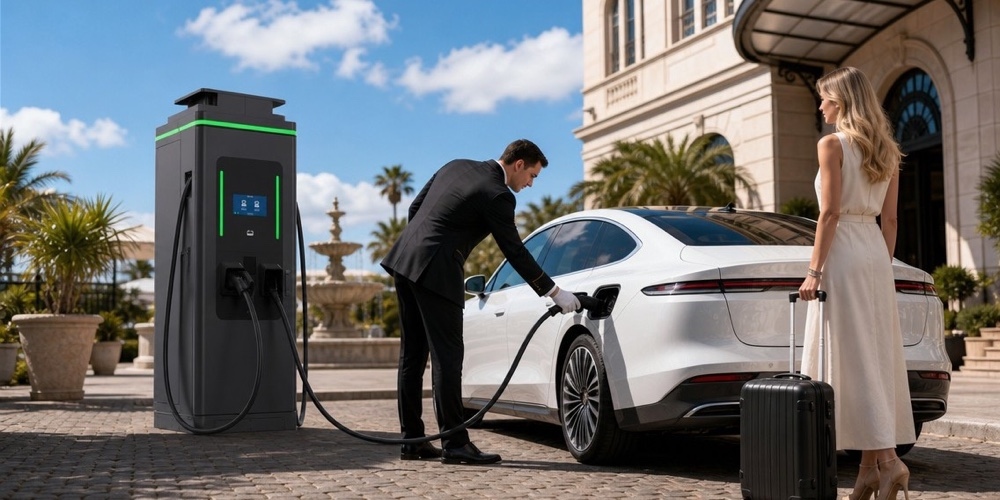
Key Takeaways
- Plug and Charge: ISO 15118 delivers plug-in, charge and auto-settlement; new mainstream Japanese chargers begin to include it as standard in 2026.
- Reservations and availability display: real-time occupancy status plus reserved slots cut the probability of arriving to a queue by more than 50%.
- Multilingual interaction: Japanese, English, Chinese and Korean coverage serves inbound tourists (continuing to recover in 2026) charging needs.
- Accessibility design: large fonts, voice prompts, low-position gun docks, lighting and anti-slip features fit the age-structure of an aging society.
- Membership and payment: charging apps with credit card/QR/transit IC card multi-payment, with membership points and consumption linkage lifting repeat use.
Why the Charging Experience Is the Hidden Bottleneck of EV Adoption in Japan
One core reason Japan’s EV adoption rate (about 2–3% of new vehicles in 2026) trails Europe, the US and China is “charging anxiety”—hard-to-find, queueing, cumbersome and inconveniently paid chargers directly deter potential buyers, and surveys by the Consumer Affairs Agency and METI both show charging convenience is the second-biggest reason against EV purchase (after price). In 2026, policy and market signals for charging experience upgrades appear simultaneously: METI pushes app interconnection and information opening (API), leading operators upgrade Plug and Charge and reservation functions, and hardware makers include multilingual and accessibility design in specifications—the charging experience shifts from “add-on” to “competitiveness.” This article proceeds through pain-point breakdown, feature system, technical implementation, experience design and a case study.
H2: User Pain Points and the Feature System: Digital Solutions to the Three Big Pains
Japanese charging user surveys identify three pain points and their corresponding features. Pain point one, “cannot find an available charger” (42%): the solution is real-time availability display (open APIs plus map integration), reserved slots and arrival prediction. Pain point two, “operation process is complex” (28%): the solution is Plug and Charge, NFC quick start and one-tap reuse of history. Pain point three, “payment is inconvenient” (18%): the solution is multi-payment (credit card/QR/transit IC), automatic settlement, transparent pricing and electronic receipts.
H3: Charging Experience Pain Points and Smart Feature Mapping Table
| User pain point | Share | Smart solution | Experience gain |
|---|---|---|---|
| Cannot find an available charger | 42% | Availability display + reserved slots | Charger-hunting time cut 60% |
| Operation process is complex | 28% | Plug and Charge + one-tap start | Operation steps cut 70% |
| Payment is inconvenient | 18% | Multi-payment + auto settlement | Payment time cut 80% |
| Slow charging / waiting | 12% | Ultra-fast upgrade + queue prediction | Waiting time controlled |
H2: Plug and Charge: From the QR-Code Era to the Zero-Operation Era
Plug and Charge is based on ISO 15118-2/20: the charger and vehicle authenticate each other via TLS certificates, and after plugging in, the vehicle is automatically identified, charging starts and settlement completes—no app, card or QR scan at any step. Japan’s rollout path: new chargers (with native OCPP 2.0.1 support) support it directly; existing units gain support gradually through firmware upgrades and platform adaptation. Data worth citing: Japanese operator pilot data shows Plug and Charge cuts per-session operation time from about 2–3 minutes to under 10 seconds and raises charging start success rates from 96% to over 99%; with the vehicle-charger-platform certificate system (PKI), security meets payment-grade requirements—Plug and Charge support on high-end fast chargers newly delivered in Japan in 2026 is expected to exceed 60%.
H2: Reservations, Availability Display and Multilingual Support: “Certainty” and “Inclusiveness” in the Experience
The value of reservations and availability display is “certainty”: charging apps connect to open APIs (the charging information connection METI promotes), showing real-time occupancy, estimated waiting and fault status; the reservation function locks a slot so users charge on arrival, converting queue anxiety into a certain schedule. Multilingual and accessibility design serves Japan’s diverse society: Japanese, English, Chinese and Korean interfaces cover inbound tourists (whose numbers continue recovering in 2026, with rental-car EV demand rising); large fonts, high contrast, voice prompts, low gun docks and wheelchair routes fit the aging user structure; and canopies, lighting and nighttime visibility raise safety and peace of mind.
H3: Charging Experience Smart Feature Value Assessment Table
| Feature | Cost to deploy | User value | Operator value | Priority |
|---|---|---|---|---|
| Availability display (open API) | Low | High | High (traffic) | High |
| Reservation slot locking | Medium | High | Medium (utilization) | High |
| Plug and Charge | Medium-high | High | High (retention) | Medium-high |
| Multilingual interface | Low | High (tourists) | Medium | Medium |
| Accessibility design | Low-medium | High (elderly) | Medium (brand) | Medium |
| Membership points linkage | Medium | Medium-high | High (repeat use) | Medium-high |
H2: Technical Implementation: OCPP 2.0.1, Open APIs and Payment Interoperability
The technical foundation of charging experience upgrades is threefold. OCPP 2.0.1 natively supports Plug and Charge, smart charging and secure communication, and is the standard channel for experience features. Open APIs: METI pushes charging information connection so operators open availability, price and reservation capabilities to map and aggregation apps. Payment interoperability: credit cards, QR codes and transit IC cards (Suica and others) run as multiple channels, with future access to a unified charging service network. Data worth citing: METI’s charging information connection (API) pilot data shows that after information opening, average charger utilization rises 15–25% and available-charger search time falls over 60%—”open data” is itself an experience upgrade and a policy direction, so 2026 new sites should include open APIs in operating requirements.
H2: Experience Design and Scene Narrative: From “Charging Operator” to “Charging Enjoyer”
The landing point of experience upgrades is scene-based design. The commute scene: plug in on arrival, charge on overnight valley tariffs, depart full in the morning. The long-distance scene: reserved slots at highway SA, dining and rest during charging, and “charge plus rest” packages linked to route planning. The tourist scene: multilingual interfaces, rental-EV charging guidance and duty-free linkage. Equipment-side design language upgrades in parallel: large touchscreens (10 inches and above), anti-glare, card-swipe height and wheelchair adaptation, breathing-light charging status (visible at distance) and clear fault-guidance QR codes.
H2: Scene Narrative: A Tokyo Charging Operator’s Experience Upgrade Record
In early 2026, a Tokyo charging operator running 15 stations and 120 guns launched an experience upgrade. Phase one deployed availability display and reservations: connected open APIs to mainstream map and charging aggregation apps and added “reserved slot” (15-minute hold) in the app. Phase two upgraded Plug and Charge: all newly purchased chargers support ISO 15118, with firmware upgrades for existing units. Phase three delivered multilingual and accessibility: four-language switching, voice prompts and low gun docks. Six-month results: charging app monthly active users grew 40%, reservation feature usage reached 35%, and arrival queueing fell 55%; Plug and Charge users reached 28% with average start time down from 2 minutes 30 seconds to 15 seconds; inbound tourist users tripled, lifting utilization at tourist-area stations 30%; user NPS rose from 32 to 58. The operations director’s verdict: the essence of experience upgrades is “certainty”—what users fear most is not slow charging but not knowing where they can charge and whether they will get a slot; give them certainty and they stay.
Measured against these scenes, the hardware baseline for 2026 is already clear: every new station should ship with a 10-inch-plus touchscreen, an NFC reader, a multi-payment terminal, OCPP 2.0.1 connectivity and at least one reserved Plug and Charge slot per four guns. Operators that standardize this hardware baseline can roll out experience features as software updates rather than forklift upgrades, cutting both capital expenditure and time-to-market for each new experience function.
H2: 7 High-Frequency FAQs
- Q: What is the worst part of the charging experience in Japan? A: User surveys show three pain points: cannot find an available charger (42%), complex operation (28%) and inconvenient payment (18%); smart charging (availability display, Plug and Charge, multi-payment) targets exactly these.
- Q: Is Plug and Charge widespread in Japan? A: Support on high-end fast chargers newly delivered in 2026 is expected to exceed 60%, based on ISO 15118; existing units gain support gradually via firmware and platform upgrades.
- Q: How do charging reservations work? A: Select a station and time slot in the charging app to lock a slot and charge on arrival; reservations and availability display depend on operator open APIs, and information opening is the 2026 policy direction.
- Q: Which payment methods do Japanese chargers support? A: Credit cards, QR-code payment and transit IC cards (Suica/PASMO) are mainstream, alongside charging membership cards and automatic settlement; future access to a unified charging network is planned.
- Q: Do charging apps need multilingual support? A: Yes. Inbound tourist rental-EV use is growing, and Japanese, English, Chinese and Korean coverage is a competitive edge at tourist-area stations and an inclusiveness requirement.
- Q: What do experience upgrades do for operators? A: They directly raise utilization (15–25% from information opening), user retention (membership repeat use) and NPS, and indirectly support charging-fee premiums plus advertising and consumption-linked revenue.
- Q: Which experience features should new 2026 charging stations include as standard? A: Availability display (open API), reservation slot locking, multi-payment, Plug and Charge reserve (OCPP 2.0.1) and multilingual/accessibility interfaces—five features form the experience baseline.
H2: Related Products and Internal Links
Equipment support for the Japan charging experience upgrade: main charging equipment can use DC fast charging stations (20kW–480kW, with OCPP 2.0.1 and Plug and Charge reserve, large multilingual screens and optional multi-payment modules); flagship and ultra-fast experiences use floor-standing DC charger stations (320kW–480kW liquid-cooled, 10-minute ultra-fast experience); and station energy and experience coordination uses BESS charger stations (120kW/141kWh mobile) to protect peak-hour charging success, paired with energy storage systems for valley-tariff savings passed back to users. The recommended path is to work with MIDA on “open API → reservations and availability → Plug and Charge → multilingual and accessibility” to upgrade the Japan charging experience into measurable user value.
Post time: Aug-17-2026
