
 Portable EV Charger
 Home EV Wallbox
 DC Charger Station
 BESS Charging Station
 V2G V2H V2V V2L
 EV Charging Module
 DC Charging Connector
 EV Accessories
A Comprehensive Analysis of the Seismic Market Shift Down Under as BYD Surges to Challenge Tesla’s Dominance Amidst Intensifying Competition in Australia’s Rapidly Evolving Electric Vehicle Landscape during 2026
1. Introduction: The Great Southern Electrification
For decades, the Australian automotive market was defined by a preference for large, internal combustion engine (ICE) utes and SUVs, and a historical loyalty to domestic brands like Holden and Ford. However, by 2026, a seismic shift has occurred. Australia has become one of the most dynamic and competitive electric vehicle (EV) markets in the world.
This “Market Shift Down Under” is characterized by a fierce duel between the established pioneer, Tesla, and the surging challenger, BYD. While Tesla once held an almost monopolistic grip on the Australian EV consciousness, the entry and rapid expansion of BYD (Build Your Dreams) have fundamentally changed the landscape. As of 2026, Australia has become a critical battleground for global EV supremacy, with its unique geographic challenges, high disposable income, and a policy environment that has rapidly shifted from skepticism to enthusiastic support for green transport.
In this deep-dive analysis, we will examine the data behind BYD’s surge, analyze Tesla’s defensive and offensive strategies, and explore the technical and supply chain foundations that are driving this competition. Furthermore, we will look at how Australia’s lack of a domestic car manufacturing industry has created an “open field” where global brands—particularly from China—can compete on an equal footing, reshaping the Australian “ute and suv” culture into an “electric and intelligent” one.
2. The Battle for the Top Spot: By the Numbers
The 2025 and early 2026 sales data in Australia tell a story of rapid disruption.
2.1 The Erosion of Tesla’s Monopoly
In 2022, Tesla accounted for nearly 70% of all EV sales in Australia. By early 2026, that share has fallen to approximately 40%. While Tesla’s absolute sales numbers have remained strong, particularly with the Model Y consistently topping the charts, the growth in the market is being captured by newcomers.
- The Model Y Factor: The Tesla Model Y remains the single best-selling EV in Australia, prized for its performance, cargo space, and the reliability of the Tesla Supercharger network.
- The Price War Impact: Tesla has engaged in aggressive price cuts throughout 2024 and 2025 to maintain volume, but this has impacted its premium brand image and residual values, creating an opening for competitors.
2.2 The BYD Surge: From Niche to Mainstream
BYD’s entry into Australia was nothing short of a blitzkrieg. From a standing start, it has captured over 20% of the EV market by 2026, with a trajectory that suggests it could challenge Tesla for the #1 spot by 2027.
- The Atto 3 Success: The BYD Atto 3 (known as the Yuan Plus in China) became an overnight sensation in Australia, offering a high-tech, spacious SUV experience at a price point significantly below the Tesla Model Y.
- Portfolio Diversity: Unlike Tesla, which relies on a few core models, BYD has quickly introduced a range of vehicles—the compact Dolphin, the premium Seal sedan, and the highly anticipated “Shark” plug-in hybrid ute—appealing to a much broader cross-section of Australian drivers.
3. Why Australia? The Strategic “Open Market”
Australia is unique among major economies because it has no domestic passenger car manufacturing industry. This has profound implications for the EV market shift.
3.1 The Level Playing Field
Unlike the US or the EU, Australia has no domestic “legacy” manufacturers to protect. This means there are no protectionist tariffs targeting Chinese EVs (like the 100% US tariff or the EU anti-subsidy duties).
- The Free Trade Advantage: The China-Australia Free Trade Agreement (ChAFTA) ensures that Chinese-made EVs enter the market with minimal friction. This makes Australia the perfect “Western” test lab for Chinese OEMs looking to prove their global appeal.
- The Consumer as the Winner: In this open market, competition is based purely on price, technology, and brand experience. Australian consumers are seeing a wider variety of EVs at lower price points than almost anywhere else outside of China.
3.2 The Policy Pivot
After years of lagging behind, the Australian federal and state governments have introduced significant incentives.
- The FBT Exemption: The Federal Government’s Fringe Benefits Tax (FBT) exemption for EVs has been a massive driver for the corporate and novated lease markets, which make up a large portion of new car sales in Australia.
- The National EV Strategy: The rollout of a national “Charging Highway” has begun to address the “range anxiety” inherent in a country as large as Australia, providing a infrastructure foundation for mass adoption.
4. BYD’s Surge: Affordability, Diversity, and Local Adaptation
BYD’s success in Australia is not an accident; it is the result of a tailored strategy that addresses the specific needs of the Australian consumer.
4.1 The “Value-for-Money” Proposition
BYD has mastered the “Premium-at-a-Discount” segment.
- Interior Innovation: The quirky, music-inspired interiors of the Atto 3 and the high-end, minimalist design of the Seal have resonated with Australians looking for something “different” from the traditional European or Japanese aesthetic.
- Standard Features: While traditional brands often charge extra for advanced safety features or sunroofs, BYD includes almost everything as standard, simplifying the buying process and increasing perceived value.
4.2 The “Shark” and the Ute Culture
The “Ute” (utility vehicle) is the king of the Australian road. BYD’s introduction of the “Shark” (a dual-motor PHEV/EV ute) is a strategic masterstroke.
- Tapping the Heartland: By offering an electric alternative to the Toyota HiLux and Ford Ranger, BYD is moving beyond the urban “early adopter” and into the rural and industrial heartland of Australia.
- Technical Edge: The Shark’s V2L (Vehicle-to-Load) capability—allowing tradies to power their tools directly from the car—is a feature that traditional utes cannot match, providing a functional reason for the switch to electric.
5. Tesla’s Strategic Pivot: Defending the Crown
Tesla is not sitting still. Its response to BYD’s surge has been a combination of infrastructure dominance and brand ecosystem integration.
5.1 The Supercharger Moat
Despite opening its network to other brands, the seamless “Plug & Charge” experience for Tesla owners remains a significant competitive advantage in the vast Australian landscape.
- Reliability and Scale: Tesla’s Supercharger network is still seen as the most reliable and extensive in Australia. For many buyers, the peace of mind that comes with the Tesla logo at the charger is worth the premium price of the vehicle.
5.2 The “Eco-System” Play
Tesla is increasingly selling a lifestyle, not just a car.
- Powerwall and Solar: By integrating the car with the Tesla Powerwall and solar panels, Tesla offers a “Whole Home Energy” solution. In a country with the world’s highest rooftop solar penetration, this integrated approach is a powerful counter to BYD’s “car-only” focus.
- Software Dominance: The Tesla App and the fluid, game-like interface of the car’s infotainment remain the benchmark. While BYD is catching up, the “Cool Factor” of a Tesla remains a potent weapon in the battle for younger Australian buyers.
6. The Supply Chain Edge: Why BYD Wins the Logistics War
The 2024-2026 period has seen significant global logistics disruptions. BYD’s vertical integration has proven to be a decisive advantage in the Australian market.
6.1 Direct Shipping and Inventory
- The “BYD Explorer No. 1″: BYD’s investment in its own fleet of Ro-Ro (Roll-on/Roll-off) ships has allowed it to bypass global shipping bottlenecks. In 2026, BYD can deliver cars to Australian ports faster and more reliably than almost any other manufacturer.
- Local Parts Hubs: BYD has established massive parts distribution centers in Sydney and Brisbane, addressing the historical concern that “Chinese cars are hard to fix.” This investment in the “unsexy” side of the business has built significant trust with Australian consumers and fleet managers.
6.2 The LFP Advantage in the Australian Climate
Australia’s harsh sun and high temperatures are brutal on batteries.
- Thermal Stability: BYD’s use of Lithium Iron Phosphate (LFP) “Blade” batteries is a technical foundation that is particularly suited to Australia. LFP batteries are inherently more thermally stable than NCM batteries, reducing the risk of degradation in extreme heat.
- Longevity: The longer cycle life of LFP batteries appeals to Australians who tend to keep their vehicles for a long time and expect them to withstand “the big lap” around the continent.
(To be continued with Technical Foundation, Geopolitics, New Brands, and the Final Outlook…)
7. Technical Foundation: Infrastructure, Smart Charging, and the Role of V2G
The shift Down Under is not just about the vehicles; it is about the “fueling” ecosystem that supports them. As of 2026, the Australian charging landscape has matured significantly.
7.1 The Rise of Third-Party Infrastructure: The Teison Factor
While Tesla’s Superchargers are famous, the backbone of Australia’s home, workplace, and destination charging is increasingly dominated by third-party providers.
- Teison’s Strategic Role: As a global leader in EV charging hardware, Teison has captured a significant share of the Australian market. By providing reliable, OCPP-compliant AC and DC chargers, Teison has enabled Australian homeowners and businesses to install their own “fueling stations.”
- Standardization and Interoperability: Teison’s adherence to global standards like OCPP 2.0.1 and ISO 15118 has been crucial for the Australian market. It ensures that a BYD owner can charge just as easily as a Tesla owner at a destination charger in the Blue Mountains or a workplace in Melbourne’s CBD. This technical base is the “hidden engine” of the EV surge.
7.2 The Solar-EV Synergy and V2G
Australia has the highest per-capita rate of rooftop solar in the world. This creates a unique technical opportunity.
- Smart Charging Algorithms: By using intelligent chargers that can communicate with home solar systems, Australians are increasingly charging their cars for “free” using excess solar power. This makes the total cost of ownership (TCO) for an EV in Australia significantly lower than in many other countries.
- Vehicle-to-Grid (V2G) Pilots: In 2026, V2G technology is moving from pilots to reality in Australia. With the grid facing challenges from the transition away from coal, the millions of “batteries on wheels” represent a vital storage resource. BYD and Tesla are both participating in V2G trials with companies like AGL and Origin Energy, positioning the car as a key part of the national energy infrastructure.
8. Geopolitics: The “Thaw” and the Trade Dynamic
The success of Chinese EVs in Australia is intrinsically linked to the geopolitical relationship between Canberra and Beijing.
8.1 The Stabilization of Trade
The 2024-2025 period saw a significant stabilization in Australia-China relations. The removal of various trade barriers on Australian products (wine, barley, coal) has created a more favorable environment for Chinese investment and brand expansion in Australia.
- EVs as a “Positive” Trade Story: Unlike telecommunications or critical infrastructure, EVs are seen as a consumer-facing technology that aligns with Australia’s climate goals. This has allowed Chinese brands to expand without the high-level political resistance seen in the United States.
- Regional Cooperation: Australia’s involvement in the RCEP (Regional Comprehensive Economic Partnership) further facilitates the flow of components and vehicles across the Asia-Pacific, supporting the supply chain that fuels the BYD surge.
8.2 The “Security” Debate Down Under
Despite the trade thaw, concerns about data security remain part of the Australian discourse.
- The Connected Car Regulation: The Australian government is developing new regulations for “Connected and Automated Vehicles” (CAVs), focusing on where data is stored and how it is used. Chinese OEMs are responding by localizing their data servers and ensuring transparency in their software operations to build long-term trust with Australian regulators and consumers.
9. The Second Wave: New Chinese Brands Entering the Fray
While BYD and Tesla dominate the headlines, a “Second Wave” of Chinese manufacturers is entering the Australian market in 2026, further intensifying the competition.
9.1 Xiaomi and the “Smart Lifestyle” Appeal
Xiaomi’s entry into Australia in late 2025 has targeted the tech-savvy urban demographic.
- Ecosystem Integration: For Australians who already use Xiaomi’s smartphones and smart home devices, the Xiaomi SU7 and its successors offer a level of digital integration that even Tesla struggles to match. The “Phone-to-Car” experience is a powerful draw for the Gen Z and Millennial buyers.
9.2 Zeekr and the Premium Challenge
Geely’s premium brand, Zeekr, is targeting the space traditionally occupied by BMW, Audi, and Tesla’s Model S/X.
- Engineering Excellence: By leveraging Geely’s SEA (Sustainable Experience Architecture) and European engineering heritage, Zeekr is proving that Chinese brands can compete on performance and luxury, not just price. The Zeekr 001 and 009 are becoming common sights in the affluent suburbs of Sydney and Perth.
9.3 GWM and Leapmotor: The “Everyman” EV
Great Wall Motor (GWM) with its ORA brand and Leapmotor (in partnership with Stellantis) are targeting the sub-$35,000 market.
- Mass Democratization: These brands are essential for moving EVs from a middle-class luxury to a universal mobility solution. By offering 400km-range hatchbacks at the price of a Toyota Corolla, they are driving the mass adoption that will see EVs reach 80% of new sales by 2030.
10. Case Study: The “Sunshine Coast” Microcosm
The Sunshine Coast in Queensland has become a global showcase for the “Market Shift Down Under.”
- Highest Adoption Rate: Due to its high solar penetration and lifestyle-focused demographic, the Sunshine Coast has the highest per-capita EV ownership in Australia.
- The “BYD Hub”: The region has become a stronghold for BYD, with local councils replacing their entire ICE fleets with Atto 3s. The integration of public fast charging at tourist hotspots has made the region a “range-anxiety-free” zone, proving that localized infrastructure can drive regional market shifts.
11. Disruption of the Dealership Model: The Eagers Automotive vs. Direct Sales Battle
The EV surge is also revolutionizing how Australians buy cars.
11.1 The Eagers-BYD Partnership
BYD’s partnership with Eagers Automotive—Australia’s largest dealership group—has been a strategic masterpiece.
- Hybrid Model: By combining BYD’s online-first sales model with Eagers’ massive physical footprint for delivery and service, BYD has achieved a level of reach that Tesla’s “company-owned-only” model struggles to replicate in regional Australia.
- The End of the “Traditional Salesman”: These new showrooms feel more like Apple Stores than car yards. The focus is on product education and “no-pressure” test drives, a shift that Australian consumers have embraced enthusiastically.
11.2 Tesla’s Response: Pop-up Galleries and Regional Expansion
Tesla has responded by increasing its presence in shopping centers and expanding its mobile service fleet, which can perform 80% of repairs in the customer’s driveway. This “Service at Your Door” model is particularly popular in the sprawling suburbs of Australian cities.
(Continuing with even more depth: The Macroeconomic Impact, The Role of the “Ute” in the 2030 Roadmap, and the Final Synthesis…)
12. Technical Deep Dive: Blade Batteries vs. 4680 Cells – The Battle for Efficiency and Durability
The core of the BYD vs. Tesla rivalry lies in their differing approaches to energy storage. In the Australian context, these technical choices have real-world consequences.
12.1 BYD’s Blade Battery: Safety and Space Optimization
BYD’s “Blade” battery, a variant of Lithium Iron Phosphate (LFP) chemistry, uses a long, thin cell design that acts as a structural member of the battery pack.
- Safety in the Heat: One of the primary selling points for the Blade battery in Australia is its superior safety. It has passed the “nail penetration test” without catching fire or emitting smoke. In a country prone to bushfires and extreme road temperatures, this safety profile is a major psychological advantage for BYD.
- Volumetric Efficiency: By eliminating the need for modules, the Blade battery achieves a volume utilization that is 50% higher than traditional LFP packs. This allows BYD to offer long-range vehicles without the weight penalty traditionally associated with LFP.
12.2 Tesla’s 4680 Cells and Structural Pack
Tesla’s approach, particularly in the newer Model Ys, centers on the 4680 cylindrical cell and the “structural battery pack.”
- Energy Density and Performance: Tesla’s high-nickel chemistries offer superior energy density, providing the “ludicrous” acceleration and high-speed performance that the brand is known for. This appeals to the enthusiast segment of the Australian market.
- Fast Charging Leadership: Tesla’s thermal management of the 4680 cells allows for more consistent high-speed charging at Superchargers, even during long-distance trips across the Nullarbor.
13. The Intelligent Cockpit: Software as the New “Chrome”
In 2026, Australian car buyers are looking at the screen as much as the steering wheel.
13.1 BYD’s DiLink: Customization and Versatility
The signature feature of the BYD cockpit is the rotating 12.8 or 15.6-inch touchscreen.
- The “Smartphone” Experience: BYD’s DiLink system is based on Android, allowing Australians to run almost any app from the Google Play Store directly on their car’s screen. This flexibility is highly valued by users who want to use their preferred navigation (Google Maps, Waze) or entertainment apps (Spotify, YouTube).
- Localized Voice Control: BYD has invested heavily in optimizing its voice assistant for the Australian accent and local slang, reducing the frustration often found in foreign-developed systems.
13.2 Tesla’s V12 Software: The “Integrated” Benchmark
Tesla’s software remains a closed, highly optimized ecosystem.
- Minimalism and Flow: The Tesla UI is widely regarded as the most fluid and intuitive in the industry. The integration of “Theater Mode,” “Arcade,” and “Sentry Mode” creates a unique ownership experience that feels more like owning a high-end tech gadget than a traditional vehicle.
- The FSD Debate in Australia: While “Full Self-Driving” (Supervised) is a major topic in the US, in Australia, its rollout has been slower due to regulatory caution. Tesla’s focus on “Enhanced Autopilot” for highway driving remains a key feature for Australians who frequently undertake long inter-city drives.
14. Macroeconomic Impact: The “Green Dollar” and Trade Balances
The EV surge is fundamentally changing Australia’s economic relationship with the world.
14.1 The Shift in Automotive Imports
Historically, Australia’s automotive imports were dominated by Japan (Toyota) and Thailand (utes). In 2026, China has become the #1 source of passenger vehicles by value.
- The Trade Surplus Factor: While this increases imports from China, it is partially offset by the massive export of Australian lithium, nickel, and iron ore that go into the production of those very same vehicles. This creates a “Circular Trade Loop” that stabilizes the Australia-China economic relationship.
14.2 The Local “Green” Economy
The EV surge has triggered a domestic economic boom in related sectors.
- Installation and Maintenance: The demand for home charger installations (driven by brands like Teison) has created thousands of jobs for Australian electricians.
- Software and Services: Australian startups are emerging to provide fleet management software, EV-specific insurance, and “smart charging” solutions that integrate with the national energy market (AEMO).
15. The “Big Lap” Challenge: Conquering the Continent Electrically
The ultimate test for any car in Australia is “The Big Lap”—the 14,000km journey around Highway 1. In 2026, this is becoming a rite of passage for EV owners.
15.1 The “Black Spots” and Community Charging
While the national highway is increasingly well-served by fast chargers, remote areas still present a challenge.
- The Rise of “Destination Charging”: Motels, caravan parks, and small towns are installing AC chargers (often Teison units) to attract the growing fleet of EV tourists. This “Micro-Infrastructure” is essential for making the interior of the country accessible.
- The “Grey Nomad” Transition: The stereotypical Australian retiree—the “Grey Nomad”—is increasingly trading their diesel LandCruiser for an electric ute or a Tesla Model X, drawn by the lower running costs and the ability to charge from their caravan’s solar panels.
16. Detailed Roadmap 2026-2035: The Path to Net Zero Transport
Australia’s journey is guided by increasingly stringent policy frameworks.
16.1 The New Vehicle Efficiency Standard (NVES)
Introduced in 2025, the NVES has finally brought Australia in line with the EU and US.
- Penalizing the Polluters: The standard places strict limits on the average CO2 emissions of a manufacturer’s fleet. This has made traditional ICE vehicles more expensive and provided a significant “head start” for pure-play EV companies like Tesla and BYD.
16.2 The 2030 and 2035 Targets
- 2030: The goal is for EVs to account for 50% of new passenger sales and for the national charging network to be complete, with a fast charger every 100km on all major highways.
- 2035: The “Soft Ban” on new ICE sales. While not a legislative mandate in all states, the economic reality of the 75% Chinese production dominance will make ICE vehicles obsolete for the average buyer.
17. The Used Car Market and Residual Values
One of the final hurdles for EV adoption in Australia is the concern over resale value.
- The “Tesla Resale” Myth: In the early years, Teslas held their value remarkably well. However, the price wars of 2024-2025 have normalized EV depreciation, bringing them in line with luxury ICE vehicles.
- The “Battery Health” Certificate: In 2026, the second-hand market is maturing. Used car buyers now demand a “Battery Health Certificate,” similar to a roadworthy, to verify the remaining capacity of the pack. The technical base for this—standardized diagnostic data via the OBD-II or cloud API—is becoming a standard feature of the Australian automotive service industry.
18. Conclusion: The Unstoppable Current
The “Market Shift Down Under” is a microcosm of the global energy transition. Australia’s unique combination of an open market, high solar penetration, and a geographic need for reliable transport has created a “perfect storm” for the EV surge.
While Tesla remains the symbolic leader and the benchmark for performance, BYD’s rapid ascent is the story of how vertical integration, product diversity, and localized strategy can disrupt even the most established players. As more Chinese brands like Xiaomi and Zeekr enter the fray, the competition will only intensify, further driving down prices and accelerating the transition.
By 2035, the “Great Southern Electrification” will be complete. The roaring V8 will be a memory, replaced by the silent, intelligent surge of the electric motor. Whether powered by a Tesla 4680 cell or a BYD Blade battery, the future of Australian mobility is electric, and the market shift that began in the mid-2020s has become the defining industrial event of the century for the nation.
Summary Data Table: The Australia EV Battleground (2026)
| Metric | Tesla (The incumbent) | BYD (The Challenger) |
|---|---|---|
| Market Share (EV) | ~40% (Declining from 70%) | ~22% (Rising from 5%) |
| Top Model | Model Y (Best-seller overall) | Atto 3 (Fastest-growing SUV) |
| Key Advantage | Supercharger Network & Brand | Vertical Integration & Price |
| Battery Tech | 4680 Cylindrical (NCM) | Blade Battery (LFP) |
| Software | V12 Integrated (Proprietary) | DiLink Android-based (Open) |
| Regional Reach | Urban & Major Highway Focus | Strong Regional Presence via Dealers |
The story of the Australia market shift is far from over, but as of 2026, the momentum is clear. The “Green Dollar” is now the currency of the Australian road, and the duel between Tesla and BYD is the engine driving the nation toward a cleaner, more electrified future.
19. The Price War and Its Collateral Damage: The Disruption of the “Legacy” Brands
The duel between Tesla and BYD has not only affected each other; it has created a “price vacuum” that is pulling the entire Australian automotive market into a new reality.
19.1 The Squeeze on Toyota and Mazda
Historically, Toyota (HiLux, RAV4) and Mazda (CX-5) were the kings of the Australian driveway. In 2026, they are facing an existential crisis.
- The TCO Parity: With BYD and Tesla dropping prices, the Total Cost of Ownership (TCO) for an EV is now lower than a comparable Toyota hybrid over a 3-year period. This has led to a significant “defection” of loyal Toyota customers to the electric camp.
- The “Wait Time” Contrast: While Japanese brands have struggled with inventory and long wait times (up to 12 months for a RAV4 Hybrid), Chinese brands and Tesla have leveraged their superior supply chains to offer “immediate delivery,” a decisive factor for Australian buyers who need a car now.
19.2 The Discounting Cycle
To compete with the $39,990 BYD Dolphin or the price-slashed Tesla Model 3, traditional brands have been forced to offer unprecedented discounts on their ICE models. This is eroding their profit margins and making the business case for internal combustion engines increasingly difficult to justify for their Australian distributors.
20. State-Level Dynamics: The Laboratory of Australian Federalism
Australia’s six states and two territories have taken different approaches to the EV surge, creating a patchwork of incentives and regulations.
20.1 Victoria: The “EV Tax” and Its Repeal
Victoria was the first to introduce a “distance-based charge” for ZEVs (Zero Emission Vehicles), which was widely criticized and eventually overturned in the High Court. By 2026, Victoria has pivoted to an infrastructure-led approach, focusing on “charging hubs” in regional towns to support the local tourism industry.
20.2 New South Wales: The Infrastructure Vanguard
NSW has led the nation in the rollout of public charging. Its “EV Ultra-Fast Charging Masterplan” has seen the installation of hundreds of high-power stations along major freight and travel corridors.
- The Role of Teison in NSW: Many of the destination chargers in NSW’s national parks and coastal towns are Teison units, integrated into the state’s “Smart Charging” network to manage peak loads during the busy summer holidays.
20.3 Queensland: The “Electric Super Highway”
Queensland’s “Electric Super Highway” now stretches from the NSW border to the tip of Far North Queensland. This infrastructure has been critical for the success of BYD, which has established a strong following among Queenslanders who value the ability to travel long distances for leisure.
21. V2L in the Wild: Powering the Australian Lifestyle
Vehicle-to-Load (V2L) technology has become a cultural phenomenon in Australia, particularly for the camping and outdoor segment.
21.1 The “Electric Camp”: Real-World Examples
In 2026, the sight of a BYD Atto 3 or a “Shark” ute powering an entire campsite is common.
- Coffee and Connectivity: Australians are using their EVs to power coffee machines, induction cooktops, and Starlink terminals in remote areas. This “Luxury Camping” (or Glamping) experience is a major draw for the Atto 3, which comes standard with a V2L adapter.
- Emergency Resilience: During the “East Coast Floods” of 2025, several EV owners used their cars to power refrigerators and charge phones for their entire street when the grid was down. This has changed the perception of EVs from “fragile tech” to “essential survival gear.”
22. Technical Base: Conquering the Outback Off-Grid
For the most adventurous Australians, the challenge is going where the grid doesn’t.
22.1 Portable Charging and Solar Trailers
A new technical base has emerged for the “Off-Grid EV Enthusiast.”
- The Teison Portable Series: Compact, ruggedized portable chargers from Teison allow EV owners to charge from standard 15A or 32A industrial outlets found in regional workshops and mine sites.
- Solar Trailers: A niche but growing industry in Australia is the “EV Solar Trailer”—a custom-built trailer covered in high-efficiency panels that can add 50-100km of range per day to an EV parked in the outback sun. This technology is the final piece of the puzzle for a truly carbon-neutral “Big Lap.”
23. The Future of Local Manufacturing: The “Micro-Factory” Hope
While mass car manufacturing is gone, the EV surge has sparked interest in a new kind of local industry.
- SKD and CKD Assembly: Several Australian startups are in talks with Chinese OEMs to perform “Semi-Knocked Down” (SKD) assembly of EVs in former Holden or Ford sites. By adding local components—such as Australian-made seats, glass, or software—these “Micro-Factories” can create local jobs and qualify for “Australian Made” government procurement.
- Battery Repurposing: As the first generation of Tesla Model 3s and BYD Atto 3s reach the end of their primary life, a local industry is emerging to repurpose those batteries for home energy storage, creating a circular economy within Australia.
24. A Detailed 2026 Model Comparison: The Duel in the Showroom
To understand the competition, one must look at the direct head-to-heads in the 2026 Australian market.
24.1 The “High-Volume” Battle: Tesla Model 3 Refresh vs. BYD Seal
- Tesla Model 3: The “Highland” refresh has improved ride quality and noise insulation, addressing two major criticisms from Australian reviewers. It remains the choice for those who value software and the Supercharger network.
- BYD Seal: With its “Ocean Aesthetics” and premium interior materials, the Seal offers a more traditional luxury feel at a lower price point. Its 800V-like charging performance (using BYD’s proprietary boost technology) makes it a formidable long-distance cruiser.
24.2 The “Compact” Battle: MG4 vs. BYD Dolphin vs. GWM Ora
- MG4: Favored by the enthusiast for its rear-wheel-drive dynamics and European styling.
- BYD Dolphin: The “Budget Champion” that doesn’t feel cheap. Its spacious interior and high-tech features have made it the go-to choice for urban commuters and multi-car households.
- GWM Ora: The “Style Play,” attracting buyers with its retro-futuristic design and compact footprint, ideal for inner-city parking in Sydney and Melbourne.
25. The Impact on the Australian Grid: Virtual Power Plants (VPPs)
As the EV fleet grows, it is no longer just a consumer of energy; it is becoming a critical part of the Australian National Electricity Market (NEM).
- Aggregated Storage: In 2026, companies like AGL are managing “Virtual Power Plants” that include thousands of Teslas and BYDs. During periods of peak demand, these cars can be commanded to stop charging (Demand Response) or even export power (V2G), earning the owner credits and preventing grid instability.
- Grid-Edge Stability: The high-speed response of EV batteries can provide frequency regulation services that are faster and more precise than traditional gas peaker plants, making the transition to 100% renewables more feasible for Australia.
26. Final Synthesis: The Australian “Electric Dream”
The “Market Shift Down Under” is a story of national transformation. Australia, once a laggard, has become a global leader in the adoption of electric mobility, driven by the intense competition between the world’s two EV titans.
As we look toward 22026 and beyond, the picture is one of momentum: the transformation is no longer a question of whether, but of how fast and on whose terms.
A Market Defined by Competition
The BYD-vs-Tesla rivalry has been good for Australia in ways that go beyond price. It has compressed the cost of entry — with the Model 3 and BYD Seal now trading blows below A$50,000 — and it has forced both camps to differentiate on charging speed, range efficiency, and software. Australian buyers, long accustomed to paying a “technology premium” for new powertrains, are now benefiting from the most aggressive price competition in the developed world. The loser of this duel is not either automaker; it is the internal combustion engine, which loses share in every segment the two titans contest.
The Grid Becomes a Participant
The VPP story from Section 25 is the quiet revolution beneath the loud sales numbers. As AGL, Origin, and new aggregators enroll tens of thousands of EVs in virtual power plants, the Australian car fleet stops being a load problem and becomes a grid asset. Each V2G-capable BYD or Tesla adds dispatchable capacity that can be called on in milliseconds — faster than any gas peaker — and gets paid for its trouble. For a grid transitioning toward 82% renewables by 2030, that flexibility is not a nice-to-have; it is the load-bearing element of the entire architecture.
The Infrastructure Race
The remaining bottleneck is charging density outside the capital cities. Coastal tourism routes, the Hume and Pacific highways, and the outback corridors connecting the mining economy to the coast all need reliable fast charging before the full fleet can roam freely. This is where the “Electric Dream” meets its final test: the regions that gain fast-charging infrastructure first will capture the EV tourism and regional economic growth that follows.
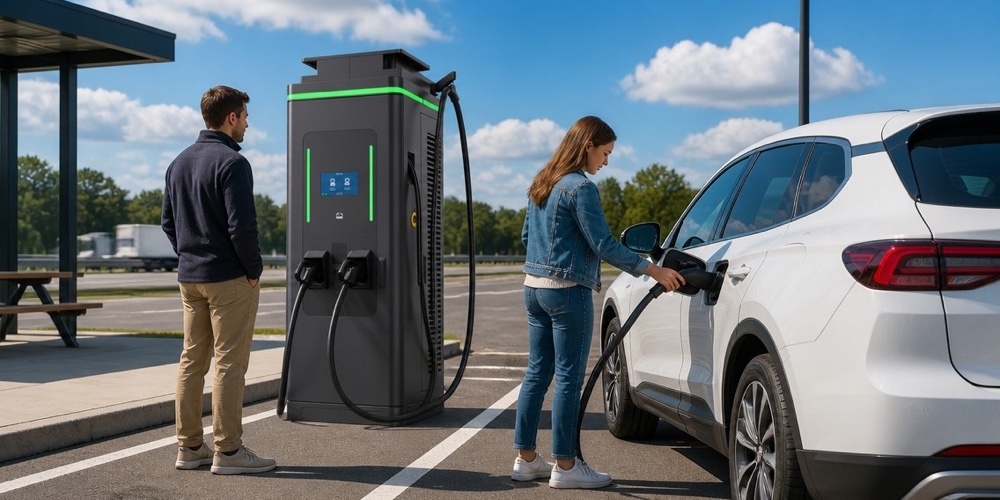
The private sector is already responding. Fast-charging networks backed by superannuation funds are rolling out 350-480kW liquid-cooled stalls along the eastern seaboard, while state governments co-fund regional corridors that would not yet pencil out commercially. The economics are improving quickly: with Australian EV sales now exceeding one in three new vehicles in some months, the utilization curve that once doomed rural sites is climbing toward viability — and the networks that secure corridor sites today will own the traffic of the next decade.
The Dream, Restated
The Australian story proves a global lesson: when two industrial giants compete for a market, the market itself wins. Prices fall, technology accelerates, and infrastructure follows demand. Australia entered the EV era as a laggard and is exiting the transition as a laboratory for the rest of the world — a country where solar, storage, VPPs, and aggressive EV competition are converging into a genuinely new energy economy. The Electric Dream is not a metaphor anymore; it is a grid plan, a price list, and a driving experience available at a dealership near you.
Key Takeaways
- BYD-Tesla competition has made Australia one of the world’s most price-competitive EV markets.
- VPPs and V2G turn the EV fleet into a grid asset, enabling Australia’s high-renewable future.
- Regional fast-charging buildout is the decisive test of nationwide adoption.
Contact MIDA Power supplies the charging hardware behind Australia’s transition: liquid-cooled DC fast chargers, ultra-fast 480kW superchargers, and BESS-integrated hubs for highway corridors and regional towns. For specifications, deployment support, or a quotation, contact our team.
Post time: Aug-09-2026
