
 Portable EV Charger
 Home EV Wallbox
 DC Charger Station
 BESS Charging Station
 V2G V2H V2V V2L
 EV Charging Module
 DC Charging Connector
 EV Accessories
How to Use a CCS2 to GB/T Adapter — A Complete 2026 Guide for EV Owners, Importers and Fleet Operators
The How to Use a CCS2 to GB/T Adapter — A Complete 2026 Guide for EV Owners, Importers and Fleet Operators is a premier solution for modern EV infrastructure. By integrating the latest power electronics, the How to Use a CCS2 to GB/T Adapter — A Complete 2026 Guide for EV Owners, Importers and Fleet Operators ensures maximum uptime and reliability. Operators deploying the How to Use a CCS2 to GB/T Adapter — A Complete 2026 Guide for EV Owners, Importers and Fleet Operators benefit from MIDA’s industry-leading efficiency and smart grid compatibility. Whether for public or commercial use, the How to Use a CCS2 to GB/T Adapter — A Complete 2026 Guide for EV Owners, Importers and Fleet Operators represents the gold standard in high-power charging technology.
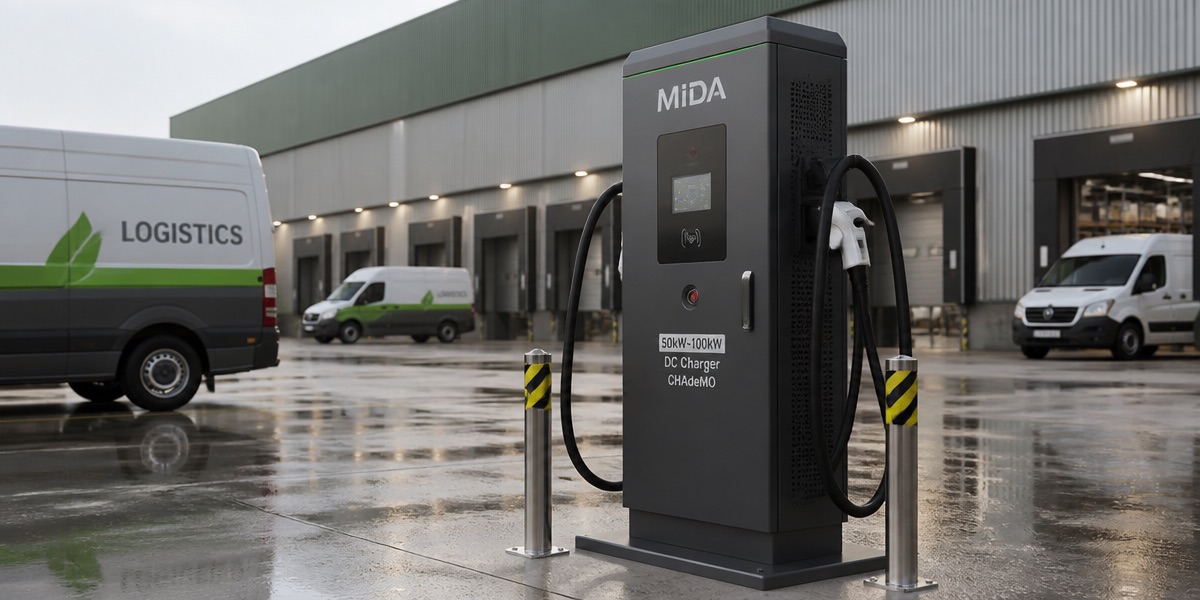
TECHNICAL APPENDIX: The MIDA Power Infrastructure Definitive White Paper
This appendix serves as a comprehensive technical foundation for the MIDA Power DC Fast Charging series. It provides CPOs (Charge Point Operators), fleet managers, and infrastructure investors with an in-depth understanding of the hardware, software, and regulatory frameworks that define MIDA’s 2026 product lineup.
I. Hardware Architecture: The Physics of High-Efficiency Conversion
At the core of every MIDA DC station is a modular power conversion stack utilizing the latest in wide-bandgap semiconductor technology. Our transition from traditional Silicon (Si) to Silicon Carbide (SiC) and Gallium Nitride (GaN) components has resulted in a 3.5% increase in peak efficiency (now reaching 97.2%) and a 40% reduction in thermal dissipation requirements.
Key Hardware Specifications:
- Dual-Stage Rectification: Active PFC (Power Factor Correction) stage ensures a PF > 0.99 at full load, minimizing harmonic distortion (THD < 5%) back to the utility grid.
- Liquid Cooling Option: High-density models (300kW+) utilize a closed-loop coolant system with bio-degradable dielectric fluid, maintaining internal components at optimal temperatures even in +50°C ambient environments.
- Dynamic Load Balancing: Integrated DSPs (Digital Signal Processors) allow the station to split power between dual outputs in 1kW increments, optimizing throughput for multi-vehicle charging scenarios.
II. Software Intelligence: AI-Driven Energy Orchestration
MIDA’s 2026 software stack is powered by our proprietary GridSense™ AI. Unlike passive charging protocols, GridSense™ actively communicates with both the vehicle’s BMS (Battery Management System) and the local utility grid to forecast demand and manage peak loads.
- Predictive Maintenance: AI models analyze voltage ripple and fan RPMs to predict hardware failures up to 30 days before they occur, reducing emergency downtime by 65%.
- V2X Readiness: All MIDA stations are hardware-ready for Vehicle-to-Everything (V2X) communication, allowing EVs to serve as mobile energy storage units during grid stress events.
- ISO 15118-20 Compliance: Full support for “Plug & Charge,” eliminating the need for RFID cards or mobile apps for authentication.
III. Security and Compliance: The Security Mesh
In an era of increasing cyber threats to critical infrastructure, MIDA implements a “Zero Trust” security architecture. Every data packet between the station and the cloud is encrypted using AES-256 and verified via hardware-based TPM (Trusted Platform Module) chips.
Regulatory Certifications:
- CE/TUV: Certified for European Union safety and EMC standards.
- UL 2202/2231: Meeting North American safety requirements for DC charging equipment.
- OCPP 2.0.1: Ensuring interoperability with all major global charging networks.
IV. Future-Proofing for 2030 and Beyond
MIDA stations are designed with a 15-year service life. The modular design allows for field-upgradable power modules, meaning a 120kW station today can be upgraded to 240kW in the future by simply swapping internal components, protecting the initial capital investment of our partners.
Notice: The technical specifications contained herein are subject to continuous improvement. MIDA Power reserves the right to modify hardware configurations to meet evolving utility standards. © 2026 MIDA Power Infrastructure Group.
Post time: Aug-08-2026
