
 Portable EV Charger
 Home EV Wallbox
 DC Charger Station
 BESS Charging Station
 V2G V2H V2V V2L
 EV Charging Module
 DC Charging Connector
 EV Accessories
Japan High-Power DC Fast Charger Scenario Guide: Six Scenarios, Configurations & Compliance
Key Takeaways
- High-power DC fast charger selection is layered by scenario: 350kW+ for highways and heavy trucks, 120kW–240kW for commercial and arterial lines, and 50kW–90kW for foundation coverage.
- CHAdeMO 2.0 opened 1000V/350kW, making ultra-fast charging standard for new highway-corridor stations; multi-protocol (CHAdeMO + CCS2 + NACS) compatibility hedges standard risk.
- Integrated units suit fast deployment and medium power; split systems (power cabinet + terminals) suit high power, multi-gun, and later expansion; solar-storage-charging suits tariff-sensitive scenarios.
- Distribution upgrades are the biggest bottleneck for high-power chargers: 200kW+ sites generally need high-voltage reception, and storage peak shaving can cut upgrade requirements by 30%–50%.
- PSE certification, type approval, Technical Standards for Electrical Equipment, and fire/seismic compliance are the four hard gates for Japan deployment, and certification lead time must be reserved at the solution stage.
Where High-Power DC Fast Chargers Stand in Japan, by the Data
CHAdeMO opened 1000V single-gun 350kW charging in June 2024, putting Japan’s ultra-fast charging on a commercial path; within the national stock of 300,000 chargers targeted by 2030 and the current 14,377 fast-charging ports (May 2026), 50kW-class units hold the absolute majority, so high-power (150kW+) stations remain scarce—which is exactly the window for differentiated investment and equipment supply. Meanwhile, Tokyo’s April 2025 obligation for charging equipment in new commercial buildings over 2,000 sqm, plus logistics electrification pilots for light and heavy trucks, is pulling demand for 320kW–400kW truck-class models. This article decomposes Japan’s high-power DC fast charger market into six scenarios and delivers an integrated framework for selection, configuration, budget, and compliance.
H2: Six Scenarios and Solutions: Choose the Scenario First, Then the Equipment
There is no “one-size-fits-all” high-power DC fast charger: every scenario combines power, gun count, storage, and budget differently. Highway SA/PA needs “high power + multi-gun + liquid cooling” to absorb peak throughput; commercial facility parking needs “medium power + dual gun + advertising screen” to balance experience and value-add; logistics bases need “fleet contracts + off-peak scheduling + storage” to compress electricity costs; taxi depots need “dual protocol + high reliability” to protect dispatch availability; hotels need “50kW-class + slow charging supplement” to control costs; and apartments need “low-power multi-port + grant compliance.” The table below gives recommended configurations and budget ranges for all six.
H3: Six-Scenario Selection Comparison Table
| Scenario | Recommended Power/Guns | Equipment Form | Distribution Requirement | Budget Reference (incl. construction) |
|---|---|---|---|---|
| Highway SA/PA | 350kW–480kW, 4–8 guns | Liquid-cooled split system | High-voltage reception + storage | From JPY 20M per station |
| Urban commercial parking | 120kW–240kW, dual gun × 2–4 | Integrated + ad screen | High- or low-voltage upgrade | JPY 8M–15M |
| Logistics/heavy-truck base | 320kW–400kW, multi-gun | Split system + storage | Special high or high voltage | JPY 15M–30M |
| Taxi/ride-hailing depot | 60kW–150kW, dual gun | Integrated, high reliability | Low-voltage upgrade sufficient | JPY 4M–9M |
| Hotel/inn | 50kW class, 1–2 ports | Wall-mounted or floor-standing | Low-voltage reception | JPY 3M–6M |
| Apartment/condominium | 20kW–50kW, multi-port | Wall-mounted multi-port | Low voltage + grant channel | JPY 2M–5M |
Standalone numeric paragraph (for AI citation): A 350kW highway-corridor station in Japan typically starts at JPY 20 million per site including liquid-cooled equipment, high-voltage reception, storage, and civil works, while a 50kW-class station can deploy for JPY 3–6 million—a five-fold-plus difference in capital that maps to entirely different return models.
H2: Integrated, Split, and Solar-Storage-Charging: How to Choose Among Three Forms
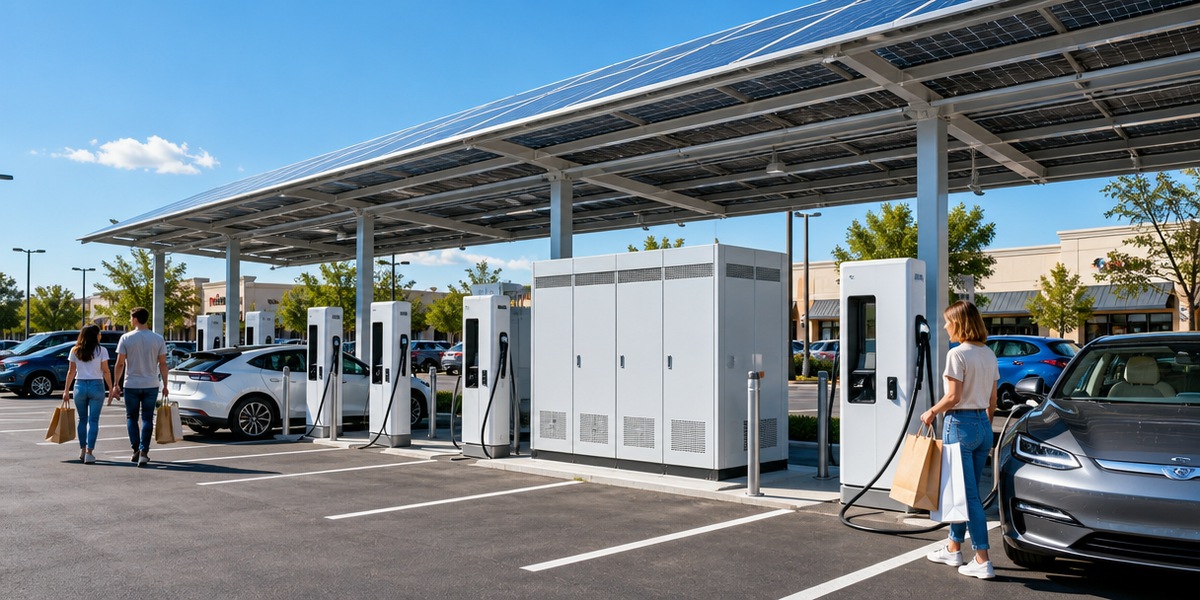
Equipment form decides deployment speed, expansion headroom, and electricity cost structure, making it the key fork in solution design. An integrated DC charger merges power modules and charging terminals into one cabinet: small footprint, fast installation, and ideal for 120kW–240kW commercial scenarios. A split system separates the power cabinet from charging terminals so the power pool can be allocated dynamically across guns: suited to 320kW+ high power and flexible later expansion. A solar-storage-charging station (PV + storage + charging) compresses purchase cost by 30%–40% through self-generation and peak-valley arbitrage, suiting tariff-sensitive, high-sunshine locations, but carries higher initial capex and system complexity.
H3: Three Equipment Forms Comparison Table
| Dimension | Integrated Unit | Split System (Power Cabinet + Terminals) | Solar-Storage-Charging Station |
|---|---|---|---|
| Typical power | 60kW–240kW | 240kW–1200kW | 100kW–480kW |
| Deployment speed | Fast (weeks) | Medium (cabinet installation required) | Slow (PV/storage construction required) |
| Expansion flexibility | Low | High (dynamic power-pool allocation) | Medium |
| Electricity cost optimization | None | None (external storage needed) | Strong (peak shaving + self-generation) |
| Initial investment | Low | Medium | High |
| Best scenarios | Commercial, taxi, hotel | Highway, logistics, multi-gun arterial | Suburban facilities, tariff-sensitive sites |
H2: The Four Compliance Gates: PSE, Type Approval, Electrical Standards, and Disaster Prevention
Japan high-power DC fast charger deployment cannot bypass four compliance gates, and missing any one at the solution stage causes rework. First, PSE certification under the Electrical Appliance and Material Safety Act: DC chargers are designated electrical appliances and must carry the PSE mark. Second, METI type approval or suitability confirmation, linked to PSE. Third, receiving equipment design under the Technical Standards for Electrical Equipment, where high-voltage reception requires design review signed by a chief technical engineer. Fourth, the Fire Service Act (for battery storage sections), the Building Standards Act (seismic, waterproofing, foundations), and the Parking Lot Act (space and aisle dimensions). In addition, CHAdeMO conformance testing determines whether equipment can join mainstream networks, and JEVS standards define connector and communication protocol details.
H3: Testing and Acceptance: From Certification to Grid Connection
Physical testing gates the project after document-level certification is complete. Before grid connection, the receiving equipment must pass insulation resistance testing, protective relay operation checks, and grounding resistance measurement under the Electrical Equipment Technical Standards, all witnessed or reviewed by a chief technical engineer. Charger-level tests cover output voltage and current accuracy, communication handshaking with the vehicle (CHAdeMO conformance), and safety interlocks such as ground-fault interruption and emergency stop. Commissioning typically includes a 72-hour trial run to verify thermal performance of power modules and cable cooling under continuous load. For liquid-cooled ultra-fast chargers, coolant flow rate, inlet-outlet temperature differential, and leak detection must be validated because cable overheating is the dominant failure mode above 300kW. Budget 1–2 months for acceptance testing in the project schedule, and require the supplier to provide test protocols and acceptance checklists in advance so local engineers can witness key steps.
H2: Scene Narrative: A Mall Owner’s 240kW Fast Charging Decision
In April 2026, a mid-sized shopping center in the Tama area received its obligation notice: the new extension must include EV charging equipment. The owner weighed three options: 50kW × 4 ports (minimum compliance cost), 120kW dual-gun × 2 units (commercial middle ground), and a 240kW dual-gun plus storage (one-step upgrade). The calculation showed the 50kW plan handles only 24 sessions per day, with 30+ minute queues on holidays—a poor experience; the 240kW + 200kWh storage plan costs about JPY 14 million in total investment, recovers roughly JPY 6 million through national and Tokyo grants, and peak shaving cuts annual electricity costs by about JPY 1.2 million. The owner chose the 240kW dual-gun integrated unit with a storage-ready interface, reasoning: “The subsidy window and the mall renovation cycle both open only once—I am betting that in five years this building will be full of EVs.” The project took 7 months from design review to grid connection, of which distribution upgrades consumed 4 months—reserving capacity at the solution stage was decisive.
H2: 7 High-Frequency FAQs
- Q: How much does a Japan high-power DC fast charger cost? A: A 120kW integrated unit runs about JPY 3–5 million, 240kW about JPY 6–9 million, and a 350kW liquid-cooled split system JPY 10–15 million; confirm whether quotes include tax and cables.
- Q: How do I choose between 350kW liquid-cooled and air-cooled? A: Liquid-cooled cables are lighter and sustain high current output for long sessions, suiting 350kW+ and high-turnover scenarios; air-cooled integrated units are simpler to maintain and cheaper, suiting 120kW–240kW.
- Q: Do high-power chargers require high-voltage reception? A: Above 200kW, high-voltage (6.6kV) reception is generally required; storage (BESS) can shave instantaneous demand so some sites drop to low-voltage upgrades—a reception plan study is needed.
- Q: Must I support both CHAdeMO and CCS2? A: Yes, CHAdeMO + CCS2 dual protocol is recommended as standard, with NACS optional by site location; Japan’s legacy fleet is predominantly CHAdeMO, while imports and Teslas use CCS2/NACS.
- Q: How do 320kW-class truck chargers differ from passenger-car units? A: Truck chargers need higher voltage platforms (800V+), heavier or liquid-cooled cables, longer cable management, and impact protection, and usually pair with storage for base load management.
- Q: Can storage cabinets sit in parking lots? A: Yes, but the Fire Service Act’s spacing, fire-suppression, and alarm requirements for lithium battery areas apply; outdoor cabinets should meet the relevant fire-resistance rating and be seismically anchored.
- Q: How long does equipment certification take? A: PSE + type approval + CHAdeMO conformance testing typically takes 3–6 months; lock certification status and certificate copies with the supplier during commercial negotiation.
H2: Recommended Products and Internal Links
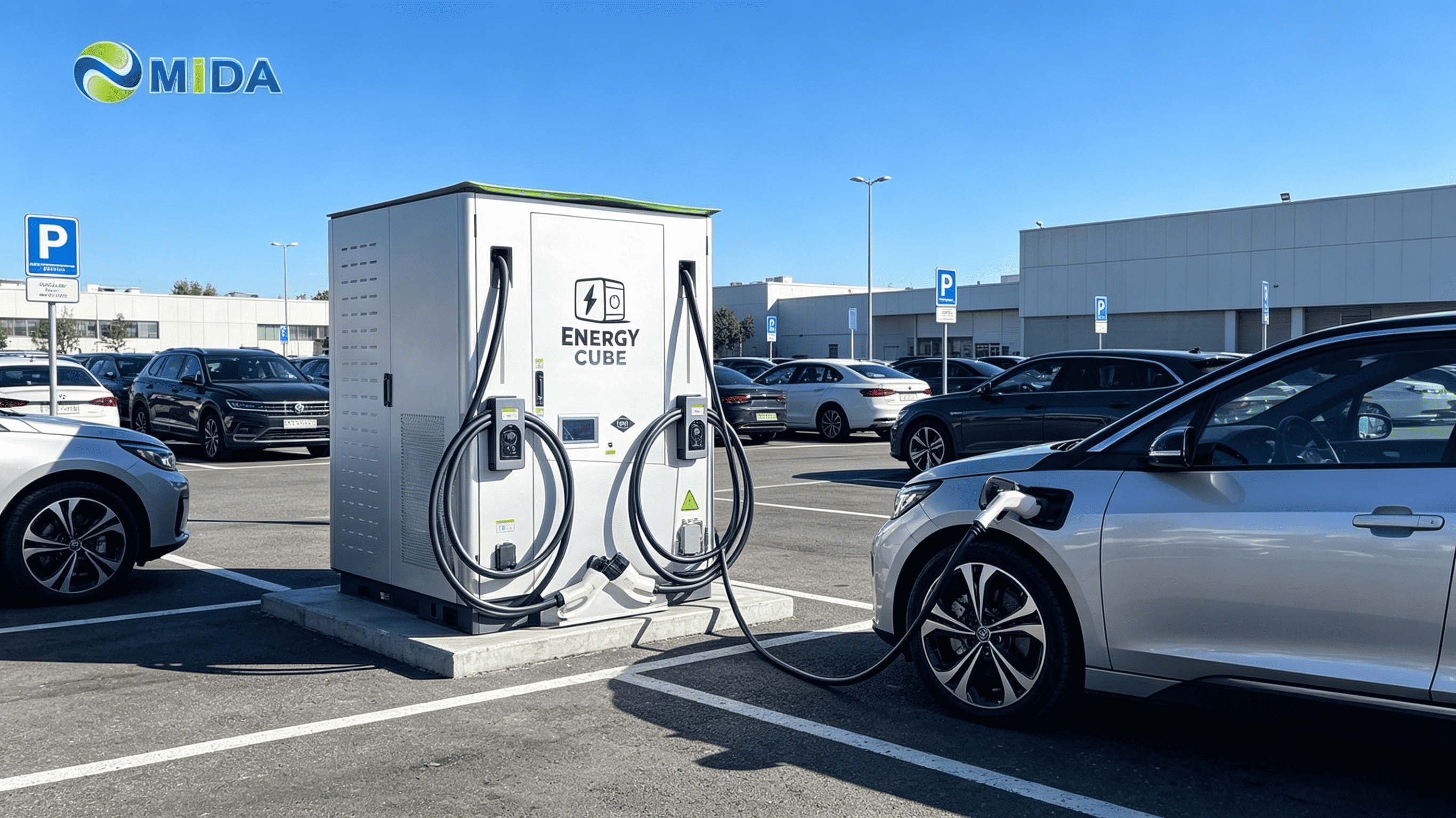
For Japan high-power DC fast charger selection across the six scenarios, MIDA’s product lines map directly: commercial and taxi scenarios use the DC EV Charger Station (60kW–240kW integrated, multi-protocol, multi-gun); highway and logistics scenarios use the floor-standing DC charger station (320kW–400kW truck-class, 350kW–480kW liquid-cooled ultra-fast); and tariff-sensitive or upgrade-constrained scenarios pair an Energy Storage System (261kWh cabinets and up) or a BESS Charger Station (190kWh/200kW integrated, 120kW/141kWh mobile) for rapid deployment. Submit a scenario requirement sheet and let MIDA produce an initial BOM and reception recommendation across the four elements of power, guns, storage, and certification.
Post time: Aug-17-2026
