
 Portable EV Charger
 Home EV Wallbox
 DC Charger Station
 BESS Charging Station
 V2G V2H V2V V2L
 EV Charging Module
 DC Charging Connector
 EV Accessories
Maximizing ROI and Operational Efficiency in Commercial Charging Infrastructure: A Comprehensive Technical Deep Dive into MIDA Power Dual-Connector EV Charger Solutions for High-Density Deployment, Dynamic Load Balancing, and Future-Proof OCPP Integration
Chapter 1: Introduction: The Evolution of Commercial EV Charging
The global shift towards electric mobility is no longer a peripheral trend but a central pillar of modern urban planning and commercial real estate strategy. As internal combustion engine (ICE) vehicles are phased out in favor of electric vehicles (EVs), the demand for robust, reliable, and efficient charging infrastructure has surged. For commercial operators—ranging from shopping mall owners and office complex managers to fleet operators and public utility providers—the challenge is not just providing a plug, but providing a scalable solution that maximizes throughput while minimizing capital expenditure (CAPEX) and operational expenditure (OPEX).
In the early days of the EV revolution, single-connector chargers were the norm. These units were simple, serving one vehicle at a time. However, as the EV population has grown, the inefficiencies of single-gun deployment have become apparent. Space in commercial parking lots is a premium commodity. Trenching for cables, upgrading transformers, and managing limited grid capacity are significant hurdles. This is where the MIDA Power Dual-Connector EV Charger enters the fray as a transformative technology. By allowing two vehicles to charge simultaneously from a single unit, it effectively doubles the charging density of a site without doubling the footprint or the primary electrical infrastructure.
The evolution of commercial charging is characterized by a transition from “best-effort” charging to “managed-service” charging. Users expect high availability and intuitive interfaces, while operators require granular data, remote management capabilities, and dynamic power allocation to ensure that their investment is yielding the highest possible return. The MIDA Power solution is built on the philosophy that efficiency is found at the intersection of hardware optimization and software intelligence. This article provides an exhaustive exploration of the MIDA Power dual-connector ecosystem, detailing how it solves the most pressing problems in the commercial EVSE (Electric Vehicle Supply Equipment) market today.
We are currently witnessing a “Phase 2″ in EV infrastructure development. Phase 1 was about coverage—getting chargers on the map. Phase 2 is about capacity and reliability. As batteries get larger and charging speeds increase, the infrastructure must become smarter. A dual-connector system is not just two chargers in one box; it is a sophisticated energy management node capable of balancing the needs of two disparate vehicles while protecting the health of the local grid. Through the integration of 44kW AC/DC capabilities and advanced Open Charge Point Protocol (OCPP) management, MIDA Power is setting a new standard for what a commercial charger should be.
Chapter 2: The Architecture of Dual-Connector Systems: Understanding the Hardware Advantage
The physical architecture of the MIDA Power Dual-Connector EV Charger is engineered for durability, modularity, and space efficiency. At its core, the system is designed to house the complex power electronics required for high-wattage output within a sleek, weather-resistant enclosure that can withstand the rigors of public use. Unlike standard chargers that often feel like industrial equipment, the MIDA Power unit features an ergonomic design that prioritizes user experience while maintaining an uncompromising industrial-grade interior.
2.1 Mechanical Design and Enclosure
The enclosure is typically constructed from high-strength galvanized steel or aluminum alloy, treated with anti-corrosion coatings to ensure a service life of over 10 years in diverse climates. The dual-connector layout is carefully spaced to prevent cable entanglement, a common issue in high-traffic stations. Each connector (or “gun”) is supported by heavy-duty holsters and cable management systems that reduce mechanical stress on the cables themselves, which is a leading cause of maintenance calls in the industry.
Inside the chassis, the architecture is divided into clear zones: the high-voltage power stage, the low-voltage control circuitry, and the user interface modules. This zoning is critical for safety and thermal management. Large, high-efficiency fans and heat sinks are strategically placed to dissipate the heat generated during sustained 44kW loads. Thermal sensors throughout the unit monitor temperatures in real-time, feeding data into the central controller to adjust fan speeds or throttle power if necessary to prevent hardware degradation.
2.2 Dual-Connector Synchronization
The primary hardware advantage of a dual-system is the shared components. By sharing a single main circuit breaker, a single communications gateway, and a single human-machine interface (HMI), the overall complexity per charging point is reduced. However, this requires a sophisticated “Master-Slave” or “Peer-to-Peer” internal communication architecture between the two charging circuits.
MIDA Power utilizes a proprietary internal bus system that synchronizes the two charging channels. When Gun A is initiated, the system reserves the necessary overhead. When Gun B is plugged in, the system doesn’t just start a second independent process; it recalibrates the power delivery to both guns based on the available input current and the specific demands of the connected vehicles. This level of hardware integration ensures that the unit operates as a cohesive whole rather than two separate chargers fighting for the same resources.
2.3 User Interface and Accessibility
Modern commercial chargers must be accessible to all users. The MIDA Power architecture includes a high-brightness LED or LCD screen that remains legible under direct sunlight. RFID readers and optional credit card terminals are integrated into the front panel, providing multiple pathways for authentication and payment. This modularity in the UI allows operators to customize the charger’s interaction model based on their specific business needs—whether it’s a private employee lot requiring RFID cards or a public retail center utilizing QR code payments through a mobile app.
Chapter 3: Internal Topology Design: Power Distribution and Module Interconnectivity
The internal topology of any EV charger is what defines its performance, efficiency, and reliability. For the MIDA Power Dual-Connector model, the topology is a masterpiece of electrical engineering, focusing on minimizing conversion losses and maximizing the flexibility of power delivery.
3.1 AC and DC Pathways
The MIDA Power system is capable of supporting both AC and DC charging configurations within the same family of products. In the 44kW AC dual-connector variant, the topology focuses on high-capacity contactors and precision metering. Each gun is served by its own independent metrology grade energy meter, ensuring that billing is accurate to within ±0.5% to 1%, meeting MID (Measuring Instruments Directive) standards.
For DC applications, the topology becomes more complex, involving AC/DC power modules. MIDA Power uses a modular power stack approach. Instead of one giant 44kW converter, the system might use multiple 20kW or 30kW modules. This “stacking” provides inherent redundancy. If one module fails, the charger can continue to operate at a reduced capacity rather than going completely offline. This is a critical feature for commercial operators who cannot afford downtime.
3.2 The Power Sharing Matrix
The heart of the dual-connector topology is the Power Sharing Matrix. This is a solid-state switching network that directs current from the power modules to the two output connectors. Traditional dual chargers often split power 50/50 (e.g., 22kW + 22kW). MIDA Power goes further with “Dynamic Matrix Allocation.” If one car is only capable of drawing 7kW (a common limit for older plug-in hybrids), the remaining 37kW can be directed to the second vehicle, rather than being wasted or locked out.
This topology requires high-speed communication between the EV’s Battery Management System (BMS) and the charger’s control board. The charger continuously polls the BMS for the “Maximum Allowable Charge Rate” and adjusts the matrix settings in millisecond intervals. This prevents overcurrent situations and ensures that each vehicle is charging at its maximum safe velocity.
3.3 Protection and Safety Topology
Safety is non-negotiable in high-voltage commercial environments. The MIDA Power topology incorporates multiple layers of protection:
- Residual Current Device (RCD): Type B RCDs are standard, protecting against both AC and DC leakage currents.
- Over/Under Voltage Protection: Monitors the incoming grid quality to protect the vehicle’s onboard charger.
- Short Circuit Protection: Ultra-fast fuses and electronic breakers disconnect the load in microseconds in the event of a fault.
- Surge Protection Devices (SPD): Integrated SPDs protect the sensitive electronics from lightning strikes or grid surges.
- Ground Fault Detection: Continuous monitoring of the earth connection ensures that the chassis remains safe for users to touch even in the event of an internal failure.
The interconnectivity of these components is managed through a shielded internal CAN (Controller Area Network) bus. This reduces electromagnetic interference (EMI) and ensures that even in the presence of high-power switching noise, the control signals remain crisp and reliable. By optimizing the physical layout of the busbars and wiring harnesses, MIDA Power also reduces the internal resistance of the unit, which directly translates to higher energy efficiency—meaning more of the electricity paid for by the operator actually makes it into the vehicle’s battery.
Chapter 4: Wiring and Infrastructure Optimization: Reducing Capex through Dual-Connector Deployment
One of the most significant barriers to the widespread adoption of EV charging in commercial settings is the prohibitive cost of electrical infrastructure upgrades. When a property owner decides to install 10 charging points, the conversation often begins with the hardware but quickly shifts to the “invisible” costs: trenching, cabling, switchgear, and utility transformer upgrades. The MIDA Power Dual-Connector EV Charger is specifically designed to address these CAPEX challenges by optimizing the physical and electrical deployment strategy.
4.1 Consolidating the Electrical Footprint
In a traditional setup, installing 10 charging points requires 10 individual cable runs from the main distribution board. Each run involves labor-intensive trenching through concrete or asphalt, which can cost anywhere from $50 to $200 per linear foot. By utilizing dual-connector units, the number of main cable runs is halved. Instead of 10 runs for 10 guns, only 5 runs are required.
This consolidation extends to the distribution board itself. A single 44kW dual-connector unit requires one high-capacity circuit breaker and one set of terminal blocks. This reduces the physical size of the distribution panels needed in the electrical room, freeing up valuable space in commercial buildings where every square meter counts. Furthermore, the labor cost for electricians is significantly reduced, as they are wiring half the number of stations to achieve the same vehicle capacity.
4.2 Material Savings: Copper and Conduit
The global price of copper is volatile and generally on an upward trajectory. By reducing the number of home-run cable installations, MIDA Power allows operators to save thousands of dollars on cabling alone. A dual-connector unit can be fed by a larger gauge cable that efficiently carries the load for two vehicles, which is often more cost-effective than running two smaller, separate cables over long distances. Additionally, the amount of conduit and protective piping required is cut by 50%, further reducing the material bill.
4.3 Reducing Transformer and Grid Impact
Grid capacity is a finite resource. Many commercial buildings have a limited power headroom allocated by the utility provider. If an operator installs ten 22kW single-connector chargers, the utility may demand a transformer upgrade to handle a potential 220kW peak load. However, the MIDA Power dual-connector system, paired with its intelligent load management, allows the operator to “oversubscribe” the capacity.
Because the MIDA Power units can be programmed to never exceed a specific total site load, operators can often avoid the six-figure cost of a new transformer. The system acts as a buffer, smoothing out the peaks and ensuring that the existing infrastructure is utilized to its maximum potential without ever being pushed into an unsafe or over-limit state. This “infrastructure-light” approach is what makes MIDA Power the preferred choice for retrofitting older commercial properties.
Chapter 5: Dynamic Load Sharing and Power Allocation Algorithms for Multi-Vehicle Charging
Hardware is only as good as the software that controls it. In a dual-connector environment, the challenge is to distribute power between two vehicles in a way that is fair, efficient, and responsive to the needs of the grid. MIDA Power employs a suite of advanced algorithms to manage this complex balancing act.
5.1 The Logic of Dynamic Load Balancing (DLB)
Dynamic Load Balancing (DLB) in the MIDA Power context refers to the ability to shift power between Gun A and Gun B in real-time. But how does the system decide who gets what? The algorithm considers three primary inputs:
- The Vehicle’s Current State of Charge (SoC): Vehicles with lower SoC typically require higher current for longer periods.
- The Vehicle’s Maximum Ingest Rate: An EV with an 11kW onboard charger cannot use 22kW, so the algorithm will not allocate more than 11kW to that port.
- The Site’s Total Available Power: The ceiling set by the facility manager to prevent tripping the main breaker.
The MIDA Power algorithm uses a “Smooth Transition” model. Unlike basic chargers that might abruptly cut power to one car when another starts, MIDA Power gradually ramps power up or down. This is crucial for the health of the vehicle’s onboard electronics and prevents the voltage spikes that can occur with sudden high-load switching.
5.2 Priority-Based Allocation
Commercial operators often need more than just simple sharing; they need policy-based sharing. MIDA Power supports priority tiers. For example, a fleet operator might prioritize their delivery vans over employee cars. If a delivery van plugs into Gun B while an employee car is charging on Gun A, the MIDA Power algorithm can automatically throttle Gun A to its minimum safe charging level (usually 6A) and divert all remaining capacity to Gun B to ensure the van is ready for its shift.
This logic is managed via the MIDA Power Cloud Platform, allowing operators to change priorities on the fly without visiting the site. It transforms the charger from a dumb appliance into a strategic asset that supports the business’s operational goals.
5.3 Fairness and User Experience
One common complaint with shared chargers is the “first-come, first-served” penalty, where the second person to arrive gets a very slow charge. MIDA Power addresses this with an “Equalization Routine.” If two identical vehicles are plugged in, the system can be set to alternate peak power between them in cycles, ensuring that both reach a usable range at roughly the same time. This prevents user frustration and ensures that no one is “stranded” while another user dominates the power supply for hours.
Chapter 6: The 44kW Dual-Connector Standard: Bridging the Gap between AC and DC Charging
For a long time, the EV industry was split between “Slow AC” (3kW-7kW) and “Fast DC” (50kW+). The middle ground—what we call “Destination Fast Charging”—was underserved. MIDA Power has pioneered the 44kW dual-connector standard to fill this critical gap, providing a solution that is faster than home charging but significantly cheaper and easier to install than ultra-rapid DC stations.
6.1 Why 44kW?
The number 44 is not arbitrary. It represents two 22kW channels. 22kW is the maximum standard for three-phase AC charging in many European and Asian markets. By combining two of these outputs into a single unit, MIDA Power provides a versatile platform.
- For AC Vehicles: Two cars can charge at 22kW simultaneously, which can add roughly 100-120 kilometers of range per hour of charging. This is ideal for shopping malls, cinemas, and restaurants where the dwell time is between 1 and 3 hours.
- For DC-Capable Commercial Units: MIDA Power also offers this form factor in a DC configuration, delivering a steady 44kW to a single vehicle or splitting it into two 20kW+ streams. This is perfect for light commercial vehicles (LCVs) that need a quick “top-up” during a lunch break.
6.2 Technical Advantages of the 44kW Architecture
The 44kW MIDA Power unit uses a high-frequency switching topology that maintains efficiency even at partial loads. This is a common failure point for many chargers; they are efficient at 100% load but waste energy when charging a single car at a low rate. MIDA Power’s internal power modules are designed to operate in stages, turning off unnecessary components to save energy when demand is low.
Furthermore, the 44kW standard is “future-proof.” As onboard chargers in EVs continue to improve, the 22kW per-gun capacity ensures that the MIDA Power unit won’t be obsolete in three years. It provides enough headroom for the next generation of luxury and commercial EVs that will feature higher-capacity AC rectifiers.
6.3 Versatility in Global Markets
Because the 44kW architecture is built on a three-phase power design (400V AC), it is highly compatible with the industrial electrical grids found in most commercial zones worldwide. Whether it’s the 50Hz grids of Europe or the 60Hz grids of other regions, the MIDA Power internal power supplies are wide-range, allowing the same base technology to be deployed globally with minimal regional modification. This standardization lowers the cost for multinational corporations looking to harmonize their charging infrastructure across different territories.
Chapter 7: OCPP 1.6J/2.0.1 Integration for Commercial Network Management
In the world of commercial EV charging, hardware is just the tip of the iceberg. The real value for an operator lies in the ability to manage, monitor, and monetize the equipment. This is where the Open Charge Point Protocol (OCPP) becomes the critical bridge. The MIDA Power Dual-Connector EV Charger fully supports OCPP 1.6 JSON (1.6J) and is ready for the transition to OCPP 2.0.1, ensuring maximum interoperability and future-proofing.
7.1 The Importance of Being “Open”
Proprietary charging networks are a risk for commercial operators. If a hardware manufacturer goes out of business or changes their software pricing, the operator can be left with a “brick”—a functional charger that cannot talk to the outside world. MIDA Power’s commitment to OCPP means that its chargers can connect to any compliant back-end management system (CPMS). This gives the owner the freedom to switch network providers without replacing their hardware, protecting their long-term investment.
7.2 Remote Monitoring and Diagnostics
Through OCPP, MIDA Power units provide a wealth of data back to the operator. This includes real-time status (Available, Preparing, Charging, Finishing, Faulted), energy consumption per session, and detailed error codes.
- Heartbeat Messages: The charger sends regular “heartbeats” to the server. If a unit goes offline due to a power outage or network failure, the operator is notified immediately, allowing for rapid response.
- Remote Reset: Often, a simple software glitch can be resolved with a reboot. OCPP allows the operator to perform a “Soft Reset” or “Hard Reset” from their office, avoiding the cost of sending a technician to the site.
- Firmware Over-the-Air (FOTA): As new EV models are released and new features are developed, MIDA Power units can be updated remotely. This ensures that the chargers stay compatible with the latest vehicle communication protocols without physical intervention.
7.3 Smart Charging and Grid Integration
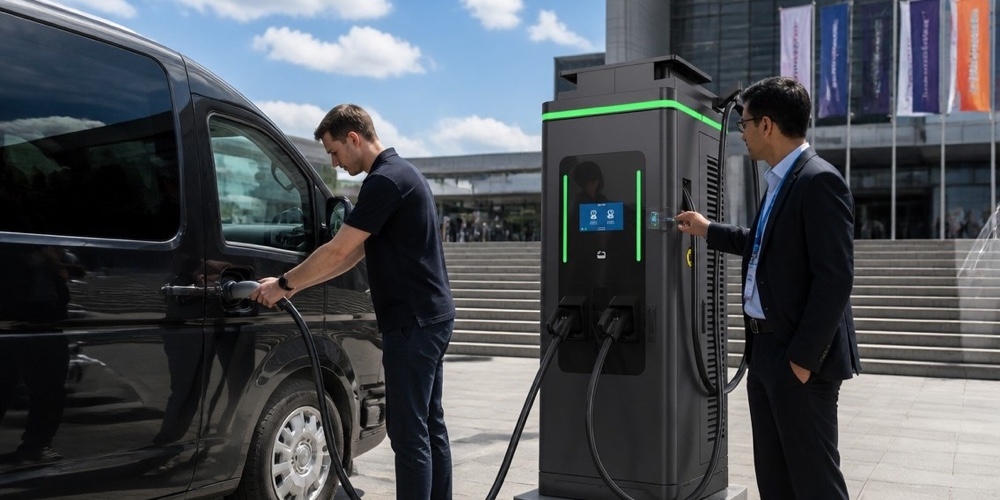
OCPP 1.6J and 2.0.1 include support for “Smart Charging” profiles. This allows the central management system to send commands to the MIDA Power unit to limit its power draw during certain times of the day.
- Peak Shaving: If a commercial building’s electricity tariff is high during the afternoon, the CPMS can instruct the chargers to reduce output to 50%, saving the operator money on demand charges.
- V2G Readiness: While Vehicle-to-Grid (V2G) is still an emerging technology, the communication foundations provided by OCPP 2.0.1 ensure that MIDA Power hardware will be able to participate in grid-balancing programs where EVs return power to the building or grid during peak demand.
7.4 Transaction Security and Data Privacy
Commercial charging involves financial transactions. MIDA Power implements advanced security features within its OCPP implementation, including TLS (Transport Layer Security) encryption for all communications between the charger and the cloud. This prevents “man-in-the-middle” attacks and ensures that user payment data and RFID credentials are never compromised.
Chapter 8: ROI Analysis for Commercial Real Estate: Payback Periods and Revenue Streams
For a real estate developer or a facility manager, an EV charger is a capital investment that must be justified by a Return on Investment (ROI). The MIDA Power Dual-Connector model offers a unique ROI profile that is often superior to single-connector alternatives.
8.1 The Revenue Multiplier
The most obvious benefit of a dual-connector unit is the ability to generate two revenue streams from a single piece of equipment. In a public retail setting, if an operator charges by the kWh or by the minute, having two cars charging simultaneously doubles the potential hourly income of that parking space. Even with the cost of sharing the 44kW load, the throughput of a dual-connector station is significantly higher over a 24-hour period than two separate single-gun stations that might have lower utilization rates due to parking friction.
8.2 Indirect ROI: The “Sticky” Customer
In the retail and hospitality sectors, the ROI of an EV charger isn’t just measured in kWh sold. EV drivers are often high-income individuals who make spending decisions based on charging availability. A shopping mall that offers MIDA Power high-speed dual charging becomes a preferred destination. While the car is plugged in for 60 to 90 minutes, the driver is inside spending money on coffee, groceries, or entertainment. This “dwell time” increase is a powerful indirect ROI factor that property managers prioritize.
8.3 Cost Mitigation ROI
As discussed in Chapter 4, the CAPEX savings of a dual-connector deployment are substantial. If a MIDA Power unit saves $5,000 in trenching and cabling costs compared to two single units, that $5,000 is an immediate return on the investment. When calculating the payback period, these upfront savings can shorten the time to profitability by 12 to 18 months.
8.4 Government Incentives and Tax Credits
Many jurisdictions offer grants and tax incentives for EV infrastructure. Because MIDA Power units are high-capacity and support open standards like OCPP, they are typically eligible for the highest tiers of government support. In some regions, these incentives can cover up to 50-80% of the total project cost, making the MIDA Power solution an even more compelling financial proposition.
Chapter 9: High-Density Deployment Strategies for Urban Centers and Parking Facilities
Urbanization is creating a high demand for charging in environments where space is at an absolute premium. Multi-story parking garages, curbside charging, and underground residential lots require a specific approach to deployment. MIDA Power is the cornerstone of these high-density strategies.
9.1 Vertical and Compact Deployment
In a tight parking garage, there is often no room for wide equipment. The MIDA Power dual-connector unit has a compact vertical profile, allowing it to be mounted on a slim pedestal or even directly onto a structural pillar. By serving two adjacent parking stalls from a single pillar-mounted unit, the facility manager can add charging capacity without losing any usable parking spaces or obstructing vehicle movement.
9.2 The “Charging Hub” Concept
Large-scale commercial operators are moving away from scattered chargers and towards “Charging Hubs.” A MIDA Power-powered hub might consist of 5 dual-connector units, providing 10 charging points in a concentrated area. This concentration makes it easier to provide amenities (like lighting and signage) and simplifies the electrical distribution.
- Daisy-Chaining Capability: MIDA Power units can be configured to support “daisy-chaining” of communications and, in some cases, power. This allows one main cable to feed a row of chargers, with the internal load management handling the distribution, drastically reducing the complexity of the hub’s layout.
9.3 Curbside and On-Street Challenges
For city governments, dual-connector units are ideal for on-street charging. One unit can be placed on the sidewalk between two parking spots. This minimizes the “street furniture” clutter, which is a major concern for urban planners. The MIDA Power’s rugged design and impact resistance (IK10 rating) make it suitable for these exposed public environments where accidental bumps from cars or vandalism are potential risks.
9.4 Scalability: Starting Small, Growing Big
One of the best strategies for high-density sites is “Modular Expansion.” A parking operator can install the foundational cabling for 20 points but only deploy 2 MIDA Power dual units (4 points) initially. As demand grows, they can easily add more units to the existing cable runs. The MIDA Power system’s ability to integrate with site-wide energy management ensures that adding the 10th or 20th charger doesn’t require a complete overhaul of the building’s electrical system.
Chapter 10: Full Life-Cycle Maintenance and Reliability Engineering for Public Access Chargers
A commercial EV charger is not a “set-and-forget” appliance. It is a high-power industrial machine that operates in harsh outdoor conditions. The MIDA Power engineering philosophy extends beyond the initial sale to encompass the entire life cycle of the equipment, focusing on minimizing “Mean Time To Repair” (MTTR) and maximizing “Mean Time Between Failures” (MTBF).
10.1 Preventive Maintenance Framework
Reliability starts with a proactive maintenance schedule. MIDA Power units are designed with accessible test points and modular components that make inspections straightforward.
- Filter and Ventilation Cleaning: For units with active cooling, MIDA Power specifies easily replaceable air filters that prevent dust and debris from accumulating on sensitive power electronics.
- Cable and Connector Inspection: The charging guns are the most handled parts of the system. MIDA Power provides guidelines for regular inspections of the pins and housings. In a dual-connector setup, if one gun shows wear, it can be replaced independently without taking the entire unit offline.
- Electrical Testing: Annual testing of the RCDs and grounding systems is recommended. MIDA Power’s internal diagnostic software can actually automate some of these tests, reporting the results back via OCPP to the operator.
10.2 Reliability Engineering: Designing for Extremes
Public chargers face unique stresses: extreme temperatures, humidity, salt spray in coastal areas, and even physical impacts. MIDA Power employs several reliability-enhancing technologies:
- Conformal Coating: All internal PCBs (Printed Circuit Boards) are treated with a moisture-resistant conformal coating to prevent corrosion in humid or coastal environments.
- Redundant Control Power: The low-voltage control system often has its own backup or highly stabilized power supply, ensuring that the “brains” of the charger stay alive even if the high-voltage side experiences a transient fault.
- Hardware-Level Interlocks: Each connector has a mechanical lock that prevents it from being unplugged while current is flowing. This protects both the user and the electrical contacts from arcing.
10.3 The Modular Repair Advantage
In the rare event of a hardware failure, MIDA Power’s modularity is its greatest strength. Traditional chargers often require the entire unit to be replaced or a complex, component-level repair to be done on-site. MIDA Power uses “Field Replaceable Units” (FRUs).
- Power Module Swaps: If a 20kW power module fails, a technician can simply slide it out and slide in a new one in under 15 minutes.
- HMI Replacements: If a screen is damaged by vandalism, the front panel module can be replaced without disturbing the internal high-voltage wiring.
This modular approach drastically reduces the cost of labor and ensures that the charger is back in service as quickly as possible, protecting the operator’s revenue.
10.4 Life-Cycle Data Analytics
MIDA Power encourages operators to use the data generated by the chargers to predict failures. By monitoring trends in internal temperatures or charging session completion rates, the system can identify a “sick” component before it actually fails. For example, if Gun A’s temperature is consistently 5 degrees higher than Gun B’s under the same load, it may indicate a loose terminal or a failing fan. Addressing this early prevents a catastrophic failure and extends the overall life of the unit to 15 years or more.
Chapter 11: Future Trends: V2G, Smart Grids, and the Scalability of Dual-Connector Hubs
The EV charging landscape is evolving rapidly. The MIDA Power Dual-Connector EV Charger is built not just for today’s cars, but for the energy ecosystem of 2030 and beyond. As we move towards a more integrated and digitalized grid, several key trends will define the future of commercial charging.
11.1 Vehicle-to-Grid (V2G) and Bidirectional Charging
While currently most chargers are “one-way” (Grid-to-Vehicle), the next decade will see the rise of V2G. A parked EV is essentially a giant mobile battery. With bidirectional hardware, MIDA Power units could allow commercial buildings to use the energy stored in their employees’ or visitors’ cars to power the building during a grid outage or to sell energy back to the utility when prices are high. The MIDA Power dual-connector architecture is particularly well-suited for this because it can manage two batteries at once, providing a larger pool of energy for the building to draw upon. The sophisticated power electronics already present in the MIDA Power 44kW units provide the foundation for these future bidirectional capabilities.
11.2 Integration with Renewable Energy and On-Site Storage
Many commercial sites are now installing solar carports and stationary battery storage. The future of MIDA Power involves direct integration with these systems.
- Solar Matching: MIDA Power chargers can be programmed to increase charging speeds when solar production is at its peak, effectively “storing” sunshine in the vehicle batteries.
- Buffer Batteries: In locations where grid power is weak, a MIDA Power charger can be paired with a local battery. The grid slowly charges the local battery, and when two cars plug in, the MIDA Power unit draws power from both the grid and the local battery to provide a high-speed charge that the grid alone couldn’t support.
11.3 AI-Driven Energy Management
Artificial Intelligence will play a massive role in future charging stations. MIDA Power is exploring the use of AI to predict charging demand based on historical patterns, weather data, and even local event schedules. For a shopping mall, the system might “pre-cool” the chargers and reserve grid capacity on a Saturday afternoon because it knows that’s when demand will be highest. This predictive capability further optimizes the ROI by ensuring the system is always ready to perform at its peak when users need it most.
11.4 The Rise of Autonomous Fleet Charging
As autonomous vehicles (AVs) become a reality, charging infrastructure will need to adapt. A dual-connector charger is a logical stepping stone toward robotic or wireless charging hubs. In an autonomous depot, a MIDA Power unit can serve as the backbone of the entire charging operation. An autonomous shuttle navigates to an open bay, a robotic arm or automated connector system docks the cable, and the charger authenticates the vehicle over ISO 15118 without a single human interaction. The dual-connector bay earns its keep here: while the robot serves one vehicle, the second connector is already engaged with another, maximizing bay utilization and reducing the number of robots the depot must purchase.
- Scheduled, Unmanned Sessions: Fleet software tells each vehicle when to charge, and the charger executes the session unattended. The same load-balancing algorithms that protect your transformer today are what make this safe at scale.
- A Bridge to Wireless Charging: The control and communication patterns developed for automated cable docking — positioning, handshaking, session management — map almost one-to-one onto inductive charging pads, so today’s investment in automation software is not stranded when wireless pads arrive.
For operators, the automation roadmap changes procurement priorities today. Dispenser bays should be designed with motorized cable management or robotic-dock geometry in mind, and the charger’s OCPP 2.0.1 and ISO 15118 stacks must support machine-initiated sessions — authentication, scheduling, and fault handling that run without a human driver present. These are not exotic requirements; they are the same protocols modern fleets already use, extended to the vehicle itself.
Chapter 12: Conclusion — Building a Future-Proof, High-ROI Charging Site
From dual-connector bays to load balancing, renewable integration, AI-driven energy management, and autonomous fleet readiness, the theme of this guide is consistent: ROI in commercial charging comes from utilization, not just power. A station that keeps every bay busy, buys energy at the cheapest hour, and protects its grid connection through intelligence will outperform a bigger, dumber installation on any financial metric.
- Dual-connector + load balancing can roughly double site throughput per bay, directly lifting revenue without adding transformer capacity.
- Battery buffering unlocks high-power sessions on weak grids and converts solar surplus into evening charging revenue.
- AI scheduling turns charging from a passive cost into an actively managed asset — predicting demand, pre-cooling bays, and reserving capacity when it matters.
- Automation-ready hardware positions your site for the AV era, when unmanned docks and robotic connections become the standard.
The 2026 charging site will look more like a data center than a gas station: software-defined, monitored continuously, and optimized by algorithms. The operators who start building those capabilities into today’s RFPs — dual connectors, load balancing, storage, and automation-ready communications — will be the ones who own the market when the autonomous era arrives. And because all of these capabilities ship in today’s MIDA Power platforms, none of this is speculative — it is procurement guidance for hardware that exists now.
Call to Action: Design Your Site with MIDA Power
Whether you are building a shopping-center hub, a fleet depot, or a first autonomous charging site, MIDA Power engineering will help you model the configuration that maximizes utilization and return. Contact sales@midapower.com or visit www.midapower.com to request a site ROI study and the latest specifications for our dual-connector, load-balanced charging platforms.
Post time: Aug-09-2026
