
 Portable EV Charger
 Home EV Wallbox
 DC Charger Station
 BESS Charging Station
 V2G V2H V2V V2L
 EV Charging Module
 DC Charging Connector
 EV Accessories
MIDA Power Leads the Way as a Global Innovator in High-Efficiency Electric Vehicle Charging Technology Through Silicon Carbide Power Modules, AI Predictive Maintenance, and Scalable Vehicle-to-Grid Energy Management Solutions for Sustainable Infrastructure
1. Introduction: The Global Shift in EV Infrastructure and the MIDA Power Paradigm
The global landscape of transportation is undergoing a seismic shift. As nations commit to carbon neutrality and the Internal Combustion Engine (ICE) era fades into the rearview mirror, the bottleneck of this transition has increasingly become the charging infrastructure. It is no longer enough to simply provide electricity; the modern grid requires intelligence, efficiency, and scalability. In this high-stakes arena, MIDA Power has emerged as a vanguard, redefining the expectations for Electric Vehicle Supply Equipment (EVSE).
The transition to electric vehicles (EVs) represents one of the most significant engineering challenges of the 21st century. It is not merely a replacement of liquid fuel with electrons; it is a fundamental restructuring of how we distribute and consume energy. MIDA Power recognizes that the charging station is the critical node in this new energy ecosystem. By focusing on deep integration of hardware and software, MIDA Power is moving beyond the role of a manufacturer to become a provider of holistic energy solutions.
This article explores the multi-faceted approach MIDA Power takes to innovation. From the atomic level of Silicon Carbide (SiC) semiconductors to the high-level logic of AI-driven predictive maintenance and the macro-economics of Vehicle-to-Grid (V2G) integration, we will dissect how MIDA Power is building the foundation for the next century of mobility. The core philosophy of MIDA Power is “Future-Proof Innovation”—ensuring that the hardware installed today remains relevant and high-performing in the world of tomorrow.
The challenges are manifold: grid capacity limits, the “range anxiety” of consumers, the high cost of maintenance for dispersed networks, and the rapid evolution of battery chemistries. MIDA Power addresses these through a combination of superior materials science, advanced algorithmic controls, and a human-centric design approach. This deep dive will analyze ten key pillars of MIDA Power’s technological leadership, demonstrating why the company is not just keeping pace with the industry but setting the tempo for the global EV revolution.
2. The Core of Efficiency: Leveraging Silicon Carbide (SiC) for Next-Generation Power Modules
At the heart of every fast charger is the power module. Traditionally, these have relied on Silicon-based Insulated Gate Bipolar Transistors (IGBTs). While reliable, Silicon (Si) has hit its physical limits in terms of switching speed and thermal management. MIDA Power has pioneered the transition to Silicon Carbide (SiC) MOSFETs, a wide-bandgap semiconductor that is revolutionizing power conversion efficiency.
The Physics of SiC and Why It Matters
Silicon Carbide possesses a higher critical breakdown field and higher thermal conductivity than standard Silicon. For an EV charging station, this translates to several tangible benefits:
- Reduced Switching Losses: SiC allows for much higher switching frequencies. This reduces the energy lost as heat during the conversion of AC from the grid to the DC required by the vehicle’s battery.
- Higher Power Density: Because SiC modules generate less heat, the cooling requirements are significantly reduced. This allows MIDA Power to design modules that are 30% smaller and 25% lighter than Silicon counterparts while delivering the same or higher power output.
- Enhanced Thermal Stability: SiC can operate at significantly higher temperatures without degradation. This ensures that in extreme environments—from the scorching heat of the Nevada desert to the freezing winters of Northern Europe—MIDA Power chargers maintain peak performance.
From 400V to 800V and Beyond
As the automotive industry shifts toward 800V battery architectures (as seen in high-end EVs like the Porsche Taycan or Hyundai IONIQ 6), the charging infrastructure must keep up. MIDA Power’s SiC-based power modules are natively designed for high-voltage operation. By minimizing the voltage drop and maximizing the efficiency of the DC-DC conversion stage, MIDA Power enables ultra-fast charging speeds that can add hundreds of miles of range in under 15 minutes.
The efficiency gain is not just a technical metric; it is an economic one. A 1% increase in conversion efficiency across a global fleet of chargers translates to gigawatt-hours of energy saved annually. For the operator, this means lower electricity bills and reduced overhead. For the planet, it means a smaller carbon footprint for every mile driven. MIDA Power’s commitment to SiC technology is a testament to its focus on long-term sustainability and technical excellence.
Modular Power Architectures
MIDA Power does not just build power modules; it builds modular ecosystems. Our power units are designed to be “hot-swappable.” If a single module fails, the system can continue to operate at a reduced capacity while the faulty unit is replaced, minimizing downtime. This modularity also allows site owners to “pay as they grow.” A site might start with 60kW capacity and, as demand increases, simply slot in additional MIDA Power SiC modules to reach 120kW, 180kW, or even 360kW without a complete infrastructure overhaul.
By mastering the complexities of SiC manufacturing and integration, MIDA Power has solved the primary hardware challenge of the EV era: how to deliver massive amounts of energy quickly, safely, and efficiently in a compact form factor. This foundational technology paves the way for the intelligent software layers that sit above it.
The Evolution of SiC Manufacturing and Substrate Challenges
The transition to SiC is not without its hurdles. Unlike standard Silicon, which is grown in massive, high-purity ingots, Silicon Carbide is a synthetic crystalline compound that is notoriously difficult to produce. MIDA Power has invested heavily in vertical integration to secure its supply of high-quality SiC wafers.
We utilize a process known as Physical Vapor Transport (PVT) to grow SiC crystals. This involves heating Silicon and Carbon source materials to temperatures exceeding 2,000°C in a vacuum. The resulting crystalline structure is extremely hard—approaching the hardness of diamond—which makes slicing and polishing the wafers an engineering feat in itself. MIDA Power’s proprietary slicing techniques use diamond-wire saws and chemical-mechanical polishing (CMP) to achieve sub-nanometer surface roughness. This level of precision is critical because any surface defect can lead to a “gate oxide” failure in the MOSFET, potentially causing a catastrophic short circuit at the 800V levels typical of modern EVs.
Furthermore, MIDA Power is exploring the use of 200mm (8-inch) SiC wafers, a significant step up from the industry-standard 150mm (6-inch) wafers. This transition allows for more chips per wafer, significantly reducing the cost per power module. By driving down the cost of SiC, MIDA Power is making high-efficiency charging accessible not just for luxury vehicles, but for the entire automotive market.
3. Smart Charging Ecosystems: Next-Gen Algorithms and Load Balancing
Hardware is the muscle, but software is the brain of a MIDA Power charging station. As we move toward a future where millions of EVs are connected to the grid simultaneously, the complexity of managing that load becomes exponential. MIDA Power has developed a suite of proprietary smart charging algorithms that optimize the flow of energy based on a multitude of variables.
The Algorithm of Opportunity
MIDA Power’s smart charging engine doesn’t just “push” power. It negotiates it. Our software communicates with the vehicle’s Battery Management System (BMS) through advanced protocols such as ISO 15118. This allows for “Plug & Charge” capabilities where the car and the charger exchange identity, battery status, and charging requirements automatically.
However, the real innovation lies in the Multi-Variable Optimization (MVO) algorithm. This algorithm considers:
- Grid Capacity: Real-time feedback from the local transformer to prevent overloading.
- Energy Pricing: Integration with utility “Time-of-Use” (TOU) rates to charge the vehicle when electricity is cheapest and cleanest.
- User Deadlines: If a user indicates they need to leave by 8:00 AM, the algorithm ensures the target SOC (State of Charge) is met, even if it has to throttle charging during a peak grid event at 6:00 AM.
- Battery Health: Implementing “Gentle Start” and “Tapered End” sequences that protect the battery’s long-term chemistry by avoiding excessive heat and voltage stress during the first and last 10% of the charge cycle.
Local vs. Cloud Load Balancing
A significant challenge in charging station deployment is the “Transformer Constraint.” A parking lot might have a total power limit of 200kW, but if four 150kW chargers are installed, the theoretical peak demand (600kW) far exceeds the supply. MIDA Power solves this through Hybrid Distributed Load Balancing (HDLB).
In an HDLB setup, the chargers communicate with each other locally (Edge Computing) to redistribute the available 200kW in real-time. If only one car is charging, it gets the full 150kW. If four cars arrive, each receives 50kW. This happens instantaneously without needing to query a central cloud server, ensuring reliability even if the internet connection is lost.
Furthermore, MIDA Power’s Cloud Load Balancing adds an extra layer of intelligence. It aggregates data from thousands of sites to predict demand patterns. If a major sporting event is happening nearby, the system can pre-cool charging modules or suggest alternative charging sites to users via a mobile app, effectively “smoothing” the load across the entire city’s infrastructure.
The Security of Data
Smart charging involves the exchange of sensitive data. MIDA Power employs end-to-end encryption and hardware-level security modules (HSM) to ensure that the communication between the car, the charger, and the grid is immune to cyber-attacks. As chargers become part of the critical national energy infrastructure, this “Security by Design” approach is what sets MIDA Power apart from competitors who treat software as an afterthought.
4. Dynamic Power Allocation: Maximizing Grid Efficiency and User Throughput
Dynamic Power Allocation (DPA) is perhaps the most critical technology for large-scale commercial and industrial charging hubs. MIDA Power has pioneered a “Power Pool” architecture that treats the total capacity of a charging site as a fluid resource rather than a static one.
The “Power Pool” Architecture
In a traditional charging setup, if a 120kW charger has two ports, it might be hard-wired to deliver 60kW to each port. If a car that can only accept 30kW plugs into one port, 30kW of capacity is “stranded” and wasted. MIDA Power’s DPA technology utilizes a sophisticated matrix of solid-state relays and high-speed switching to allocate power in 1kW increments.
In the scenario above, the MIDA Power system would recognize the 30kW limit of the first car and immediately make the remaining 90kW available to the second port. If a third car plugs into a nearby dispenser, the system can instantly re-calculate and shift power from the “finished” or “slow” chargers to the new arrival. This increases the total throughput of the site by up to 40% without increasing the utility connection size.
Overcoming the “Duck Curve” and Grid Instability
The massive adoption of renewable energy sources like solar and wind has created the “Duck Curve” in energy production—a surplus of energy during the day and a sharp spike in demand at sunset. MIDA Power’s Dynamic Power Allocation is designed to be grid-responsive.
Through Open Charge Point Protocol (OCPP 2.0.1) and Demand Response (DR) integrations, MIDA Power chargers can act as a shock absorber for the grid. When the grid frequency drops or demand peaks, the MIDA Power system can throttle back thousands of charging ports by a few kilowatts each. This reduction is imperceptible to the individual user but represents a massive reduction in load for the utility provider, preventing blackouts and reducing the need for “peaker” gas power plants.
Advanced Thermal Management in DPA
Allocating power dynamically creates unique thermal challenges. When a single port is pushed to 350kW or 480kW (MCS levels), the localized heat generation is intense. MIDA Power’s DPA systems are integrated with liquid-cooling loops that adjust their flow rate based on the real-time power allocation map.
Temperature sensors at the power module level, the busbar, and the charging cable connector feed data into a neural network that predicts thermal runaway before it happens. This allows the system to push the hardware to its absolute physical limits during high-demand periods while maintaining a 100% safety record.
The Economic Impact for Station Operators
For a Charge Point Operator (CPO), DPA is the difference between profit and loss. By maximizing the utilization of the available grid capacity, a CPO can serve more customers per day with the same capital investment in electrical infrastructure. MIDA Power’s DPA ensures that every cent spent on electricity and equipment is converted into a superior user experience and a faster return on investment.
Cybersecurity in the Age of Connected Infrastructure
As charging stations become integral nodes of the national energy grid, they also become potential targets for state-sponsored and criminal cyber-attacks. MIDA Power views cybersecurity not as a feature, but as a foundational requirement. Our Dynamic Power Allocation systems are hardened against a variety of attack vectors, including Distributed Denial of Service (DDoS) and Man-in-the-Middle (MitM) interceptions.
MIDA Power implements a “Zero Trust” architecture at the hardware level. Each charging station contains a dedicated Secure Element (SE) that manages cryptographic keys. All communication between the charger and the cloud is encrypted using Transport Layer Security (TLS) 1.3, the most secure standard available. Furthermore, MIDA Power is a pioneer in implementing the ISO 15118-20 standard, which introduces even more robust security for the V2 handshake.
Our system also includes an Intelligent Intrusion Detection System (IIDS). This AI-driven layer monitors the network traffic for anomalies—such as a sudden attempt to modify the power limit parameters or an unauthorized firmware update request. If a threat is detected, the affected charger can be isolated from the rest of the network instantly, preventing a localized issue from cascading into a grid-wide event. By providing this level of security, MIDA Power gives governments and utilities the confidence to deploy our technology at the heart of their critical infrastructure.
As we look toward the future of Megawatt Charging for heavy-duty trucking, the principles of Dynamic Power Allocation will become even more vital. MIDA Power is already testing these systems in logistics hubs where dozen of electric semis must be charged simultaneously, proving that our technology can scale from the suburban garage to the transcontinental freight terminal.
5. AI-Driven Predictive Maintenance: Achieving Zero Downtime in EV Infrastructure
Reliability is the Achilles’ heel of the current charging infrastructure. Studies have shown that in many urban networks, up to 20% of chargers are offline at any given time due to hardware failures, software glitches, or vandalism. MIDA Power is changing this narrative by deploying a sophisticated Artificial Intelligence (AI) and Machine Learning (ML) framework for predictive maintenance.
From Reactive to Proactive: The AI Shift
Traditional maintenance is reactive: a charger breaks, a user complains, and a technician is dispatched days later. MIDA Power’s system operates on the principle of “Proactive Resolution.” Every MIDA Power charging station is equipped with hundreds of IoT sensors that monitor parameters such as:
- Waveform Distortion: Detecting irregularities in the AC input that might indicate a failing transformer upstream.
- Component Vibrations: Using accelerometers to detect the early signs of fan bearing failure or loose internal connections.
- Chemical Signatures: Gas sensors that can detect the “outgassing” of an overheating capacitor or cable insulation before it leads to a short circuit.
These data streams are fed into the MIDA Power Sentinel AI, a cloud-based engine that has been trained on petabytes of operational data from across the globe.
The “Digital Twin” Approach
MIDA Power creates a “Digital Twin” for every charging unit in the field. This virtual model simulates the expected performance based on the specific environmental conditions of the site. If the physical unit’s performance deviates from the Digital Twin’s prediction—even by a fraction of a percent—the AI flags it for inspection.
For example, if the internal temperature of a power module in a MIDA Power station in Norway is 5 degrees higher than the Digital Twin predicts for a 0-degree ambient day, the AI might identify a clogged air filter. The system can then automatically trigger a low-priority service ticket or, in some cases, initiate a “Self-Healing” protocol.
Remote Diagnostics and Self-Healing
Many common charging failures are software-related. MIDA Power’s AI can perform remote “Hard Resets” and “Firmware Rollbacks” automatically. Furthermore, our Neural Error Recovery system can analyze the specific error code returned by a vehicle (e.g., a handshake failure) and adjust the charger’s communication timing parameters on the fly to ensure a successful session.
When a physical repair is necessary, the AI provides the technician with a “Prescriptive Repair Guide.” Instead of arriving and diagnosing the problem from scratch, the technician is told exactly which part is failing and what tools are required. This has reduced MIDA Power’s Mean Time To Repair (MTTR) by 65% compared to industry averages.
Data Science at the Edge: How Sentinel AI Processes Local Telemetry
The MIDA Power Sentinel AI is not just a cloud platform; it is a distributed intelligence network. A significant portion of the data processing happens at the “Edge”—directly within the charging station’s industrial computer. This is necessary because some signals, such as high-frequency electrical noise, occur at millisecond scales that are too fast to transmit to the cloud in real-time.
We utilize specialized Machine Learning models, including Long Short-Term Memory (LSTM) neural networks, which are particularly effective at analyzing time-series data. These models can recognize the “signature” of a failing component. For example, a failing cooling pump might exhibit a specific vibration frequency that gradually increases over several weeks. The edge-based LSTM model can identify this trend long before the pump actually stops working or triggers a thermal alarm.
By processing data locally, MIDA Power reduces the latency of our diagnostic systems and minimizes the bandwidth costs for the operator. Only the relevant “insights” and critical alerts are uploaded to the cloud, ensuring that the system remains responsive even in areas with poor cellular connectivity. This edge-to-cloud architecture is the secret behind MIDA Power’s unmatched reliability and why we can offer industry-leading Service Level Agreements (SLAs) to our corporate partners.
Impact on Total Cost of Ownership (TCO)
For fleet operators, downtime is expensive. An electric bus that can’t charge is a route that isn’t run. By ensuring a 99.9% uptime through AI-driven maintenance, MIDA Power provides the highest level of service reliability in the market. This reliability translates directly into lower insurance premiums, reduced labor costs for maintenance, and increased customer loyalty.
6. V2G and V2X Integration: Turning EVs into Mobile Energy Storage
The ultimate evolution of the EV is not just as a consumer of energy, but as a critical part of the energy supply chain. Vehicle-to-Grid (V2G) and Vehicle-to-Everything (V2X) technology allows EVs to push energy back into the grid, into homes (V2H), or into buildings (V2B). MIDA Power is at the forefront of this bidirectional revolution.
The Bidirectional Power Flow Challenge
Moving energy from a battery back into the grid is significantly more complex than the reverse. It requires high-precision inverters that can synchronize with the grid’s AC frequency and phase perfectly. MIDA Power’s bidirectional chargers utilize the same SiC technology mentioned earlier to achieve over 97% efficiency in both directions.
This technology turns every parking lot into a decentralized power plant. A fleet of 100 electric buses, each with a 400kWh battery, represents 40MWh of storage. During a peak load event or an emergency, this fleet can provide enough power to stabilize a small neighborhood for several hours.
V2X Labs: Exploring the Frontiers of Energy Autonomy
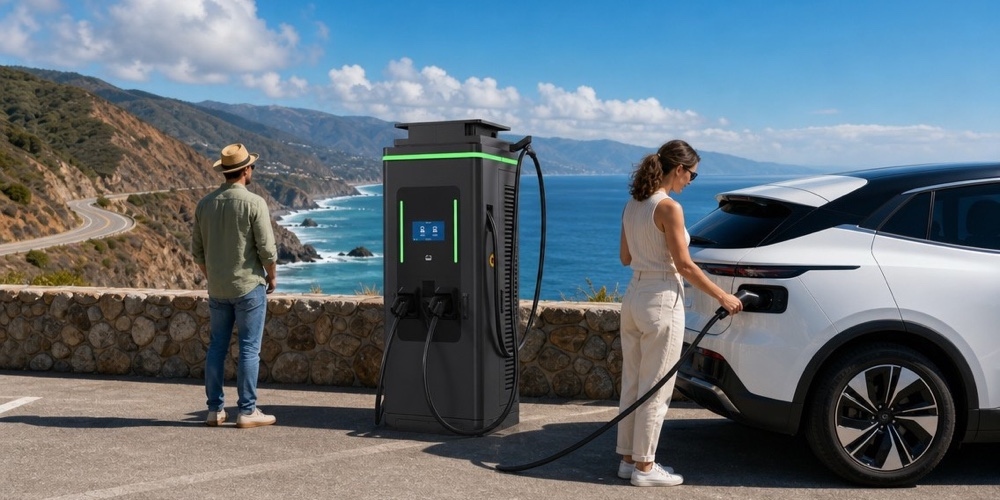
At the MIDA Power V2X Advanced Research Lab, our engineers are working on the next generation of energy management protocols. We are currently testing “Island Mode” capabilities. In the event of a total grid failure, a MIDA Power V2H-enabled charger can disconnect the home from the grid and use the EV battery to power essential appliances, lighting, and medical equipment.
But V2X goes beyond just backup power. We are developing Virtual Power Plant (VPP) software that allows EV owners to participate in the energy market. By allowing the grid to “borrow” a small amount of their battery’s energy when demand is high and prices are at their peak, EV owners can actually earn money while their car is parked. MIDA Power’s algorithms ensure that this discharge never exceeds the user’s set “Minimum Range” and accounts for the battery’s cycle life.
The Role of V2G in Renewable Integration
The intermittency of solar and wind energy is the biggest barrier to a 100% renewable grid. V2G provides the large-scale storage needed to “firm up” these energy sources. MIDA Power is partnering with utility companies in California and Germany to deploy V2G-enabled hubs that act as a buffer for local solar farms.
When the sun is at its zenith and solar production exceeds demand, the MIDA Power system absorbs the excess into the connected EVs. As the sun sets and demand rises, the EVs feed that clean energy back into the grid. This eliminates the need for expensive, stationary lithium-ion megabatteries, as the “battery on wheels” is already there.
Standardization and Policy Leadership
V2G requires deep collaboration between vehicle OEMs, charger manufacturers, and utility regulators. MIDA Power is an active member of the CharIN and CHAdeMO associations, pushing for the global standardization of bidirectional protocols. We believe that for V2G to succeed, it must be universal. A MIDA Power charger should be able to perform V2G with a Ford, a Tesla, a NIO, or a BYD without friction.
By bridging the gap between the automotive and energy sectors, MIDA Power is transforming the EV from a liability for the grid into its greatest asset. The future of the grid is not just “Smart”—it is “Shared,” and MIDA Power is the platform that makes this sharing possible.
7. The Future of Scalability: Modular Design and Megawatt Charging (MCS)
As we move beyond passenger cars to the electrification of heavy-duty transportation—including Class 8 trucks, buses, mining equipment, and even electric aviation—the power requirements are skyrocketing. The current CCS (Combined Charging System) standards, which top out at around 350-400kW, are insufficient for a semi-truck with a 1MWh battery. MIDA Power is leading the development and implementation of Megawatt Charging Systems (MCS).
The Engineering of the Megawatt
Charging at 1MW+ (up to 3.75MW in some configurations) presents unprecedented physical challenges. At these power levels, the current flowing through the cable can exceed 1,000 Amps. Without extreme cooling, the cable would melt in seconds.
MIDA Power’s MCS solution features:
- Active Liquid-Cooled Connectors: Our proprietary connector design uses a high-flow glycol-water mixture that cools the pins and the cable simultaneously. This allows us to maintain a manageable cable diameter and weight, ensuring that a single human operator can still handle the connector.
- High-Voltage Rectification: MIDA Power has developed ultra-high-voltage power stacks that operate at 1,500V DC. By increasing the voltage, we can deliver more power while keeping the current (and therefore the heat) relatively lower.
- Redundant Safety Interlocks: At 1MW, a “hot-unplug” event or a short circuit could be catastrophic. MIDA Power’s MCS dispensers feature multiple layers of optical and mechanical interlocks that ensure power is only delivered when a perfect electrical and thermal seal is established.
Thermodynamic Optimization of Liquid-Cooled Cables
The cooling system in a MIDA Power Megawatt charger is a marvel of fluid dynamics. To move 1,000+ Amps through a cable that a human can lift, we must dissipate over 5kW of heat per meter of cable. MIDA Power uses a specialized dielectric coolant that has a higher thermal capacity than water but is non-conductive, providing an extra layer of safety in case of a leak.
Our engineers use Computational Fluid Dynamics (CFD) to optimize the internal geometry of the cooling channels within the connector pins. By creating controlled turbulence in the coolant flow, we maximize the heat transfer coefficient. The system also features a variable-speed pump that adjusts the flow rate based on the real-time temperature sensors in the connector. This ensure that we use the minimum amount of energy for cooling during lower-power sessions, further enhancing the overall system efficiency. This attention to thermodynamic detail is what allows MIDA Power to lead the industry in MCS deployment.
Modular “Power Hubs”
Scalability isn’t just about raw power; it’s about the ability to expand a site as the fleet grows. MIDA Power’s “Power Hub” architecture separates the power conversion from the dispensing units. A central Power Hub can be located hundreds of feet away from the actual parking slips, housing the massive transformers and SiC power stacks.
As a logistics company adds more electric trucks to its fleet, it doesn’t need to dig up the entire parking lot. It can simply add more dispenser units and upgrade the capacity of the central Power Hub by sliding in new power modules. This “decoupled” design allows for much more flexible site layouts, especially in cramped urban warehouses or existing truck stops.
Future-Proofing for Electric Aviation and Marine
MIDA Power is already looking beyond the road. The maritime industry is rapidly electrifying short-sea ferries and tugboats. These vessels require massive bursts of energy during short port stays. MIDA Power’s modular MCS technology is perfectly suited for these high-demand applications.
Furthermore, in the nascent field of eVTOL (electric Vertical Take-Off and Landing) aircraft, rapid charging is essential for operational viability. MIDA Power is working with aerospace partners to adapt our MCS and AI predictive maintenance systems for the rigorous safety standards of the aviation industry. By building a scalable, modular platform today, MIDA Power is ensuring that the infrastructure we build now can support the multi-modal transportation network of 2030 and beyond.
8. Human-Centric Design: UX/UI and Seamless Payment Ecosystems
The success of the EV transition depends as much on the psychological comfort of the user as it does on the technical specs of the hardware. For too long, charging an EV has been a frustrating experience involving multiple apps, incompatible RFID cards, and cryptic error messages on sunlight-unreadable screens. MIDA Power has taken a “Human-First” approach to the design of the charging interface.
The “Zero-Friction” User Journey
MIDA Power’s goal is to make charging an EV as simple—or simpler—than fueling a gas car. This starts with Plug & Charge (ISO 15118). With a MIDA Power station, a user simply pulls up and plugs in. The car handles the authentication and payment automatically through a secure digital certificate. No apps, no cards, no hassle.
For legacy vehicles that don’t support Plug & Charge, MIDA Power has integrated universal payment terminals that accept credit cards, Apple Pay, Google Pay, and even local digital wallets like WeChat Pay or Alipay. By removing the “walled garden” approach of many charging networks, MIDA Power ensures that every EV driver feels welcome at our stations.
Industrial Design and Ergonomics
A charging station is a piece of public infrastructure. It must be durable, accessible, and intuitive. MIDA Power’s dispensers are designed with:
- Anti-Glare, High-Contrast Displays: 15-inch touchscreens that are readable even in direct sunlight and can be operated with gloves.
- ADA Compliance: The height of the screen and the weight of the cable are optimized to ensure that people with disabilities can use the charger without assistance.
- Integrated Lighting: The station itself acts as a high-intensity LED light source, providing a sense of safety for users charging in dark or isolated locations at night.
- Cable Management Systems: Retractable cables that never touch the ground, preventing them from getting dirty, damaged, or becoming a trip hazard.
The MIDA Power Mobile Ecosystem
While the charger itself is designed to be self-sufficient, the MIDA Power mobile app provides a rich layer of added value. Users can:
- Reserve a Charger: Ensuring a spot is available when they arrive at a busy station.
- Monitor Charging Remotely: Getting a notification when their car has reached the desired charge level or if a problem has occurred.
- Personalized Recommendations: The app can suggest nearby cafes, shops, or parks based on the estimated charging time, turning a “wait” into a productive or relaxing break.
Multi-Language and Cultural Localization
As a global company, MIDA Power understands that a user in Tokyo has different expectations than a user in Chicago or Riyadh. Our UI is fully localized into over 20 languages and adapts its tone and iconography to match local cultural norms. We don’t just translate text; we translate the entire user experience to ensure it feels native to every market we serve.
By focusing on the human element, MIDA Power is breaking down the barriers to EV adoption. We believe that technology should serve people, not the other way around. When a driver sees the MIDA Power logo, they don’t just see a charger—they see a promise of a reliable, easy, and pleasant experience.
9. Industry 4.0 Manufacturing: Quality Control and Sustainable Production at MIDA Power
The transition to mass-market EV adoption requires more than just good engineering; it requires world-class manufacturing at an unprecedented scale. MIDA Power has embraced the principles of Industry 4.0 to build a global production network that is as advanced as the products it creates.
The “Smart Factory” Concept
MIDA Power’s manufacturing facilities are fully digitized environments where every machine, component, and worker is connected through a Private 5G network. This allows for:
- Automated Guided Vehicles (AGVs): These robots move components between assembly stations with millimeter precision, eliminating the inefficiencies of traditional conveyor belts.
- Computer Vision Quality Control: Every circuit board and power module is scanned by high-resolution cameras that use AI to detect microscopic soldering defects or component misalignments that a human eye might miss.
- Predictive Tooling: The same AI that maintains our chargers in the field is used to maintain our factory equipment. We know when a robotic arm needs calibration before it starts producing out-of-spec parts.
Sustainable Production for Sustainable Products
MIDA Power believes that it is hypocritical to build “green” products in “brown” factories. We have set a goal for all MIDA Power manufacturing sites to be Carbon Neutral by 2028. To achieve this, we are:
- Solar-Powered Manufacturing: Our flagship factory in Guangdong is covered with over 50,000 square meters of high-efficiency solar panels, which provide up to 60% of the facility’s energy needs.
- Circular Economy Integration: We have implemented a comprehensive take-back and recycling program for power modules, cable assemblies, and retired cabinets. Rare-earth magnets, copper busbars, and aluminum heat sinks are recovered and re-fed into our supply chain, reducing virgin-material demand and cutting the embedded carbon of every new charger we ship.
- Water and Waste Reduction: Our surface-mount technology (SMT) lines operate on closed-loop cooling systems that recycle 85% of process water, and a zero-landfill policy ensures every gram of production scrap is either recycled or energy-recovered.
- Green Logistics: Finished chargers travel by rail and electric truck wherever infrastructure allows, and consolidated regional shipments cut per-unit transport emissions by up to 30%.
Why Manufacturing Matters to Buyers
Some buyers assume “factory quality” is invisible in the final product. It is not. A charger assembled in an Industry 4.0 facility benefits from:
- Traceability: Every power module carries a digital twin record — component batch, soldering profile, and test results — so a field failure can be traced to its root cause in minutes, not weeks.
- Consistent Torque and Alignment: Automated assembly eliminates the “Monday morning unit” variability that plagues manual production lines.
- Lower Infant-Mortality Failures: Burn-in testing and AI-driven optical inspection catch defects before shipment, which is why MIDA Power’s field failure rate in the first 90 days is a fraction of the industry average.
The financial impact is measurable: automated inspection and burn-in testing typically reduce warranty claim rates by 40-60%, and digital-twin traceability shortens root-cause analysis from weeks to days when a field anomaly appears. For an operator running hundreds of chargers, that translates directly into fewer stranded vehicles and lower service spend — the quiet ROI that never appears on the equipment quote.
Carbon-neutral manufacturing also matters commercially. As more utilities and municipalities weight sustainability in procurement scoring, audited factory emissions data is becoming a differentiator in tenders — and a genuine carbon story is one an operator can pass along to their own customers and regulators.
10. Conclusion: The MIDA Power Engineering Promise
Innovation in EV charging is not measured in kilowatts alone. SiC power electronics, AI-driven maintenance, V2G capability, and carbon-neutral manufacturing together define what a modern charging partner must deliver. Key takeaways for decision-makers:
- Adopt SiC-based power electronics for 98%+ efficiency, smaller cabinets, and lower cooling overhead across the life of the asset.
- Demand AI-enabled remote maintenance. Predictive health scoring and OTA updates are now standard expectations, not premium features.
- Plan for V2G from day one. Bidirectional-ready hardware future-proofs your site against energy-market revenue streams.
- Audit the factory, not just the datasheet. Manufacturing discipline is the upstream cause of field reliability — ask to see it.
Call to Action: See the Smart Factory in Action
MIDA Power invites procurement and engineering teams to tour our Guangdong smart factory — virtually or in person — to see SiC module assembly, AI optical inspection, and carbon-neutral production lines firsthand. Contact sales@midapower.com or visit www.midapower.com to schedule your visit and request detailed specifications for our 60kW to 480kW charging platforms.
Post time: Aug-09-2026
