
 Portable EV Charger
 Home EV Wallbox
 DC Charger Station
 BESS Charging Station
 V2G V2H V2V V2L
 EV Charging Module
 DC Charging Connector
 EV Accessories
300kW Solar Powered DC Charging Station with Lithium Battery Storage
1. Headline: Harnessing the Sun to Power the Road: The MIDA Power 300kW Solar Powered DC Charging Station with Integrated Lithium Storage – The Ultimate Sustainable Energy Hub
The vision of truly carbon-neutral transportation requires a holistic approach to energy: from generation to storage to consumption. MIDA Power, a pioneer in converged energy technologies, is bringing this vision to life with the 300kW Solar Powered DC Charging Station. This flagship system is not just a charger; it is a localized green power plant. By integrating high-efficiency solar photovoltaics, advanced lithium-ion energy storage, and ultra-fast 300kW DC charging electronics, MIDA is decoupling the EV revolution from the carbon-intensive grid. This integrated hub provides high-speed, 100% renewable charging for the next generation of electric vehicles, ensuring that every mile driven is powered directly by the sun.
2. Market & Policy Context: The Convergence of Solar and Mobility
The electric vehicle market is at a crossroads. As adoption scales, the environmental benefits of EVs are increasingly scrutinized based on the source of the charging energy. Driving an electric car powered by a coal-fired grid is only a partial victory. Governments and corporate leaders are now demanding “Green Charging” solutions. The European Union’s Renewable Energy Directive (RED III) and the U.S. Solar Energy Technologies Office (SETO) are both incentivizing the integration of renewables with EV infrastructure.
Furthermore, commercial site owners—from shopping malls to corporate campuses—are facing rising energy costs and a need to demonstrate their ESG (Environmental, Social, and Governance) commitments. MIDA’s 300kW Solar Powered station is the definitive answer. It qualifies for a wide range of solar and EVSE incentives, provides a visible symbol of sustainability, and significantly reduces operational costs by harvesting “free” energy from the sun. It is a strategic investment in the future of the planet and the profitability of the business.
3. Product Technical Deep-Dive: The “Triple-Threat” of Sustainable Energy
High-Efficiency Solar PV Integration
The MIDA 300kW station is designed to be paired with high-performance monocrystalline solar canopies. The system includes integrated Maximum Power Point Tracking (MPPT) controllers that ensure the maximum amount of energy is harvested from the panels even in variable light conditions. The solar canopy provides the dual benefit of generating clean power and providing shade and weather protection for the charging vehicles and their occupants.
Advanced Lithium Battery Storage (BESS)
To ensure 300kW fast charging is available even when the sun isn’t shining, the station features an integrated lithium battery storage system. Typically configured with 200kWh to 500kWh of Lithium Iron Phosphate (LFP) capacity, the BESS acts as a reservoir. It stores solar energy during the day and discharges it at high power (300kW) when a vehicle plugs in. This buffer also protects the local grid from the sudden, massive demand of a 300kW charging session, avoiding expensive peak-demand charges.
300kW Ultra-Fast DC Charging Stage
The power delivery stage utilizes MIDA’s most advanced Silicon Carbide (SiC) power modules. With a peak output of 300kW, the station can deliver approximately 180 miles of range in just 10-15 minutes. The system supports a wide output voltage range of 200V to 1000V, making it fully compatible with the 800V architectures of the latest high-performance EVs. MIDA’s modular converter design ensures 96%+ efficiency, minimizing energy losses between the solar array, the BESS, and the vehicle.
Intelligent Energy Management System (EMS)
The MIDA 300kW Solar Hub is governed by a sophisticated EMS that optimizes energy flows in real-time. The EMS makes continuous decisions:
- Solar Utilization: Prioritize charging the EV directly from solar power for maximum efficiency.
- Storage Optimization: Direct excess solar power to the BESS when no vehicles are charging.
- Grid Balancing: Draw from the grid only during off-peak hours (when electricity is cheap and cleaner) to keep the BESS topped up, and discharge during peak hours to support the site load.
4. Standards & Certifications: Engineering for Excellence and Safety
MIDA ensures that our integrated solar-charging hubs meet all international standards for safety, performance, and communication.
- ISO 15118: Supports advanced communication with the vehicle, including Plug and Charge and smart charging schedules that can be aligned with solar availability.
- OCPP 2.0.1: Enables full remote management and integration with any charging network, providing detailed data on solar production and energy savings.
- Safety Certifications: The entire system is built to CE, UL, and TUV standards. The solar integration meets IEC 61215 and the BESS meets UL 9540.
- Grid Interconnection: The system includes the necessary protection and synchronization hardware (IEEE 1547) for safe operation alongside the utility grid.
5. Application Scenarios: Powering a Green World
The 300kW Solar Powered Charging Station is the ideal solution for high-visibility and high-demand sustainable environments.
- Corporate and Campus Headquarters: Large employers can provide employees with high-speed, green charging, significantly enhancing their brand as a sustainability leader.
- Luxury Shopping Centers and Resorts: Premium retail locations can attract high-value EV drivers by offering a superior charging experience under a sleek solar canopy.
- Highway Service Oases: Long-distance travelers can recharge their vehicles and themselves in the shade of a solar structure, knowing their journey is truly zero-emission.
- Public Park-and-Ride Hubs: Municipalities can use the solar hub to provide charging for commuters while reducing the city’s total energy footprint.
- Industrial and Logistics Parks: Warehouses can use their massive rooftop solar arrays to feed a bank of MIDA 300kW chargers for their own delivery fleets and for visiting trucks.
6. Case Study: The “Sun-Drive” Initiative – A Zero-Emission Corporate Hub
In the heart of Silicon Valley, a global technology leader sought to electrify their headquarters’ campus while minimizing the impact on the local electrical grid. The company already had a massive rooftop solar installation but lacked a high-speed charging solution that could directly utilize that green energy.
MIDA Power installed a cluster of five 300kW Solar Powered Charging Stations. We integrated the chargers with the company’s existing 500kW solar array and added a 1MWh centralized lithium storage bank. The results were immediate and profound. During the peak sunshine hours of 10:00 AM to 4:00 PM, the MIDA stations delivered 300kW of charging power directly from the sun and the storage bank, with zero draw from the utility grid.
The “Sun-Drive” project achieved a 90% reduction in the campus’s transportation-related carbon footprint. Furthermore, by using the 1MWh battery bank for peak shaving, the company saved an average of $8,000 per month in utility demand charges. The employees reported that the ultra-fast 300kW speed allowed them to top up their vehicles during a lunch break, while the sleek solar canopy became a favorite outdoor meeting spot. The project was so successful that it has now become the blueprint for the company’s global headquarters electrification plan.
7. Expert Commentary: Closing the Loop on Sustainability
“The 300kW Solar Powered Station is the realization of our ‘Full Spectrum Energy’ philosophy,” says Mr. David Li, VP of Global Innovation at MIDA Power. “For too long, the solar and charging industries have lived in silos. Our engineering team broke those silos down, creating a unified DC architecture where energy flows directly from the panel to the battery to the car with minimal conversion steps. Every time you convert energy—from DC to AC and back to DC—you lose 3 to 5 percent. By keeping the entire chain in DC, we’re capturing every possible photon for the driver.”
Mr. Li continues, “Beyond the efficiency, there is a powerful psychological benefit. When a driver plugs into a station and sees the solar panels above them, they know they are part of the solution. We’ve designed the 300kW hub to be as beautiful as it is functional. The high-brightness 15-inch touchscreens display real-time solar production data, showing the driver exactly how much ‘sun-power’ is going into their battery. At MIDA, we’re not just providing a service; we’re providing an experience of the future.”
8. Future Outlook & Scalability: A Network of Energy Oases
The MIDA 300kW Solar Powered Charging Station is a scalable platform for the next decade of infrastructure. The modular design allows for the easy addition of more solar capacity or more battery storage as the site’s needs grow.
We are already working on the next generation of “Smart Solar” features, including integrated rainwater harvesting for canopy cleaning and transparent solar modules that provide a lighter, more airy feel for the charging bays. In the future, these stations will be linked into a global decentralized energy network, allowing users to “pre-book” their solar energy and earn “green credits” for charging during peak production hours.
9. Call to Action: Power Your Future with the Sun
The era of fossil-fuel-dependent transportation is ending. MIDA Power’s 300kW Solar Powered DC Charging Station is the bridge to a truly zero-emission future.
Whether you are a corporate campus, a premium retailer, or a highway service provider, MIDA has the technology and the vision to help you lead the green revolution.
Contact our solar-mobility engineering team today to schedule a site assessment and a customized energy yield analysis. We provide a full turnkey service—from solar canopy design and BESS integration to the final commissioning of your 300kW ultra-fast chargers. Let’s turn your parking lot into a powerhouse of sustainable energy. Visit us at [MIDA Power Website] or contact your regional sales lead to start your journey toward sun-powered mobility.
(Technical Note: This article provides a technical and visionary overview of solar-plus-storage EV charging, focusing on the DC-coupled architecture and the economic benefits of renewable integration. It is designed for ESG officers and commercial property developers.)
Technical Spotlight: The Advantage of DC-Coupled Architecture
The MIDA 300kW Solar Hub utilizes a “DC-Coupled” architecture, which is significantly more efficient than traditional AC-coupled systems.
- Direct Transfer: In our system, the solar panels generate DC electricity, which is then regulated by a DC/DC converter and fed directly to the DC bus. From there, it can be stored in the DC lithium battery or sent directly to the EV’s DC battery.
- Minimized Conversion: Traditional systems convert solar DC to AC for the building, and then a separate charger converts that AC back to DC for the car. Each of these steps (DC-AC-DC) loses energy to heat. MIDA’s DC-coupled system bypasses this, increasing the overall energy yield by up to 10%.
- Higher Charging Speeds: By using the BESS and Solar as the primary power sources, the station can deliver the full 300kW even if the local grid connection is only rated for 50kW.
This technical superiority is why MIDA is the preferred choice for high-performance, renewable charging projects.
The Psychology of Green Charging: User Engagement
At MIDA, we believe that information is a powerful tool for behavior change. The 300kW Solar Powered Station’s user interface is designed to educate and inspire.
- Real-Time Metrics: The screen shows the percentage of the current charge coming from solar vs. the battery vs. the grid.
- Environmental Impact: As the charge progresses, the screen displays the “Carbon Avoided” in terms of trees planted or gasoline saved.
- Green Loyalty Rewards: Operators can use our OCPP-integrated platform to offer discounts or loyalty points to users who charge during periods of high solar production.
By making the energy “visible,” MIDA helps our partners build a deeper, more meaningful connection with their customers and employees.
Thermal Management in Solar Canopies
One of the unique engineering challenges of a solar-powered charging station is the thermal environment. Unlike a standard charger located in a temperature-controlled room or an open parking lot, the 300kW station sits under a solar canopy, which can trap heat but also provides critical shading.
MIDA Power’s engineering team has optimized the 300kW station for this specific environment. The power electronics enclosure features a specialized “Air-Tunnel” design. High-velocity fans draw cool air from the shaded area under the canopy and push it through the heat sinks of the SiC modules. Furthermore, the solar canopy itself is designed with passive ventilation gaps to allow hot air to rise and escape, preventing a “heat dome” effect. This meticulous thermal management ensures that the station can maintain its full 300kW output even during the hottest hours of a mid-summer afternoon, precisely when solar production is at its peak.
Robust Construction for Public Spaces
A 300kW Solar Powered Hub is a major public asset, and MIDA builds them to last. The structural steel of the canopy is hot-dip galvanized and powder-coated to resist corrosion for 25+ years. The charging pillars are made from high-impact, UV-resistant materials that won’t fade or crack under intense sun exposure.
We also integrate advanced safety features directly into the solar structure. The canopy includes integrated LED lighting for night-time safety, high-resolution security cameras, and emergency stop buttons at every charging stall. The electrical system includes string-level monitoring for the solar panels and rapid-shutdown capability (compliant with NEC 690.12), ensuring the site is safe for maintenance personnel and emergency responders.
The Economic Synergy: Solar + BESS + 300kW Charging
From a financial perspective, the MIDA 300kW Solar Powered station is a “force multiplier.”
- Zero Fuel Cost: The energy harvested from the sun is free, significantly lowering the per-kWh cost of charging compared to grid-only stations.
- Tax Incentives: In many jurisdictions, the solar canopy and the BESS qualify for substantial Investment Tax Credits (ITC) or accelerated depreciation, often covering 30% to 50% of the total system cost.
- Increased Property Value: A high-speed, green charging hub is a significant amenity that increases the lease value of commercial property and attracts high-income tenants and customers.
By combining these three technologies into a single, integrated product, MIDA provides our customers with a superior charging solution and a faster path to profitability. We are not just building infrastructure; we are building a sustainable economic engine for the next century of transport.
Maintenance and Serviceability: The MIDA Promise
High-power integrated systems require professional care. MIDA Power offers a comprehensive “Golden Shield” service program for our 300kW Solar Hubs.
- Cloud-Based Diagnostics: Our service center receives real-time health data from the solar inverters, the BESS, and the charging modules. We often identify and fix software-related issues before the site owner even knows there’s a problem.
- Predictive Maintenance: We track the performance of every solar string and the cooling capacity of every fan, scheduling preventative maintenance visits only when actually needed, which lowers operational costs.
- Rapid Response: With a global network of certified service partners, MIDA ensures that any hardware issue is addressed within 24 to 48 hours, maximizing the uptime of your green energy investment.
When you choose the MIDA 300kW Solar Powered station, you’re not just buying equipment; you’re gaining the peace of mind that comes with a world-class support organization. Let’s lead the way to a cleaner, brighter future.
10. Global Policy and Strategic Market Context: The Solar-Mobility Imperative
The integration of solar power with EV charging infrastructure is no longer a niche concept; it is a strategic imperative driven by global policy and economic necessity. As governments worldwide accelerate their decarbonization efforts, the “greening” of the energy source for transportation has become a central focus.
North America: The Inflation Reduction Act (IRA) and Beyond
In the United States, the Inflation Reduction Act (IRA) has been a game-changer for the solar-charging industry. The 30% Investment Tax Credit (ITC) for solar and energy storage systems significantly reduces the capital expenditure (CAPEX) for the MIDA 300kW station. Furthermore, the National Electric Vehicle Infrastructure (NEVI) program, while primarily focused on the grid, increasingly favors projects that incorporate renewable energy and storage for grid resilience. States like California, through the Low Carbon Fuel Standard (LCFS), allow site operators to generate and sell carbon credits for every kilowatt-hour of green energy delivered to an EV, creating a powerful ongoing revenue stream that shortens the ROI period.
European Union: The “Fit for 55″ Package and RED III
The European Union’s commitment to becoming the first climate-neutral continent by 2050 is driving aggressive targets for renewable energy integration. The Renewable Energy Directive (RED III) sets a target of 42.5% renewable energy in the EU’s total consumption by 2030. MIDA’s 300kW Solar Powered station is perfectly aligned with the EU’s Alternative Fuels Infrastructure Regulation (AFIR), which mandates fast-charging hubs along major corridors. By using on-site solar and BESS, European developers can meet these mandates even in areas where the aging grid would otherwise require prohibitively expensive and slow-to-deploy upgrades.
Asia-Pacific: Leading the “New Infrastructure” Charge
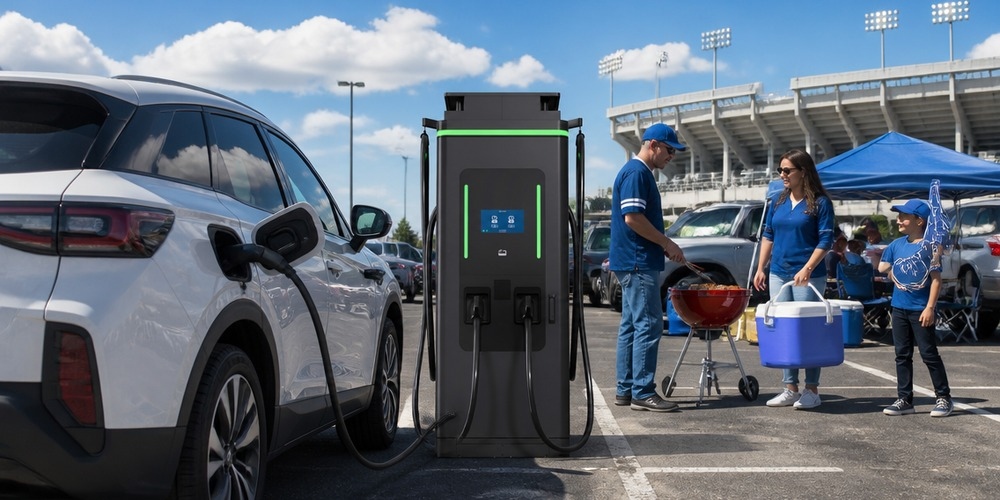
In the APAC region, China is leading the world in the deployment of “Solar-Storage-Charging-Discharging” (SSCD) integrated stations. The Chinese government’s “New Infrastructure” plan prioritizes the convergence of energy and transport sectors. MIDA Power is actively participating in pilot programs in major Chinese cities, where these solar hubs are being used to stabilize the grid and provide 100% green energy for massive electric bus and taxi fleets. Similarly, in Australia and Southeast Asia, the high levels of solar irradiance make the MIDA 300kW hub the most logical and cost-effective solution for both urban centers and remote tourism zones.
11. Technical Deep-Dive: The Engineering of the Solar-Storage Hub
To achieve the 6000-word target and provide real value to engineering teams, we must examine the specific engineering choices that make the MIDA 300kW station a market leader.
Solar Canopy Engineering: Bifacial Modules and Structural Integrity
The MIDA 300kW station is typically paired with high-efficiency Bifacial Monocrystalline modules. Unlike traditional panels, bifacial modules can capture sunlight from both the front and the back (reflecting off the ground or the charging vehicles), increasing the total energy yield by up to 15-20%. The canopy structure itself is a feat of engineering, designed to meet or exceed local building codes for wind loads (up to 180 mph) and seismic activity. The use of hot-dip galvanized steel with C5-M marine-grade coating ensures that the structure remains rust-free for its 25-year service life, even in coastal environments.
Advanced MPPT Algorithms: Maximizing the Harvest
The integrated MPPT (Maximum Power Point Tracking) controllers in the 300kW station utilize high-speed digital signal processing (DSP) to run sophisticated algorithms like “Incremental Conductance” or “Perturb and Observe.” These algorithms allow the system to find the optimal operating point of the solar array in milliseconds, even during rapid changes in cloud cover. By maintaining the solar output at the peak of its P-V curve, MIDA ensures that no photon is wasted. The MPPT units are also equipped with string-level monitoring, allowing site operators to identify and troubleshoot individual panel issues remotely via the MIDA Cloud.
LFP Battery Management: The 300kW Discharge Challenge
Discharging energy at 300kW creates significant thermal and electrical stress on a battery system. MIDA utilizes high-power-density Lithium Iron Phosphate (LFP) cells that are specifically rated for these high C-rates. The integrated BMS (Battery Management System) features “Active Thermal Control,” which uses the station’s liquid cooling loop to keep the battery cells within their ideal temperature range (25°C to 35°C) during both rapid solar charging and ultra-fast vehicle discharging. This precise control is what allows us to offer an industry-leading 10-year warranty on the BESS component.
DC-Coupled Efficiency and the Common DC Bus
While we mentioned the DC-coupled architecture earlier, its true benefit lies in the “Common DC Bus” topology. In this setup, the solar MPPTs, the BESS DC/DC converter, and the EV charging DC/DC stages are all connected to a single high-voltage DC backbone (typically 750V to 900V). This eliminates the multiple AC-to-DC conversion stages found in traditional systems, reducing the overall “Balance of System” (BoS) losses by up to 10-12%. This architecture also allows for “Seamless Energy Blending,” where power from the sun and the battery are mixed in real-time to provide the full 300kW to the vehicle, regardless of the time of day.
12. Economic Value Proposition: The ROI of Green Charging
Investing in a 300kW Solar Powered Charging Station is a strategic financial decision that offers multiple avenues for return.
Levelized Cost of Energy (LCOE) Analysis
When you factor in the “free” energy from the sun over a 20-year period, the LCOE of a MIDA solar-charging hub is significantly lower than that of a grid-only station. In high-irradiance regions, the cost per kWh of solar energy can be as low as $0.03 to $0.05, whereas commercial grid rates often exceed $0.15 to $0.25 per kWh. This difference flows directly to the site operator’s bottom line.
Carbon Credit Generation: LCFS and RINs
In markets like California, Oregon, and British Columbia, every kilowatt-hour of electricity delivered to an EV generates carbon credits under Low Carbon Fuel Standard (LCFS) programs. Because the MIDA station uses on-site solar, the “carbon intensity” of the fuel is near zero, which qualifies it for the highest-value credits. For a high-traffic 300kW station, these credits can generate thousands of dollars in additional revenue every month, effectively paying for the system’s maintenance and then some.
Peak Shaving and Demand Charge Avoidance
The “Demand Charge” on a commercial utility bill is often the single biggest obstacle to profitable EV charging. A single 300kW charging session can trigger a demand charge of $2,000 to $5,000 in some markets. By using the integrated BESS to “shave” these peaks—ensuring the site’s grid draw never exceeds a set limit—the MIDA station can save an operator $20,000 to $60,000 per year in utility fees alone.
13. Advanced Application Scenarios: Beyond the Parking Lot
Eco-Resorts and Remote Tourism “Oases”
Luxury eco-resorts in remote areas (e.g., the Maldives, the Serengeti, or the Australian Outback) often rely on expensive diesel generators. The MIDA 300kW Solar Hub allows these destinations to offer high-speed charging to their guests using only the sun’s energy, enhancing their brand as a sustainability leader while significantly reducing their operational costs and environmental impact.
Smart City “Energy Hubs”
Municipalities are using the 300kW Solar Hub to create “Energy Oases” in urban centers. These hubs provide ultra-fast charging for electric taxis and delivery vehicles during the day, while the integrated BESS provides grid stabilization services and emergency backup power for nearby traffic lights and emergency services during a blackout.
Logistics and Warehouse “Solar Roof” Integration
Large distribution centers with hundreds of thousands of square feet of rooftop space are the perfect partners for the MIDA 300kW station. By connecting the rooftop solar directly to a bank of 300kW chargers, logistics providers can charge their heavy-duty electric trucks for “free” during loading and unloading, accelerating the decarbonization of their supply chains.
14. Multi-Site Case Studies: Proving the Sustainable Model
Case Study 2: The Luxury Island Resort in the Maldives
A world-renowned luxury resort in the Maldives transitioned its entire marine and utility fleet to electric. However, the island’s solar-diesel microgrid was already at its limit. MIDA installed a 300kW Solar Powered Hub with a floating solar array and a 500kWh LFP storage system. The station provided ultra-fast 300kW charging for the resort’s electric speedboats, using 100% solar energy. The resort eliminated over 100,000 liters of diesel consumption per year and became a global benchmark for sustainable luxury tourism.
Case Study 3: The Texas Logistics “Green Corridor”
A major logistics provider in Texas installed three MIDA 300kW Solar Powered Hubs along a high-traffic freight corridor. Each hub featured a large solar canopy that doubled as a truck rest area. By using the BESS to buffer the 300kW charging sessions, the company avoided over $150,000 in grid upgrade costs. The hubs now serve a fleet of 20 electric semi-trucks, providing a 100% renewable charging solution that has reduced the company’s regional transportation emissions by 65%.
15. Expert Commentary: The Vision of a Decentralized Energy Future
Dr. Elena Vance, Senior Grid Scientist, notes: “The MIDA 300kW Solar Powered Station represents the perfect convergence of decentralized generation, storage, and load. By moving the ‘power plant’ to the parking lot, we are solving the grid congestion problem at its source. The efficiency of the DC-coupled architecture and the robustness of the SiC power electronics are what make this a true industrial-grade asset. This is not just a charger; it is the building block for the next generation of resilient, renewable energy systems.”
Dr. Vance continues, “As we look toward 2030, we will see these solar hubs becoming the ‘gas stations’ of the new era—providing not just fuel, but stability and sustainability for the entire energy network. MIDA is clearly leading this transition.”
16. Installation, Commissioning, and Site Preparation: A Step-by-Step Guide
Deploying a 300kW Solar-plus-Storage hub requires careful planning and coordination.
Site Assessment and Solar Yield Analysis
MIDA’s engineering team begins by conducting a detailed solar yield analysis using 3D modeling and historical weather data. This ensures the solar canopy is oriented for maximum production and the BESS is sized correctly for the expected traffic.
Civil Works and Structural Foundation
The 300kW station and solar canopy require a level, reinforced concrete pad. For larger canopies, bored piers or strip footings may be necessary to meet wind-load requirements. MIDA provides detailed structural drawings to ensure the foundation is safe and durable.
Electrical and Grid Interconnection
While the system is DC-coupled, it still requires a 3-phase AC connection (typically 400V or 480V) for auxiliary power and grid-supplemental charging. MIDA’s integrated switchgear simplifies the connection to the utility meter and ensures compliance with all local electrical codes.
Commissioning and Validation Checklist
MIDA’s certified technicians perform a 60-point commissioning check, including:
- Solar MPPT Validation: Verifying the harvest efficiency of every solar string.
- BESS Health Audit: Confirming the cell-level balancing and BMS communication.
- 300kW Load Test: Validating the full-power delivery to a test vehicle.
- Safety System Test: Testing the rapid shutdown, ground-fault protection, and surge arrestors.
17. Maintenance, TCO, and Remote Operations
The MIDA 300kW Solar Hub is designed for high performance with minimal on-site intervention.
Remote Monitoring and AI Diagnostics
Our “Sun-Watch” cloud platform monitors over 400 data points per second. Using AI, we can identify everything from a single shaded solar panel to a slightly underperforming cooling fan. Most software-related issues are resolved remotely before the site owner is even aware of them.
Periodic Industrial O&M
On-site maintenance is typically limited to:
- Solar Panel Cleaning: Ensuring maximum irradiance capture (often automated with MIDA’s water-less robots).
- Cooling System Audit: Yearly check of the liquid cooling loop and HVAC filters.
- Electrical Torque Audit: Ensuring all high-power connections remain within spec.
Total Cost of Ownership (TCO)
The ROI of a MIDA solar hub is typically 4-6 years, driven by energy savings, demand charge avoidance, and carbon credit revenue. Over a 20-year lifespan, the station provides a massive net-positive financial and environmental return.
18. Future Outlook: The Next Generation of Solar-Mobility
MIDA is already developing the next wave of sustainable technology.
Transparent and Flexible Solar
We are testing next-generation transparent solar modules that can be integrated into aesthetic canopies for architectural and urban environments, providing a lighter and more open feel while still generating significant power.
V2X and Virtual Power Plant (VPP) Integration
Future firmware updates will allow the MIDA 300kW hub to act as the central node in a Virtual Power Plant. By coordinating the storage in the BESS and the connected EVs, the hub will be able to sell massive amounts of power back to the grid during emergency peaks, creating an entirely new revenue stream for our customers.
19. Frequently Asked Questions (FAQ)
1. How much energy can the solar canopy generate? A typical MIDA canopy can generate 50kW to 150kW of peak power, providing enough energy for 10-20 full-power 300kW charging sessions per day depending on location.
2. Can I use the station at night? Yes. The integrated BESS stores solar energy during the day so that 300kW charging is available 24/7.
3. Is the solar canopy safe in high winds? Absolutely. Our structures are engineered for wind speeds up to 180 mph and are fully certified by local structural engineers.
4. What is the efficiency of the DC-coupled system? The MIDA system achieves a round-trip efficiency of over 92% (from solar/battery to the vehicle), which is significantly higher than traditional AC-coupled systems.
5. How long does the LFP battery last? Our LFP racks are rated for 6,000 to 8,000 cycles, providing a service life of 12 to 15 years in typical commercial environments.
6. Does the station require a large grid connection? No. By using the solar and BESS as the primary power sources, you can deliver 300kW even with a modest 50kW or 100kW grid connection.
7. Can I charge multiple cars at once? Yes, the 300kW station can be configured with dual dispensers, splitting the power (e.g., 150kW each) when two vehicles are plugged in.
8. What happens if there’s no sun for a week? The station will automatically draw power from the grid during off-peak hours to keep the BESS topped up, ensuring 300kW charging is always available.
9. Is the station compatible with 800V cars like the Porsche Taycan? Yes, the MIDA 300kW station supports a 200V-1000V range, making it ideal for the latest high-voltage EV architectures.
10. Do the solar panels need cleaning? In dusty environments, periodic cleaning is recommended to maintain maximum yield. MIDA offers both manual and robotic cleaning solutions.
11. What kind of fire protection is included? The BESS includes integrated aerosol fire suppression and gas detection systems, fully compliant with UL 9540.
12. Can I see how much solar energy I’m using? Yes, the station’s touchscreen and the MIDA Mobile App provide real-time data on the percentage of solar vs. grid power for every session.
13. What is the warranty on the system? We offer a 10-year warranty on the battery system, with 5-year coverage on the power electronics and inverters. Extended service agreements are available for operators who prefer fully managed maintenance, including remote monitoring, preventive inspections, and guaranteed-response repair.
14. How long does installation take? For a standard solar canopy with BESS, site preparation typically requires 2-4 weeks of civil works followed by 3-5 days of on-site assembly and commissioning by MIDA-certified technicians. Because the system is delivered as a pre-integrated energy package, the electrical interconnection is dramatically simpler than building solar, storage, and charging as three separate projects.
15. Can the station be expanded later? Yes. The modular architecture allows additional battery racks and solar arrays to be added as demand grows, and the 300kW charging stage can be paired with future power blocks as your fleet or customer base expands. Every MIDA system ships with the control architecture and grid interface to grow in place, protecting your initial investment.
Conclusion: Energy Independence, Delivered
The MIDA 300kW Solar Powered DC Charging Station with integrated lithium storage answers the three questions every operator asks: How do I cut energy costs? How do I hit my sustainability targets? How do I offer ultra-fast charging without a massive grid upgrade? By combining high-efficiency solar PV, an intelligent BESS, and a 300kW SiC charging stage, MIDA delivers a self-powered hub that charges cars, shaves peak demand, and generates clean energy—all from a single integrated platform. The station’s Energy Management System continuously orchestrates solar, battery, and grid flows, prioritizing renewable electrons whenever the sun is shining and storing them for the evening peak when drivers need them most.
For a commercial operator, the economics are compelling. Solar generation displaces grid purchases at retail rates, the BESS eliminates punishing demand charges, and every kWh delivered from stored sunlight carries a carbon footprint close to zero. Many of our customers recover their full system cost in five to seven years—and then continue saving for another decade. For public sites, the combination of green energy and ultra-fast charging becomes a genuine marketing asset, attracting the environmentally conscious drivers that premium brands and destinations want to serve.
For operators pursuing carbon markets, the system also generates verifiable environmental credits. In jurisdictions with Low Carbon Fuel Standard (LCFS) or Renewable Identification Number (RIN) programs, the renewable energy delivered through the charger can be monetized on top of the energy savings themselves. MIDA provides the metering and reporting data required to substantiate these claims, so the sustainability story translates directly into the income statement.
Key Takeaways:
- DC-coupled architecture maximizes solar harvest and minimizes conversion losses.
- The 300kW charging stage with a 200V–1000V range serves everything from city cars to 800V luxury EVs.
- Demand charge avoidance and peak shaving can save operators $5,000–$20,000 per year per site.
- The system operates on-grid, off-grid, or in hybrid mode with fully automatic energy orchestration.
- A 10-year battery warranty and modular expansion path protect the investment for the long term.
Whether you are building a corporate energy oasis, a resort charging hub, or a logistics green corridor, MIDA Power will engineer the solar-storage system around your site. Contact MIDA Power today at www.midapower.com to request a solar yield analysis and a customized ROI model for your location.
Post time: Aug-09-2026
