
 Portable EV Charger
 Home EV Wallbox
 DC Charger Station
 BESS Charging Station
 V2G V2H V2V V2L
 EV Charging Module
 DC Charging Connector
 EV Accessories
Exploring How the Unstoppable Momentum of Chinese Intelligent Manufacturing is Fundamentally Reshaping the Global Automotive Industry through Advanced Robotics, Digital Twins, and a Relentless Focus on Supply Chain Innovation in 2026
1. Introduction: The 2026 Industrial Tectonic Shift
The global automotive industry has reached a watershed moment. As of 2026, the traditional methods of vehicle production—methods that defined the 20th century from Detroit to Wolfsburg—are being rapidly superseded by a new industrial paradigm. This paradigm is not merely about electrification; it is about the “Unstoppable Momentum of Chinese Intelligent Manufacturing.”
For over a century, manufacturing prowess was measured by the mechanical precision of the assembly line. Today, it is measured by the integration of artificial intelligence, the ubiquity of advanced robotics, and the seamless synchronization of a digitalized supply chain. China, once the world’s “low-cost factory,” has evolved into the world’s “innovation powerhouse,” setting a new global benchmark for what it means to build a car in the 21st century.
This deep-dive analysis explores the layers of this manufacturing revolution. We will dissect the technical foundations—from the “Gigacasting” revolution to the “Cell-to-Chassis” (CTC) integration—that have allowed Chinese OEMs to build better cars, faster and at a lower cost than their global rivals. We will examine the role of “Digital Twins” in optimizing every second of the production process and analyze how China’s dense, localized supply chain ecosystems have created a level of industrial agility that is currently unmatched. Finally, we will look at the geopolitical and macroeconomic consequences as this momentum reshapes the global automotive map, challenging the survival of legacy manufacturers and defining the future of intelligent mobility.
2. The Pillars of Intelligent Manufacturing: Robotics and AI at the Core
At the heart of a modern Chinese automotive factory in 2026, the human element has transitioned from manual labor to high-level orchestration. The production floor is dominated by a silent, high-speed ballet of advanced robotics and AI-driven systems.
2.1 The “Lights-Out” Factory Concept
Leading manufacturers like Xiaomi and BYD have pioneered “lights-out” or “dark” factories, where entire sections of the assembly line operate with zero human intervention.
- Robotic Density: In these facilities, the ratio of robots to human workers has reached unprecedented levels. Tasks that were once considered too delicate for machines—such as interior trim installation or complex wiring harnesses—are now performed by multi-axis collaborative robots (cobots) equipped with advanced tactile sensors.
- Precision at Scale: The use of AI-powered vision systems allows for real-time quality control at every stage. If a weld is off by a fraction of a millimeter, or if a paint finish has a microscopic defect, the system detects it instantly, either correcting it on the fly or diverting the component for rework before it ever reaches the next station.
2.2 AI as the Industrial Brain
Artificial Intelligence in 2026 is the “brain” of the Chinese factory.
- Predictive Maintenance: By analyzing telemetry from thousands of sensors across the production line, AI systems can predict when a motor or a hydraulic seal is about to fail. This allows for maintenance to be performed during scheduled downtime, virtually eliminating the catastrophic “line-stoppage” events that plague traditional manufacturing.
- Dynamic Scheduling: The AI manages the flow of materials and the sequence of assembly. In a “Software-Defined Factory,” each car on the line can have a completely different configuration—different battery size, different interior, different color—without slowing down the production rate. This “Factory of One” capability is a direct result of Chinese intelligent manufacturing prowess.
3. Digital Twins and the “Virtual Factory”: Optimizing the Invisible
One of the most significant technical bases of China’s manufacturing momentum is the universal adoption of Digital Twin technology.
3.1 The Mirror Image
For every physical factory in China, there is a corresponding digital twin—a high-fidelity, real-world simulation that resides in the cloud.
- Simulation Before Execution: Before a new model ever touches a physical assembly line, its entire production process is simulated in the digital twin. This allows engineers to identify bottlenecks, optimize robot paths, and test the assembly of new components in a risk-free virtual environment.
- Real-Time Optimization: During production, the digital twin is fed a constant stream of data from the physical factory. AI algorithms analyze this data to find marginal gains—shaving two seconds off a cycle time here, reducing energy consumption by 5% there. Over the course of producing a million vehicles, these marginal gains translate into a massive competitive advantage.
3.2 The Integrated Supply Chain Twin
The digital twin concept extends beyond the factory walls and into the supply chain. Chinese OEMs can “see” into their suppliers’ factories, tracking the production and shipping of every component in real-time. This level of transparency allows for “Just-in-Time” manufacturing to operate with a degree of precision that minimizes inventory and maximizes capital efficiency.
4. Supply Chain Synchronization: The 100km Ecosystem
The 75% production share (as explored in previous articles) is supported by a unique geographic and industrial phenomenon: the “100km Supply Chain Ecosystem.”
4.1 The Vertical Integration in One Place
In provinces like Guangdong, Jiangsu, and Anhui, entire industrial cities have been built around the automotive industry.
- The Proximity Advantage: In these ecosystems, the battery manufacturer (e.g., CATL), the semiconductor foundry, the motor supplier, and the final assembly plant are often located within a 100km radius. This “physical proximity” reduces logistics costs, minimizes the carbon footprint of production, and allows for instantaneous collaboration between engineers from different companies.
- Rapid Iteration: When a new technical base is developed—such as a more efficient thermal management sensor—it can be integrated into the production line in weeks, rather than the months or years required by traditional global supply chains.
4.2 The Resilience of Localization
While the rest of the world struggled with global shipping disruptions and geopolitical instability in 2024 and 2025, China’s localized ecosystems remained resilient. By controlling the entire supply chain from raw material refining to final assembly within a single region, Chinese intelligent manufacturing has insulated itself from the volatility of the global market.
5. Technical Foundation: Gigacasting, CTC, and Platform Modularity
The momentum of Chinese manufacturing is also driven by radical changes in how the vehicle itself is designed and put together.
5.1 The “Gigacasting” Revolution
Following the lead of Tesla but scaling it with Chinese speed, manufacturers like Xiaomi and Geely have adopted ultra-large die-casting machines (6,000 to 12,000 tons of pressure).
- Consolidation of Parts: Gigacasting allows dozens of individual stamped and welded parts to be replaced by a single, massive cast component (usually the rear underbody). This reduces the number of parts in a vehicle by hundreds, simplifies the assembly line, and significantly lowers the weight of the vehicle, which is critical for EV range.
- Structural Integrity: These cast components offer superior structural rigidity and crash performance compared to traditional multi-part assemblies, proving that manufacturing efficiency can go hand-in-hand with safety.
5.2 Cell-to-Chassis (CTC) and Integrated Powertrains
Chinese engineers have pioneered the integration of the battery directly into the structure of the car.
- CTC Technology: By making the battery pack a structural member of the chassis, manufacturers like Leapmotor and Xiaomi have eliminated the need for separate battery housings and cross-members. This “integrated design” supports the 75% production efficiency by reducing the number of assembly steps and maximizing the energy density of the vehicle.
- 8-in-1 and 10-in-1 Drive Units: The integration of the motor, inverter, transmission, and power electronics into a single, compact unit is another technical base that simplifies manufacturing and improves vehicle efficiency.
(To be continued in the next section with the Software-Defined Vehicle, Global Impact, Case Studies, and Future Outlook…)
6. The “Software-Defined Vehicle” (SDV): A Manufacturing Masterpiece
In 2026, the car is no longer just a mechanical object; it is a complex, mobile computing platform. This shift has profound implications for how vehicles are manufactured.
6.1 The Transition from Mechanical to Electronic Assembly
Intelligent manufacturing in China has pivoted to prioritize the “Electronic Heart” of the vehicle.
- Advanced ECU Consolidation: Rather than dozens of separate Electronic Control Units (ECUs) connected by kilometers of wiring, Chinese SDVs utilize centralized “Zone Controllers.” This simplifies the wiring harness (reducing weight and assembly time) and allows for a more streamlined, modular assembly process.
- The “Clean Room” Assembly Line: The most critical parts of a modern Chinese factory are not the welding stations, but the “clean room” environments where advanced SoCs (System-on-Chip), LiDAR sensors, and intelligent cockpit modules are integrated. This environment is more akin to a semiconductor fab than a traditional car plant.
6.2 The Software “Flash” and Validation
A key stage in Chinese intelligent manufacturing is the final software integration.
- High-Speed Flashing: In 2026, a vehicle’s entire software stack—several gigabytes of data—is flashed onto the onboard computers in minutes as the car nears the end of the line.
- Automated Validation: Thousands of automated software tests are run simultaneously as the car undergoes its final physical checks. This ensures that every sensor, Every AI algorithm, and every connectivity module is functioning perfectly before the car leaves the factory, a process that is essential for the reliability of high-tech Chinese EVs.
7. The Human Capital Shift: The New “Digital Workforce”
The “Momentum of Intelligent Manufacturing” is as much about people as it is about robots.
7.1 From “Laborer” to “Systems Orchestrator”
The role of the factory worker in China has undergone a radical transformation.
- The Rise of the STEM Technician: Modern Chinese assembly lines are managed by technicians with backgrounds in computer science, robotics, and electrical engineering. They are responsible for debugging the AI, optimizing the robot paths, and managing the digital twin.
- Continuous Learning Culture: Companies like BYD and Xiaomi invest heavily in internal “Manufacturing Universities,” where workers are constantly re-skilled to keep pace with the rapid evolution of production technology. This ensures that the human element of the factory remains a source of innovation rather than a bottleneck.
7.2 The “996″ Iteration Speed and the Global Talent War
While controversial, the intense work culture in Chinese industrial hubs allows for a pace of manufacturing innovation that is currently unmatched.
- Iteration at the Speed of Software: In a Chinese factory, a production process can be redesigned and implemented in a matter of weeks. Traditional Western OEMs, with their rigid labor agreements and slower decision-making structures, find it difficult to compete with this “Industrial Agility.”
- Attracting Global Expertise: To maintain their lead, Chinese OEMs are hiring top-tier manufacturing engineers from Tesla, BMW, and Toyota, creating a hybrid manufacturing culture that combines Western quality control with Chinese speed and scale.
8. Global Impact: Disruption of the Traditional “Automotive Triangle”
The momentum of Chinese manufacturing is creating a new world order in the automotive industry, threatening the historical dominance of the US, Germany, and Japan.
8.1 The German De-industrialization Threat
Germany’s “Mittelstand”—the dense network of specialized suppliers that fueled its ICE dominance—is facing an existential crisis.
- The Cost Gap: As Chinese intelligent manufacturing brings the cost of an EV down to price parity with an ICE vehicle, the high labor and energy costs of German manufacturing become a critical liability.
- The Technology Gap: German suppliers are struggling to pivot to the high-tech components (batteries, SoCs, sensors) that Chinese firms already produce at scale. The 2026 reality is that many German “national icons” are now reliant on Chinese manufacturing platforms to remain competitive.
8.2 Japan’s “Second Mover” Challenge
Japan, which pioneered the high-quality assembly line with Toyota, has been slow to embrace the “Software-Defined Manufacturing” paradigm.
- Legacy Resistance: The commitment to the traditional “Kaikaku” and “Kaizen” methods, while effective for ICE and hybrid vehicles, has struggled to adapt to the speed and digitalization of the EV era.
- The Supply Chain Void: Japan lacks the domestic battery and software ecosystem that China has cultivated, leaving its manufacturers vulnerable to supply shocks and price volatility.
8.3 The US Response: Protectionism vs. Innovation
The United States has responded with the 100% tariff on Chinese EVs, effectively creating a “walled garden” for its domestic industry.
- The Innovation Penalty: While tariffs protect US jobs in the short term, they also insulate US manufacturers from the competitive pressure of Chinese intelligent manufacturing. The IEA and other global observers warn that this could lead to a “technology lag,” where US-made EVs are more expensive and less advanced than those available in the rest of the world.
9. Geopolitics of Productivity: Manufacturing as a Strategic Asset
In 2026, manufacturing prowess is a form of geopolitical power.
9.1 The “Manufacturing as a Service” (MaaS) Export
China is increasingly exporting its manufacturing expertise.
- Regional Assembly Hubs: As Chinese OEMs build factories in Hungary, Brazil, and Thailand, they aren’t just building cars; they are exporting the entire “Intelligent Manufacturing” ecosystem. This creates local jobs and integrates these nations into the Chinese industrial orbit, a new form of “Soft Power” through hard infrastructure.
- Standards Hegemony: By setting the global standard for how EVs are built (Gigacasting, CTC, 800V platforms), China is ensuring that the global automotive industry of the 2030s will be built on Chinese-defined foundations.
9.2 The “Security of Supply” Weapon
The concentration of manufacturing capacity in China gives it significant leverage in global trade. The ability to increase or decrease production of critical components (like LFP batteries or rare-earth magnets) can influence the economic health of other nations, making “Intelligent Manufacturing” a central pillar of China’s national security strategy.
(Continuing with even more depth: Case Study of Xiaomi’s Hyperfactory, The Future of Humanoid Robots, and the Final Synthesis…)
10. Case Study: Xiaomi’s “Hyperfactory” – The Flagship of 2026 Intelligent Manufacturing
To understand the “Unstoppable Momentum,” one must look at the Xiaomi Hyperfactory in Beijing. Completed in 2024 and expanded in 2025-2026, it is the most advanced automotive production facility in the world.
10.1 The 9100t “Xiaomi Die-Casting” Machine
At the center of the factory are two 9,100-ton “Super Die-Casting” clusters.
- Revolutionary Integration: These machines cast the entire rear floor of the SU7 and its successors in a single piece, replacing 72 separate parts and reducing 840 welding points. The technical base for this was developed entirely in-house by Xiaomi’s materials and mechanical engineering teams.
- Cycle Time Leadership: The process takes less than 120 seconds per part, a speed that has allowed Xiaomi to ramp up production to over 200,000 units annually within its first two years of operation.
10.2 The “Robot-to-Human” Synergy: 700+ Robots
The Hyperfactory utilizes over 700 industrial robots, performing 100% of the key assembly tasks.
- Automatic Interior Installation: A specialized robotic arm, equipped with 3D vision and force feedback, installs the entire cockpit module, the seats, and the sunroof with sub-millimeter precision. This task, traditionally the most labor-intensive part of car assembly, is now fully automated.
- AMR (Autonomous Mobile Robots): The factory floor has no traditional conveyor belts. Instead, parts and even the partially assembled cars are moved between stations by hundreds of AMRs that navigate using LiDAR and SLAM (Simultaneous Localization and Mapping) technology, allowing for a hyper-flexible production layout.
11. Technical Deep Dive: The Silicon Carbide (SiC) and Battery Cell Integration
Chinese intelligent manufacturing isn’t just about the car body; it’s about the high-tech heart of the vehicle.
11.1 Automated SiC Module Assembly
The production of 800V Silicon Carbide (SiC) inverters requires extreme precision.
- Vacuum Soldering and Automated Bonding: The SiC chips are soldered and wire-bonded to their substrates in fully automated clean rooms. Any dust or vibration would compromise the efficiency of the module. China’s lead in this technical base ensures that its EVs have a 5-10% efficiency advantage over Western rivals.
- 100% EoL (End-of-Line) Testing: Every inverter is subjected to a series of high-voltage stress tests managed by AI. This ensures that a component with a 15-year expected lifespan is reliable from day one.
11.2 The “Giga-Cell” Production Line
The assembly of the battery pack is now a masterpiece of high-speed automation.
- Blade and Qilin Integration: The process of inserting the thin “Blade” cells into the structural pack is performed by high-speed pick-and-place robots. The precision required is comparable to that of a high-speed smartphone assembly line, but on a much larger scale.
- Real-Time Thermal Imaging: During the assembly and initial “burn-in” of the battery, every cell is monitored by thermal cameras to identify any “hot spots” that might indicate a manufacturing defect, ensuring 100% safety.
12. 5G-Advanced and 6G: The “Neural Network” of the Factory
The 2026 Chinese factory is a fully connected ecosystem, leveraging the world’s most advanced telecommunications infrastructure.
12.1 The 5G-A (5.5G) Industrial Internet
China has led the deployment of 5G-Advanced, which offers the low latency and high reliability required for industrial control.
- Wireless PLC (Programmable Logic Controller): In the Hyperfactory, the robots are not connected by miles of ethernet cables. They communicate wirelessly with the central control system via 5.5G. This allows the production line to be reconfigured in hours rather than days, a key feature of “Software-Defined Manufacturing.”
- AR (Augmented Reality) Maintenance: Technicians use 5G-connected AR glasses to perform maintenance. The system overlays the digital twin data onto the physical machine, highlighting the exact component that needs attention and providing step-by-step instructions.
12.2 Towards 6G and “Ubiquitous Intelligence”
As we look toward the late 2020s, the technical base for 6G is being tested in these industrial environments. The goal is to create “Zero-Latency” communication, where the factory and the cloud are essentially a single, unified entity.
13. The Future: Humanoid Robots as the New Industrial Force
The most exciting development in 2026 is the entry of humanoid robots onto the production floor.
13.1 Xiaomi’s CyberOne and Beyond
While industrial arms are great for fixed tasks, humanoid robots offer the flexibility to navigate the factory like a human and perform a variety of roles.
- Hazardous Task Displacement: Humanoid robots are being used for high-temperature testing, chemical handling, and heavy lifting in tight spaces where traditional robots cannot reach.
- The “AI Embodiment” Breakthrough: These robots are the physical manifestation of China’s lead in “Embodied AI.” They learn from observing human workers and then perform the tasks with 100% consistency and zero fatigue.
14. Environmental Impact: The “Zero-Carbon” Intelligent Factory
Chinese intelligent manufacturing is proving that industrial momentum can be green.
14.1 Onsite Renewable Energy
The new generation of EV factories in China are designed as “Green Energy Hubs.”
- Solar Roofs: The Xiaomi Hyperfactory is covered in over 50,000 square meters of high-efficiency solar panels, providing up to 20% of its peak power demand.
- Energy Storage Integration: Massive stationary battery systems (using “second-life” EV batteries) store excess solar power for use during the night shift, creating a truly circular energy ecosystem.
14.2 Water and Material Recycling
- Zero-Liquid Discharge: Advanced filtration systems recycle 100% of the water used in the painting and cooling processes.
- Scrap Recovery: The Gigacasting process generates almost zero waste, as any excess aluminum is immediately remelted and reused onsite, reducing the “Embodied Carbon” of the vehicle body by over 30%.
15. Macroeconomic Impact: From “Made in China” to “Engineered in China”
The momentum of intelligent manufacturing is fundamentally altering China’s economic profile.
15.1 The Transition to High-Value GDP
In 2026, the automotive sector has become a primary driver of China’s high-quality growth.
- The “Multiplier Effect”: For every job created in an intelligent EV factory, five more are created in the surrounding high-tech ecosystem (software, semiconductors, new materials).
- Global Trade Dominance: China’s trade surplus is increasingly driven by the export of “High-Tech Manufacturing Value,” rather than just low-cost assembly. This strengthens the Chinese Yuan and provides the capital for the next generation of global R&D.
15.2 The “Middle-Income Trap” Solution
By moving to a technology-led industrial model, China has successfully navigated the “middle-income trap.” The high wages paid to the “STEM Technicians” in these factories are fueling a new domestic consumption boom, creating a “Dual Circulation” economy that is self-sustaining and resilient.
(Continuing with the Final Roadmap 2035, the Geopolitical Conclusion, and the Summary…)
16. The Industrial Internet of Things (IIoT) and the Power of Big Data
The “Unstoppable Momentum” is fueled by data. In 2026, the Chinese automotive factory is the largest generator of industrial data on the planet.
16.1 The “Data Lake” and Real-Time Analytics
Every machine, every robot, and every vehicle component in the factory is a data point.
- Massive Telemetry: A single assembly line generates terabytes of data every day. This data is fed into a “Data Lake” where AI algorithms search for patterns, anomalies, and opportunities for optimization.
- Predictive Quality (PQ): By correlating data from the stamping press with the final vehicle alignment, the system can predict the quality of the final product long before it is finished. This “Predictive Quality” eliminates the need for expensive and time-consuming end-of-line inspections.
16.2 The Feedback Loop from the Road
The data loop doesn’t end when the car leaves the factory.
- Real-World Performance Data: Millions of connected EVs on the road send performance data back to the factory. If a specific component shows higher-than-expected wear in cold climates, the “Digital Twin” in the factory is updated, and the manufacturing process is adjusted in real-time to improve the component’s durability for future vehicles. This “Closed-Loop Manufacturing” is a technical base that traditional OEMs are struggling to replicate.
17. Technical Deep Dive: The Evolution of Coating and Painting – A Zero-Emission Masterpiece
Painting is traditionally the most energy-intensive and environmentally damaging part of car manufacturing. Chinese intelligent manufacturing has turned this into a “Zero-Emission” process.
17.1 Water-Based and Solvent-Free Technologies
By 2026, all new Chinese EV plants have transitioned to 100% water-based or solvent-free painting systems.
- Eliminating VOCs: Volatile Organic Compounds (VOCs) have been virtually eliminated from the production process, drastically improving air quality in and around the factory.
- Precision Spraying: AI-controlled robotic arms use “Electrostatic Atomization” to ensure that 99.9% of the paint reaches the car body, minimizing waste and ensuring a perfectly consistent finish that meets the highest luxury standards.
17.2 The “Compact” Paint Shop
By integrating several coating layers into a single application process, Chinese factories have reduced the size of the paint shop by 40%. This reduces the “thermal mass” of the facility, lowering energy consumption for heating and ventilation and contributing to the “Zero-Carbon Factory” goal.
18. The Disruption of the Global Supply Chain: From “Just-in-Time” to “Integrated Hubs”
The old model of “Just-in-Time” delivery from hundreds of distant suppliers is being replaced by the “Integrated Industrial Hub.”
18.1 The “In-Plant” Supplier Model
In the new Chinese paradigm, the most critical suppliers (e.g., battery module assembly, motor winding) are located inside the OEM’s factory building.
- Zero-Logistics Cost: Parts are moved from the supplier’s line to the OEM’s assembly line via automated conveyors, eliminating the need for trucks, crates, and warehouse storage.
- Synchronized R&D: When the OEM needs to make a design change, the supplier’s engineers are literally in the next room, allowing for the “China Speed” of iteration that defines the 2026 market.
18.2 The “Resilient Hub” vs. The “Fragile Chain”
Traditional global supply chains are a series of links that can be broken by a port strike, a canal blockage, or a trade war. The Chinese “Integrated Hub” is a self-contained ecosystem that is much more resilient to external shocks, ensuring a consistent 75% production share regardless of global conditions.
19. Geopolitics of Productivity: Manufacturing as a Weapon of Trade and Diplomacy
The “Unstoppable Momentum” is a central tool of China’s 2026 foreign policy.
19.1 Setting the Global “Industrial Standard”
By dominating the manufacturing of EVs, China is in the primary position to set the global standards for battery safety, charging protocols, and software interoperability.
- The “Technical Base” as a Barrier to Entry: If the rest of the world wants to compete, it must adopt the standards defined by Chinese intelligent manufacturing, creating a natural preference for Chinese equipment and expertise.
19.2 “Factory Diplomacy”: The Belt and Road 2.0
In 2026, the Belt and Road Initiative is focused on “Green Industrialization.”
- Exporting the Factory, Not Just the Car: China is building “Intelligent Industrial Parks” in Africa, the Middle East, and Southeast Asia. These parks utilize Chinese IIoT, Chinese robotics, and Chinese management systems, creating a global network of “Chinese-style” production hubs that anchor these regions to the Chinese economy.
20. The 2035 Roadmap: Autonomous Factories and Self-Healing Production Lines
Looking toward 2035, the momentum of intelligent manufacturing will lead to a new level of industrial autonomy.
20.1 The “Self-Healing” Factory
In the 2030s, the factory will be capable of “Self-Healing.”
- Automated Repair: If a robot fails, a mobile repair robot (potentially a humanoid) will be dispatched to fix it immediately, using 3D-printed parts made onsite. The production line will automatically reroute the workflow around the failure, ensuring zero downtime.
- Generative Design for Manufacturing: AI will not just manage the line; it will design the next generation of the factory. By analyzing years of production data, the AI will generate the most efficient layouts and robot configurations for new models, removing the “human error” from industrial planning.
20.2 The “Global Production Web”
By 2035, the distinction between “domestic” and “international” production will blur. A “Global Production Web” managed by a unified AI will coordinate manufacturing across hundreds of hubs worldwide, optimizing production based on local demand, energy costs, and material availability in real-time.
21. Comparison: The “Smart Factory” Models of 2026
To understand the diversity of the momentum, one must compare the leading models.
21.1 BYD: The “Vertical Integration” Giant
BYD’s factories are characterized by their “Everything In-House” philosophy. From the semiconductors to the upholstery, almost every part is made by a BYD-owned subsidiary, ensuring absolute control over cost and quality.
21.2 Tesla Shanghai: The “Efficiency” Benchmark
The Shanghai Gigafactory remains the gold standard for “Throughput Per Square Meter.” Its vertical orientation and hyper-compressed layout are a testament to the power of American design executed with Chinese manufacturing speed.
21.3 Xiaomi: The “Software-Defined” Flagship
The Xiaomi Hyperfactory represents the “Tech Giant” approach—leveraging the digital heritage of a smartphone company to create the most flexible, data-driven, and consumer-centric production system in the world.
22. Conclusion: The Irreversible Industrial Evolution
The “Unstoppable Momentum of Chinese Intelligent Manufacturing” is not a temporary trend; it is the irreversible evolution of the automotive industry. The combination of advanced robotics, digital twins, localized supply chain hubs, and a relentless focus on software integration has created a new standard of industrial productivity.
As we look at the global landscape in 2026, the question is no longer whether traditional manufacturers can “catch up” to China; the question is how they will adapt to a world where the very definition of “manufacturing excellence” has been rewritten. The electric revolution was the spark, but intelligent manufacturing is the engine that is driving the world into a new era of mobility.
The future of the car is silent, intelligent, and connected. And the future of the factory that builds it is being defined, refined, and perfected on the production floors of China. The momentum is unstoppable, and the transformation of the global automotive industry is now complete.
23. Technical Base: The Silicon Carbide (SiC) Revolution and Advanced Power Electronics
The “Unstoppable Momentum” is not just about the visible assembly of the car, but the invisible mastery of power electronics. In 2026, China has become the world’s leader in the manufacturing of Silicon Carbide (SiC) modules, the critical “brains” of the EV powertrain.
23.1 The Shift to 800V and the Role of SiC
Traditional EVs use 400V systems based on Silicon IGBTs. However, the next generation of intelligent vehicles in China has moved almost exclusively to 800V platforms.
- Why SiC? Silicon Carbide allows for much higher voltages and switching frequencies than traditional silicon. This means the inverter—the device that converts DC battery power into AC motor power—can be smaller, lighter, and up to 98% efficient.
- The “Range and Charging” Dividend: For the consumer, this translates to 5-10% more range from the same battery and the ability to add 200km of range in just 5 minutes at an ultra-fast charger. This technical base is the primary reason why Chinese EVs are now outperforming their Western counterparts in real-world range tests.
23.2 The Automated SiC Supply Chain: From Wafer to Module
China’s intelligent manufacturing has solved the difficulty of producing SiC at scale.
- Wafer Growth and Slicing: Growing SiC crystals is a slow, complex process. Chinese firms like SICC and TankeBlue have developed automated furnaces that use AI to monitor and adjust the growth process in real-time, significantly increasing the yield of high-quality 8-inch wafers.
- Automated Module Packaging: The packaging of SiC chips requires extreme thermal management. Chinese manufacturing lineslines use robotic die-attach, automated wire bonding, and inline X-ray inspection to place and connect SiC dies with micron-level precision. Because a single void in the solder joint beneath a die can create a hot spot that kills the module, automated optical inspection (AOI) and active thermal testing at the end of the line catch defects that human eyes cannot. The result is a yield curve — and a cost curve — that Western fabs cannot match, giving Chinese automakers a structural advantage in the most critical component of the electric drivetrain.
23.3 The SiC Dividend Extends to Charging
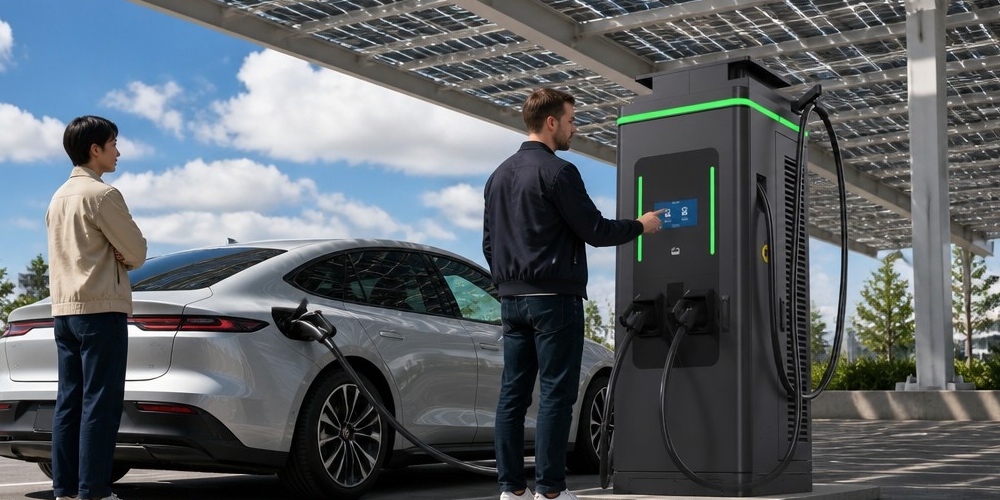
The same SiC revolution that powers Chinese EVs also powers the charging infrastructure they depend on. Chinese manufacturers have industrialized SiC-based power modules for DC fast chargers, enabling 480kW liquid-cooled superchargers that achieve 97-98% efficiency while shrinking cabinet size and weight. The “200km of range in 5 minutes” experience promised by 800V EVs is only possible because the chargers themselves are built on the same wide-bandgap foundation — a symmetry that is unique to the Chinese ecosystem, where vehicle and charger development happen within the same supply chain.
This is the deeper point of the SiC story: China has not simply adopted a new semiconductor material; it has automated the entire pipeline from crystal growth to finished module, and then applied it across both the vehicle and the grid. The compounding effect is that every generation of Chinese EVs and chargers gets cheaper, smaller, and more efficient simultaneously — a rate of improvement that defines the new competitive baseline for the global industry.
23.4 What This Means for the Global Industry
For non-Chinese OEMs and charging operators, the SiC gap is the single most consequential technical divide of this decade. Catching up means not only licensing or buying modules, but rebuilding the automated manufacturing capability behind them. The pragmatic alternatives are partnership with Chinese module makers or heavy investment in domestic wide-bandgap fabs — both of which are happening, but both of which lag the Chinese learning curve by several years.
Conclusion: The Intelligent Manufacturing Edge
China’s intelligent manufacturing revolution is not about robots replacing workers; it is about closing the loop between design, production, and continuous improvement at a speed no other industrial ecosystem can match. In SiC power electronics, that loop has produced the most efficient drivetrains and the most cost-effective charging hardware on earth. As the global auto industry pivots to electric, it is not just competing with Chinese products — it is competing with a manufacturing system that improves itself with every unit produced.
Key Takeaways
- Automated SiC production — from AI-monitored crystal growth to robotic packaging — gives Chinese manufacturing an unmatched cost and yield advantage.
- The same SiC foundation powers both 800V EV drivetrains and ultra-fast charging infrastructure, creating a uniquely integrated ecosystem.
- The global industry’s strategic choices are partnership or catch-up; the Chinese learning curve continues to widen.
Contact MIDA Power is a product of this intelligent manufacturing ecosystem: SiC-based DC fast chargers and liquid-cooled superchargers built on automated, high-yield production lines. For technical specifications, supply-chain discussions, or quotations, contact our team today.
Post time: Aug-09-2026
