
 Portable EV Charger
 Home EV Wallbox
 DC Charger Station
 BESS Charging Station
 V2G V2H V2V V2L
 EV Charging Module
 DC Charging Connector
 EV Accessories
The Comprehensive Technical Guide to Next-Generation EV Charging Solutions for Logistics Fleets: Integrating Advanced Scheduling, AI-Driven Load Balancing, BESS Microgrids, and Cold Chain Optimization for Maximum Uptime and Minimal TCO
1. Introduction: The Paradigm Shift in Logistics Electrification
The logistics industry is currently navigating one of the most significant transformations since the invention of the internal combustion engine. As global regulatory frameworks tighten and the urgency for decarbonization intensifies, the transition to electric vehicles (EVs) has moved from a peripheral corporate social responsibility (CSR) goal to a core operational necessity. For logistics fleets, which operate on razor-thin margins and demanding time-sensitive schedules, the shift to electrification is not merely about replacing diesel trucks with electric ones; it is about reinventing the entire energy ecosystem that powers the movement of goods.
Electrifying a logistics fleet introduces a layer of complexity that traditional refueling never faced. While a diesel truck can be refueled in minutes at any commercial station, an electric fleet requires a sophisticated infrastructure that balances power availability, vehicle downtime, and grid constraints. The “fuel” is now a dynamic resource—electricity—whose price fluctuates by the hour and whose delivery is limited by the physical capacity of the local power grid.
The primary objective for any fleet operator is the optimization of “Uptime” and “Total Cost of Ownership” (TCO). Uptime in the EV context means ensuring that every vehicle has sufficient state-of-charge (SoC) to complete its assigned route without unplanned stops. TCO minimization involves managing the high initial CAPEX of charging infrastructure and the ongoing OPEX of electricity procurement, maintenance, and battery degradation.
This article provides a deep technical exploration into the solutions that enable logistics fleets to thrive in an electrified future. We will examine the integration of Fleet Management Systems (FMS), the application of AI-driven scheduling, the deployment of Battery Energy Storage Systems (BESS), and the unique challenges of specialized sectors like cold chain logistics. By the end of this guide, fleet managers and infrastructure engineers will have a blueprint for building a resilient, cost-effective, and scalable charging ecosystem.
2. The Architecture of Fleet Charging Infrastructure: Depot Strategy and Hardware Selection
The foundation of any successful electrification project is the physical charging infrastructure. Unlike public charging networks, logistics fleet charging is primarily “depot-centric.” The depot serves as the hub where vehicles are parked, loaded, and energized. The architecture of this infrastructure must be designed for reliability, scalability, and efficiency.
2.1 Depot Layout and Flow Optimization
The physical placement of chargers within a logistics hub significantly impacts operational efficiency. A poorly designed layout can lead to “charging bottlenecks,” where vehicles must wait for a stall, or excessive maneuvering that increases the risk of accidents.
- Linear vs. Pull-Through Charging: For smaller delivery vans, linear charging (backing into a stall) is often sufficient. However, for heavy-duty tractors and long-haul trailers, pull-through configurations are preferred to minimize maneuvering time.
- Overhead Charging Systems: In high-density urban depots where floor space is at a premium, pantograph or overhead reel systems can be deployed. These systems keep the cables off the ground, reducing wear and tear and trip hazards.
- Modular Scalability: Initial deployments might only require a few chargers, but the electrical backbone (transformers, switchgear, and trenching) should be sized for the eventual 100% electrification of the fleet. This “dig once” philosophy prevents massive future costs.
2.2 AC vs. DC: Finding the Right Balance
The choice between Alternating Current (AC) and Direct Current (DC) charging is governed by the “dwell time”—the amount of time a vehicle remains parked at the depot.
- AC Charging (Level 2): Typically providing 7kW to 22kW, AC charging is the most cost-effective solution for overnight dwell times. Logistics vans that return to the depot at 6 PM and depart at 6 AM have 12 hours to charge. A 22kW AC charger can deliver over 250kWh in this window, which is more than enough for most last-mile delivery vehicles. The lower cost of AC hardware allows for a 1:1 ratio of chargers to vehicles, eliminating the need for complex vehicle shuffling.
- DC Fast Charging (DCFC): Ranging from 50kW to 350kW (and soon Megawatt Charging Systems or MCS for heavy trucks), DCFC is essential for “opportunity charging.” This occurs during driver shift changes, loading/unloading periods, or mid-day breaks. While DC hardware is significantly more expensive, it provides the high-power injection needed to keep high-utilization vehicles on the road.
2.3 Connector Standards and Interoperability
In a mixed-fleet environment, interoperability is critical. While CCS (Combined Charging System) is the dominant standard in Europe and North America, and GB/T in China, fleet operators must ensure that their Charging Management System (CMS) can communicate with various hardware brands via the Open Charge Point Protocol (OCPP). This prevents “vendor lock-in” and allows the fleet to integrate new vehicle types and charger models as the technology evolves.
3. Closed-Loop Data Integration: Synergizing FMS and CPMS
The most significant efficiency gains in fleet charging are found not in the hardware, but in the software. Specifically, the integration between the Fleet Management System (FMS) and the Charge Point Management System (CPMS) creates a “closed-loop” data environment that transforms charging from a passive activity into an optimized operational process.
3.1 The FMS-CPMS Data Bridge
Traditionally, the FMS handles route planning, driver behavior, and vehicle maintenance, while the CPMS manages the chargers’ status and energy flow. In an optimized EV fleet, these two systems must talk to each other in real-time.
- Route Data to CPMS: The FMS informs the CPMS when a vehicle is expected to arrive at the depot and what its current SoC is. It also provides the “Departure SoC Requirement” based on the next day’s planned route length, elevation changes, and weather conditions.
- Charger Status to FMS: The CPMS informs the FMS of charger availability and health. If a high-power DC charger is down for maintenance, the FMS can proactively reassign vehicles to different routes or adjust departure times to account for slower charging.
3.2 Automated Dispatch and Charging Assignment
In a large fleet, manually deciding which vehicle plugs into which charger is impossible. A closed-loop system automates this:
- Vehicle Arrival: A van enters the depot; its telematics system transmits its SoC (e.g., 20%).
- Task Analysis: The FMS looks at tomorrow’s schedule; this van is assigned a 150-mile route requiring 80% SoC by 7 AM.
- Slot Allocation: The CPMS identifies an available 22kW AC charger. It calculates that the van needs 6 hours of charging to hit the target.
- Priority Queuing: If the depot is at its power limit, the CPMS delays the start of this van’s session until 11 PM to take advantage of lower electricity rates, knowing it will still meet the 7 AM deadline.
3.3 Battery Health Monitoring
Continuous data flow allows for sophisticated battery health monitoring. By tracking the charging curves and temperature profiles of each vehicle, the system can identify premature degradation. If a specific vehicle consistently shows high internal resistance during charging, it can be flagged for maintenance before a breakdown occurs on the road. This predictive maintenance is vital for maintaining the high uptime required in logistics.
4. Advanced Scheduling Algorithms for Optimized Fleet Uptime
In a logistics environment, scheduling is the heartbeat of operations. With the introduction of EVs, the schedule must now account for energy as a finite, time-constrained resource. Advanced scheduling algorithms are required to harmonize vehicle availability with charging requirements, ensuring that no route is missed due to a low battery.
4.1 The Vehicle-Charger Coupling Problem
At its core, fleet charging is a complex optimization problem. We must match $N$ vehicles with $M$ chargers over a time horizon $T$, subject to numerous constraints. This is often modeled as a variation of the “Job Shop Scheduling Problem” or the “Vehicle Routing Problem with Time Windows (VRPTW).”
- Variables: Vehicle ID, Arrival Time, Current SoC, Target SoC, Departure Time, Charger Type, and Power Rating.
- Constraints: Grid power limits (kW), total energy capacity (kWh), driver labor hours, and maintenance windows.
4.2 Mathematical Modeling of Charging Priorities
Not all vehicles are created equal in the eyes of a scheduler. An algorithm must prioritize charging based on several factors:
- Slack Time: The difference between the time required to charge and the time remaining until departure. A vehicle with zero slack time must start charging immediately at maximum power.
- Route Criticality: High-priority deliveries (e.g., medical supplies or high-value electronics) may receive charging priority over routine stock transfers.
- Battery State: Vehicles at very low SoC may be prioritized to prevent battery damage or to allow for quick “rescue” deployment if another vehicle fails.
4.3 Heuristics and Meta-heuristics
Because the number of variables in a large depot (100+ vehicles) leads to a combinatorial explosion, simple linear programming is often too slow for real-time adjustments.
- Genetic Algorithms (GA): These are used to evolve an optimal schedule by simulating “survival of the fittest” among various scheduling strategies. GAs are excellent at finding near-optimal solutions in complex environments with many local minima.
- Simulated Annealing: This technique helps the system “jump” out of inefficient scheduling patterns to find a globally optimal energy distribution.
- Real-time Re-optimization: If a vehicle returns late due to traffic, the algorithm must instantaneously re-calculate the entire depot’s charging plan. This prevents a single delay from cascading into a fleet-wide crisis.
5. Load Balancing and Dynamic Power Allocation: A Technical Deep Dive
One of the greatest barriers to fleet electrification is the “Grid Constraint.” Most logistics parks were designed for lighting and conveyor belts, not for simultaneously charging dozens of heavy trucks. Upgrading a grid connection can cost millions and take years. Load balancing (or Smart Charging) is the technical solution that bypasses these physical limits.
5.1 Static vs. Dynamic Load Management
- Static Load Management (SLM): This involves setting a hard limit for each charger. For example, if a depot has a 100kW limit and 10 chargers, each is capped at 10kW. While simple, SLM is highly inefficient. If only one truck is plugged in, it still only gets 10kW, even though 100kW is available.
- Dynamic Load Management (DLM): This is the gold standard for fleet operators. A central controller monitors the total depot load in real-time. If only one truck is plugged in, it receives the full 100kW. As more trucks arrive, the power is dynamically redistributed based on the priority algorithms discussed in Chapter 4.
5.2 Local vs. Cloud-based Control
- Local Controllers: A physical hardware device on-site (often an Edge Gateway) manages the chargers. The primary advantage is latency and reliability; the system works even if the internet goes down.
- Cloud-based Controllers: The logic resides in a remote server. This allows for better integration with utility price signals (demand response) and cross-site management, but it introduces a dependency on connectivity. A hybrid approach—cloud logic with local fail-safe—is generally recommended.
5.3 Phase Balancing and Power Quality
In three-phase electrical systems, it is crucial to balance the load across all three phases. If too many single-phase chargers are active on one phase, it can lead to voltage instability and equipment damage. Sophisticated DLM systems monitor phase usage and can switch charging sessions between phases (if the hardware supports it) or modulate power to maintain equilibrium. Furthermore, managing “Total Harmonic Distortion” (THD) is essential to prevent interference with other sensitive logistics equipment, like automated sorting systems and servers.
6. The Role of Battery Energy Storage Systems (BESS) in Peak Shaving and Load Shifting
To truly optimize TCO, logistics fleets must become “Energy Prosumers”—entities that both consume and manage energy. Integrating a Battery Energy Storage System (BESS) into the depot infrastructure is a game-changer for economic and operational resilience.
6.1 Peak Shaving: Reducing Demand Charges
In many regions, a significant portion of a commercial electricity bill is determined by the “Peak Demand”—the highest amount of power used in any 15-minute interval during the month. A fleet of 50 electric vans starting to charge simultaneously at 6 PM creates a massive demand spike. A BESS can “shave” this peak by discharging stored energy during these high-demand periods. Instead of pulling 500kW from the grid, the depot pulls 250kW from the grid and 250kW from the BESS. This reduction in demand charges can save a fleet operator thousands of dollars per month, often paying for the BESS in under five years.
6.2 Load Shifting: Arbitraging Energy Prices
Electricity prices are rarely static. Through “Time-of-Use” (ToU) rates, electricity is cheap at night (off-peak) and expensive during the afternoon (on-peak). A BESS allows a depot to “buy low and use high.” The storage system charges from the grid during the night when rates are at their lowest. During the day, when vehicles return for a quick top-up during expensive on-peak hours, they are charged from the BESS rather than the grid.
6.3 Emergency Backup and Islanding
Logistics is a business where downtime is unacceptable. A grid outage can paralyze an electric fleet. A BESS, combined with an intelligent microgrid controller, allows the depot to “island” itself. In the event of a blackout, the BESS provides the necessary power to keep essential vehicles charging and maintain critical depot operations (like refrigeration and security).
6.4 Second-Life EV Batteries in BESS
A burgeoning trend in logistics is the use of “Second-Life” batteries. When an EV battery’s capacity drops to 70-80%, it may no longer be suitable for a high-range delivery route, but it is perfectly capable of stationary storage. By repurposing old fleet batteries into a depot BESS, operators can lower the CAPEX of their storage systems while improving the environmental lifecycle of their vehicles.
7. Microgrid Construction in Modern Logistics Parks: Integrating Solar, Storage, and Grid
As logistics hubs evolve into energy hubs, the construction of on-site microgrids has become a strategic priority. A microgrid is a localized group of electricity sources and loads that normally operates connected to and synchronous with the traditional wide-area synchronous grid, but can also disconnect to “island mode”—and function autonomously as physical or economic conditions dictate.
7.1 Solar Photovoltaic (PV) Integration
Logistics centers are ideal candidates for solar power due to their massive, flat roof areas. A typical warehouse can host several megawatts of solar capacity.
- System Sizing: Engineers must balance the “Self-Consumption Rate” (SCR) with the “Self-Sufficiency Rate” (SSR). Sizing a system too large can lead to excess energy that might be sold back to the grid at low rates, while sizing it too small fails to significantly impact the charging TCO.
- Mounting and Structural Integrity: Logistics roofs are often designed for minimal loads. Modern ultra-lightweight PV modules and specialized racking systems are necessary to avoid expensive structural reinforcements.
- Inverter Technology: String inverters are common for their reliability, but micro-inverters or DC optimizers are increasingly used in logistics parks where skylights, HVAC units, or varying roof orientations might cause shading issues.
7.2 Microgrid Control Systems (MCS)
The MCS is the “brain” of the logistics park. It manages the flow of energy between the solar array, the BESS, the EV chargers, and the utility grid.
- Predictive Generation Forecasting: The MCS uses local weather data to predict solar output. If a cloudy afternoon is expected, the system might preserve BESS energy instead of using it for morning peak shaving.
- Economic Optimization: The MCS continuously evaluates the cost of grid power versus the cost of stored energy and the value of selling solar back to the grid. It makes real-time decisions to minimize the daily energy bill.
- Grid Services: A well-equipped microgrid can participate in Frequency Regulation or Voltage Support markets, turning the logistics park from an energy cost-center into a revenue-generating asset for the utility company.
7.3 Infrastructure for Resilience
Construction of a microgrid requires specialized switchgear and protection relays that can handle bidirectional power flow and rapid disconnection from the grid. For logistics fleets, this resilience ensures that even during regional grid failures, the fleet can maintain a minimum level of service, which is critical for essential supply chains.
8. Cold Chain Logistics: Addressing Specialized Power Requirements and Resilience
Cold chain logistics represents the most challenging frontier for electrification. Transporting temperature-sensitive goods—such as pharmaceuticals, fresh produce, and frozen foods—requires continuous, high-power energy for Transport Refrigeration Units (TRUs). Unlike a standard delivery van, a refrigerated truck’s energy consumption is split between propulsion and thermal management.
8.1 The Dual Energy Burden
For an electric refrigerated truck, the battery must power both the motor and the cooling system. This leads to significantly faster SoC depletion, especially in hot climates or during frequent door-opening cycles.
- Technical Specification: A typical TRU might require 5kW to 15kW of continuous power. On a 10-hour route, this can consume 100kWh or more—often 30-50% of the total battery capacity of a medium-duty truck.
- Pre-Cooling Strategies: One of the most effective ways to optimize cold chain charging is “Shore Power Pre-Cooling.” While the vehicle is plugged into the depot charger, the TRU uses grid power to bring the cargo area to the target temperature before departure. This ensures the truck leaves with a “full tank” of thermal energy and a full battery for propulsion.
8.2 Integration of TRUs into the Charging Management System
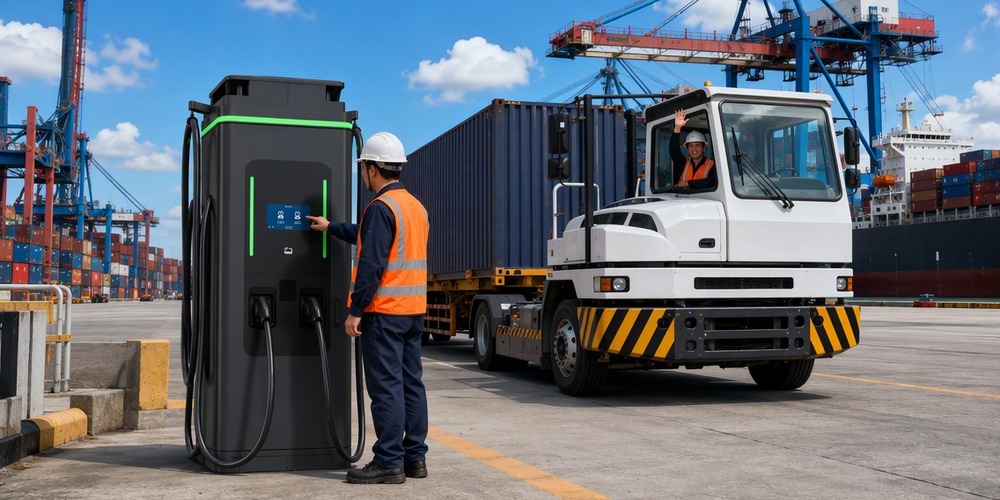
The CPMS must treat the TRU as a separate, critical load.
- Standby Power Management: When a refrigerated trailer is parked but still loaded, it must remain powered. The CPMS must prioritize these “active loads” even if other vehicles are waiting for a charge.
- E-TRU (Electric TRU) Architectures: Modern designs use high-voltage DC directly from the traction battery to power the refrigeration compressor, rather than using an inefficient inverter or a separate diesel engine. This integration requires sophisticated communication between the truck’s Battery Management System (BMS) and the refrigeration controller.
8.3 Redundancy and Safety
In the cold chain, a power failure is not just an inconvenience—it is a total loss of cargo. Logistics parks specializing in cold chain must have “n+1″ redundancy in their charging infrastructure. This often involves dedicated backup generators (or massive BESS units) specifically reserved for the refrigeration load, ensuring that even if the propulsion charging fails, the cooling never stops.
9. AI-Based Charging Priority Models: Predictive Analytics and Real-Time Optimization
As fleets scale to hundreds of vehicles, the number of permutations for charging schedules becomes astronomical. Artificial Intelligence (AI) and Machine Learning (ML) are no longer optional; they are the engines that drive efficiency.
9.1 Predictive Arrival and SoC Forecasting
AI models can predict when a vehicle will arrive at the depot and what its SoC will be with high accuracy.
- Data Inputs: The model ingests real-time GPS data, historical traffic patterns, driver behavior (aggressive vs. eco-driving), and ambient temperature (which affects battery efficiency).
- Algorithm Type: Recurrent Neural Networks (RNNs) or Long Short-Term Memory (LSTM) networks are particularly effective at processing this time-series data to forecast the energy needs of each returning vehicle hours before they arrive.
9.2 Reinforcement Learning (RL) for Power Steering
Standard rule-based systems (e.g., “Charge Van A first”) are too rigid for dynamic environments. Reinforcement Learning allows the CPMS to “learn” the optimal strategy through trial and error in a simulated environment.
- Agent Reward Functions: The RL agent is “rewarded” for meeting all departure deadlines and minimizing total energy cost, and “penalized” for peak demand spikes or missed routes.
- Real-time Adaptation: If a driver reports a faulty connector or an unexpected detour, the RL-based system can adjust the power allocation to all other vehicles in milliseconds, ensuring the overall fleet objective is still met.
9.3 Battery Life Optimization through AI
Fast charging generates heat, which accelerates battery degradation. AI can manage “Charge Profiles” that balance the need for speed with the longevity of the battery. By analyzing the “State of Health” (SoH) of each battery pack, the AI can slow down the charging rate for older batteries or during high ambient temperatures, extending the vehicle’s operational life by 15-20% and significantly improving the TCO.
10. TCO Minimization Strategies: CAPEX vs. OPEX and V2G Potential
The decision to electrify a logistics fleet is ultimately a financial one. While the environmental benefits are clear, the economic viability depends on achieving a Total Cost of Ownership (TCO) that is competitive with, or superior to, traditional diesel operations. TCO in the context of EV charging is divided into two primary categories: Capital Expenditures (CAPEX) and Operating Expenditures (OPEX).
10.1 Breaking Down CAPEX: The Cost of Infrastructure
The initial investment for fleet charging is often the largest hurdle.
- Hardware Costs: DC fast chargers can range from $20,000 to over $100,000 per unit, depending on power rating and features. AC chargers are more affordable ($500 – $3,000) but require more units to cover a large fleet.
- Installation and Trenching: A significant portion of CAPEX is hidden underground. Running high-voltage conduits across a large logistics yard involves extensive civil works, which can often exceed the cost of the chargers themselves.
- Grid Upgrades: If the local utility needs to install new transformers or substations to handle the depot’s load, these costs are often passed on to the fleet operator.
- Permitting and Engineering: The “Soft Costs”—including site design, electrical engineering, and local government permits—can account for 10-20% of the total CAPEX.
10.2 Analyzing OPEX: The Cost of Energy and Upkeep
The advantage of EVs lies in their lower operational costs, provided the infrastructure is managed correctly.
- Electricity Procurement: As discussed in previous chapters, managing peak demand and leveraging off-peak rates is critical. Advanced software integration can reduce energy costs by 30-50% compared to unmanaged charging.
- Maintenance and Network Fees: Chargers are high-power electronics exposed to the elements and heavy usage. Annual maintenance contracts and software subscription fees for the CPMS are ongoing costs that must be factored into the budget.
- Staff Training: Operational downtime due to “human error” (e.g., a driver forgetting to plug in) is an indirect OPEX cost. Investing in training and automated notification systems is essential.
10.3 Vehicle-to-Grid (V2G) and Vehicle-to-Building (V2B)
V2G technology allows the fleet to act as a massive mobile battery. During periods of peak grid stress, parked EVs can discharge energy back into the grid, receiving payments from the utility provider.
- Technical Challenges: V2G requires bidirectional chargers and specialized vehicle hardware. It also increases battery cycling, which could potentially impact long-term battery health—though AI-driven management can mitigate this.
- Revenue Potential: For a fleet of 100 trucks, each with a 300kWh battery, the total storage capacity is 30MWh. Even discharging a small fraction of this during high-price events can generate significant revenue, further offsetting the TCO.
- V2B for Resilience: In a V2B setup, the fleet can power the logistics warehouse during a blackout or peak price window, reducing the facility’s demand from the grid.
10.4 Financing Models: Charging as a Service (CaaS)
To avoid the massive upfront CAPEX, many logistics providers are turning to “Charging as a Service.” In this model, a third-party provider installs, owns, and operates the infrastructure. The fleet operator pays a monthly fee or a per-kWh rate. This shifts the financial burden from CAPEX to OPEX, making electrification more accessible for smaller fleets or those with limited capital.
11. Regulatory Compliance, Grid Standards, and Future Scalability
Navigating the regulatory landscape is a critical component of fleet electrification. Governments and utility commissions are rapidly evolving standards to ensure safety, interoperability, and grid stability.
11.1 Interoperability and the ISO 15118 Standard
ISO 15118, also known as “Plug & Charge,” is the international standard for vehicle-to-charger communication.
- Automatic Authentication: With ISO 15118, the vehicle and charger automatically handle identification and billing through digital certificates. The driver simply plugs in the cable, and the session starts. For a logistics fleet, this eliminates the need for RFID cards or mobile apps, streamlining operations.
- Advanced Smart Charging: The standard supports sophisticated bidirectional communication, allowing the vehicle to tell the charger its exact energy needs and battery health, facilitating better AI optimization.
11.2 Cybersecurity in Charging Infrastructure
As charging networks become part of the critical national infrastructure, they become targets for cyberattacks.
- OCPP Security: The Open Charge Point Protocol has evolved to include robust security layers (OCPP 2.0.1 and later). Data encryption, secure boot processes for chargers, and multi-factor authentication for management platforms are non-negotiable.
- Vulnerability Management: A breach in the CPMS could allow an attacker to shut down an entire fleet or cause grid instability by simultaneously triggering maximum power draw across multiple sites. Fleet operators must implement strict network segmentation and regular security audits.
11.3 Environmental Reporting and ESG Compliance
Logistics companies are under increasing pressure from customers and investors to report their carbon footprint.
- Scope 2 and Scope 3 Emissions: Electrification directly reduces Scope 1 emissions (tailpipe). However, companies must also track Scope 2 (the emissions from the electricity used to charge) and Scope 3 (the lifecycle emissions of the batteries and infrastructure).
- Real-time Carbon Tracking: Advanced CPMS platforms can track the carbon intensity of the grid in real-time, allowing fleets to prioritize charging when renewable energy (wind/solar) is most prevalent on the grid, further improving their ESG (Environmental, Social, and Governance) scores.
11.4 Scalability: From Pilot to Pervasive
The technical challenges of charging 10 vehicles are vastly different from charging 1,000.
- Modular Power Blocks: Scalability is achieved by using modular power cabinets that can be expanded as the fleet grows.
- Software Horizontal Scaling: The management platform must be built on cloud-native architecture (e.g., Kubernetes) to handle the massive data influx from thousands of simultaneous charging sessions without latency.
12. Case Studies and Future Trends in Mega-Fleet Electrification
To understand the practical application of these technologies, we can look at the emerging blueprints of “Mega-Depots” currently being deployed by global logistics leaders.
12.1 Case Study: The 500-Vehicle Parcel Delivery Hub
A leading global courier service recently electrified a major urban distribution center.
- The Challenge: 500 electric vans returning every evening with less than 20% SoC, all needing to be at 100% by 6 AM. The available grid capacity was only 40% of the total theoretical load.
- The Solution: Deployment of 250 dual-port AC chargers managed by an AI-driven CPMS. Integration of a 2MW/4MWh BESS and 500kW of rooftop solar.
- The Result: The AI system staggered charging throughout the night, ensuring all vehicles were ready for departure. The BESS shaved evening peaks, avoiding $15,000 per month in demand charges. The project achieved a positive ROI in 4.2 years.
12.2 Future Trends: The Road to Autonomy and Beyond
The future of logistics charging is increasingly automated and integrated.
- Automated Cable Handling and Robotic Charging: For autonomous trucks, human intervention during charging is a bottleneck. Robotic arms or under-vehicle induction (wireless) charging systems are being developed to allow for completely autonomous depot operations.
- Megawatt Charging System (MCS): Designed for heavy-duty long-haul trucking, MCS will provide over 1,000kW of power, allowing a Class 8 truck to add 300 miles of range in less than 30 minutes. This will revolutionize middle-mile and long-haul logistics.
- Solid-State Batteries: While still in the development phase, solid-state batteries promise higher energy density and faster charging speeds with lower fire risk, which will further reduce the charging footprint and time requirements in logistics parks.
Conclusion
Electrifying a logistics fleet is a multi-dimensional challenge that requires a synergy of hardware, software, and financial engineering. By integrating Fleet Management Systems with intelligent Charging Platforms, leveraging AI for predictive optimization, and deploying microgrid technologies like BESS and solar, fleet operators can not only meet environmental mandates but also build a more resilient and cost-effective operation.
The transition to electric logistics is no longer a question of “if,” but “how fast.” The technical solutions detailed in this guide provide the roadmap for navigating this transition, ensuring that the wheels of global commerce continue to turn—more cleanly, more efficiently, and more profitably than ever before. As the grid evolves and battery technology matures, the logistics depot of the future will stand as a beacon of the sustainable energy revolution, proving that high-performance freight and environmental stewardship can go hand-in-hand.
Technical Appendix: Glossary of Terms and Standards in Logistics Electrification
To facilitate a deeper understanding for engineers and fleet managers, this appendix provides a technical glossary of the key terms and international standards mentioned throughout this guide.
- AC (Alternating Current): The form in which electric power is delivered to businesses. For EV charging, an on-board charger in the vehicle converts AC to DC to store energy in the battery.
- BESS (Battery Energy Storage System): A system that stores energy using battery technology for later use. In logistics, it is used for peak shaving, load shifting, and backup power.
- CCS (Combined Charging System): A standard for charging electric vehicles which uses a single connector for both AC and DC charging.
- CPMS (Charge Point Management System): The software pplatform that orchestrates charger scheduling, energy allocation, and driver authentication across a depot. The CPMS is the “brain” that converts the fleet management system’s departure requirements into per-charger power commands, ensuring every vehicle leaves on time without overloading the site’s grid connection.
- CSMS (Charge Station Management System): The back-office software layer that aggregates data from multiple CPMS installations, handles billing, monitors charger health, and reports to the fleet’s telematics platform.
- DCFC (Direct Current Fast Charging): Charging that bypasses the vehicle’s onboard charger, delivering DC power directly to the battery at power levels from 30kW to over 1MW. DCFC is the enabling technology for electric trucks and vans that must return to service quickly.
- Demand Charge: A utility fee based on the highest power draw (kW) during a billing period, typically averaged over 15 minutes. Demand charges often represent 30-60% of a depot’s electricity bill and are the primary driver of BESS adoption in logistics.
- Depot Charging: The practice of charging fleet vehicles at their home base, typically overnight using lower-power AC or medium-power DC chargers, supplemented by en-route fast charging for long-haul duty cycles.
- ISO 15118: The international standard for vehicle-to-grid communication, enabling Plug & Charge (automatic authentication), smart charging based on grid signals, and bidirectional power flow (V2G).
- OCPP (Open Charge Point Protocol): The open, vendor-neutral communication protocol between chargers and the CPMS/CSMS. OCPP ensures that a depot’s hardware is never locked to a single software vendor, protecting the fleet operator’s long-term flexibility.
- SoC (State of Charge): The percentage of usable energy remaining in a battery. Fleet scheduling algorithms treat SoC as the primary constraint: each vehicle must reach its minimum required SoC by its planned departure time.
- TOU (Time-of-Use) Tariff: A utility rate structure with different prices at different times of day. Overnight depot charging exploits low off-peak rates, while BESS and AI load balancing protect the operator during peak windows.
- V2G (Vehicle-to-Grid): The ability of an EV to export power back to the grid or building. For depots with predictable idle periods, V2G turns the fleet itself into a revenue-generating storage asset.
- V2L (Vehicle-to-Load): The ability of an EV to power external equipment. For logistics operators, this enables “tool-of-trade” applications such as powering lift gates, refrigeration units, or portable workshop equipment.
- C-Rate: The measure of a battery’s charge or discharge speed relative to its capacity. A 1C rate charges a 100kWh battery at 100kW in one hour; a 4C rate (typical for heavy-duty fast charging) charges it in 15 minutes.
Closing Note
This glossary reflects the vocabulary of a mature, standards-driven industry. The fleet operators who master these terms — and the technologies behind them — will be the ones who convert electrification from a compliance burden into a competitive advantage.
Contact MIDA Power supplies the hardware at the heart of modern logistics depots: depot DC fast chargers, liquid-cooled superchargers, and BESS-integrated charging systems that cut demand charges and keep fleets moving. For specification sheets, integration guidance, or a quotation sized to your fleet, contact our team — our engineers will help you electrify your depot on a clear, bankable roadmap.
Post time: Aug-09-2026
