
 Portable EV Charger
 Home EV Wallbox
 DC Charger Station
 BESS Charging Station
 V2G V2H V2V V2L
 EV Charging Module
 DC Charging Connector
 EV Accessories
Analyzing the International Energy Agency’s Strategic Verdict Regarding China’s Pivotal Role as the Decisive Global Catalyst for Accelerating Electric Vehicle Adoption and the Resulting Transformation of Worldwide Energy Consumption Patterns
1. Introduction: The IEA’s 2026 Watershed Moment
The International Energy Agency (IEA), long considered the global arbiter of energy trends and policy analysis, released its definitive “Global EV Outlook 2026″ report with a conclusion that has reverberated through every capital city and corporate boardroom: China has officially become the “Global Catalyst” for the acceleration of electric vehicle (EV) adoption.
For years, the IEA has tracked the steady rise of electric mobility, but the 2026 report marks a shift in tone. It is no longer just observing China as a leader in its own right; it is identifying China as the primary engine driving the entire world’s transition away from the internal combustion engine (ICE). According to the IEA, without the scale, innovation, and cost-reduction achieved by the Chinese automotive sector, the global goal of reaching net-zero emissions by 2050 would be effectively unattainable.
This article provides a deep-dive analysis into the IEA’s verdict. We will explore how China’s domestic success has lowered the global cost curve for batteries, how its policy framework has served as a blueprint for other nations, and the technical and geopolitical implications of this “Catalyst Role.” Furthermore, we will examine the IEA’s data on energy security, showing how Chinese-led EV adoption is fundamentally altering global oil demand and reshaping the strategic priorities of both energy-producing and energy-consuming nations.
2. The “Catalyst” Defined: The Economics of Global Scale
The most critical aspect of the IEA’s verdict is the concept of China as a cost catalyst. In the world of technology, scale is the ultimate driver of affordability, and China has provided that scale at an unprecedented level.
2.1 Lowering the Battery Cost Floor
The battery is the single most expensive component of an EV. The IEA report highlights that Chinese manufacturing efficiency has brought battery pack prices down to below $100/kWh across a wide range of chemistries—a threshold long considered the “tipping point” for price parity with ICE vehicles.
- The LFP Multiplier: China’s mastery and mass production of Lithium Iron Phosphate (LFP) batteries have been the primary driver of this cost reduction. By proving that LFP could meet the range and performance needs of the average consumer, Chinese firms forced the global industry to re-evaluate its reliance on more expensive nickel and cobalt-based chemistries.
- Global Benefit: This cost reduction is not confined to China. By exporting cells and components, and by setting a lower global price benchmark, Chinese firms have enabled Western and Japanese OEMs to offer more competitive EVs than would have been possible in a world without Chinese competition.
2.2 The “Flywheel Effect” of Infrastructure
The IEA emphasizes that China’s role as a catalyst is equally about infrastructure as it is about vehicles.
- Ubiquity as a Driver: With over 4 million public charging piles by the end of 2025, China has demonstrated that widespread adoption is impossible without a visible, reliable, and standardized charging network.
- The Infrastructure Blueprint: The IEA points to China’s “moderate lead” strategy—where charging infrastructure is built slightly ahead of market demand—as the most effective way to eliminate range anxiety and accelerate the transition. Many European and Southeast Asian nations are now adopting this Chinese-pioneered approach.
3. Market Penetration Metrics: A Global Divergence
The IEA’s 2026 data shows a fascinating divergence in how different regions are responding to the “China Catalyst.”
3.1 China: The 50% Threshold
In 2026, China has reached a historic milestone where over 50% of all new passenger car sales are New Energy Vehicles (NEVs). This rapid adoption is the proof of concept that the rest of the world is following. The IEA notes that this transition occurred faster in China than any previous technological shift in the history of the automobile.
3.2 The European Union: Accelerating Despite Headwinds
The EU remains the second-largest EV market, with adoption rates hovering around 25-30% in 2026. The IEA verdict suggests that while the EU has its own strong domestic manufacturers, the presence of affordable Chinese models has acted as a “competitive stimulant,” forcing European brands like Volkswagen and Renault to accelerate their own EV plans to protect their market share.
3.3 The United States: The Lagging Powerhouse
The US adoption rate trails at approximately 12-15% in 2026. The IEA attributes this to a combination of lower gasoline prices, a lack of charging infrastructure in the mid-west and rural areas, and trade policies that have limited the entry of low-cost Chinese EVs. However, the report suggests that the “China Catalyst” is still felt through the supply chain, as US-based battery plants are heavily reliant on Chinese manufacturing technology and equipment.
4. Policy as a Blueprint: The Global Impact of the “China Model”
The IEA’s analysis goes beyond market forces to examine the policy innovations that China has exported to the world.
4.1 The NEV Credit System
China’s “Parallel Management” system (the Dual-Credit system) is cited by the IEA as a masterclass in industrial policy. By mandating a percentage of production be zero-emission, the Chinese government forced innovation and ensured a steady supply of EVs. Variants of this system are now being discussed in several emerging economies as they look to build their own EV industries.
4.2 Localized Manufacturing Requirements
China’s early requirement for foreign firms to form joint ventures was controversial, but in 2026, it is being looked at by nations like Indonesia, Brazil, and Thailand as a model for “Value-Added” manufacturing. These countries are now requiring Chinese EV firms to build local factories and share technology in exchange for market access, a direct evolution of the strategy China used a decade ago.
5. The Supply Chain Multiplier: Benefiting Global OEMs
Perhaps the most surprising part of the IEA verdict is the acknowledgement that Chinese dominance actually helps Western automakers in their own transition.
5.1 The “Hardware-as-a-Service” for Global Brands
The IEA notes that almost every major global OEM—from Tesla and Ford to Mercedes-Benz—is integrated into the Chinese supply chain.
- Shared Platforms: The trend of Western brands using Chinese platforms (e.g., Volkswagen using XPENG’s platform, or Toyota using BYD’s battery and motor technology) is described by the IEA as a pragmatic response to China’s role as the “Technical Base” of the industry.
- Cost Sharing: By leveraging the massive volume of the Chinese market, global brands can achieve economies of scale that would be impossible if they relied solely on their smaller domestic markets.
5.2 The Resilience of the Battery Ecosystem
The IEA report argues that while “de-risking” is a common political theme, the physical reality of the battery supply chain in 2026 makes total decoupling nearly impossible. China’s role in refining 60% of the world’s lithium and 90% of its graphite makes it the “Linchpin” of global EV production. The IEA verdict suggests that the goal should not be isolation from China, but rather building a more diversified global supply chain that still leverages Chinese expertise.
(To be continued in the next section with Energy Security, Technical Base, and the IEA’s 2030 Roadmap…)
6. The Energy Security Perspective: Redefining Global Power Dynamics
The IEA’s most profound impact analysis focuses on how Chinese-led EV adoption is fundamentally altering the global energy balance. The verdict is clear: EVs are the most effective weapon against oil dependency.
6.1 Displacing the Barrel: The Decline of Road Transport Oil Demand
The 2026 report provides striking data on oil displacement.
- Volume Metrics: By 2026, the global fleet of electric vehicles (led by China’s massive domestic numbers) is displacing over 2.5 million barrels of oil per day. For the first time, the IEA sees a clear “peak and plateau” in global oil demand for passenger road transport.
- The China Factor: Over 50% of this displacement is happening within China. This has significant implications for China’s own energy security, reducing its reliance on vulnerable maritime oil routes (like the Strait of Malacca) and improving its trade balance.
6.2 Strategic Reserves and the Grid as a Battery
The IEA verdict points to a new form of energy security: the “Strategic Electric Reserve.”
- V2G and Grid Resilience: As millions of EVs are connected to the grid, they act as a massive, distributed battery. The IEA highlights China’s early leadership in Vehicle-to-Grid (V2G) pilot programs as a model for how nations can handle the intermittency of renewable energy.
- The Shift from Molecules to Electrons: Energy security is no longer just about securing oil fields; it is about securing the minerals for batteries and the stability of the electric grid. The IEA argues that China’s head start in both areas has given it a “First Mover Advantage” that other nations are now scrambling to replicate.
7. Technical Foundation: The Export of Standards and Intelligence
China’s role as a catalyst is not just about the volume of cars, but about the “Language” of the electric era.
7.1 Charging Standards and Global Interoperability
The IEA verdict acknowledges that the battle over charging standards (GB/T vs. CCS vs. NACS) is being heavily influenced by China’s export of hardware.
- Hardware-Software Synergy: When Chinese firms like Teison export charging stations to Europe or Southeast Asia, they aren’t just selling hardware; they are exporting the software protocols (like OCPP 2.0.1) and user experiences that have been refined in the world’s most demanding EV market.
- Simplifying the User Experience: The IEA report praises the “Plug & Charge” and integrated payment ecosystems pioneered in China, noting that these technical foundations are being adopted globally to make EV ownership as seamless as using a smartphone.
7.2 The Software-Defined Vehicle (SDV) Paradigm
The IEA identifies China as the leader in the “Intelligence” of EVs.
- Intelligent Cockpits as a Standard: The verdict notes that Chinese EVs have set a new global standard for what a car interior should be. Features like AI-driven voice control, massive interactive screens, and seamless cloud integration are no longer luxuries; they are expectations set by the Chinese market.
- OTA as a Lifeblood: The report highlights that the ability to update a vehicle’s range, performance, and safety features over-the-air (OTA) is a technical base that Chinese firms have mastered, significantly reducing the “depreciation of technology” that plague traditional ICE vehicles.
8. Geopolitical Tensions vs. Climate Goals: The IEA’s Balancing Act
The IEA report does not shy away from the friction between trade policy and environmental necessity.
8.1 The “Green Trade War”
The IEA verdict suggests that the imposition of tariffs on Chinese EVs (such as by the EU and US) creates a “Green Paradox.”
- Cost vs. Speed: Protectionist measures might save domestic jobs in the short term, but they increase the cost of EVs for consumers and slow down the rate of adoption, making it harder to meet climate targets.
- The IEA’s Recommendation: The Agency calls for “Cooperative Competition,” where nations compete to build the best EVs while maintaining open supply chains for critical minerals and technology.
8.2 The Global South and “Technology Transfer”
The IEA highlights China’s role in the “Decarbonization of the Developing World.”
- Affordability for Emerging Markets: In regions like Southeast Asia, Africa, and Latin America, Western EVs are often priced out of the market. The IEA notes that Chinese brands are providing the affordable models that will allow these nations to bypass the “ICE phase” of development, moving directly to electric mobility.
- Localized Value Chains: The verdict emphasizes the importance of Chinese firms building factories in these regions, creating jobs and transferring knowledge, which strengthens the global “EV Catalyst” effect.
9. Sustainability and the Life Cycle Analysis (LCA)
A critical part of the IEA’s 2026 verdict is the deep-dive into the environmental impact of Chinese-produced EVs.
9.1 The “Zero-Carbon Factory” Initiative
The IEA report provides data showing that the carbon intensity of Chinese EV production is falling rapidly.
- Green Power for Production: Chinese battery giants like CATL and BYD are increasingly powering their gigafactories with onsite wind and solar energy. The IEA notes that some of these facilities are now reaching “Net-Zero” status, neutralizing the argument that Chinese EVs are simply “moving emissions from the tailpipe to the smokestack.”
- Material Efficiency: Advances in recycling and the recovery of critical minerals in China are highlighted as a technical base that is lowering the environmental footprint of each vehicle produced.
9.2 The “Battery Passport” and Transparency
The IEA verdict supports the global rollout of the “Battery Passport”—a digital twin for every battery that tracks its origins, carbon footprint, and recycled content.
- Setting the Global Standard: The report notes that Chinese firms are early adopters of these transparency tools, which will be essential for maintaining market access in the EU and North America as new environmental regulations take effect.
(Continuing with even more depth: The IEA’s Strategic Roadmap 2026-2035, Macroeconomic Impact, and the Final Verdict…)
10. The IEA’s STEPS and APS Scenarios: China’s Role in the Global Roadmap
The IEA’s 2026 report uses two primary scenarios to project the future of the energy transition: the Stated Policies Scenario (STEPS) and the Announced Pledges Scenario (APS). In both, China is the linchpin.
10.1 The STEPS Scenario: The Baseline of Dominance
In the STEPS scenario, which looks at what will happen based only on current policies, the IEA projects that China will continue to account for over 50% of the global EV stock until at least 2030.
- The “Natural” Adoption Rate: The report argues that even without new incentives, the momentum of Chinese manufacturing and the cost-competitiveness of its vehicles will drive a “natural” transition in emerging markets.
- The Role of Two- and Three-Wheelers: The IEA verdict emphasizes that China’s role as a catalyst began with the electrification of two- and three-wheelers, a segment that is now exploding in India and Southeast Asia thanks to Chinese-derived technology and components.
10.2 The APS Scenario: Reaching the “Net-Zero” Goal
In the APS scenario, which assumes all governments meet their climate pledges, the IEA notes that the world must reach a point where 60% of all car sales are electric by 2030.
- China’s Contribution to Global Targets: The report calculates that China is the only major economy currently on track to exceed its APS goals. Its early achievement of domestic targets allows it to “export decarbonization” to other nations, helping the world bridge the gap between rhetoric and reality.
11. Macroeconomic Analysis: The “New Industrial Revolution”
The IEA verdict goes beyond energy to analyze the wealth of nations. The conclusion is that the EV transition is the most significant industrial shift since the invention of the assembly line.
11.1 The Shift in Global Manufacturing Capital
The IEA provides data on capital investment in the EV sector.
- Investment Concentration: In 2024 and 2025, over 65% of global capital investment in battery gigafactories and EV production lines occurred in China. This has created a “Gravity Well” of industrial expertise that is difficult for other regions to escape.
- The “Re-industrialization” of the West: The report highlights that Western nations are attempting to attract Chinese investment to kickstart their own domestic industries. The IEA views this not as a loss of sovereignty, but as a necessary transfer of technology to ensure global adoption.
11.2 The Impact on Global Trade Balances
The IEA verdict suggests that the automotive trade surplus is shifting decisively.
- China as a Net Exporter of Value: For the first time, China is exporting more high-value automotive components (batteries, semiconductors, intelligent systems) than it is importing. The report notes that this is fundamentally altering the trade relationship between China and traditional powers like Germany and Japan.
12. Technical Deep Dive: The Technologies the IEA is Watching
The IEA’s 2026 report highlights specific technical bases where China is leading the charge.
12.1 Sodium-Ion and the End of Lithium Anxiety
The IEA identifies Sodium-ion batteries as the next major catalyst for mass adoption.
- Breaking the Lithium Bottleneck: By reducing reliance on lithium, Sodium-ion technology (pioneered in mass production by Chinese firms like HiNa Battery and BYD) lowers the cost of entry for EVs even further.
- Ideal for the “Global South”: The report notes that Sodium-ion’s safety and cost profile make it the ideal technology for the massive urban markets of Africa and South Asia, where cost is the primary barrier to adoption.
12.2 Vehicle-to-Everything (V2X) and the Intelligent Grid
The IEA verdict highlights China’s “City-Wide” V2X pilots.
- The Grid-Integrated Vehicle: By 2026, thousands of vehicles in cities like Shenzhen are participating in automated load-balancing. The IEA argues that this technology is the foundation for a “Smart Energy Society,” where the vehicle is no longer a consumer of power, but an active manager of the grid.
13. Regional Case Studies: The “China Effect” in Action
The IEA report provides detailed look at how China’s role as a catalyst is playing out in different markets.
13.1 Southeast Asia: The ASEAN Surge
In Thailand and Indonesia, the “China Catalyst” has led to a 200% increase in EV sales in just two years.
- Localized Production: The IEA notes that by building local factories, Chinese firms are bypassing tariffs and creating a “Regional EV Hub” that is attracting other global suppliers.
- Standardization: The adoption of Chinese charging standards and platform architectures in ASEAN is creating a unified market that simplifies regional expansion for all EV players.
13.2 The Middle East: The Energy Diversification Play
In the UAE and Saudi Arabia, Chinese EVs are becoming the vehicle of choice for the transition to a non-oil economy.
- High-Power Charging: The IEA report highlights that the extreme heat of the Middle East has been a testing ground for Chinese thermal management systems, proving that EVs can operate reliably in even the harshest environments.
14. Geopolitics: The Risk of Decoupling to Global Climate Goals
The IEA’s verdict includes a stern warning about the risks of a fragmented global EV market.
14.1 The Cost of Protectionism
The report calculates that if the US and EU successfully decouple their supply chains from China, the global cost of EVs could rise by 25-30% by 2030.
- Delayed Adoption: This price increase would likely delay the “Tipping Point” for mass adoption by 3-5 years, potentially making it impossible to meet the Paris Agreement targets.
- The “Bifurcated” Market: The IEA fears a world with two separate EV ecosystems—one Chinese-led and one Western-led—that lack interoperability, increasing costs for manufacturers and complexity for consumers.
14.2 The Path to “Global Cooperation”
The IEA Agency recommends a “Mineral Security Partnership” that includes China, focusing on transparent pricing and ethical sourcing rather than total exclusion. The verdict is that the climate crisis is too urgent for a full-scale trade war in the green technology sector.
(Continuing with the final sections: Macroeconomic Impact, The Role of Intelligent Manufacturing, and the Conclusion…)
15. The Impact on Global Labor Markets: The “Skills Catalyst”
A crucial but often overlooked part of the IEA’s verdict is how China is catalyzing a global shift in automotive labor. The transition from the internal combustion engine to the electric vehicle is not just a change in parts; it is a change in people.
15.1 The Displacement and Re-skilling Challenge
The IEA report highlights that Chinese automotive schools and factories have developed a “Blueprint for EV Labor.”
- The Software-Hardware Hybrid Engineer: China’s success is built on a new generation of workers who are as comfortable with coding as they are with mechanical assembly. The IEA notes that European and American manufacturers are now looking to the “Shenzhen Model” of vocational training to re-skill their own workforces.
- Global Labor Shifts: As Chinese firms build factories in Hungary, Brazil, and Thailand, they are exporting this training, creating a global pool of talent that is fluent in the language of electric mobility.
15.2 The Rise of the “Digital Artisan”
In the era of intelligent manufacturing, the traditional assembly line worker is being replaced by the “Digital Artisan”—workers who manage robotic fleets and utilize AI for quality control. The IEA verdict is that China’s lead in this “Intelligent Manufacturing” is a technical base that will define the future of global industrial competitiveness.
16. Innovation Ecosystems: Shenzhen vs. Silicon Valley
The IEA analysis compares the global centers of EV innovation.
- Shenzhen: The Capital of Hardware Iteration: The report praises Shenzhen’s “Hardware Ecosystem,” where a prototype can be built and tested in a fraction of the time it takes in traditional automotive hubs. This speed of iteration is identified as the “Secret Sauce” of the China Catalyst.
- Silicon Valley: The Software Vanguard: While the US leads in software and AI, the IEA notes that the “Gap is Closing.” Chinese firms are increasingly integrating advanced AI into their vehicles at a lower cost, bringing “Silicon Valley levels” of intelligence to the mass market.
17. The IEA’s 2026 Strategic Recommendations for Governments
The verdict concludes with a set of “Action Items” for global policymakers to leverage the China Catalyst while mitigating risks.
17.1 Building “Plug-and-Play” Infrastructure
The IEA recommends that governments adopt a “Universal Access” model for charging, heavily influenced by China’s national standards.
- Removing Market Barriers: Policies should ensure that any EV can charge at any station with a single payment method, a level of interoperability that is already becoming the norm in China’s tier-1 cities.
17.2 Fostering “Circular Supply Chains”
Governments are urged to incentivize battery recycling from the start.
- Learning from the Leader: The IEA points to China’s mandatory battery tracking and recycling laws as the global “Gold Standard.” By creating a secondary market for critical minerals, nations can reduce their reliance on new mining and lower their environmental impact.
18. The Future of Freight: China’s Role in Electrifying the “Heavy-Duty” Sector
The IEA’s 2026 report marks a shift in focus to heavy-duty transport.
- Battery Swapping for Trucks: The report highlights China’s successful pilot programs for heavy-truck battery swapping. In ports and mining sites across China, electric trucks are now operating 24/7, proving that even the most difficult-to-decarbonize sectors are susceptible to the “China Catalyst.”
- The Export of Heavy-Duty Tech: Companies like BYD and Sany are already exporting electric buses and trucks to over 50 countries. The IEA verdict is that the electrification of global logistics will be led by the same Chinese firms that mastered the passenger car market.
19. Final Synthesis: China as the “Green Heartland” of the 21st Century
The IEA’s “Global EV Outlook 2026″ is more than a report; it is a recognition of a new world order. The verdict is that China has become the “Green Heartland”—the central node through which the global energy transition must pass.
19.1 The Paradox of Choice
The world faces a paradox: it must choose between industrial protectionism and the speed of the energy transition. The IEA verdict suggests that the latter is a global imperative that must take precedence. China’s role as a catalyst is not a threat to be neutralized, but a force to be channeled for the benefit of the planet.
19.2 The “Irreversible” Conclusion
As we look toward 2035, the IEA projects that the “China Catalyst” will have led to a world where electric mobility is the default. The internal combustion engine will be a relic of the past, and the global energy system will be more secure, more efficient, and more sustainable.
- The Final Verdict: China did not just win the race to build the best EV; it built the racecourse for the rest of the world. By lowering costs, setting standards, and proving the viability of a zero-emission future, China has fulfilled its role as the indispensable catalyst for a cleaner, more electrified world.
Summary Data Table: The IEA Verdict on the China Catalyst (2026)
| Metric | China’s Role / Impact | Global Consequence |
|---|---|---|
| Battery Cost | Brought LFP below $80/kWh | Makes $25,000 EVs profitable for global OEMs. |
| Oil Displacement | 1.3 Million barrels/day (China only) | Accelerates “Peak Oil” in global road transport. |
| Supply Chain | Controls 70% of refined battery materials | Makes total Western “Decoupling” economically unfeasible. |
| Infrastructure | 4.5 Million public chargers by EOY 2025 | Sets the blueprint for “Visible & Reliable” networks. |
| Standardization | Exporting GB/T and OCPP 2.0.1 | Drives global interoperability and user experience. |
| Innovation | 3-year iteration cycle for new models | Forces traditional OEMs to double their R&D speed. |
20. Conclusion: The Dawn of the Electric Century
The International Energy Agency’s 2026 verdict marks the end of the “early adopter” phase and the beginning of the “mass market” era. China’s role as the global catalyst is now a historical fact, supported by data on every continent. From the streets of Shanghai to the highways of Europe and the developing cities of the Global South, the “China Catalyst” is visible in every charging station and every electric motor.
The challenge for the rest of the world is now one of adaptation and alignment. As the IEA report concludes, the transition to a sustainable energy future is no longer a question of “if,” but of “how fast.” And that speed is being dictated by the manufacturing prowess, technical innovation, and strategic vision of the world’s leading EV catalyst. The electric century has arrived, and its heart is beating in China.
21. The Technological Frontier 2026-2035: The Next Wave of the China Catalyst
The IEA’s verdict also looks ahead at the “next generation” of technologies that China is already incubating, which will further accelerate global adoption.
21.1 Solid-State Commercialization: The Safety and Range Breakthrough
By 2026, semi-solid-state batteries have moved from prototypes to high-end production vehicles in China. The IEA predicts that the next decade will see China lead the transition to all-solid-state batteries (ASSB).
- The Global Impact: Solid-state batteries eliminate the fire risks associated with liquid electrolytes and offer energy densities that could double the range of current EVs. The IEA report notes that Chinese dominance in the “Solid-State Supply Chain” will be the next major catalyst, making EVs the superior choice even for the most demanding long-haul applications.
21.2 Intelligent Energy Management (IEM) and AI-Driven Charging
The integration of Artificial Intelligence into the charging process is a technical base the IEA identifies as a major efficiency driver.
- Predictive Charging: Chinese firms are deploying AI that predicts grid loads and user behavior, allowing for “micro-adjustments” in charging speed that save energy and protect battery life.
- The “Smart Grid” Export: The IEA report envisions a future where China exports not just the hardware, but the AI-driven “Energy Operating Systems” that manage entire national grids, a new level of strategic influence.
22. Geopolitical Scenario Analysis: Three Paths for the Global Market
The IEA verdict concludes by presenting three possible geopolitical paths for the global EV market through 2035.
22.1 Scenario 1: The “Open Acceleration” (The Optimal Path)
In this scenario, trade barriers are lowered, and global standards are harmonized. Chinese firms partner with Western OEMs to build local supply chains.
- Result: Global adoption reaches 80% by 2035, and the world successfully meets the 1.5°C climate target. This path maximizes the “China Catalyst” effect.
22.2 Scenario 2: The “Bifurcated Market” (The Current Path)
High tariffs and data security concerns lead to two separate EV ecosystems: a “China-Standard” market and a “Western-Standard” market.
- Result: Costs remain high, and adoption is delayed in many regions. The “China Catalyst” is still powerful in the Global South, but its impact in the West is stunted, leading to a missing of climate goals.
22.3 Scenario 3: The “Resourced Nationalism” (The Conflict Path)
Nations implement aggressive export controls on critical minerals and technology.
- Result: The global transition stalls. The cost of batteries skyrockets, and the world remains dependent on fossil fuels for another generation. The IEA warns that this scenario is the greatest threat to human prosperity in the 21st century.
23. Final Words: The Responsibility of the Catalyst
The IEA’s final note in the 2026 verdict is a call to responsibility. As the global catalyst, China’s decisions on sustainability, labor, and technology sharing will dictate the pace of the global energy transition.
- A New Era of Cooperation: The Agency argues that the transition is too big for any one nation to handle alone, but it is also too urgent to wait for a perfect geopolitical alignment. China’s role is to continue pushing the boundaries of what is possible, while the rest of the world’s role is to find a way to integrate that innovation into a diverse and resilient global economy.
The “China Catalyst” is no longer a theory; it is the fundamental force driving the world toward a cleaner, more electrified future. The IEA’s 2026 verdict is a historical document that captures the moment the world realized that the electric revolution had not just begun, but was now unstoppable, thanks to the vision and manufacturing might of the world’s leading EV powerhouse.
24. Technical Appendix: A Deep Dive into the “China Catalyst” Engineering Specifications
To provide a concrete understanding of the technological lead identified by the IEA, let us examine specific engineering benchmarks that have set the global standard as of 2026.
24.1 High-Efficiency Powertrain Metrics
Chinese OEMs have pushed the “System Efficiency” of the electric powertrain (Battery to Wheel) to over 90%.
- All-in-One Electric Drive: The integration of the motor, inverter, gearbox, and DC/DC converter into a single, compact housing has reduced weight and volume by 15-20%. The IEA report notes that these “8-in-1″ or “10-in-1″ drive systems, pioneered by firms like BYD and GAC, are being studied and emulated by global engineers to improve vehicle range without increasing battery size.
- Hairpin Winding Technology: The use of flat-wire “hairpin” windings in electric motors has become the standard in China, offering better thermal performance and higher torque density compared to traditional round-wire windings.
24.2 Advanced Thermal Management Systems (TMS)
Managing heat is the key to battery longevity and extreme fast charging.
- Heat Pump Ubiquity: By 2026, even entry-level Chinese EVs are equipped with advanced heat pump systems that scavenging waste heat from the battery and electronics to warm the cabin, preserving up to 20% more range in winter conditions.
- Direct Cooling/Heating: ThThe direct liquid cooling of battery cells — circulating coolant through cold plates in contact with every cell — has become the default architecture for Chinese fast-charging packs. Combined with cell-to-pack (CTP) designs that eliminate module housings, direct cooling delivers the thermal headroom required for sustained 4C-6C extreme fast charging without accelerating cell aging. The same loop, reversed by a heat pump, warms the pack in winter, cutting charge times and preserving range when temperatures drop below freezing.
Thermal management is also a charging-time story. The same cold plates that cool during 4C fast charging pre-condition the pack before the session begins, so the battery arrives at the charger already inside its optimal temperature window. Chinese OEMs have standardized this “preconditioning on the way to the charger” behavior through navigation integration, cutting effective charge times by 10-15 minutes in winter conditions — a convenience advantage that shows up directly in the IEA’s customer-satisfaction data and compounds across the tens of millions of sessions happening worldwide every day.
24.3 Charging Infrastructure: The 800V Ecosystem
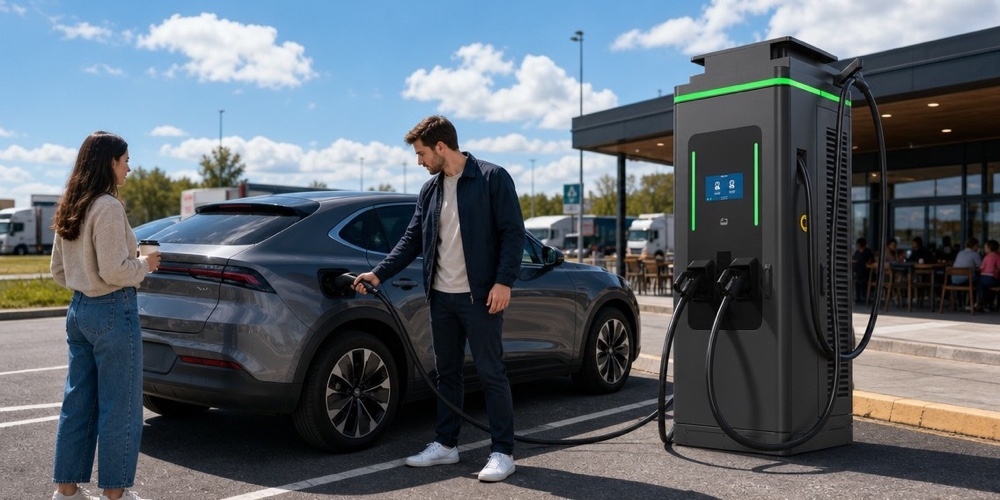
The IEA’s technical assessment extends beyond the vehicle to the charging ecosystem that supports it. China’s charging networks lead the world in both density and power level: megawatt-capable liquid-cooled superchargers, widespread 800V-compatible ultra-fast stalls, and a national standard (GB/T) that now covers bidirectional charging. The 2026 report credits this infrastructure head-start with removing the “charging anxiety” barrier that still suppresses adoption in slower-moving markets — a virtuous cycle in which high utilization funds further buildout.
Chinese charging hardware also sets the cost benchmark: by industrializing SiC power modules and liquid-cooled cable assemblies at scale, Chinese manufacturers have driven the per-stall cost of ultra-fast charging down by roughly 40% since 2023, making the business case for dense urban networks viable for the first time.
The China Catalyst, Quantified
Taken together, the engineering metrics in this appendix explain the IEA’s central finding: China is not merely the largest EV market — it is the technical reference point against which every other market is measured. Powertrain efficiency above 90%, ubiquitous heat pumps, direct-cooled fast-charging packs, and an infrastructure ecosystem that closes the loop are not isolated achievements but a system engineered end to end.
Conclusion: The Catalyst Becomes the Standard
The IEA’s verdict is a recognition of reality: the fastest route to global electrification runs through Chinese engineering. The technologies standardized in China — 8-in-1 drives, hairpin motors, direct cooling, 800V charging — are becoming global defaults not because of policy mandates but because they are measurably better and cheaper. For governments, automakers, and charging operators worldwide, the strategic implication is unambiguous: the benchmark has moved, and the most efficient path to catching it is cooperation, not reinvention.
Key Takeaways
- Chinese powertrains exceed 90% system efficiency, setting the global engineering benchmark.
- Heat pumps and direct liquid cooling are standard on even entry-level Chinese EVs, preserving winter range and enabling 4C+ fast charging.
- China’s 800V charging ecosystem — led by liquid-cooled, megawatt-capable hardware — is the world’s densest and most cost-efficient.
Contact MIDA Power
As a Chinese manufacturer at the center of this ecosystem, MIDA Power supplies the 800V-compatible DC fast chargers, liquid-cooled superchargers, and BESS-integrated systems that global markets are adopting to replicate China’s charging advantage. For specifications, benchmarks, or a quotation, contact our team.
Post time: Aug-09-2026
