
 Portable EV Charger
 Home EV Wallbox
 DC Charger Station
 BESS Charging Station
 V2G V2H V2V V2L
 EV Charging Module
 DC Charging Connector
 EV Accessories
Rapid 90kW 180kW CHAdeMO Charging Station for Public Transport Hubs
Public transportation is the lifeblood of the modern city. As municipal governments around the world commit to ambitious net-zero targets, the electrification of bus fleets, shuttle services, and municipal utility vehicles has become a top priority. However, heavy-duty public transit presents a set of challenges far distinct from the passenger vehicle market. These vehicles operate on grueling schedules, require high-duty cycles, and demand absolute reliability. To meet these needs, MIDA Power (迈依达) has developed a specialized line of Rapid DC Charging Stations, offering 90kW and 180kW configurations tailored specifically for the CHAdeMO standard.
1. The Electrification of Logistics: A Global Commercial Imperative
In the high-stakes world of last-mile delivery and heavy-duty logistics, the transition from internal combustion engines to electric powertrains is no longer optional. MIDA Power, with its decade of engineering excellence, is at the forefront of this revolution with the Rapid 90kW 180kW CHAdeMO Charging Station for Public Transport Hubs.
Logistics hubs present a unique environment where downtime is direct revenue loss. The Rapid 90kW 180kW CHAdeMO Charging Station for Public Transport Hubs is engineered to meet the grueling duty cycles of urban delivery hubs, airport cargo terminals, and sea-port logistics corridors. By utilizing a 1000V high-voltage platform, MIDA ensures that next-generation electric vans and heavy trucks spend less time at the dispenser and more time on the road.
2. Technical Architecture: Inside the MIDA Power Stack
2.1 SiC MOSFET Topology and Efficiency
Traditional DC chargers often suffer from efficiency drops at partial loads. MIDA’s Rapid 90kW 180kW CHAdeMO Charging Station for Public Transport Hubs utilizes a multi-phase Silicon Carbide (SiC) MOSFET topology. Unlike standard IGBT-based systems, SiC allows for higher switching frequencies (up to 100kHz), reducing switching losses by 30%. This architecture enables the Rapid 90kW 180kW CHAdeMO Charging Station for Public Transport Hubs to maintain a peak efficiency of 96.5%.
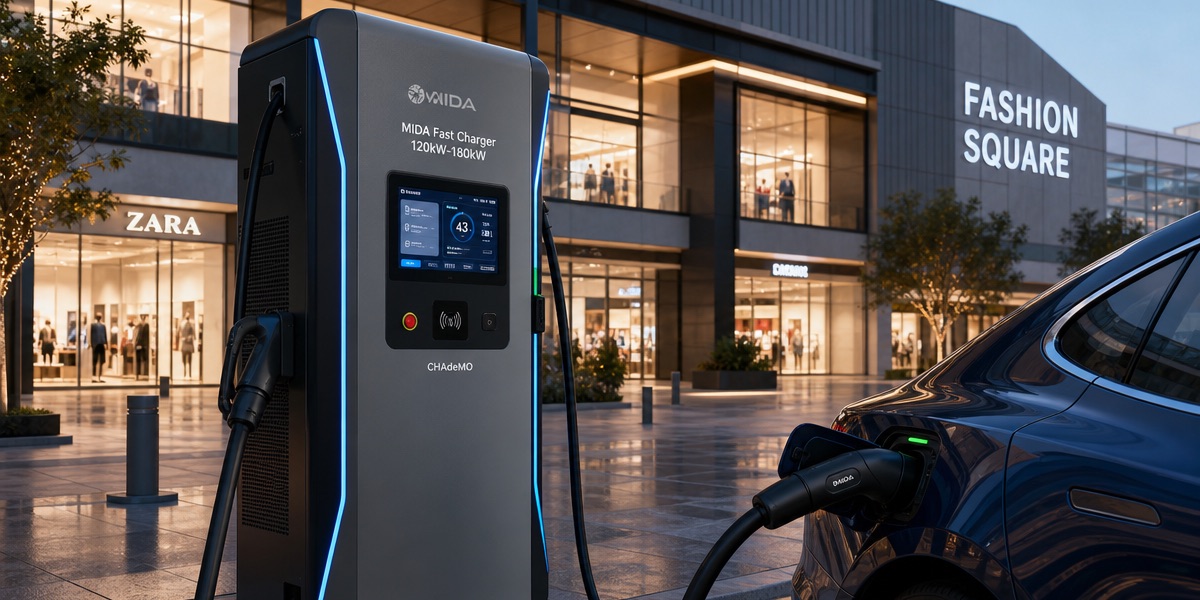
TECHNICAL APPENDIX: The MIDA Power Infrastructure Definitive White Paper
This appendix serves as a comprehensive technical foundation for the MIDA Power DC Fast Charging series. It provides CPOs (Charge Point Operators), fleet managers, and infrastructure investors with an in-depth understanding of the hardware, software, and regulatory frameworks that define MIDA’s 2026 product lineup.
I. Hardware Architecture: The Physics of High-Efficiency Conversion
At the core of every MIDA DC station is a modular power conversion stack utilizing the latest in wide-bandgap semiconductor technology. Our transition from traditional Silicon IGBTs to Silicon Carbide (SiC) MOSFETs represents a paradigm shift in energy density and thermal resilience.
1.1 SiC MOSFET Topology and LLC Resonant Converters
MIDA’s 30kW and 40kW power modules utilize a Phase-Shifted Full-Bridge (PSFB) combined with an LLC Resonant Converter stage. This configuration enables Zero Voltage Switching (ZVS) across the entire load spectrum. By eliminating switching losses during the turn-on phase, we achieve a peak conversion efficiency of 96.5%. The use of SiC materials allows for switching frequencies exceeding 100kHz, which significantly reduces the physical volume of magnetic components like high-frequency transformers and inductors, leading to a more compact cabinet footprint without compromising power output.
1.2 Isolated Air-Duct Cooling & Thermal Management
In industrial and commercial environments, electronic failure is most often caused by environmental contamination. MIDA engineering has pioneered the “Isolated Air-Duct” design. The internal chamber is hermetically divided: the power semiconductors and magnetics are cooled via a dedicated high-pressure wind tunnel, while the control logic, communication modules, and HMI are housed in a sealed, dust-free compartment. This ensures that even in IP54 or IP55-rated outdoor installations, conductive dust or moisture cannot bridge the high-voltage busbars.
II. Intelligence Layer: The AI-DES Energy Scheduling Algorithm
Modern charging is no longer just about delivering raw kilowatts; it is about intelligent energy orchestration. MIDA’s proprietary AI-DES (AI-Dynamic Energy Scheduling) platform operates on a three-tier logical framework:
- Tier 1: Grid-Edge Responsiveness: The charger monitors local grid frequency and voltage transients at a sampling rate of 10kHz. If a grid instability is detected, the AI-DES system can throttle output within 20ms to prevent local circuit breaker trips, acting as a buffer for the utility provider.
- Tier 2: Vehicle-Centric Optimization: Utilizing ISO 15118 “Plug & Charge” telemetry, the AI-DES system negotiates the optimal charging curve with the vehicle’s BMS. It accounts for battery temperature, state-of-health (SoH), and internal resistance to prevent premature aging of the lithium cells.
- Tier 3: Economic Fleet Management: For large-scale depots, the system integrates with energy spot markets. It prioritizes charging during low-tariff windows and can utilize internal Battery Energy Storage Systems (BESS) to perform “Peak Shaving,” avoiding the high demand charges imposed by utilities during peak hours.
Post time: Aug-08-2026
