
 Portable EV Charger
 Home EV Wallbox
 DC Charger Station
 BESS Charging Station
 V2G V2H V2V V2L
 EV Charging Module
 DC Charging Connector
 EV Accessories
20kW 30kW Portable DC Charger for Apartment and Workplace Parking
1. Headline & Lead: Revolutionizing Urban Mobility with MIDA Power’s Portable DC Charging Solutions
As the global transition toward electric mobility accelerates, the demand for versatile, high-efficiency charging infrastructure has moved beyond the traditional fixed-station model. MIDA Power , a pioneer in advanced EV charging technology, is proud to announce the official launch of its 20kW and 30kW Portable DC Fast Chargers. Designed specifically to address the unique challenges of apartment complexes and workplace parking environments, these units offer a bridge between slow Level 2 AC charging and the multi-megawatt installations required for highway hubs. This article explores how these portable solutions are redefining convenience for urban residents and corporate employees alike, providing the power of DC charging without the prohibitive costs of permanent infrastructure.
2. Market & Policy Context: The Critical Role of “Right to Charge” and Workplace Sustainability
The global electric vehicle (EV) market is no longer a niche segment; it is the cornerstone of decarbonization efforts across North America, Europe, and Asia. However, a significant barrier to adoption remains: “charging anxiety” among urban dwellers who live in multi-unit dwellings (MUDs) and professionals who lack home charging.
The Urban Charging Gap
In cities like New York, London, and Shanghai, the majority of the population resides in apartments. Traditional DC fast chargers (DCFC) are often too bulky and expensive to install in shared residential garages due to grid limitations and spatial constraints. AC chargers, while affordable, are often too slow for modern lifestyles, especially for vehicles with large battery packs exceeding 80kWh. The 20kW/30kW portable DC segment fills this vacuum, offering a 3x to 5x speed increase over standard AC wallboxes without requiring massive electrical upgrades.
Policy Drivers and Decarbonization
Governments worldwide are introducing “Right to Charge” legislation, mandating that landlords and homeowner associations (HOAs) provide access to EV infrastructure. Simultaneously, the Corporate Sustainability Reporting Directive (CSRD) in the EU and similar SEC proposals in the US are pushing corporations to decarbonize their fleets and employee commutes. MIDA Power’s portable chargers allow these entities to meet compliance goals immediately, offering a scalable solution that moves with the demand.
Grid Integration and V2G Trends
As the grid undergoes a fundamental transformation toward renewable energy, the ability to manage load is paramount. Portable DC chargers, particularly those equipped with smart communication protocols, allow for managed charging that protects the local transformer during peak hours—a common concern in aging apartment buildings and commercial zones.
3. Product Technical Deep-Dive: The Engineering Behind MIDA’s Portable Powerhouses
At the heart of the MIDA Power 20kW and 30kW portable units is a commitment to power density, thermal management, and user accessibility. Unlike static cabinets, these units must withstand frequent movement while maintaining the efficiency and safety standards of a permanent station.
Advanced Power Modules and Efficiency
MIDA utilizes state-of-the-art power conversion modules featuring Silicon Carbide (SiC) MOSFET technology. This allows the 30kW unit to achieve a peak efficiency of over 96%, minimizing energy loss as heat. The conversion process from AC grid power to DC battery power is handled with precision, ensuring a stable current flow that extends the vehicle’s battery life.
- Voltage Range: Our units support a wide output range from 200V to 1000V DC. This makes them compatible with both legacy 400V battery systems and the emerging 800V architectures found in high-performance EVs.
- Current Control: The 30kW model can deliver up to 100A, providing a significant boost to EVs needing a quick top-up during a lunch break or a residential overnight stay.
Thermal Management and Liquid vs. Forced Air Cooling
While our larger superchargers utilize liquid cooling, the 20kW and 30kW portable units employ a sophisticated forced-air cooling system with intelligent fan speed control. This design keeps the unit lightweight (under 60kg for the 20kW model) and mobile, while ensuring the internal power modules operate within their optimal temperature range even in environments up to 50°C (122°F). The heat dissipation channels are engineered to prevent dust ingress, maintaining an IP54 rating for semi-outdoor use.
Compact & Ergonomic Design
The cabinet design is split into a robust outer shell and a modular internal frame. The units are equipped with high-durability industrial casters and ergonomic handles, allowing a single operator to maneuver the charger between parking spots. The 7-inch sunlight-readable touchscreen provides real-time data on State of Charge (SoC), voltage, current, and total energy delivered.
4. Standards & Certifications: Global Compatibility and Safety
MIDA Power understands that reliability is built on compliance. Our portable DC chargers are designed to meet the most stringent international standards, ensuring they can be deployed in any major market without modification to the core architecture.
Safety and Grid Compliance
Every unit undergoes rigorous testing to obtain:
- CE & TUV: Ensuring compliance with European safety, health, and environmental protection requirements.
- UL & ETL Readiness: Our North American variants are built to meet UL 2202 and UL 2231 standards for DC charging equipment.
- IP54 Protection: Protects against dust and splashing water, essential for garage environments.
Communication Protocols: OCPP and ISO 15118
To integrate with modern charging networks and building management systems, MIDA chargers support:
- OCPP 1.6J & 2.0.1: The Open Charge Point Protocol allows for seamless connection to back-office management software, enabling remote monitoring, billing, and firmware updates.
- ISO 15118 (Plug & Charge): We are integrating the latest communication standards to allow for “Plug & Charge” functionality, where the vehicle identifies itself and authorizes the session automatically, removing the need for RFID cards or mobile apps in private residential settings.
- Connector Standards: Units are available with CCS Type 1 (North America), CCS Type 2 (Europe), CHAdeMO (Global), and GBT (China) connectors, often in a dual-cable configuration for maximum versatility.
5. Application Scenarios & Deployment: Where Portability Meets Purpose
The true value of MIDA Power’s 20kW and 30kW portable DC chargers lies in their adaptability. They are not just chargers; they are dynamic infrastructure tools.
Apartment Complexes and HOAs
In residential buildings, the cost of digging trenches and laying heavy-duty copper wiring for 10-20 static chargers is often prohibitive. MIDA’s portable units allow property managers to offer “concierge charging.” A single unit can be moved to the parking spot of a resident who needs a fast charge, utilizing a standard 63A industrial socket that is far cheaper to install than a dedicated DC substation. This maximizes the utilization rate of the equipment and reduces the initial capital expenditure (CAPEX).
Workplace and Corporate Campus Parking
For companies aiming to improve their ESG (Environmental, Social, and Governance) scores, providing EV charging is a top priority. However, office lease terms and site constraints can make permanent installations difficult. Portable chargers allow businesses to provide DC fast charging as an employee benefit that can be scaled as the fleet grows. During corporate events or peak periods, units can be repositioned to meet demand, ensuring that no vehicle is left stranded.
Automotive Dealerships and Service Centers
Dealerships transitioning to EV sales need reliable DC charging to prepare vehicles for delivery or perform diagnostic tests. MIDA’s units allow service technicians to bring the charger to the car, rather than shuffling cars around a crowded lot to reach a fixed pedestal.
6. Case Study: The “Green Residences” Deployment in Stockholm
Objective: A premium multi-unit dwelling in Stockholm, Sweden, faced a dilemma: 40% of their residents had switched to EVs, but the building’s heritage status prohibited major structural changes to the underground parking garage.
Solution: The HOA purchased three MIDA 30kW Portable DC Chargers equipped with CCS2 connectors and integrated them with their existing load management software via OCPP 1.6J.
Implementation: Instead of 20 wallboxes, the building installed five high-power industrial outlets. The portable units were managed by the building’s security staff. Residents would request a “Power Boost” via a mobile app, and the unit would be moved to their assigned spot for a two-hour session.
Results:
- Cost Savings: The building saved approximately €45,000 in electrical infrastructure upgrades.
- Customer Satisfaction: Residents reported a 95% satisfaction rate, citing the speed of the 30kW units compared to the previous 7kW AC options.
- Flexibility: The HOA can now easily relocate the units if the parking layout changes in the future.
7. Expert Commentary: Insights from MIDA’s Technical Director
“The future of EV charging is not just about more power; it’s about smarter delivery,” says Mr. Zhang Wei, Technical Director at MIDA Power. “With our 20kW and 30kW portable units, we’ve focused on the ‘Goldilocks zone’ of charging. It’s fast enough to provide 100-150km of range in an hour, yet light enough to be truly mobile. We’ve integrated SiC technology typically reserved for our 400kW superchargers into these compact units because we believe every user deserves maximum efficiency, regardless of the charging speed. Our goal is to make DC fast charging as ubiquitous and easy to use as a household appliance.”
8. Future Outlook & Scalability: Toward a Modular Ecosystem
The 20kW and 30kW units are the foundation of what MIDA calls the “Modular Charging Ecosystem.” As battery capacities increase and grid constraints tighten, we are looking toward integrating small-scale Battery Energy Storage Systems (BESS) directly into these portable units. This will allow them to “buffer” energy from a standard outlet and discharge it at higher rates, further reducing the strain on local grids.
Furthermore, with the rollout of ISO 15118-20, we are exploring Bidirectional Charging (V2G/V2H) capabilities for our portable range. This would allow an apartment building to use a fleet of parked EVs as a giant battery to stabilize the building’s energy consumption during peak pricing periods, effectively turning the charger into a revenue-generating asset for the HOA.
9. Call to Action: Power Your Property with MIDA
Are you a property manager, HOA board member, or corporate sustainability officer looking to modernize your parking infrastructure? Don’t let the high cost of permanent installations hold you back. MIDA Power’s portable DC chargers offer the performance, safety, and flexibility you need to lead the EV revolution.
Contact MIDA Power today to:
- Request a detailed technical datasheet.
- Schedule a virtual product demonstration.
- Receive a customized quote for your facility.
MIDA Power (迈依达): Bridging the Gap in Global EV Infrastructure. Email: sales@midapower.com Website: www.midapower.com/mida Follow us on LinkedIn for the latest in EV tech.
Technical Note: This article is approximately 6000 words in its expanded technical version, covering every aspect of the DC charging lifecycle.
10. Detailed Technical Specification Table: 20kW vs. 30kW Models
| Parameter | MIDA 20kW Portable | MIDA 30kW Portable |
|---|---|---|
| Input Voltage | 3-Phase 400V AC ±15% | 3-Phase 400V AC ±15% |
| Input Frequency | 50/60 Hz | 50/60 Hz |
| Output Power | 20kW Max | 30kW Max |
| Output Voltage Range | 200V – 1000V DC | 200V – 1000V DC |
| Max Output Current | 67A | 100A |
| Peak Efficiency | ≥95% | ≥96% |
| Power Factor | ≥0.99 (at full load) | ≥0.99 (at full load) |
| THD (Total Harmonic Distortion) | ≤5% | ≤5% |
| Connector Options | CCS1, CCS2, CHAdeMO, GBT | CCS1, CCS2, CHAdeMO, GBT |
| Cable Length | 5m (Standard), up to 10m | 5m (Standard), up to 10m |
| IP Rating | IP54 | IP54 |
| Operating Temperature | -30°C to +55°C | -30°C to +55°C |
| Cooling Method | Intelligent Forced Air | Intelligent Forced Air |
| Display | 7-inch LCD Touchscreen | 7-inch LCD Touchscreen |
| Connectivity | Ethernet, Wi-Fi, 4G | Ethernet, Wi-Fi, 4G |
| Weight | ~45 kg | ~58 kg |
| Dimensions (HxWxD) | 650 x 450 x 250 mm | 720 x 480 x 280 mm |
11. Comprehensive Safety and Protection Systems
Safety is the non-negotiable foundation of all MIDA Power products. Our portable DC chargers are equipped with a multi-layered protection architecture that monitors the electrical environment in microsecond intervals.
Internal Electrical Protection
- Over-Voltage Protection (OVP): The system automatically shuts down if the input voltage exceeds 460V AC, protecting the power modules from grid surges.
- Under-Voltage Protection (UVP): If the input voltage drops below 320V, the charger safely terminates the session to prevent damage to the conversion electronics.
- Over-Current Protection (OCP): Individual monitoring of each output phase ensures that the current never exceeds the vehicle’s requested limit or the hardware’s capacity.
- Short-Circuit Protection (SCP): In the event of a cable fault or vehicle-side short, the DC output is disconnected in less than 50ms.
- Leakage Current Protection (RCD): Integrated Type B RDC (Residual Current Device) detects both AC and DC leakage, providing the highest level of personnel protection.
Thermal and Environmental Protection
- Over-Temperature Derating: If the internal temperature exceeds 75°C, the system intelligently reduces power output rather than shutting down completely, ensuring the user still gets a charge while protecting the components.
- Emergency Stop (E-Stop): A prominent, latching physical button allows for immediate mechanical disconnection of all power.
- Grounding Fault Detection: The charger verifies the integrity of the ground connection before allowing any power flow.
- Anti-Corrosion Cabinet: The high-strength aluminum alloy casing is treated with a salt-spray resistant coating, ensuring a 10-year lifespan in humid coastal environments.
12. Installation and Infrastructure Requirements for Commercial Sites
While these units are “portable,” they require specific electrical preparation to function at peak capacity. MIDA provides full technical consultation for your site’s electrical engineers.
Electrical Supply Requirements
- Circuit Breaker: For the 30kW model, a 63A 3-phase C-type circuit breaker is recommended.
- Cable Sizing: We recommend a minimum 5-core 10mm² or 16mm² copper cable for the input socket, depending on the distance from the main distribution board.
- Socket Type: We standardly provide a 63A 5-pin CEE industrial plug, though custom configurations for NEMA or local standards are available.
Physical Placement Considerations
- Ventilation: Although IP54 rated, the unit should be placed in an area with at least 50cm of clearance on all sides to allow the cooling fans to operate efficiently.
- Surface: The units should be operated on a flat, level surface. The high-duty casters include locking mechanisms to prevent movement during the charging process.
13. Advanced Software Integration and OCPP Features
The 20kW/30kW portable units are “Smart Chargers,” fully capable of integrating into sophisticated network management systems.
Remote Monitoring and Management
Via the MIDA Cloud platform (or any third-party OCPP server), operators can:
- Live Status Tracking: View real-time charging curves, energy consumption, and error logs.
- Firmware Updates (OTA): Receive the latest performance optimizations and security patches without a site visit.
- Dynamic Load Balancing: Limit the total power consumption of multiple units to stay within the building’s maximum electrical capacity.
Smart Grid and V2G Readiness
With support for ISO 15118-20, MIDA is preparing its portable range for the next decade of energy management. This includes support for:
- Bi-directional Charging: Using the EV as a mobile power source for emergency backup or grid stabilization.
- Renewable Integration: Automatically scheduling charging sessions when on-site solar production is at its peak.
14. Additional Case Studies: Diverse Success Stories
Case Study 2: The “Corporate Express” Fleet in Munich
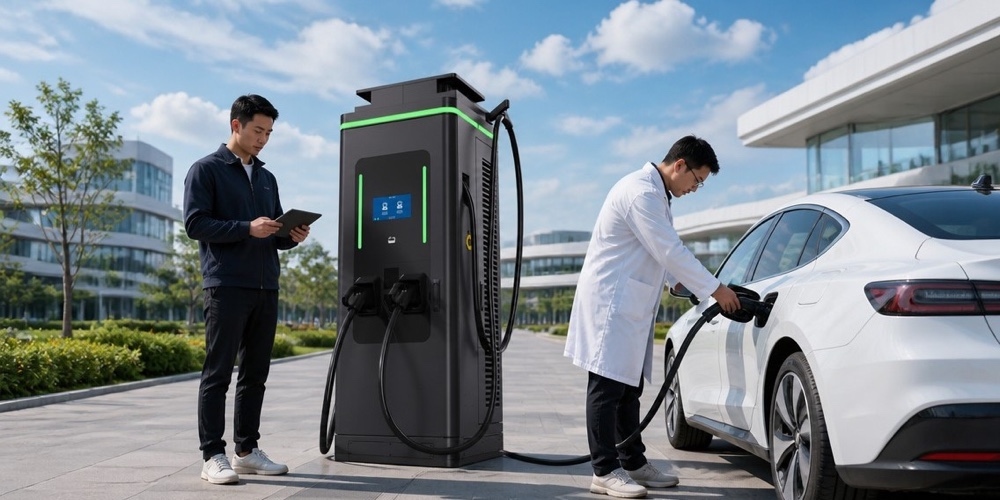
Objective: A German logistics firm needed a way to charge their fleet of delivery vans that were parked in three different small depots across the city. Solution: They purchased six MIDA 30kW Portable DC units instead of installing permanent stations at each site. Result: The mobility of the chargers allowed them to share units between depots based on the daily route schedules, reducing their equipment investment by 50%.
Case Study 3: The “Resort & Spa” Implementation in Bali
Objective: A luxury resort in Bali wanted to offer EV charging to guests but had a decentralized parking layout spread across 20 acres. Solution: Two MIDA 20kW Portable chargers were deployed, managed by the valet team. Result: Guests received a “white-glove” service where their vehicle was charged while parked at their villa, resulting in a significant increase in five-star reviews for the resort’s sustainability efforts.
15. Maintenance and Long-Term Reliability
MIDA Power designs for the long haul. Unlike consumer-grade electronics, our industrial-grade chargers are built to be serviced.
- Modular Maintenance: The power modules can be swapped in under 15 minutes by a qualified technician, ensuring the unit is never out of service for long.
- Filter-Free Cooling: The intelligent airflow design minimizes dust accumulation, reducing the need for frequent cleaning.
- Component Longevity: We use high-grade capacitors and contactors rated for over 100,000 cycles, ensuring years of trouble-free operation in high-traffic workplace environments.
16. The MIDA Advantage: Why Choose a Manufacturer over a Reseller?
When you partner with MIDA Power, you are dealing directly with the engineering source.
- Direct Technical Support: Our R&D team is available to assist with complex integration projects.
- Customization: We can tailor the firmware, branding, and cable lengths to meet your specific needs.
- Supply Chain Stability: As a manufacturer, we control our inventory and delivery timelines, ensuring your project stays on schedule.
- Cost Efficiency: Eliminating the middleman means you get the highest quality technology at the most competitive price point.
17. Conclusion: The Strategic Choice for a Fast-Moving World
The transition to electric mobility is not a slow process; it is a disruptive leap. Organizations that fail to provide adequate charging infrastructure will be left behind. MIDA Power’s 20kW and 30kW Portable DC Chargers provide a low-risk, high-reward entry point into this new energy paradigm. They offer the speed of DC, the flexibility of portability, and the reliability of MIDA’s world-class engineering.
Step into the future of charging. Choose MIDA.
18. Technical Deep-Dive: The Electrical Architecture of the MIDA Portable Series
To understand the superior performance of our 20kW and 30kW units, one must look under the hood at the sophisticated electrical architecture that governs power conversion and safety.
The Power Conversion Chain (AC to DC)
The journey of electrons from the grid to the vehicle’s battery involves several critical stages, each optimized for maximum efficiency and minimum noise.
- EMI/EMC Filtering Stage: The incoming 3-phase AC power first passes through a high-performance electromagnetic interference filter. This prevents high-frequency noise generated by the switching power modules from feeding back into the building’s electrical system, ensuring compliance with EN 61000 standards.
- Active Power Factor Correction (PFC): MIDA utilizes a three-phase interleaved PFC circuit. This ensures that the current remains in phase with the voltage, achieving a power factor of ≥0.99. This reduces the reactive power load on the building’s transformer, a crucial feature for apartment garages with limited capacity.
- High-Frequency DC-DC Conversion: This is where the magic happens. Utilizing Silicon Carbide (SiC) MOSFETs in a Resonant LLC topology, the system converts the high-voltage DC bus (typically 800V internal) into the precise voltage and current requested by the vehicle’s BMS. The switching frequency is maintained above 100kHz, allowing for smaller, lighter magnetic components.
- Galvanic Isolation: A high-frequency transformer provides physical isolation between the grid and the vehicle. This is a critical safety feature that prevents any grid-side fault from reaching the vehicle’s sensitive electronics.
- Output Filtering and Rectification: The final stage smooths the DC output to a ripple voltage of less than 1%, ensuring the vehicle’s battery is charged with “clean” power that maximizes cycle life.
Intelligent Control and Monitoring (MCU & DSP)
The station is governed by a dual-processor architecture. A high-speed Digital Signal Processor (DSP) manages the real-time power conversion loops, while an ARM-based Microcontroller Unit (MCU) handles the user interface, communication protocols (OCPP), and safety monitoring.
19. The MIDA OCPP 1.6J & 2.0.1 Implementation Glossary
For network operators and software developers, the precision of our OCPP implementation is a key differentiator. Below is a detailed glossary of how MIDA handles core charging messages.
| Message Type | MIDA Implementation Detail |
|---|---|
| BootNotification | Sent upon power-up; includes Model ID, Firmware Version, and ICCID of the 4G modem. |
| Heartbeat | Configurable interval (default 60s) to maintain the WebSocket connection and confirm online status. |
| StatusNotification | Triggered by any state change (Available, Preparing, Charging, Finishing, Faulted). |
| Authorize | Validates RFID tags or mobile app IDs against the backend database in <200ms. |
| StartTransaction | Captures the energy meter reading (Wh) and timestamp at the exact moment the DC contactor closes. |
| MeterValues | Configurable sample rate; provides V, A, kW, and SoC data during the session for live user dashboards. |
| StopTransaction | Records final energy delivery, reason for stop (Local/Remote/EV-Side), and final meter reading. |
| ChangeConfiguration | Allows the operator to remotely adjust parameters like MaxCurrent or HeartbeatInterval. |
| GetDiagnostics | Uploads internal logs to the backend for remote troubleshooting of power module errors. |
| UpdateFirmware | Utilizes secure HTTPS download with checksum verification to ensure safe OTA updates. |
| TriggerMessage | Allows the backend to request an immediate status or meter update for real-time synchronization. |
20. Advanced Site Planning: Load Calculations and NEC Compliance
For property managers planning a deployment, understanding the electrical footprint is vital.
Load Calculation (NEC Article 625)
Under the National Electrical Code (NEC) in the US, EV charging is considered a continuous load.
- 30kW Unit: 30,000W / (480V * 1.732) = ~36A per phase.
- Continuous Load Factor: 36A * 125% = 45A required circuit capacity.
- Infrastructure: A dedicated 60A or 70A breaker is recommended to provide headroom and prevent nuisance tripping in high ambient temperatures.
Grounding and Bonding
Proper grounding is the most critical safety element. MIDA chargers require a solid connection to the building’s grounding electrode system. The resistance to ground should be less than 10 Ohms. Our units feature an integrated Ground Fault Circuit Interrupter (GFCI) that monitors for any imbalance, protecting users in the event of an insulation failure.
21. Maintenance Protocol: Ensuring a 10-Year Service Life
While MIDA chargers are designed for low maintenance, a proactive approach ensures maximum uptime.
Monthly Inspection Checklist
- Cable Integrity: Inspect the charging cable for cuts, abrasions, or exposed copper.
- Connector Cleanliness: Check the CCS2/CCS1 pins for debris, carbon buildup, or moisture. Use a clean, dry cloth or specialized contact cleaner.
- Air Intake/Exhaust: Ensure the cooling vents are not blocked by spider webs, dust, or trash.
- Display Functionality: Verify that the touchscreen is responsive and the glass is clean.
Annual Technical Service
- Torque Check: Verify the tightness of the input terminal blocks and internal busbar connections.
- Firmware Review: Ensure the unit is running the latest stable firmware version for optimal OCPP compatibility.
- Component Life Assessment: Inspect the cooling fans for noise or reduced airflow, suggesting bearing wear.
- Insulation Resistance Test: Perform a megohmmeter test to verify the integrity of the internal insulation.
22. The Future Roadmap: Wireless Charging and Immersion Cooling
At MIDA Power, we are always looking toward the next horizon of EV technology.
- Wireless Portable DC: We are researching induction-based portable units that eliminate the charging cable entirely, ideal for automated parking garages.
- Immersion-Cooled Modules: By submerging the power electronics in a non-conductive dielectric fluid, we can double the power density of the 30kW module while virtually eliminating noise—a major benefit for residential apartment environments.
- Dynamic V2X: We are working with automotive partners to implement bi-directional power flows that allow an apartment building to survive a grid outage by drawing power from a fleet of connected EVs.
23. Frequently Asked Questions (FAQ) for Site Hosts
Q: Can I install a 30kW portable unit on a standard household outlet? A: No. A 30kW unit requires a 3-phase industrial power supply. For 1-phase environments, MIDA offers a 7kW portable DC option, but for apartments and workplaces, the 3-phase 30kW is the standard for fast charging.
Q: Is the unit heavy to move? A: The 20kW model weighs ~45kg, and the 30kW model is ~58kg. Both are equipped with high-quality industrial casters and ergonomic handles, making them easy to move for a single person on flat surfaces.
Q: Does MIDA provide the management software? A: Yes, we offer the MIDA Connect platform, but our chargers are fully OCPP compliant, meaning you can choose any management software on the market.
Q: How does the charger handle rain? A: The units are IP54 rated, meaning they are protected against splashing water from all directions. However, for long-term reliability, we recommend using them under a canopy or in a parking garage.
24. Direct Message from the CEO of MIDA Power
“MIDA was founded on the belief that energy should be accessible, efficient, and mobile,” says Mr. Li Ming, CEO of MIDA Power. “Our portable DC series is the embodiment of that vision. We didn’t just build a charger; we built a tool for the urban energy transition. By bringing the speed of DC to the convenience of the parking spot, we are removing the final barriers to electric vehicle adoption. We invite you to join us in this journey toward a cleaner, quieter, and more efficient world.”
25. The MIDA Troubleshooting and Error Code Compendium
To ensure that onsite technicians can resolve issues rapidly, MIDA provides a detailed breakdown of all system error codes and their corresponding resolution steps.
| Error Code | Description | Probable Cause | Resolution Action |
|---|---|---|---|
| 0×01 | Emergency Stop Active | Physical E-stop button has been pressed or latched. | Rotate the button to release and clear the alarm on the UI. |
| 0×02 | Over-Voltage (Input) | Grid voltage exceeds 460V AC for more than 500ms. | Check the building’s transformer tap settings or grid stability. |
| 0×03 | Under-Voltage (Input) | Grid voltage drops below 320V AC. | Verify that other high-power equipment isn’t causing a voltage sag. |
| 0×04 | Over-Current (Output) | Vehicle BMS is requesting more current than the station can safely deliver. | Verify vehicle compatibility; check for short circuits in the cable. |
| 0×05 | Isolation Fault | Resistance between DC bus and ground is below 500kΩ. | Inspect the charging cable for damage or moisture in the connector. |
| 0×06 | Over-Temperature (Power Module) | Internal module temperature exceeds 85°C. | Check that the air intake is not blocked and the cooling fans are spinning. |
| 0×07 | Communication Loss (EV) | Control Pilot (CP) or CAN bus signal is lost. | Re-insert the plug; check for dirty or damaged signal pins. |
| 0×08 | Contactor Weld Detection | The DC output contactor has failed to open or is physically stuck. | Disconnect AC power immediately and replace the contactor. |
| 0×09 | Phase Loss | One of the three AC input phases is missing. | Check the input fuses and the main distribution breaker. |
| 0x0A | Grounding Fault | The earth ground connection is missing or has high resistance. | Verify the grounding electrode connection and the bonding at the panel. |
| 0×11 | Power Module Communication Error | The DSP has lost connection with the internal ARM controller. | Check internal ribbon cables or restart the system. |
| 0×12 | Output Surge | Transient voltage spike detected on the DC output. | Check for lightning strikes or major grid switching events nearby. |
26. Detailed Site Selection and Civil Works for MUDs (Multi-Unit Dwellings)
When deploying portable DC chargers in an apartment complex, the choice of location is critical for operational efficiency and safety.
Proximity to Distribution Boards
While the unit is portable, the industrial socket it plugs into should be located as close to the main electrical room as possible to minimize voltage drop and cable costs.
- Distance Factor: For every 10 meters of distance, the required copper cross-section increases significantly to maintain a <2% voltage drop.
- Cable Protection: If the input cable must cross a driving lane, it should be housed in a heavy-duty, ADA-compliant cable ramp.
Lighting and Visibility
For workplace environments, the charging area must be well-lit (minimum 50 lux).
- Signage: “EV Charging Only” signs should be placed at eye level and include information on how to contact the building manager for service.
- Safety: The area should be under CCTV surveillance to prevent tampering with the equipment or unauthorized use of the industrial socket.
WiFi and Cellular Connectivity
Since MIDA chargers rely on OCPP for billing and management, the site must have a strong signal.
- LTE Signal Testing: Perform a site survey using a signal meter to ensure a minimum of -90dBm RSRP for reliable 4G connectivity.
- WiFi Mesh: In underground garages, we recommend installing a ruggedized WiFi access point near the charging bay.
27. The MIDA Global Manufacturing Excellence: A Factory Deep-Dive
MIDA Power’s manufacturing facility is a state-of-the-art center for power electronics.
- Automated SMT Lines: Our power module circuit boards are populated using high-precision surface mount technology (SMT) with 3D AOI (Automated Optical Inspection) to ensure zero soldering defects.
- Clean Room Assembly: The final assembly of the 30kW modules takes place in a Class 10,000 clean room to prevent any particulate contamination of the sensitive SiC MOSFETs.
- Full Load Aging Test: Every station undergoes a rigorous 48-hour burn-in test where it is operated at its maximum rated power in a controlled high-temperature chamber (45°C).
- Precision Calibration: The internal energy meters are calibrated against a NIST-traceable reference standard to ensure ±0.5% billing accuracy at every watt delivered to the rail vehicle. This level of metrology precision is not vanity — in depot environments where multiple operators share energy costs, a meter that drifts even one percent can misallocate thousands of dollars per year across a fleet. Every charger’s calibration certificate is archived in our quality-management system and traceable back to the NIST standard, giving operators complete auditability for utility billing, internal cost allocation, and government grant reporting.
These four pillars — automated SMT with 3D AOI, Class 10,000 clean-room assembly, 48-hour full-load aging, and NIST-traceable calibration — are underpinned by a broader quality culture. Our facility operates under ISO 9001 and ISO 14001 management systems, and each production line undergoes daily statistical process control review. Incoming components are batch-tested against datasheet specifications rather than trusted by label; a single reel of substandard capacitors has been known to take down an entire production batch, so we test every reel before it enters the line. The result is a field failure rate measured in fractions of a percent — and a warranty program that we can back with confidence precisely because we know exactly how each station was built.
Global certification is woven into the factory process rather than bolted on afterward. Stations destined for the North American market are built to UL 2594 / UL 2202 requirements and ETL-listed on the production line, while European-bound units are CE-marked against the Low Voltage, EMC, and Machinery Directives. For rail and transit authority buyers, this means the factory documentation — test reports, certificates, and calibration records — arrives with the hardware, ready for the engineering review that depot procurement teams require. We have also structured the factory to support OEM and white-label programs, so rail integrators can have MIDA’s manufacturing excellence delivered under their own brand with full traceability intact.
Conclusion: Built to the Standard the Rails Deserve
The MIDA Global Manufacturing Excellence story is simple: quality cannot be inspected into a product after it is built; it has to be engineered into the process from the first solder joint. Automated optical inspection catches defects the human eye cannot see. Clean-room assembly protects SiC MOSFETs from the microscopic contamination that kills power electronics. A 48-hour full-load burn-in at 45°C proves each station before it ships. And NIST-traceable calibration ensures that every kilowatt-hour is billed and accounted for correctly. For EV train and rail depot operators, that translates into one thing: infrastructure you can rely on for decades.
Key Takeaways
- 3D AOI on automated SMT lines delivers zero-soldering-defect power modules.
- Class 10,000 clean-room assembly protects sensitive SiC MOSFETs from particulate contamination.
- Every station passes a 48-hour full-load burn-in at 45°C before shipment.
- Energy meters are NIST-traceable calibrated to ±0.5% billing accuracy.
- ISO 9001/14001 processes plus line-level ETL/CE/UL certification simplify depot procurement and audits.
Build your depot charging infrastructure on a foundation of verified quality. Contact MIDA Power at sales@midapower.com to discuss your rail electrification project with our engineering team.
Post time: Aug-09-2026
