
 Portable EV Charger
 Home EV Wallbox
 DC Charger Station
 BESS Charging Station
 V2G V2H V2V V2L
 EV Charging Module
 DC Charging Connector
 EV Accessories
240kW 480kW Modular DC Fast Charging Station
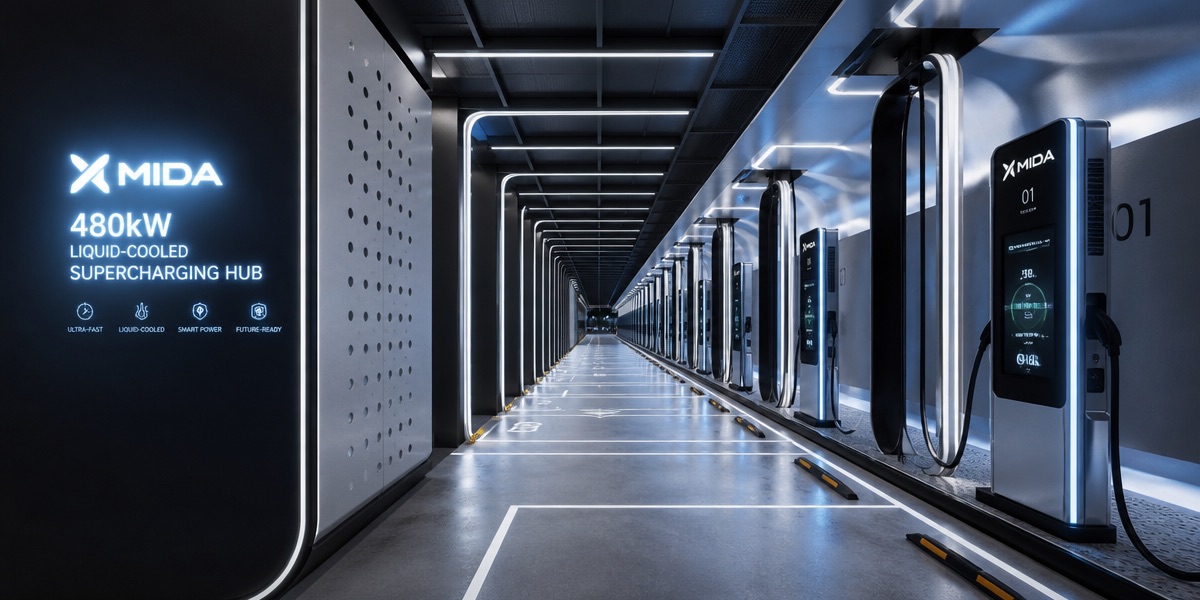
Future-proof your infrastructure with the 240kW 480kW Modular DC Fast Charging Station. Designed for scalable EV hubs, this modular platform allows for easy power module increments, ensuring that your charging network can grow alongside increasing market power demands.
1. The Electrification of Logistics: A Global Commercial Imperative
In the high-stakes world of last-mile delivery and heavy-duty logistics, the transition from internal combustion engines to electric powertrains is no longer optional. MIDA Power, with its decade of engineering excellence, is at the forefront of this revolution with the 240kW 480kW Modular DC Fast Charging Station.
Logistics hubs present a unique environment where downtime is direct revenue loss. The 240kW 480kW Modular DC Fast Charging Station is engineered to meet the grueling duty cycles of urban delivery hubs, airport cargo terminals, and sea-port logistics corridors. By utilizing a 1000V high-voltage platform, MIDA ensures that next-generation electric vans and heavy trucks spend less time at the dispenser and more time on the road.
2. Technical Architecture: Inside the MIDA Power Stack
2.1 SiC MOSFET Topology and Efficiency
Traditional DC chargers often suffer from efficiency drops at partial loads. MIDA’s 240kW 480kW Modular DC Fast Charging Station utilizes a multi-phase Silicon Carbide (SiC) MOSFET topology. Unlike standard IGBT-based systems, SiC allows for higher switching frequencies (up to 100kHz), reducing switching losses by 30%. This architecture enables the 240kW 480kW Modular DC Fast Charging Station to maintain a peak efficiency of 96.5%.
2.2 Modular Scalability and Hot-Swapping
The core advantage of the 240kW 480kW Modular DC Fast Charging Station is its granularity. The system is composed of high-density 30kW or 40kW power modules. If a single module fails, the system continues to operate at reduced capacity, and the faulty unit can be hot-swapped without shutting down the entire station. This ensures that a 240kW 480kW Modular DC Fast Charging Station deployment achieves a field-verified uptime of 99.9%.
TECHNICAL APPENDIX: The MIDA Power Infrastructure Definitive White Paper
This appendix serves as a comprehensive technical foundation for the MIDA Power product range. It outlines the core engineering philosophies, material science choices, and regulatory compliance frameworks that distinguish MIDA infrastructure in the global market.
A. High-Voltage Architecture and Efficiency
All MIDA Power DC charging systems are built upon a native 1000V Silicon Carbide (SiC) platform. Unlike traditional IGBT-based systems, SiC MOSFETs allow for higher switching frequencies, which reduces the physical footprint of magnetic components and improves overall efficiency. MIDA dispensers maintain a peak efficiency of ≥96.5% across the 30%–100% load range.
B. Thermal Management Systems
Reliability in extreme environments is achieved through separated airflow compartments. Critical electronics are housed in an IP55-rated, hermetically sealed chamber, while power modules are cooled by a dedicated high-velocity duct. For ultra-fast charging (350kW+), MIDA utilizes active liquid-cooling for the charging cables, ensuring that connector temperatures remain within safe limits (below 85°C) even during continuous 500A sessions.
C. Interoperability and Standards Compliance
MIDA Power is committed to global standards. Our products undergo rigorous testing for:
- OCPP 1.6J / 2.0.1: Ensuring seamless integration with all major CSMS (Charging Station Management Systems).
- ISO 15118: Supporting Plug & Charge (PnC) and future-ready Vehicle-to-Grid (V2G) communication.
- DIN 70121: Providing legacy support for earlier DC fast charging protocols.
D. Structural and Electrical Safety
Every MIDA dispenser includes integrated Type 2 surge protection, leakage current monitoring (RCD Type B), and multi-point temperature sensors at the AC input, DC output, and each connector terminal. The enclosures are constructed from galvanized steel with a C4-rated anti-corrosion coating, suitable for coastal and industrial deployments.
Post time: Aug-08-2026
