
 Portable EV Charger
 Home EV Wallbox
 DC Charger Station
 BESS Charging Station
 V2G V2H V2V V2L
 EV Charging Module
 DC Charging Connector
 EV Accessories
Why Modular BESS Offers Unmatched Flexibility for Operators
Quick Answer: A modular battery energy storage system (BESS) is built from standardized, independently replaceable power and battery blocks rather than as a single monolithic unit, which lets operators scale capacity in predictable steps — for example from a 120 kWh/60 kW unit to a 625 kWh/400 kW station — by adding identical modules. Modularity delivers four operational advantages that monolithic designs cannot match: pay-as-you-grow capital expenditure, hot-swap maintenance that cuts downtime from days to hours, N+1 redundancy that keeps the site online during component failures, and deployment flexibility across stationary, mobile, and solar-integrated formats using the same core hardware. For fleet and charge point operators, modular architecture converts storage from a fixed, risky investment into a scalable operating asset with faster commissioning, lower total cost of ownership, and a clear path to future expansion.
Key Takeaways:
- Modular BESS reduces first-move capital by 40–60% versus an oversized monolithic system, because capacity is added only when utilization justifies it.
- Standardized battery and power blocks enable hot-swap replacement, slashing mean time to repair from days to hours and shrinking spare-parts inventory.
- N+1 module redundancy means a single failed power or battery module degrades capacity slightly instead of taking the whole site offline.
- The same modular blocks scale from 60 kW/120 kWh wall-mount deployments to 400 kW/625 kWh highway stations — and migrate between stationary, mobile, and solar-plus-storage configurations.
- Operators choosing modular architectures shorten project lead times and simplify procurement, training, and warranty management across multiple sites.
The Monolithic Trap: Why One Big Battery Hurts Operators
A logistics operator needed 300 kW of fleet charging capacity and, following a consultant’s advice, purchased a single integrated storage system sized at 480 kWh to cover “future growth.” Eighteen months later, utilization had reached only 40% of the battery’s capacity: the fleet had grown slower than forecast, the site’s peak was 220 kW, and the oversized battery was cycling shallowly — the least profitable operating mode for storage. Worse, when the sole inverter failed, the entire charging site was dark for five days while a replacement was shipped from overseas.
The monolithic approach fails operators on three axes: capital timing (paying today for capacity used in three years), failure blast radius (single points of failure take down the whole asset), and adaptability (a fixed architecture cannot migrate when fleet routes or site layouts change). These are precisely the failure modes that modular design eliminates, which is why modular BESS has become the default architecture in the commercial and industrial segment, and why virtually every reference architecture published by grid operators and aggregators assumes modular, standardized building blocks.
What Modularity Actually Means in a BESS
Modularity in BESS-integrated EV charging operates at two levels: the power path and the energy path. The power path consists of standard bidirectional power conversion units — for MIDA, modules in the [20–40 kW class](https://www.midapower.com/ev-charging-power-module) that convert AC grid to DC for both battery and charger, with liquid-cooled variants up to 125 kW for high-power applications. The energy path consists of standard battery blocks, typically 20–100 kWh each, built from certified LFP cells with integrated BMS and thermal management.
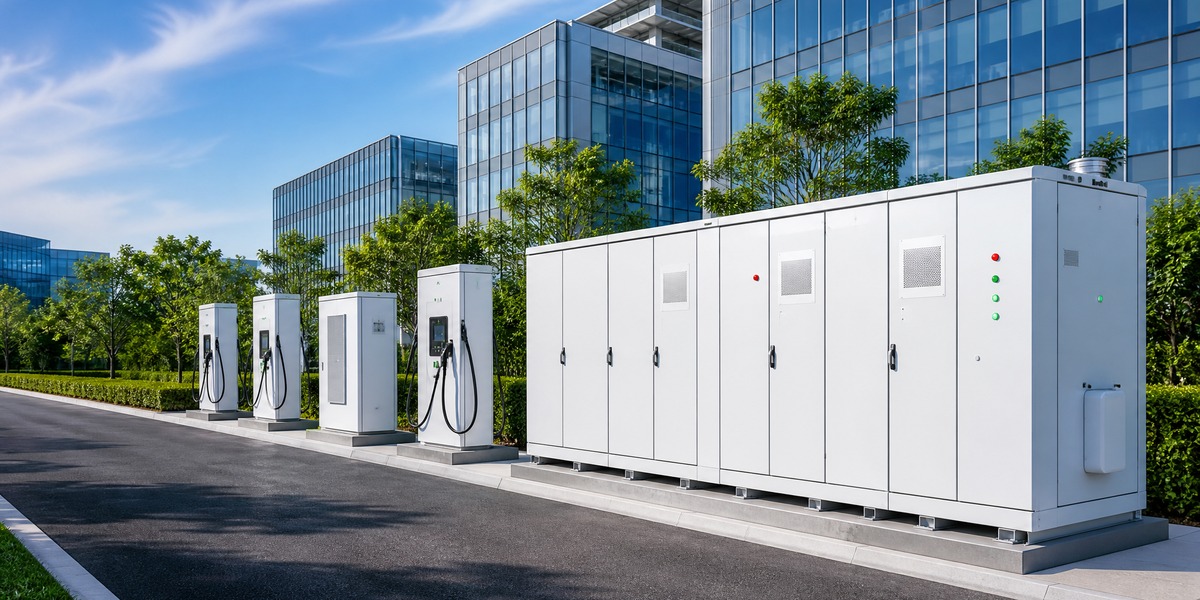
Each block is self-contained: its own BMS, its own cooling connections, and standardized mechanical and electrical interfaces. Blocks are combined in series and parallel to reach the target voltage and capacity. This is what differentiates true modularity from a mere component: any block can be swapped, serviced, or replaced without touching the others, and the system controller automatically reconfigures to the new block count. An operator scaling from 240 kWh to 482 kWh simply adds another standard block, connects it to the DC bus, and lets the EMS re-optimize — no redesign, no requalification of the site, no extended downtime.
Modular vs. Monolithic: A Side-by-Side Comparison
| Criterion | Monolithic BESS | Modular BESS |
| :— | :— | :— |
| Initial CAPEX | Full capacity paid upfront | Buy base capacity; add blocks as utilization grows |
| Scaling path | Replace or parallel a second complete system | Add standard blocks/cabinets incrementally |
| Failure impact | Single inverter/battery fault can stop the site | N+1 redundancy; site continues at reduced capacity |
| Mean time to repair | Days (factory repair or full replacement) | Hours (hot-swap a standard block from local stock) |
| Spare parts inventory | Unique, expensive, long lead time | Standardized, interchangeable across sites |
| Deployment formats | Fixed to original enclosure design | Same blocks migrate to stationary, mobile, or solar-integrated frames |
| Warranty & training | Vendor-specific per site | One system family, one training syllabus, one support chain |
| Technology refresh | Replace whole system to upgrade | Upgrade power blocks or battery blocks independently |
The comparison table reflects what operators report in practice: monolithic systems win only where a site’s load profile is perfectly static for the full asset life — a rare condition in a charging market where vehicle counts, power levels, and tariff structures all shift within a five-year horizon.
Scaling Without Overbuilding: Right-Sizing with Standard Blocks
Right-sizing is the single biggest financial decision in a storage project, and modularity makes it reversible. The engineering rule of thumb for EV charging is to size storage at 0.5–1× the site’s peak charging power in kilowatt-hours: a 120 kW site typically needs 120–240 kWh; a 320 kW site needs 240–480 kWh. A [modular product family](https://www.midapower.com/energy-storage-charging-station) lets the operator buy the lower bound first and expand when the utilization data justifies it.
| MIDA Modular Configuration | Battery Capacity | Charging Power | Typical Deployment |
| :— | :— | :— | :— |
| 120 kWh / 60 kW | 120 kWh | 60 kW | Workplace, small depot, emergency rescue |
| 160 kWh / 313 kWh-class mobile | 313 kWh | 160 kW | Mobile fleet support, events, temporary hubs |
| [200 kWh / 120 kW](https://www.midapower.com/ccs-nacs-chademo-200kwh-120kw-bess-charging-station-energy-storage-ev-charger-piles-product/) | 200 kWh | 120 kW | Commercial parking, off-grid solar sites |
| 241 kWh / 120 kW | 241 kWh | 120 kW | Highway stops with advertising / retail |
| [482 kWh / 320 kW](https://www.midapower.com/320kw-482kwh-bess-charger-mobile-ev-charging-station-energy-storage-system-product/) | 482 kWh | 320 kW | Fleet depots, highway corridors |
| [625 kWh / 400 kW](https://www.midapower.com/400kw-625kwh-bess-charger-station-mobile-charging-battery-energy-storage-system-product/) | 625 kWh | 400 kW | Major hubs, bus depots, truck stops |
All configurations share the same module family, so an operator running five sites at different scales stocks one spare power module and one spare battery block for the whole network. Expansion between configurations is a site-level reconfiguration — adding blocks and re-balancing the EMS — not a new procurement.
Maintenance, Redundancy, and Spare-Parts Strategy
Availability is where modularity earns its keep operationally. In a modular power architecture, the station controller uses N+1 redundancy: a 6×40 kW power block arrangement serving a 240 kW load tolerates the failure of any single module without reducing site capacity, and a second failure merely derates capacity proportionally. Battery blocks behave the same way — the BMS isolates a failed block, and the remaining blocks continue to serve the DC bus.
Hot-swap maintenance then converts that redundancy into fast recovery. Because blocks have standardized interfaces, a technician replaces a failed unit in under an hour using hand tools, versus a multi-day factory repair for an integrated monolithic unit. This shrinks mean time to repair from days to hours, lifts fleet availability guarantees, and reduces the spare-parts inventory to a small set of interchangeable units shared across the network. For operators with service-level agreements on highway charging — where every hour offline is lost revenue and lost driver trust — this is the difference between a serviceable asset and a liability.
Deployment Flexibility: One Architecture, Many Formats
Modularity also decouples the energy hardware from its physical format. The same battery and power blocks mount into three frames: floor-standing cabinets for permanent sites, mobile skids for temporary or emergency deployments, and solar-integrated containers where PV input feeds the DC bus directly.
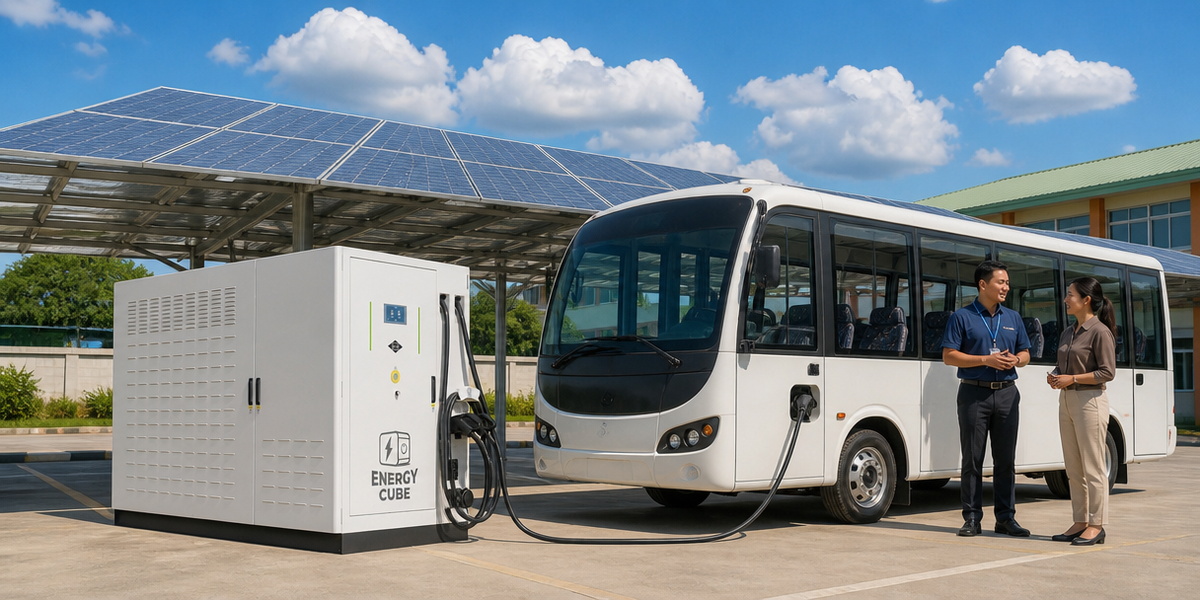
This format flexibility lets operators redeploy assets as business conditions change. A 200 kWh mobile storage unit used to cover a summer events season becomes a permanent depot buffer the following year; a station displaced by a highway re-alignment moves to the new site instead of being written off. Solar-integrated configurations — such as MIDA’s off-grid 200 kWh/120 kW mobile EV charger with MPPT solar input — allow the same modular blocks to serve sites with weak or absent grid connections, turning a storage purchase into a grid-independence enabler.
How to Choose the Right Modular Architecture
Selecting a modular BESS for EV charging reduces to six decisions, in order:
1. Define the 24-month floor and ceiling. Buy storage for the floor; plan block additions for the ceiling. 2. Standardize one block size across the network to maximize interchangeability of spares and training. 3. Verify hot-swap and N+1 behavior in the system design — confirm the controller rebalances automatically when blocks are added or removed. 4. Confirm the power module family matches charger power levels so the DC bus serves both battery and vehicles efficiently (92–95% round-trip). 5. Check protocol support (OCPP, ISO 15118, Modbus) on the base unit, because modularity of hardware must extend to software configuration. 6. Choose a supplier whose module family spans your target range — from wall-mount to highway-scale — so growth never forces a vendor change.
Modularity is not a feature; it is an operating strategy. It converts storage from a fixed, oversized gamble into a portfolio of standardized blocks that scale with evidence, fail gracefully, and move where the business goes. For operators planning five-year charging networks in a fast-moving market, that is the definition of flexibility — and the reason modular BESS has become the industry’s default.
FAQ
1. What is a modular BESS? A modular BESS is an energy storage system built from standardized, independently replaceable power and battery blocks that are combined to reach the required capacity, allowing incremental scaling and hot-swap maintenance.
2. How does modular BESS reduce capital costs? Operators buy only the capacity needed at deployment and add standard blocks later, avoiding the 40–60% premium of paying upfront for oversized monolithic storage that may sit underutilized for years.
3. What is N+1 redundancy in a modular BESS? N+1 redundancy means the system is configured with one more power module than the load requires, so any single module failure leaves full capacity intact and a second failure only derates the site.
4. Can a modular BESS be expanded after installation? Yes — expansion means connecting additional standard battery and power blocks to the DC bus and re-optimizing the EMS, typically completed within days without requalifying the site.
5. How fast can a failed module be replaced? A failed block is hot-swapped in under an hour with standard interfaces and hand tools, cutting mean time to repair from days (typical for monolithic systems) to hours.
6. Is modular BESS more expensive per kWh than monolithic systems? Per-kWh hardware cost is comparable or slightly higher at the component level, but modular systems win on total cost of ownership through avoided overbuilding, lower downtime, smaller spare inventories, and redeployability.
7. Can the same modular blocks be used for mobile and solar-integrated stations? Yes — the same power and battery blocks mount into floor-standing, mobile skid, and solar-integrated frames, so assets can be redeployed between formats as site conditions change.
Post time: Aug-14-2026
