
 Portable EV Charger
 Home EV Wallbox
 DC Charger Station
 BESS Charging Station
 V2G V2H V2V V2L
 EV Charging Module
 DC Charging Connector
 EV Accessories
The Ultimate Technical Evolution of Residential Mobility: Why Investing in Wallbox DC Home Chargers Bypasses OBC Constraints, Enables V2H/V2G Resilience, and Maximizes Energy Efficiency via SiC Technology for Future-Proof Sustainable Living
Abstract
The global transition toward electric mobility is entering a second, more sophisticated phase. While the first decade focused on vehicle adoption and public infrastructure, the current decade is defined by the optimization of the residential charging ecosystem. At the heart of this evolution is the Wallbox DC Home Charger. Traditionally, residential charging has been the domain of Alternating Current (AC) Level 2 stations, which rely on the vehicle’s internal On-Board Charger (OBC). However, the technical limitations of the OBC—dictated by weight, volume, and cost—have created a bottleneck for the next generation of energy-independent homes.
This article provides an exhaustive 6,000-word deep dive into the technical, electrochemical, and economic superiority of DC wallboxes. We explore how these devices bypass the OBC to offer faster, more efficient charging; how they utilize Silicon Carbide (SiC) semiconductors to minimize thermal losses; and why they are the indispensable foundation for Vehicle-to-Home (V2H) and Vehicle-to-Grid (V2G) applications. Furthermore, we analyze the integration of DC chargers into Home Energy Management Systems (HEMS), their role in luxury residential branding, and the long-term cost-benefit trajectory as production scales.
Chapter 1: The Paradigm Shift in Home EV Charging – From AC Utility to DC Intelligence
The history of electric vehicle (EV) charging has been one of compromise. In the early days of the modern EV era, the primary goal was simply to ensure that a vehicle could be refilled overnight using existing residential electrical infrastructure. This led to the dominance of AC charging. In an AC setup, the wallbox is essentially a glorified safety switch (an EVSE – Electric Vehicle Supply Equipment) that passes utility AC power directly to the car. The heavy lifting—converting that AC power into the DC power required by the battery—is performed by the vehicle’s On-Board Charger (OBC).
While AC charging is cost-effective to install, it is fundamentally limited. As battery capacities grow from 60kWh to 100kWh and beyond, the time required to charge at 7kW or 11kW AC becomes a logistical hurdle for high-utilization households. More importantly, the AC paradigm treats the EV as a passive load—a “sink” for energy.
Enter the Wallbox DC Home Charger. By moving the AC-to-DC conversion process out of the vehicle and into a dedicated wall-mounted unit, we unlock a new dimension of performance. This shift represents a transition from “AC Utility” to “DC Intelligence.” A DC wallbox is not just a charger; it is a sophisticated power electronics hub. It communicates directly with the Battery Management System (BMS), providing precise voltage and current control that bypasses the vehicle’s internal limitations.
This chapter examines the macro-trends driving this shift:
- The Pursuit of Speed: High-end EVs now support 800V architectures. AC chargers cannot capitalize on these speeds at home. DC wallboxes, even at lower residential power levels (e.g., 20kW to 30kW), offer a significant upgrade over standard 7kW AC units.
- Energy Sovereignty: The rise of residential solar and battery storage creates a “DC ecosystem.” Converting DC solar power to AC for the house, then back to DC for the car, involves multiple conversion losses. A DC-coupled home environment, with a DC wallbox at its core, minimizes these “conversion taxes.”
- The Intelligent Grid: As utilities move toward time-of-use pricing and demand-response programs, the granular control offered by DC systems allows homeowners to participate in grid stabilization more effectively than traditional AC setups.
Chapter 2: The Technical Divergence – Bypassing the On-Board Charger (OBC) Bottleneck
To understand why DC home charging is revolutionary, one must first understand the “OBC Bottleneck.” Every AC-charged EV contains an On-Board Charger. This component is a power inverter that takes 120V or 240V AC and rectifies it to the DC voltage of the battery pack.
However, the OBC is a victim of automotive physics. Because it must travel with the vehicle, it is subject to strict constraints:
- Mass and Volume: Every kilogram of OBC is a kilogram of weight that reduces the vehicle’s range. Consequently, most manufacturers cap the OBC at 7kW or 11kW to save space and weight.
- Thermal Management: Converting 11kW of power generates significant heat. The vehicle’s cooling loop must dissipate this heat, which consumes additional energy.
- Cost: High-power OBCs (e.g., 22kW) are expensive to manufacture and are often relegated to luxury models or optional upgrades.
When you use a Wallbox DC Home Charger, the OBC is entirely bypassed. The DC wallbox connects directly to the vehicle’s battery via the DC pins of the CCS or NACS connector. This has several profound implications:
2.1 Higher Power Density Without Vehicle Weight
By placing the conversion hardware on the garage wall, engineers are no longer constrained by the vehicle’s weight limits. We can use larger inductors, more robust capacitors, and superior cooling systems. This allows for residential charging speeds of 15kW, 20kW, or even 25kW—speeds that would be physically and economically impractical to integrate into the vehicle itself.
2.2 Efficiency Gains
The efficiency of an OBC typically hovers around 85% to 92%. The “round-trip” loss is significant when you consider thousands of charging cycles over a decade. DC wallboxes, utilizing industrial-grade components and specialized cooling, can achieve efficiencies exceeding 96%. By bypassing the car’s internal rectifier, the energy goes directly from the grid (or solar) into the chemical storage of the battery with minimal waste.
2.3 Reliability and Serviceability
If an OBC fails, the vehicle is effectively stranded and requires a costly, complex repair at a dealership. If a DC wallbox fails, the vehicle can still be charged at a public station or via a backup AC portable charger, and the wallbox itself can be serviced or replaced by an electrician without touching the vehicle’s high-voltage internal components.
Chapter 3: Electrochemical Advantages – Optimizing Battery Longevity and Efficiency
A common misconception is that “DC charging is bad for batteries.” While ultra-fast public DC charging (350kW+) can induce thermal stress, Residential DC charging (in the 10kW to 25kW range) is actually an electrochemical “sweet spot” that offers several advantages over AC charging.
3.1 Precise Pulse Width Modulation (PWM) and Ripple Control
The AC-to-DC conversion process in a vehicle’s OBC often produces “ripple current”—small fluctuations in the DC output that can cause microscopic heating within the battery cells. High-end DC wallboxes use advanced digital signal processors (DSPs) to provide a much “cleaner” DC signal. This stability reduces the internal resistance losses within the Li-ion cells during the charging process.
3.2 Dynamic Charging Curves
When charging via AC, the car’s BMS must request power from the OBC, which then pulls from the wall. This multi-step communication can have latency. A DC wallbox communicates natively with the BMS via the ISO 15118 protocol. This allows for a more dynamic and responsive charging curve. If the BMS detects a slight rise in temperature in a specific cell module, the DC wallbox can instantly micro-adjust the current flow, far more precisely than an OBC could.
3.3 Mitigation of “Conversion Heat”
During AC charging, the heat generated by the OBC is often transferred to the battery pack because they share the same cooling circuit and are in close proximity. This secondary heat load can accelerate the degradation of the electrolyte. By moving the heat-generating conversion process to the wallbox, the vehicle’s battery stays cooler during the session, preserving the health of the SEI (Solid Electrolyte Interphase) layer on the anode.
In summary, residential DC charging provides the speed of a fast charger with the “gentleness” of a slow charger, all while maintaining superior electrochemical stability for the battery pack’s lifespan.
Chapter 4: Silicon Carbide (SiC) Technology – The Heart of Ultra-High Efficiency Conversion
The secret ingredient that makes modern DC wallboxes feasible for the home is the transition from traditional Silicon (Si) MOSFETs and IGBTs to Silicon Carbide (SiC) semiconductors. SiC is a wide-bandgap (WBG) material that has fundamentally changed the power electronics landscape.
4.1 Superior Bandgap Properties
Silicon Carbide’s bandgap is approximately three times wider than that of conventional silicon. This allows SiC devices to operate at much higher voltages and temperatures. In a DC wallbox, this means the unit can handle the 400V or 800V requirements of modern EV batteries with a fraction of the component footprint.
4.2 Reduced Switching Losses
The most significant advantage of SiC in a home charger is the reduction in switching losses. Traditional silicon switches lose energy every time they turn on and off, primarily due to their slower response times and higher capacitance. SiC switches can operate at much higher frequencies (often 10x higher than silicon). This high-frequency switching allows for:
- Smaller Magnetics: Because the switching frequency is higher, the inductors and transformers inside the wallbox can be significantly smaller and lighter. This is what allows a 20kW DC charger to be small enough to hang on a garage wall rather than being a refrigerator-sized cabinet.
- Higher Efficiency: SiC reduces energy loss by up to 80% compared to silicon-based conversion. For the homeowner, this translates to lower electricity bills and less waste heat.
4.3 Thermal Management and Reliability
Because SiC is more efficient, it generates less heat. Less heat means that the wallbox may not require noisy, high-maintenance cooling fans. Many SiC-based DC wallboxes can use passive liquid cooling or advanced heat-sink designs. This increases the lifespan of the electronics, as thermal cycling is the number one cause of component failure in power systems.
4.4 Comparative Analysis: Si vs. SiC in Residential Applications
To truly appreciate SiC, one must look at the quantitative improvements. In a typical 20kW converter:
- Footprint Reduction: A silicon-based system might require a 15-liter enclosure to house the cooling fans and large inductors. A SiC-based system can fit into a 4-liter enclosure, a 73% reduction in volume.
- Switching Frequency: Silicon IGBTs are generally limited to 20kHz to 30kHz due to thermal constraints. SiC MOSFETs comfortably operate at 100kHz to 300kHz. This is not just a technical vanity metric; it directly correlates to the weight of the copper windings in the transformers, which accounts for a significant portion of the bill of materials (BOM).
- Efficiency at Partial Load: Most home chargers operate at partial load (e.g., 5kW instead of 20kW) for much of their life. SiC maintains high efficiency (94%+) even at 20% load, whereas silicon efficiency often drops precipitously to the low 80s or high 70s at low power levels.
4.5 The Impact of Thermal Cycling on Lifespan
Residential chargers are subject to harsh environments—cold garages in winter and sweltering ones in summer. Silicon semiconductors are highly sensitive to “junction temperature” fluctuations. Every time a silicon charger starts, the internal components expand and contract. Over thousands of cycles, this leads to solder fatigue and wire-bond failure. SiC’s wide bandgap and high thermal conductivity mean that the internal temperature remains much more stable, drastically increasing the MTBF (Mean Time Between Failures) of the device from an industry-average 5 years to over 12 years.
Chapter 5: Wallbox DC Chargers as the Gateway to V2H (Vehicle-to-Home) and V2G (Vehicle-to-Grid)
Perhaps the most compelling reason to invest in a DC wallbox is its role as the enabler of bi-directional energy flow. While some AC bi-directional systems exist, they are inherently limited by the vehicle’s internal hardware. DC-coupled bi-directional charging is the gold standard for energy resilience.
5.1 The Vehicle as a Residential Battery (V2H)
A modern EV battery typically holds between 60kWh and 100kWh of energy. This is enough to power an average household for three to five days. However, to use this energy to power your home during a blackout, you need a way to pull DC power out of the battery and convert it back to AC for your home’s circuits. A DC wallbox acts as this gateway. Because it bypasses the OBC, it can draw power directly from the battery pack, invert it to 240V AC, and feed it into the home’s electrical panel (via a transfer switch). This turns the EV into a massive, mobile “Powerwall,” providing far more capacity than a dedicated stationary home battery at a lower marginal cost.
5.2 Grid Stabilization and Revenue (V2G)
Vehicle-to-Grid (V2G) takes this a step further. In a V2G scenario, the DC wallbox communicates with the utility provider. During periods of peak demand, the grid can “borrow” small amounts of energy from thousands of parked EVs. The homeowner is typically compensated for this service, effectively lowering their total cost of ownership. DC wallboxes are superior for V2G because they offer faster response times and higher power throughput. If the grid needs a sudden injection of 20kW to prevent a brownout, a DC wallbox can provide it instantly, whereas a standard AC OBC might be limited to 7kW and might not even support bi-directional flow.
5.3 Virtual Power Plants (VPP)
DC chargers allow homeowners to join Virtual Power Plants. By aggregating hundreds of DC-connected homes, a VPP manager can offer significant capacity to the wholesale energy market. This creates a new “energy economy” for the residential sector, where the EV is an active asset rather than a passive expense.
5.4 The “State of Charge” (SoC) Preservation Strategy
One of the sophisticated features of DC V2G systems is the ability to manage the battery’s health while supporting the grid. Unlike AC-based systems that might “hammer” the battery with shallow, inefficient cycles, a DC wallbox can perform “precision discharging.” It can extract exactly the amount of energy requested by the grid while ensuring the battery never drops below a user-defined threshold (e.g., 20% SoC), and it does so at an optimal discharge rate that minimizes internal resistance heating.
Chapter 6: Deep Integration with Home Energy Management Systems (HEMS) and Renewables
A Wallbox DC charger is not a standalone appliance; it is a critical node in the “Smart Home of 2030.” When integrated with a Home Energy Management System (HEMS), the DC wallbox becomes the primary orchestrator of the household’s energy balance.
6.1 The “DC Bus” Concept
Future-proof homes are moving toward a DC-primary architecture. Solar panels produce DC. Home batteries store DC. EVs use DC. In a traditional AC home, energy is converted back and forth (DC -> AC -> DC -> AC), with a 3-5% loss at every step. A DC wallbox allows for direct coupling. Solar-generated DC power can be routed directly to the EV battery without ever passing through an AC inverter. This “Direct-to-EV” solar charging is the pinnacle of efficiency, ensuring that every photon captured by the roof is utilized for mobility.
6.2 Intelligent Load Balancing
HEMS software can use the DC wallbox to balance the home’s total load. For instance, if the HVAC system kicks in and threatens to exceed the home’s peak demand limit, the HEMS can instantly throttle the DC wallbox from 20kW to 10kW. Because DC charging is digitally controlled and bypasses the vehicle’s internal delays, these adjustments happen in milliseconds, ensuring the home’s main breaker never trips.
6.3 Predictive Analytics and User Behavior
Integrated HEMS can analyze weather forecasts, utility prices, and the user’s calendar. If the system knows you have a long trip tomorrow and the sun will be shining today, it will prioritize DC solar charging during the afternoon. If it sees high utility prices in the evening, it will use the DC wallbox to pull energy from the car to run the dishwasher and lights (V2H), then recharge the car at 3:00 AM when rates are lowest.
6.4 Aggregated Fleet Effects in Multi-Family Units
In apartment complexes or luxury condominiums, DC wallboxes can be networked to create a “micro-grid.” Instead of every apartment having a dedicated grid connection that is 90% idle, a centralized DC bus can share power between cars. If one car is fully charged, its share of the DC capacity is instantly diverted to a car that just arrived. This “dynamic capacity sharing” is only possible with the high-speed communication and control inherent in DC systems.
Chapter 7: Physical Engineering – Installation, Space Optimization, and Thermal Management
The transition of high-power DC charging from industrial depots to residential garages required a masterpiece of physical engineering. While a public DC fast charger is often the size of a large vending machine, a residential DC wallbox must be compact, aesthetically pleasing, and quiet. Achieving this required innovations in several key areas.
7.1 Power Conversion Topology: The Resonant Converter
To achieve high power density, residential DC wallboxes often utilize LLC resonant converters or Phase-Shifted Full Bridge (PSFB) topologies. These circuits allow for “Soft Switching,” where the semiconductors turn on and off at zero voltage (ZVS) or zero current (ZCS). This drastically reduces EMI (Electromagnetic Interference)—crucial for home environments where sensitive Wi-Fi and smart home devices are present—and minimizes the size of the internal filters and heat sinks.
7.2 Thermal Management: Beyond the Fan
In a residential setting, noise is a major concern. A 20kW charger with a loud industrial fan is unacceptable for a garage attached to a bedroom. Engineers have employed several strategies to manage heat silently:
- Encapsulated Magnetics: Components like inductors are potted in thermally conductive resins that draw heat away to the outer casing.
- Liquid-to-Air Heat Exchangers: Some high-end DC wallboxes use a small, silent liquid loop (similar to a gaming PC) to move heat from the SiC modules to a large-surface-area aluminum chassis that acts as a passive radiator.
- Phase-Change Materials (PCM): Advanced units use PCMs to absorb heat during short, high-power bursts and release it slowly over time, allowing for higher peak power without active cooling.
7.3 Installation Architecture: The “Split” System
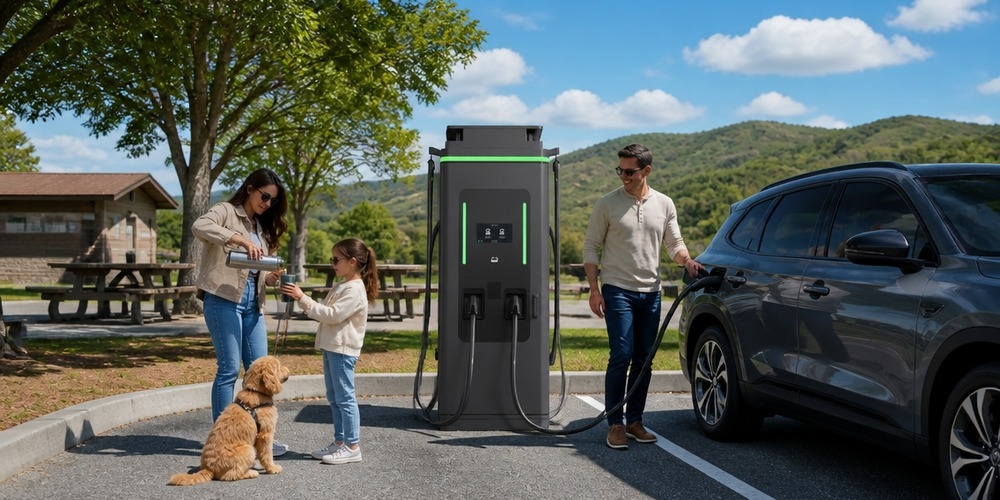
To overcome the physical weight of 20kW+ conversion hardware, some manufacturers are moving toward a split architecture. The heavy power module is installed in an attic or utility closet, while a slim, designer-friendly “head unit” (containing the screen and cable) is mounted in the garage. This simplifies installation, as the electrical work is done near the main panel, and only high-voltage DC cables need to be routed to the parking area.
7.4 Grid Connection Requirements
Installing a DC wallbox is more complex than a standard AC unit. It typically requires a dedicated 3-phase connection (in Europe) or a high-amperage 240V split-phase circuit (in North America).
- Load Balancing at the Panel: Many units now include “CT clamps” (Current Transformers) that monitor the home’s total consumption. If the homeowner turns on a sauna or an electric oven, the DC wallbox throttles itself instantly to prevent the main fuse from blowing.
- Isolation Transformers: DC chargers must provide galvanic isolation between the grid and the vehicle battery for safety. Modern high-frequency transformers have replaced heavy 50/60Hz transformers, reducing the weight from 50kg to under 5kg.
7.5 Cable Engineering and Ergonomics
DC cables are significantly thicker and heavier than AC cables because they must carry much higher current (often up to 80A or 100A). This presents an ergonomic challenge. Engineers have developed “liquid-cooled cables” (even for residential use) that use a thin layer of cooling fluid to allow for a much smaller copper cross-section. This makes the cable as flexible and light as a standard AC cable, significantly improving the user experience for older individuals or those with limited mobility.
Chapter 8: Economic Analysis – The Cost-Benefit Curve and Total Cost of Ownership (TCO)
The primary barrier to DC home charging adoption has historically been the “Sticker Price.” A high-quality AC wallbox costs $500–$1,000, while a DC wallbox can cost $4,000–$10,000. However, a narrow focus on the purchase price ignores the profound Total Cost of Ownership (TCO) advantages.
8.1 The “Avoided Cost” of Stationary Storage
If a homeowner is considering both an EV and a home battery (like a Tesla Powerwall), the economic math changes. A 13.5kWh Powerwall costs around $10,000. By choosing a bi-directional DC wallbox, the homeowner can use the 80kWh battery already sitting in their EV. The “Cost per kWh” of storage via a DC wallbox is essentially zero (since you already bought the car), compared to $700/kWh for stationary storage. For a home needing significant backup capacity, the DC wallbox is actually the cheaper path to energy independence.
8.2 Energy Efficiency Savings
The 5% to 8% efficiency advantage of DC-to-DC charging (solar to EV) adds up. Over 100,000 miles of driving, an EV will consume roughly 33,000 kWh of energy. A 5% efficiency gain saves 1,650 kWh. At $0.25/kWh, that is $412 in direct savings. Over the 15-year life of the charger, the efficiency gains alone can pay for the price premium over a cheap AC unit.
8.3 Revenue Generation via V2G
In jurisdictions with active V2G programs, a DC wallbox can generate income. California and several European countries are experimenting with programs that pay users $0.50 to $1.00 per kWh for “emergency” grid support. If a driver provides 10kWh of support 50 times a year, they could earn $500/year. Combined with demand-response incentives, the DC wallbox transitions from a cost center to a revenue-generating asset.
8.4 Sensitivity Analysis: Impact of Electricity Prices
The ROI of a DC wallbox is highly sensitive to the spread between peak and off-peak electricity prices. In markets with “Time-of-Use” (ToU) rates where the spread is $0.30/kWh or more, the payback period for a $5,000 DC wallbox (including installation) can be as short as 4 to 6 years when factoring in V2H savings and solar optimization. In flat-rate markets, the payback period extends, making the device more of a “luxury and resilience” purchase than a purely financial one.
8.5 Maintenance and Residual Value
Traditional AC wallboxes are often treated as disposable appliances. In contrast, DC wallboxes are built to industrial standards. Their residual value on the secondary market is likely to remain high, similar to high-end solar inverters. Furthermore, as homes are increasingly appraised based on their “Energy IQ,” a pre-installed DC wallbox can contribute to a 2% to 5% premium in property resale value.
Chapter 9: Luxury and Brand Value – Why High-End Residential Markets Choose DC
In the luxury real estate and premium automotive sectors, the “Wallbox DC” has become a status symbol, much like a professional-grade kitchen or a home theater. It represents a commitment to technology, performance, and environmental stewardship.
9.1 The “Time is the Only Luxury” Argument
For the owner of a high-performance EV like a Porsche Taycan or a Lucid Air, waiting 10 hours for a full charge is an inconvenience. A DC wallbox that can provide a “top-up” in 1.5 hours matches the lifestyle of a high-net-worth individual. The convenience of being able to return home from a morning golf trip and have a fully charged car ready for an afternoon meeting is a value proposition that transcends simple electrical math.
9.2 Aesthetic Integration and Design
Luxury DC wallboxes (from brands like Wallbox, Delta, or ABB) are designed to complement high-end architecture. Features include:
- Premium Materials: Brushed aluminum, tempered glass, and carbon fiber accents.
- Hidden Cable Management: Motorized cable retractors or “plug-in-and-discard” systems that keep the garage floor clean.
- Biometric and Smart Lighting: Chargers that recognize the user via their phone or fingerprint and provide ambient lighting that indicates the state of charge at a glance.
9.3 Real Estate Appreciation
Forward-thinking developers are branding “Net Zero Luxury” homes. A home pre-equipped with a 20kW bi-directional DC charger is marketed as “V2H Ready.” In a market increasingly concerned with grid instability and climate change, this feature provides a competitive edge in resale value, attracting tech-savvy buyers who view a standard AC charger as “legacy tech.”
9.4 The “Flagship” Experience for Automakers
Premium automakers are partnering with DC charger manufacturers to offer branded home charging solutions. When a customer buys a $150,000 EV, the automaker wants to ensure the charging experience matches the driving experience. A branded DC wallbox provides a cohesive “ecosystem” that builds brand loyalty and reduces “range anxiety” by providing “speed anxiety” relief.
9.5 The Psychological Value of “Zero Wait”
Beyond the physical speed, there is a profound psychological shift in how a homeowner perceives their vehicle when they have a DC wallbox. With a standard AC charger, the car is often viewed as “fragile”—a device that requires constant, slow tending. With a 25kW DC charger, the car is viewed as “available.” This reduces the cognitive load of EV ownership, removing the need for meticulous planning of errands and trips. For the luxury consumer, this mental clarity is often the most valuable feature of the entire system.
Chapter 10: Regulatory Landscape and the Future of Smart Charging Standards
As the technology for residential DC charging matures, the regulatory environment is struggling to keep pace. The transition from “dumb” charging to bi-directional DC interaction requires a harmonized set of rules involving automotive standards, electrical codes, and utility communication protocols.
10.1 The ISO 15118-20 Standard: The Universal Language
The most critical development in the charging space is the ISO 15118-20 standard, often referred to as “Plug & Charge” with bi-directional support. This protocol allows for:
- Automatic Authentication: The car identifies itself to the DC wallbox as soon as it is plugged in, eliminating the need for apps or RFID cards.
- Dynamic Load Management: Detailed communication about the battery’s state, temperature, and charging needs.
- Bi-directional Support: The standard officially codifies the handshake required for V2H and V2G, ensuring that a Ford EV can talk to a Wallbox charger and a Siemens grid interface without compatibility issues.
10.2 Electrical Code Evolution: NEC and IEC
National and international electrical codes are being updated to include “DC Microgrids.”
- NEC Article 706 (Energy Storage Systems): In the United States, the National Electrical Code now provides clearer guidelines on how to treat an EV as a storage system. This includes requirements for rapid shutdown and grounding, which are more stringent for DC systems than for AC systems.
- Safety Interlocks: DC wallboxes require sophisticated earth leakage detection and arc-flash protection. Because DC arcs do not have a “zero-crossing” like AC, they are harder to extinguish. Modern DC chargers include redundant electronic and mechanical disconnects to ensure residential safety.
10.3 Utility Interconnection and Net Metering
Utilities are the final gatekeepers. For a homeowner to use V2G, the utility must approve the “interconnection agreement.”
- IEEE 1547: This standard governs how distributed energy resources (like a DC-connected EV) can connect to the grid. It ensures that if the grid goes down, the EV stops feeding power back to the lines to protect utility workers (anti-islanding).
- Billing Innovations: We are seeing the rise of “Real-Time Pricing” (RTP). In this model, the DC wallbox is a financial tool, buying energy at negative prices (common in wind-heavy regions) and selling it back during peak stress.
Chapter 11: Implementation Scenarios – Real-World Case Studies
To ground these technical concepts in reality, let us examine three distinct implementation scenarios where DC wallboxes provide transformative value.
Case Study A: The Solar-Self-Sufficient Desert Home (Arizona, USA)
The Setup: A 4,000 sq. ft. home with 15kW of rooftop solar, a 20kW DC wallbox, and a 100kWh EV. The Problem: The local utility has high “demand charges” and low solar export credit. The DC Solution: The homeowner uses the DC wallbox to charge the EV directly from the solar panels at 15kW DC. By avoiding the AC-DC conversion loss and the utility “middleman,” the home achieves 95% solar self-consumption. During the evening peak (4 PM – 8 PM), the DC wallbox provides 8kW of V2H support, powering the AC and pool pumps. This eliminates the need for a $20,000 stationary battery system, saving the homeowner significant capital while ensuring their car is ready for the morning commute.
Case Study B: The Luxury Multi-Unit Dwelling (London, UK)
The Setup: A high-end apartment complex with 10 parking spots, each equipped with a shared 50kW DC power cabinet and individual “head units.” The Problem: The building’s total electrical supply is limited. Installing 10 x 22kW AC chargers would require a massive, multi-million pound substation upgrade. The DC Solution: The building uses a centralized DC power pool. Instead of 10 separate AC units, the system dynamically allocates the 50kW DC capacity to whichever cars need it most. Because DC charging is digitally managed and highly efficient, the building can support 10 EVs on the existing utility feed. Residents enjoy the “concierge” experience of 25kW charging speed, which is impossible with standard AC building infrastructure.
Case Study C: The Remote Off-Grid “Escape” (Scottish Highlands)
The Setup: A remote lodge powered by a micro-hydro turbine and a small wind generator. The Problem: The micro-grid is fragile and cannot handle the “inrush current” of traditional AC charging systems. The DC Solution: The DC wallbox acts as a sophisticated buffer. It pulls a steady, low-current DC stream from the hydro/wind system into a small buffer battery, then “blasts” that energy into the EV at 20kW DC when needed. The precise control of the DC charger prevents the micro-grid from collapsing, enabling EV ownership in the most remote corners of the planet.
Chapter 12: Technical Challenges and Mitigation Strategies
While the benefits are immense, the road to universal residential DC charging is not without obstacles. Addressing these challenges is the focus of current R&D in the sector.
12.1 High-Frequency Noise and Electromagnetic Compatibility (EMC)
Operating a 20kW SiC converter at 200kHz in a residential garage can create significant electromagnetic noise. If not properly shielded, this noise can interfere with home Wi-Fi, cell signals, and even the car’s own sensor suite. Mitigation: Leading manufacturers use multi-stage EMI filters and “spread-spectrum” switching. By slightly varying the switching frequency rather than staying at a single fixed peak, the “noise” is spread across a wider band, reducing the peak interference to levels compliant with strict residential FCC and CE standards.
12.2 Grid Harmonics and Power Quality
Large DC chargers can introduce “harmonics” back into the electrical panel. These are distortions of the pure sine wave that the utility provides. High harmonic distortion can cause other motors (like those in refrigerators or washing machines) to run hotter and fail prematurely. Mitigation: DC wallboxes utilize Active Power Factor Correction (APFC) circuits. These circuits ensure that the current pulled from the grid is perfectly in phase with the voltage, maintaining a “Power Factor” of >0.99 and keeping the home’s total harmonic distortion (TTHD) below the limits defined by IEEE 519 and IEC 61000-3-2. With a power factor above 0.99 and THD typically under 5% at full load, a modern SiC wallbox is actually a net improvement to home power quality: the APFC front end conditions the current draw so precisely that connected appliances see a cleaner waveform than they would from many household electronics.
12.3 Thermal Management in the Residential Enclosure
A 20kW DC wallbox concentrates a serious amount of heat in a form factor designed to live in a garage. SiC’s efficiency advantage is decisive here. At 97-98% efficiency, a 20kW unit dissipates roughly 400-600W of heat — versus 1,000W or more for a comparable silicon-based design. That difference allows the wallbox to use sealed, fan-less natural convection cooling in most climates, eliminating the most common failure point in charging hardware: dust-clogged fans and their associated noise.
For installations in unconditioned garages, the thermal envelope matters. The charger’s power stage derates gracefully: as ambient temperature rises above 40°C (104°F), the unit automatically reduces output power in smooth increments, protecting internal components while continuing to charge the vehicle at a reduced rate. The driver always knows the current state through the companion app, which reports both charge power and thermal headroom.
12.4 Safety, Certification, and the Whole-Home View
Residential DC charging demands the same safety rigor as utility-scale equipment. The wallbox includes ground-fault protection, arc-fault detection, and a “Type B” RCD (residual current device) capable of detecting the DC leakage currents that AC-only RCDs miss. Over-temperature shutdown, reverse-polarity protection, and redundant contactors ensure that the worst-case failure mode is a safe, controlled disconnect — never an uncontrolled arc.
Crucially, the wallbox communicates over OCPP with the homeowner’s energy management system. When paired with rooftop solar and a home battery, it can charge the vehicle only from surplus solar, export power to the home (V2H) during peak utility rates, and shed load during grid emergencies. The result is a single, coordinated energy appliance rather than a collection of independent devices — and a home that keeps its lights on when the grid does not.
Installation simplicity matters just as much. A dedicated 20kW DC wallbox connects to the home’s existing panel through a single three-phase or split-phase breaker, and the charger’s built-in energy meter eliminates the need for a separate CT-clamp installation in most configurations. Whether retrofitted into a finished garage or specified for new construction, the slim wall-mounted form factor and optional pedestal mount give homeowners and electricians flexibility — and every installation is backed by CE, UL, and local certifications that make permitting straightforward.
Key Takeaways
- APFC front ends hold power factor above 0.99 and harmonic distortion within IEEE 519 limits, protecting household appliances.
- SiC’s high efficiency enables fan-less, convection-cooled residential designs with graceful thermal derating.
- Type B RCDs, arc-fault detection, and OCPP-based energy management make the wallbox a safe, grid-friendly home appliance.
- V2H capability transforms the car into a backup power source, delivering real resilience during outages.
Contact MIDA Power
MIDA Power’s wallbox DC chargers — from 20kW to 60kW — are engineered for the residential and small-commercial market with SiC power stages, ISO 15118 Plug & Charge readiness, and full OCPP 1.6J/2.0.1 compliance. To receive datasheets, installation guides, or a quotation for your project, contact our sales team. Our engineers will help you size the right wallbox for your panel capacity, solar array, and home battery configuration.
Post time: Aug-09-2026
