
 Portable EV Charger
 Home EV Wallbox
 DC Charger Station
 BESS Charging Station
 V2G V2H V2V V2L
 EV Charging Module
 DC Charging Connector
 EV Accessories
As the global new energy vehicles enter the stage of intelligent energy integration, ISO 15118-20 has gradually become the hottest technology keyword in the charging industry.
More and more EVCC and SECC products are beginning to label:
- ✓ Support ISO 15118-20
- ✓ Support Plug&Charge
- ✓ Support V2G
- ✓ Support bidirectional charging
- ✓ Support intelligent energy interaction
From a marketing perspective, ISO 15118-20 seems to have become the “entry ticket” for the next generation of charging products.
However, from the perspective of practical application, supporting the ISO 15118-20 protocol ≠ achieving the complete ecological application. The industry is currently going through a critical stage where communication standards have evolved, but electrical standards, grid standards, and business models are still maturing.
Three Levels of ISO 15118-20 Market Readiness
1. Beginner level: Protocol layer support
This is the most common category. It supports EXI parsing and XML messaging but lacks complete intelligent charging capabilities like BPT, V2G, or full PnC processes.
2. Intermediate: Partial functional level support
Focuses on Plug&Charge (PnC), including Contract Certificates and TLS communication. While promoted in Europe, it still faces PKI system and operator compatibility challenges.
3. Level 3: System level support
The next generation of products must integrate:
- The six international standards (ISO15118-20, IEC61851, ISO5474, OCPP 2.0.1, GridCode)
- CyberSecurity integration for a secure energy ecosystem
Current European Market Status
Europe remains the most active market, yet ISO 15118-2 remains the mainstream. ISO 15118-20 features like V2G and Bidirectional Power Transfer are still in the early stages of commercial implementation and interoperability testing.
Key Technical Bottlenecks
Bottleneck 1: IEC 61851 electrical behavior mismatch (Safety, Contactor control, Fault handling).
Bottleneck 2: Lack of a unified Grid Code for V2G (EN 50549, RfG, VDE).
Bottleneck 3: ISO 5474 energy exchange system is still in development.
The Verification System
To succeed, products must pass a comprehensive testing suite:
- ISO15118 testing (Protocol correctness)
- IEC61851 Test (Electrical safety)
- EMC (Electromagnetic compatibility)
- Cyber Security (Attack resistance)
- Interoperability (Real-world cross-manufacturer testing)
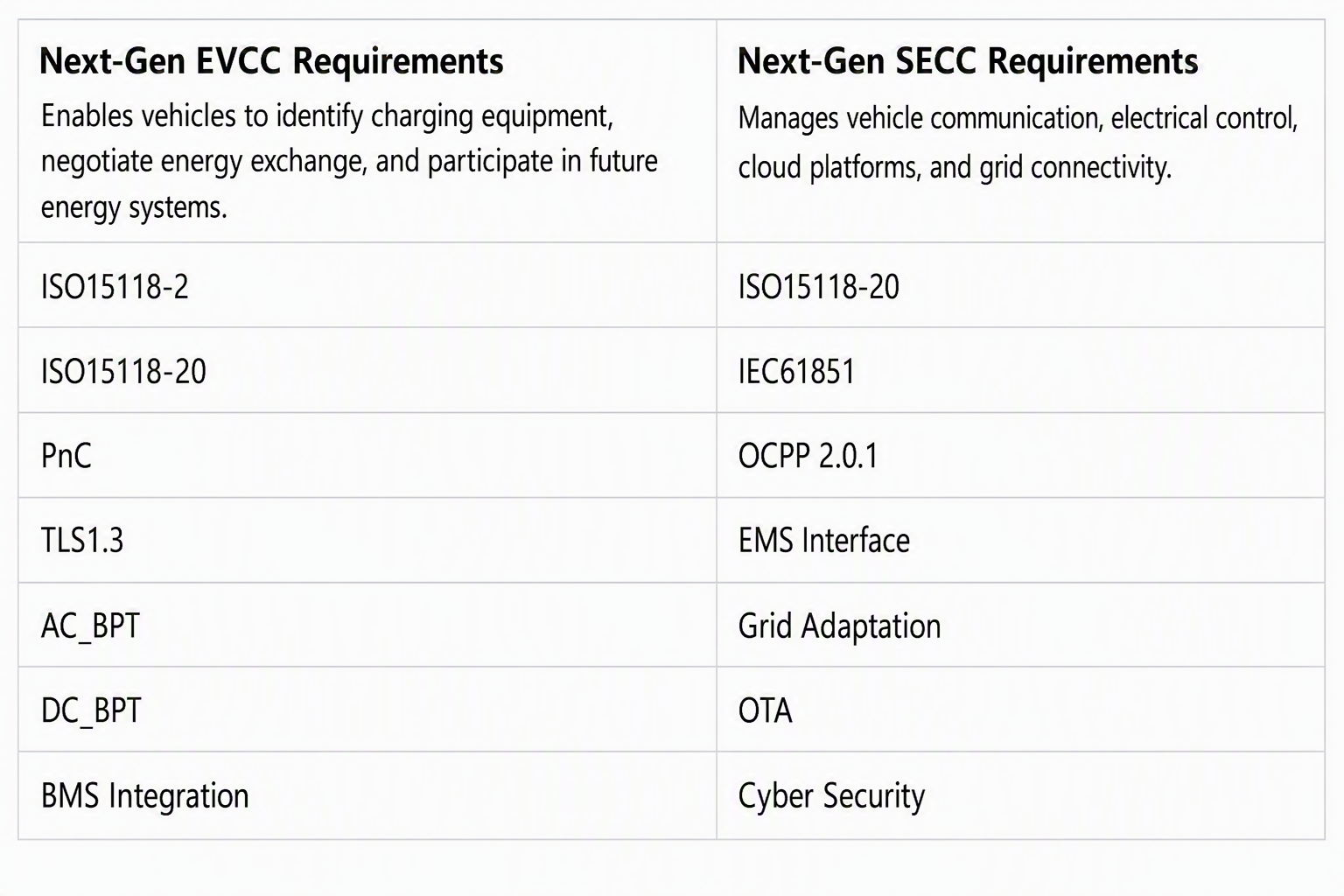
RNL MIDA’s Viewpoint
“The truly valuable EVCC and SECC in the future is not about ‘supporting ISO15118-20′, but about ‘being able to help vehicles, charging equipment, and energy systems achieve reliable interoperability in the ISO15118-20 era’.”
ISO 15118-20 is the communication portal of the energy Internet era. The competition has shifted from “who supports the protocol” to “who can achieve complete energy system integration.”
Post time: Sep-20-2026
