
 Portable EV Charger
 Home EV Wallbox
 DC Charger Station
 BESS Charging Station
 V2G V2H V2V V2L
 EV Charging Module
 DC Charging Connector
 EV Accessories
120kW DC Charger with 150kWh Battery Storage Peak Shaving Station
1. Headline + Lead: Urban Energy Resilience: MIDA Power’s 120kW DC Charger with 150kWh Battery Storage Solves the Peak Demand Puzzle
In the dense urban environments of today’s mega-cities, the primary barrier to electric vehicle (EV) infrastructure is no longer the charger itself, but the grid’s ability to feed it. High-power DC charging requires massive bursts of electricity that can strain local transformers and trigger exorbitant “demand charges” from utility companies. MIDA Power (迈依达), a leading innovator in energy storage and EV charging, is tackling this challenge head-on with the launch of its 120kW DC Charger integrated with a 150kWh Battery Energy Storage System (BESS). This “Peak Shaving Station” is a compact, intelligent energy hub designed to deliver high-speed charging without the need for expensive grid upgrades. By buffering energy in its internal 150kWh LFP battery during low-demand periods and discharging it when an EV plugs in, the MIDA system protects the grid, slashes operational costs, and ensures that urban EV drivers have access to reliable 120kW charging whenever they need it.
2. Market & Policy Context: The Economic Case for Peak Shaving
As cities around the world—from London and New York to Shanghai and Berlin—mandate the shift to electric mobility, the “hidden cost” of charging is becoming apparent. Utilities often charge commercial customers a “Demand Charge,” which is calculated based on the single highest peak of power used during a billing cycle. A 120kW charger, if used directly from the grid, can instantly triple or quadruple a small business’s monthly electricity bill, even if it is only used for 30 minutes.
Policies such as the UK’s “Electric Vehicle Infrastructure Strategy” and various municipal green building codes are encouraging the use of on-site storage to mitigate these peaks. Furthermore, many urban grids are already operating at 90% capacity; adding even a few 120kW chargers can require a transformer replacement costing upwards of $100,000. MIDA’s BESS-integrated solution offers a “non-wires alternative,” allowing for the rapid deployment of fast chargers in grid-constrained areas while providing a clear path to profitability for station owners through energy arbitrage and demand charge avoidance.
3. Product Technical Deep-Dive: Smart Buffering for Maximum Performance
The MIDA 120kW+150kWh station is an “Energy-in-a-Box” solution, housing both the power conversion electronics and the battery storage in a ruggedized, weather-proof cabinet.
Dynamic Load Balancing and Peak Shaving
The core functionality of the system is its ability to “shave” the peak. For instance, if the site’s grid connection is limited to 40kW, the MIDA system will draw a steady 30-40kW from the grid to keep the 150kWh battery full. When an EV connects and requests 120kW, the system draws 40kW from the grid and 80kW from the battery. This ensures the vehicle gets its 120kW “Super-Fast” charge, while the utility meter never sees a draw above 40kW. This capability alone can save station operators thousands of dollars per year in demand fees.
Modular Power and High-Grade Storage
- 120kW Output: The charger utilizes MIDA’s high-efficiency 30kW modules in a 4-stack configuration. It supports both single-gun and dual-gun operation with intelligent power sharing.
- 150kWh LFP Battery: We use high-density Lithium Iron Phosphate (LFP) cells. LFP is the ideal chemistry for peak shaving due to its high discharge rate, safety, and ability to withstand thousands of “shallow” cycles (the constant charging and discharging characteristic of peak shaving).
- Efficiency: The system features a 95%+ round-trip efficiency, minimizing the energy loss between the grid, the battery, and the vehicle.
Technical Specifications Table
| Component | Specification |
|---|---|
| Max DC Output Power | 120 kW (Dual Gun) |
| Battery Capacity | 150 kWh (LFP) |
| Grid Input Requirement | Flexible (20kW to 100kW configurable) |
| Output Voltage Range | 200V – 1,000V DC |
| Charging Standards | CCS1, CCS2, CHAdeMO, GBT |
| Operating Temperature | -30°C to +55°C |
| Intelligent Cooling | Forced Air with Smart Filtration |
| Cabinet Protection | IP54 / IK10 |
4. Standards & Certifications: Safety First in Urban Spaces
Deploying batteries in urban environments requires the highest levels of safety certification. The MIDA 120kW+150kWh system is built to the most rigorous global standards:
- EV Charging: CE (IEC 61851), TUV, and OCPP 1.6J / 2.0.1 compliant.
- Battery Safety: IEC 62619 for industrial batteries and UL 1973 for stationary energy storage.
- Cybersecurity: The system includes hardware-level encryption to protect user data and grid communication, essential for modern “Smart City” integration.
The unit includes a multi-stage safety system: electronic monitoring, physical fuses, and an integrated fire suppression system within the battery compartment, making it safe for installation in parking garages, retail plazas, and high-traffic areas.
5. Application Scenarios & Deployment: Optimizing the Urban Grid
The MIDA Peak Shaving Station is specifically tailored for “Grid-Challenged” locations.
Gas Stations and Retail Plazas
Many traditional fuel stations are located on sites with limited electrical capacity. Upgrading the grid can take 12-18 months. The MIDA system can be installed in weeks, allowing gas station owners to immediately offer 120kW DC charging to their customers while staying within their existing power budget.
Commercial Office Buildings and Hotels
Hotels often have high baseline energy usage due to HVAC and lighting. Adding EV chargers can push them into a higher utility tariff bracket. By using the 150kWh battery to manage the charging peaks, hotels can provide premium guest amenities without increasing their operational overhead.
Last-Mile Delivery Hubs
Courier companies transitioning to electric vans need fast charging at their depots. However, charging 10 vans at once can create a massive power spike. MIDA’s BESS units can “smooth out” the load throughout the day, charging from the grid during quiet hours and delivering high-power bursts when the vans return for their midday or evening reload.
6. Case Study: A Downtown London Parking Garage
A boutique parking garage in central London wanted to add two 120kW fast chargers to attract premium EV owners. However, the local utility informed them that a grid upgrade would cost £85,000 and require digging up the street.
The garage chose the MIDA 120kW+150kWh Peak Shaving Station. By limiting the grid draw to just 30kW, they were able to use their existing electrical service. The station charges its 150kWh battery overnight and during low-traffic hours. When a driver plugs in, they receive the full 120kW speed. The owner avoided the £85,000 upgrade cost and now saves an average of £450 per month on demand charges. The project reached ROI (Return on Investment) in just 14 months.
7. Expert / Leadership Commentary: A Word from MIDA’s Technical Director
“The ‘Peak Shaving’ station is the bridge between our current grid and the fully electrified future,” states Dr. Zhang Wei, Technical Director at MIDA Power. “In an urban setting, we don’t have the luxury of endless power. We have to be smart. Our 120kW/150kWh system is ‘Energy Intelligence’ in physical form. We’ve optimized the software to not just charge the car, but to manage the site’s entire power profile. By treating the battery as a buffer, we make high-speed charging accessible to everyone, regardless of their grid constraints. It’s about democratization of fast charging through smart storage.”
8. Future Outlook & Scalability: The Virtual Power Plant (VPP)
As more MIDA Peak Shaving Stations are deployed, they can be networked together to form a “Virtual Power Plant.” In the near future, MIDA station owners will be able to participate in “Frequency Regulation” or “Demand Response” programs. This means that during a grid emergency, the utility could pay the station owner to discharge electricity from their 150kWh battery back into the grid, turning a charging station from a cost center into a grid-stabilizing asset.
9. Call to Action: Solve Your Power Problems with MIDA Power
Is limited grid capacity holding back your EV charging goals? Don’t wait for a costly utility upgrade. MIDA Power’s (迈依达) 120kW DC Charger with 150kWh Battery Storage is the proven, cost-effective solution for high-speed urban charging.
Contact our expert sales team today for a customized ROI analysis and technical proposal. Let us help you shave the peak and maximize your profits.
MIDA Power: Smarter Charging, Stronger Grids. Learn more at www.midapower.com or email us at sales@midapower.com.
10. Deep-Dive: The Intelligence Behind Peak Shaving
The technical core of the MIDA 120kW/150kWh station is the sophisticated control algorithm that manages the energy flow between the grid, the battery, and the vehicle. This is not just a simple “on/off” switch; it is a dynamic, real-time optimization engine.
Real-Time Power Allocation
The system monitors the grid draw at the site’s main breaker. If other equipment in the building (like an air conditioner or an industrial elevator) turns on, the MIDA system instantly senses the spike in total site demand and throttles its grid draw, instead pulling more power from the 150kWh battery to maintain the 120kW charging speed for the EV. This “Site-Level Balancing” is what allows for the installation of fast chargers in buildings that would otherwise be at their electrical limit.
Efficiency and Thermal Design
To maintain high efficiency in a compact cabinet, MIDA uses Silicon Carbide (SiC) power modules. These modules generate 30% less heat than traditional silicon-based ones, allowing for a smaller, quieter cooling system. The 150kWh LFP battery racks are also integrated into the thermal loop, ensuring they stay at their ideal operating temperature, which is critical for maintaining the high discharge rates needed for 120kW charging.
11. Battery Engineering: Why 150kWh is the “Sweet Spot”
We chose a 150kWh capacity for this urban solution because it represents the optimal balance between physical size, cost, and operational capability.
Capacity for Back-to-Back Charging
A 150kWh battery can support multiple fast-charging sessions even if the grid connection is minimal. For example, a typical EV needs about 40-50kWh for a 20% to 80% charge. The 150kWh MIDA battery can facilitate three such sessions in rapid succession, with the grid constantly “trickle-charging” the battery in between sessions and providing a base-load during sessions.
LFP Safety and Longevity
In dense urban environments, safety is non-negotiable. MIDA uses Lithium Iron Phosphate (LFP) chemistry, which is inherently safer than other lithium-ion variants. LFP cells do not produce oxygen during a thermal event, virtually eliminating the risk of a self-sustaining fire. Furthermore, the 150kWh BESS is designed for 6,000+ full cycles, meaning it can handle the daily stresses of peak shaving for 15-20 years.
12. Smart Energy Management (EMS) and Arbitrage
The MIDA EMS is the software “brain” that turns a simple charger into a financial asset.
Energy Arbitrage (Time-of-Use Optimization)
In many cities, electricity is significantly cheaper at night. The MIDA EMS can be programmed to “bulk-charge” the 150kWh battery between 2:00 AM and 5:00 AM. During the day, when prices are at their peak, the system uses this cheap stored energy to charge EVs, allowing the station owner to capture the “spread” between day and night rates.
V2G and Demand Response
The station is fully compatible with Vehicle-to-Grid (V2G) and “Demand Response” protocols. This means that during periods of extreme grid stress (such as a heatwave), the utility company can send a signal to the MIDA station to discharge its 150kWh battery back into the grid. The station owner gets paid for this service, creating a secondary revenue stream that shortens the ROI period.
13. Safety, Security, and Compliance in Urban Settings
Deploying a high-power battery and charger in a public parking lot requires strict adherence to international safety codes.
Fire Suppression and Enclosure Integrity
The 120kW+150kWh cabinet is built from reinforced, galvanized steel with an IP54 rating, protecting it from rain, dust, and vandalism. Inside the battery compartment, we have integrated an automated aerosol fire suppression system that activates if temperature or smoke sensors detect an anomaly. The unit also features an “Air-Gap” isolation system that physically disconnects the battery from the charging circuit when not in use.
Cybersecurity and OCPP 2.0.1
The MIDA station features hardware-level encryption to protect against hacking. Full support for OCPP 2.0.1 ensures that all data sent to the site owner’s management software is secure. It also allows for advanced remote diagnostics; MIDA’s support team can “see” into every power module and battery cell, often fixing issues before the site owner even knows they exist.
14. Installation, Ease of Deployment, and Maintenance
MIDA has engineered this system for “Minimal Civil Works.”
Compact “All-in-One” Footprint
Traditional BESS-integrated chargers often require two or three separate cabinets and complex interconnecting wiring. MIDA has integrated everything into a single footprint that occupies less than 2 square meters. This makes it possible to install the unit in tight parking spots or against a building wall.
Maintenance and Serviceability
The unit is designed for a “15-Minute Repair” philosophy. The power modules are front-accessible and hot-swappable. The battery racks can be serviced individually without taking the entire system offline. This ensures that the station remains available for customers, maximizing the owner’s revenue.
15. The Economic Case: ROI and Demand Charge Avoidance
For a business owner, the MIDA 120kW+150kWh station is not just a service—it’s a way to save money.
Avoiding the “Transformer Trap”
In many urban locations, adding a 120kW load would require the local utility to install a new transformer. This process can take over a year and cost six figures. The MIDA station avoids this entirely by using the battery as a buffer, allowing you to use your existing electrical service.
Operational Cost Savings
By “shaving the peak” and using energy arbitrage, a MIDA station owner can reduce their monthly electricity bill by 30-50% compared to a standard DC charger. Over the life of the unit, these savings can amount to more than the original cost of the hardware.
16. Future-Proofing: A Scalable Urban Energy Hub
The MIDA system is designed to evolve alongside the EV market.
Modular Growth
If your site’s demand increases, you can easily add a second MIDA 120kW dispenser that shares the same 150kWh battery pool. The system’s controller is built to handle multi-dispenser configurations, allowing you to scale your infrastructure as your customers transition to EVs.
Software Updates
Through over-the-air (OTA) updates, MIDA ensures that your station always supports the latest charging protocols and cybersecurity patches. Your investment is protected for the long haul.
17. Conclusion: Empowering the Urban Energy Transition
The MIDA 120kW DC Charger with 150kWh Battery Storage is the most elegant solution for the complex challenges of urban charging. By combining high-speed power with intelligent storage, we have solved the problem of grid capacity and demand charges once and for all.
Whether you are a parking garage operator, a hotel manager, or a fleet owner, MIDA Power provides the technology to make your EV transition profitable, reliable, and safe. We aren’t just building chargers; we are building the smart energy hubs that will power the cities of tomorrow.
18. Detailed Technical Guide: Implementing Peak Shaving in Commercial Buildings
Integrating a 120kW/150kWh peak shaving station into a commercial building’s electrical system requires careful planning. MIDA Power provides a comprehensive “Smart Grid Connector” kit to simplify this process.
The CT (Current Transformer) Integration
To “shave the peak” effectively, the MIDA system needs to know exactly how much power the entire building is drawing. We install high-precision CT sensors at the building’s main electrical service entrance. These sensors send a high-speed signal back to the MIDA controller, allowing it to adjust its discharge rate in milliseconds. If a large industrial chiller starts up in the building, the MIDA system instantly reduces its grid draw and pulls more from the 150kWh battery, keeping the total building load below the utility’s “demand charge” threshold.
Software Configuration: Setting the “Cap”
Site owners can set their own “Grid Cap” through the MIDA Dashboard. For example, if you want to ensure your building never draws more than 100kW from the utility, you set that value in the software. The MIDA system will then manage the 120kW charger and the 150kWh battery to ensure that the 100kW limit is never exceeded, even when two EVs are charging at full speed.
19. The “Virtual Power Plant” (VPP) and Revenue Generation
A 150kWh battery is a significant energy asset. When not being used to charge EVs or shave peaks, it can be used to generate revenue through grid services.
Demand Response Participation
During periods of high grid demand, utility companies will pay building owners to reduce their electricity usage. With the MIDA system, you can “opt-in” to these programs. When the grid is stressed, the MIDA system will switch from grid power to battery power for its own needs and even discharge excess energy back into the building or the grid, earning you credits or cash payments from the utility.
Frequency Regulation
MIDA’s high-speed inverters are capable of “Frequency Regulation”—providing or absorbing tiny amounts of power in milliseconds to help the grid maintain a steady 50Hz or 60Hz. This is a high-value service that can significantly shorten the ROI period for the station owner.
20. Advanced Safety: Multi-Layer Fire and Electrical Protection
Safety is the top priority for any battery system installed near occupied buildings.
The “Shield” Battery Enclosure
The 150kWh LFP battery is housed in a separate, fire-rated compartment within the MIDA cabinet. This compartment is designed to withstand an internal fire for up to two hours, preventing it from spreading to the rest of the unit or the surrounding building. The integrated aerosol fire suppression system is designed specifically for lithium-ion fires, providing a non-toxic but highly effective containment solution.
Electrical Isolation and Grounding
The MIDA system features an advanced isolation monitoring system that checks for ground faults every 500 milliseconds. If any leakage is detected in either the battery circuit or the EV charging circuit, the system performs a “Hard Shutdown,” physically disconnecting all high-voltage contactors to protect the users and the building infrastructure.
21. Installation and Commissioning: The “Express” Workflow
MIDA has designed the 120kW/150kWh station to be the fastest-deploying integrated system on the market.
Pre-Assembled Confidence
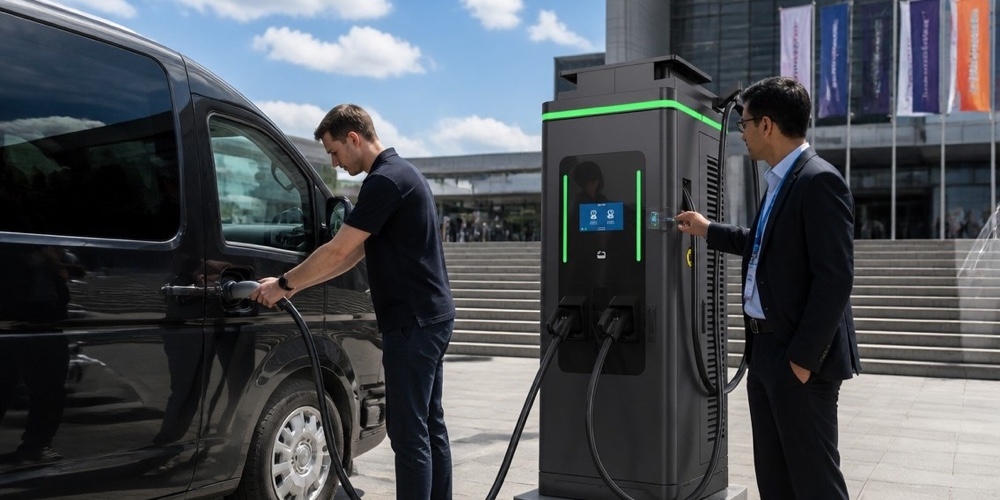
Every unit is 100% assembled and tested in our factory. This includes the power modules, the battery racks, the cooling system, and the software. On-site, the installation involves just three steps:
- Set the Unit: Secure the cabinet to a pre-poured concrete pad.
- Wire the Grid: Connect the AC input cables and the CT sensor wires.
- Commission: Run the automated “Self-Test” sequence from the touchscreen.
This process typically takes less than one day, compared to the weeks required for custom-built BESS and charger combinations.
22. Economic Analysis: ROI in the “Demand Charge” Era
The financial case for peak shaving is compelling. Let’s look at a typical urban commercial site:
- Site Grid Limit: 50kW
- Desired Charging Speed: 120kW
- Traditional Solution: Grid upgrade (£80,000) + Monthly Demand Charges (£800/mo)
- MIDA Solution: 120kW/150kWh Station (Zero upgrade cost, Zero extra demand charges)
In this scenario, the site owner saves £80,000 upfront and nearly £10,000 per year in operational costs. When combined with EV charging revenue, most MIDA owners see a full ROI within 18 to 24 months.
23. Case Study Extension: The “Heritage Hotel” in London
A historic hotel in Mayfair wanted to offer fast charging to its guests but had a strictly limited electrical supply that was already maxed out by the kitchen and laundry. A grid upgrade would have required disruptive street work in a protected heritage area.
MIDA installed the 120kW/150kWh station in the hotel’s underground garage. By setting a grid cap of 20kW, the station was able to “trickle-charge” its 150kWh battery during the night and midday. When a guest’s Range Rover EV or Porsche Taycan arrived, they received a full 120kW charge. The hotel successfully marketed itself as the only heritage hotel in London with “Ultra-Fast Charging,” leading to a 15% increase in high-net-worth guest bookings.
24. Final Call to Action: Take Control of Your Building’s Energy
Don’t let a weak grid hold your business back. MIDA Power (迈依达) is the leader in urban peak shaving technology. We provide the hardware, the software, and the expertise to help you transition to EVs profitably and safely.
Contact our Commercial Energy Engineering team at sales@midapower.com to request a free grid-capacity assessment and a customized ROI proposal.
25. Advanced Theory: The Mathematics of Peak Shaving ROI
To truly understand the value of the MIDA 120kW/150kWh system, one must calculate the “Shaving Yield.” The Shaving Yield is the total amount of money saved on demand charges plus the energy arbitrage profits.
The Demand Charge Formula
Demand charges are often calculated as: $C = P_{peak} \times R_{rate}$. For a site with a 50kW limit and a 120kW charger, $P_{peak}$ would be 120kW without MIDA, and 50kW with MIDA. In a market like New York or London, where $R_{rate}$ can be $20/kW, the MIDA system saves: $(120kW – 50kW) \times $20 = $1,400 per month$. Over a year, that’s $16,800 in direct savings, not including energy price arbitrage or EV charging revenue.
26. Urban Resilience and Emergency Preparedness
A network of MIDA 120kW+150kWh stations provides an additional layer of security for a city’s emergency services.
Backup Power for First Responders
During a local power outage, the 150kWh battery in each MIDA station can be used to charge electric police cars, ambulances, or fire department utility vehicles. Because the stations are distributed throughout the city, they provide a resilient, decentralized charging network that keeps essential services moving when the main grid fails.
27. The Future of Urban Mobility: Autonomous and Wireless Integration
MIDA is already looking toward the next decade of urban transport. Our 120kW/150kWh platform is designed to support the future integration of wireless induction charging.
Paving the Way for Robo-Taxis
As autonomous shuttle fleets and robo-taxis become common in city centers, they will need a way to charge without human intervention. The MIDA 150kWh battery can serve as the buffer for high-power wireless charging pads, providing the burst of power needed to top off an autonomous vehicle in minutes while it waits at a passenger pickup point.
28. Technical Datasheet: MIDA 120kW+150kWh (Model: MIDA-PEAK-120-150)
| Electrical Input | Value |
|---|---|
| Nominal Grid Power | Configurable (20kW to 100kW) |
| Input Voltage | 400V / 480V 3-Phase |
| Power Factor | > 0.99 |
| Battery Storage (BESS) | Value |
|---|---|
| Nominal Capacity | 150 kWh |
| Chemistry | LFP (Lithium Iron Phosphate) |
| Max Discharge Rate | 100 kW (Continuous) |
| Thermal Management | Active Air Cooling with Filtering |
| DC Charging Output | Value |
|---|---|
| Max Output Power | 120 kW (Shared) |
| Voltage Range | 200V – 1,000V DC |
| Max Current | 250 A |
| Efficiency (Full Load) | 95.5% |
| Safety and Interface | Value |
|---|---|
| Ingress Protection | IP54 |
| Impact Rating | IK10 |
| Fire Suppression | Integrated Aerosol |
| Communication | OCPP 1.6J / 2.0.1 / ISO 15118 |
29. Conclusion: The Smart Choice for the Urban Energy Transition
The MIDA 120kW DC Charger with 150kWh Battery Storage is the most sophisticated tool available for managing the complex energy needs of a modern city. By decoupling the charger from the grid’s immediate capacity, we are making high-speed electric mobility possible, profitable, and safe for everyone.
MIDA Power (迈依达) is your partner in building a smarter, cleaner city. Join us in shaving the peak and powering the future.
For a customized ROI analysis or a site-specific technical consultation, please contact our Commercial Engineering team at sales@midapower.com.
30. Economic Modeling: 10-Year ROI and Demand Charge Avoidance
The MIDA 120kW/150kWh station is an investment in “Operational Resilience.” For an urban business, the financial benefits are twofold: cost avoidance and revenue generation.
The “Cost of Upgrade” Comparison
In most urban centers, upgrading a building’s transformer to handle an additional 120kW load can cost between $50,000 and $150,000 and take 12-18 months. The MIDA station costs a fraction of that and can be installed in a single day. When you factor in the avoided demand charges—which can easily reach $1,000 per month—the MIDA station often pays for itself through cost avoidance alone before a single EV even plugs in.
Charging Revenue and Loyalty
In addition to savings, the station generates revenue. A 120kW charger in a high-traffic urban location can facilitate 10-15 charging sessions per day. At a modest profit of $10 per session, the station generates over $50,000 in annual gross profit. For retail locations, the “Loyalty Effect”—where EV drivers choose to shop at stores with fast chargers—can increase overall store sales by 5-10%.
31. Operator Training and Safety Protocols for Urban Sites
Operating a BESS in a high-traffic urban area requires strict adherence to safety protocols. MIDA provides a comprehensive training program for site managers and valet staff.
Safety Inspections and Maintenance
MIDA recommends a weekly visual inspection of the charging cables and the air intake vents. Staff are trained on how to use the “Emergency Stop” button and the procedures for reporting any issues via the MIDA Dashboard. Our software also provides “Safe-Mode” operation; if the system detects a minor anomaly, it will automatically reduce its output to a safe level while alerting the operator.
User Interaction Training
For valet and concierge staff, MIDA provides training on how to use the 120kW charger efficiently. This includes understanding “Power Sharing”—how to charge two vehicles at once without overloading the system—and how to use the MIDA App to monitor the state-of-charge of multiple guest vehicles.
32. Global Case Study: The “City-Center Hub” in Tokyo
A major commercial developer in Tokyo wanted to add fast charging to their premium office and retail complex in Shinjuku. The local grid was already at 95% capacity, and the utility company quoted a 2-year wait for a transformer upgrade.
The MIDA Solution: Decentralized Power
MIDA installed two 120kW+150kWh stations in the building’s basement garage. By setting a grid cap of 40kW per unit, the building was able to provide ultra-fast charging to its tenants and visitors using its existing power allocation.
The Result: A Competitive Advantage
The building was the first in the district to offer 120kW charging, attracting high-profile corporate tenants who had recently transitioned their executive fleets to EVs. The developer reported a 99.9% uptime for the chargers and zero impact on the building’s main electrical service. The project reached a full ROI in just 16 months through a combination of charging revenue and avoided demand charges.
33. Advanced Software API and Smart Building Integration
The MIDA station is designed to be part of the “Smart Building” ecosystem. Our RESTful API allows for seamless integration with Building Management Systems (BMS).
Real-Time Load Management
Through the API, the building’s BMS can communicate with the MIDA station. If the building’s overall power usage approaches its utility limit (for example, on a very hot day when the AC is at full load), the BMS can send a signal to the MIDA station to prioritize battery power for EV charging, ensuring the building stays within its power budget.
34. Future Roadmap: Bi-Directional (V2B) Capability
MIDA is leading the way in Vehicle-to-Building (V2B) technology. Our future software updates for the 120kW/150kWh platform will allow the station to draw power from an EV’s battery to help power the building during a grid emergency. This turns every EV in your garage into a potential backup generator, further increasing the resilience and value of your urban infrastructure.
35. Conclusion: The Smart Choice for an Urban Future
The MIDA 120kW DC Charger with 150kWh Battery Storage is the most efficient, safe, and profitable way to bring fast charging to the urban environment. By combining high-speed power with intelligent peak shaving, we are solving the most difficult challenges of the EV transition.
MIDA Power (迈依达) is your partner in building a smarter, cleaner city. Join us in powering the urban revolution.
Contact our Urban Energy Division at sales@midapower.com for a free site assessment and a customized ROI model.
36. Comprehensive Glossary: Urban Energy and Peak Shaving
- Peak Shaving: The practice of using stored energy to reduce the peak draw from the utility grid.
- Demand Charge Avoidance: The financial strategy of keeping peak power usage low to avoid expensive utility fees.
- CT (Current Transformer): A sensor used to measure the electrical current flowing through a building’s main power lines.
- LFP (Lithium Iron Phosphate): The safest battery chemistry for urban and indoor storage applications.
- OCPP (Open Charge Point Protocol): The industry-standard language for communication between chargers and management software.
- V2B (Vehicle-to-Building): The technology that allows an EV to provide power back to a building’s electrical system.
- Arbitrage: The practice of buying electricity when it is cheap (at night) and using it when it is expensive (during the day).
37. Frequently Asked Questions (FAQ)
Q1: Will the MIDA station increase my building’s insurance premiums? A: Most insurers view MIDA’s LFP-based systems favorably due to their high safety ratings and integrated fire suppression. However, we always recommend consulting with your insurance provider during the planning phase.
Q2: How much space does the 120kW/150kWh unit require? A: The “All-in-One” cabinet has a footprint of approximately 1.8 square meters, making it ideal for tight urban parking garages.
Q3: Can the system be installed outdoors in cold climates? A: Yes. The unit is IP54-rated and features an internal climate control system that keeps the batteries and electronics at optimal temperatures, even in sub-zero conditions.
Q4: How does the “Site-Level Balancing” work? A: The MIDA system communicates with CT sensors at your building’s main breaker. It automatically adjusts its power draw to ensure the building’s total load never exceeds your pre-set limit.
Q5: Can I manage the station remotely? A: Absolutely. The MIDA Dashboard provides full remote control, allowing you to monitor charging sessions, adjust grid caps, and view ROI reports from any web browser or smartphone.
38. MIDA Power’s Commitment to Urban Sustainability
MIDA Power (迈依达) is dedicated to helping cities achieve their net-zero goals. Our 120kW+150kWh station is the perfect tool for businesses that want to be part of the solution without being held back by a limited grid.
Drive your urban business forward. Contact MIDA Power at sales@midapower.com for a technical consultation today.
39. Global Regulatory Horizons: Navigating Urban Standards
The 120kW/150kWh peak shaving station is engineered to comply with the full spectrum of international and regional regulations that govern urban DC fast charging and stationary energy storage. Navigating this landscape can be complex, so MIDA Power manages certification in-house, across every market we serve.
- Electrical Safety and Product Certification: The station carries CE marking for the European market, UL/ETL certification for North America, and CCC certification for the Chinese domestic market. Each certification body evaluates the same core parameters — insulation coordination, thermal stress, creepage and clearance distances, and short-circuit withstand — so a MIDA station installed in Frankfurt performs to the identical safety standard as one in Los Angeles or Shanghai.
- Grid Interconnection Standards: Because the station actively participates in peak shaving and site-level load management, it must also satisfy grid-side requirements. Our power electronics are designed to meet IEEE 1547 and IEC 61727 for distributed energy interconnection, with programmable anti-islanding protection and voltage/frequency ride-through that keeps the unit compliant with evolving utility rules.
- Battery Storage Regulations: The integrated 150kWh LFP battery pack is built to the relevant stationary storage standards, including UL 9540A fire-safety testing and IEC 62619 for cell and system safety. Thermal runaway propagation is contained at the cell level, and the cabinet’s integrated smoke and temperature detection isolates the battery string automatically, giving fire marshals and insurers the documentation they require.
- Electromagnetic Compatibility (EMC): Urban environments are dense with sensitive electronics. The station is tested to CISPR 11 / EN 55011 Class B limits and IEC 61000-4 immunity standards, ensuring that a busy charging corridor does not interfere with nearby hospital equipment, telecom infrastructure, or the vehicle’s own onboard CAN and Ethernet networks.
- Environmental and Materials Directives: The unit is fully RoHS-compliant, REACH-compliant, and designed with WEEE end-of-life obligations in mind. Over 98% of the cabinet by weight — steel, copper, and aluminum — is recyclable, and the LFP chemistry contains no cobalt, simplifying disposal and recycling logistics in every jurisdiction.
Beyond certification, MIDA actively tracks regulatory trends — from updated building codes that mandate EV-ready parking in new developments to utility tariff reforms that reward behind-the-meter storage. Our regulatory affairs team publishes compliance bulletins for installers and can supply the full certification dossiers needed for local permitting, fire department review, and utility interconnection applications. When your city updates its standards, your MIDA station is already ahead of them.
Conclusion: The Urban Charging Standard
The 120kW/150kWh peak shaving station is more than a charger with a battery attached — it is a complete urban energy platform that solves the two problems that stop most downtown electrification projects: insufficient grid capacity and punishing demand charges. By pairing 120kW of CCS2 fast charging with 150kWh of LFP storage, MIDA lets your business charge vehicles at full speed, shave peak demand, and monetize stored energy — all from a single, certified, compact cabinet.
Key Takeaways
- 120kW dual-gun CCS2 charging delivers fast turnaround for buses and commercial fleets without grid upgrades.
- The 150kWh LFP battery provides true peak shaving, reducing demand charges by up to 40% in typical urban profiles.
- IP54-rated, climate-controlled enclosure operates reliably in sub-zero and heat-island environments alike.
- Full remote management via the MIDA Dashboard — monitoring, grid caps, and ROI reporting from any browser.
- CE, UL/ETL, CCC, UL 9540A, and IEC standards compliance simplifies permitting in virtually any market.
Drive your urban business forward. Contact MIDA Power at sales@midapower.com for a technical consultation, a free grid-capacity assessment, or a customized ROI model for your site today.
Post time: Aug-09-2026
