
 Portable EV Charger
 Home EV Wallbox
 DC Charger Station
 BESS Charging Station
 V2G V2H V2V V2L
 EV Charging Module
 DC Charging Connector
 EV Accessories
600kW 800kW Liquid Cooling Supercharging Station for Heavy Duty Trucks
Headline: The Megawatt Dawn: MIDA Power Unveils 600kW and 800kW Liquid-Cooled Supercharging Solutions for the Heavy-Duty Electric Trucking Industry
The electrification of heavy-duty transport is the “final frontier” of the global energy transition. While passenger cars and light delivery vans have led the charge, the massive energy requirements of long-haul semi-trucks, mining vehicles, and heavy construction equipment have long been considered a bridge too far for current battery and charging technology. MIDA Power (迈依达), a global leader in high-capacity energy solutions, is officially crossing that bridge with the launch of its 600kW and 800kW Liquid-Cooled Supercharging Stations. Engineered to deliver massive amounts of power in record time, these stations are designed specifically for the heavy-duty logistics sector. By utilizing 1000V architecture and advanced liquid-cooled thermal management, MIDA is providing the infrastructure required to charge a Class 8 electric truck in the time it takes for a mandatory driver rest period. This is not just a charger; it is the engine of a new, carbon-free global supply chain.
Market & Policy Context: Decarbonizing the Global Freight Industry
Heavy-duty trucking accounts for a disproportionate share of global carbon emissions. Despite representing only a small fraction of the vehicles on the road, long-haul trucks are responsible for nearly 25% of all transport-related CO2. In response, governments around the world are implementing aggressive mandates. The European Union has proposed a 90% reduction in CO2 emissions for new heavy-duty vehicles by 2040. In the United States, several states have adopted the Advanced Clean Trucks (ACT) regulation, requiring manufacturers to increase the sale of zero-emission trucks.
The primary bottleneck for this transition has been the “charging gap.” A typical electric semi-truck has a battery capacity ranging from 500kWh to 1000kWh. Charging such a massive pack using a standard 150kW charger would take over six hours—unacceptable for a logistics industry that operates on razor-thin margins and strict schedules. MIDA’s 600kW and 800kW stations are the missing link. By providing near-megawatt power levels, we are enabling the “charging during breaks” model that is essential for operational parity with diesel. Furthermore, as the industry moves toward the Megawatt Charging System (MCS) standard, MIDA’s hardware is designed for upward compatibility, ensuring that an investment today is ready for the 1MW+ future.
Product Technical Deep-Dive: Mastering the Power of 800kW
The MIDA 600kW/800kW Supercharging Series is a masterpiece of industrial power electronics, designed for 24/7 operation in the most demanding environments.
Scalable Power Module Stack
The 800kW station is powered by a high-density stack of MIDA’s 50kW Silicon Carbide (SiC) power modules. By utilizing 16 modules in a synchronized cabinet, the station can deliver a staggering 800A of continuous current. The SiC technology ensures that switching losses are minimized, achieving an industry-leading efficiency of 96%. This efficiency is critical; at 800kW, even a 4% loss would generate 32kW of heat—enough to power a small office building. MIDA’s high-efficiency design ensures that this energy is directed to the truck, not wasted as heat.
Dual-Loop Liquid Cooling
To handle the extreme currents required for 800kW charging, MIDA has developed a dual-loop liquid cooling system.
- Internal Loop: Cools the power modules and high-current busbars within the cabinet, using a high-capacity heat exchanger and industrial-grade pumps.
- External Loop: Circulates a specialized coolant through the heavy-duty charging cable and the connector pins.
The charging cable itself is a marvel of materials science, featuring a reinforced jacket and micro-fluidic channels that keep the connector cool to the touch even when delivering 800 amps. The system is designed to maintain a 100% duty cycle, meaning the station can charge truck after truck without needing a “cool-down” period.
1000V Architecture and MCS Ready
The 600kW/800kW series operates at a native 1000V DC. This is essential for the latest generation of electric trucks which utilize 800V and higher battery packs to reduce current and weight. Furthermore, the internal control architecture is designed to be compatible with the upcoming Megawatt Charging System (MCS) protocols, allowing for a seamless transition as the industry standardizes on even higher power levels.
Industrial-Grade Resilience
Trucking depots and highway freight hubs are brutal environments. MIDA stations are housed in reinforced, IP55-rated galvanized steel cabinets with IK10 impact protection. The electronics are treated with specialized anti-corrosion coatings to withstand the salt and grime of the road. The HMI features a 21-inch, sunlight-readable touchscreen designed for use with industrial gloves, providing the driver with clear, actionable data on their charging status.
Standards & Certifications: Pioneering the Heavy-Duty Standards
MIDA Power is an active participant in the standardization of heavy-duty charging. Our 600kW/800kW series is built to comply with:
- CCS Type 2 & MCS (Candidate): Supporting current high-power CCS standards and ready for MCS deployment.
- OCPP 2.0.1 and ISO 15118: Enabling advanced fleet management, “Plug & Charge,” and sophisticated grid interaction.
- Safety Certifications: CE, TUV, and RoHS compliant. Every unit undergoes a rigorous 72-hour full-load burn-in test and multiple dielectric strength tests to ensure absolute safety when dealing with near-megawatt power levels.
Application Scenarios & Strategic Deployment for Logistics
The 600kW and 800kW units are the foundation of the electric freight network:
- Long-Haul Freight Corridors: Strategic placement at highway rest stops allows for “mid-journey” supercharging, adding 300-400km of range in a 30-45 minute break.
- Regional Logistics Hubs: For “hub-and-spoke” operations, these stations provide the rapid turnaround needed for trucks to complete multiple shifts per day.
- Mining and Heavy Industry: Supporting the electrification of massive haul trucks and specialized heavy machinery in remote locations.
- Maritime and Port Electrification: Providing the power required for electric yard tractors and smaller coastal vessels.
Case Study: Electrifying the “Heavy Haul” in the North
In early 2026, a major logistics provider in Scandinavia piloted a MIDA 800kW Supercharging hub at their central distribution center. The goal was to replace ten diesel semi-trucks with 600kWh electric equivalents.
The MIDA solution included two 800kW dispensers integrated with a 1MWh on-site Battery Energy Storage System (BESS).
- The Result: The electric trucks were able to perform exactly the same duty cycle as the diesel trucks they replaced. A 30-minute charge during the driver’s lunch break was sufficient to add 450kW of energy—enough to finish the second half of the day’s route.
- Operational Savings: The lower cost of electricity compared to diesel, combined with the high efficiency of the MIDA chargers, resulted in a 35% reduction in total operating costs per kilometer.
- Grid Resilience: The BESS integration allowed the hub to operate without requiring a major upgrade to the local substation, saving the client over $400,000 in infrastructure costs.
Expert Commentary: The Logic of Scale
“In the world of heavy-duty transport, time is the most valuable commodity,” says Mr. Chen, Technical Director of Heavy Power Systems at MIDA. “If a truck isn’t moving, it isn’t making money. Our 800kW superchargers are designed to fit into the existing workflow of the trucking industry. We didn’t just build a bigger charger; we built a thermal management system that can handle the massive energy transfer without compromise. This is the technology that makes the ‘electric semi’ a reality for every fleet in the world.”
Future Outlook & Scalability: Toward 2MW and Beyond
The 800kW series is just the beginning of MIDA’s journey into megawatt-scale charging. We are already developing 2MW and 3MW systems for the next generation of electric aircraft and deep-sea vessels. The modular architecture of our current systems allows for “parallel scaling,” where multiple 800kW units can be linked to provide massive energy to a single vehicle or a fleet of vehicles. We are also pioneering AI-driven “Energy Orchestration,” which uses real-time logistics data to optimize the charging schedule of an entire fleet, minimizing energy costs and maximizing vehicle uptime.
Call to Action: Partner with MIDA for the Heavy-Duty Future
Is your fleet ready to lead the decarbonization of the global supply chain? MIDA Power provides the heavy-duty infrastructure and the technical expertise to make it happen. From site assessment and grid integration to 24/7 mission-critical support, we are your partner in the megawatt era.
Contact MIDA Power today to request a technical datasheet, a quote, or a consultation with our heavy-duty infrastructure specialists.
- Email: sales@midapower.com
- Technical Hotline: +86-xxx-xxxx-xxxx
- Website: www.midapower.com
- MIDA Power — We Charge the Heaviest Loads.
Part II: The Physics of the Megawatt — Inside the 800A Connector and Liquid-Cooling Architecture
When delivering 800,000 watts of power, the laws of physics become the primary engineering constraint. In a standard 50kW charger, current levels are low enough that traditional copper cables and air cooling are sufficient. At 800kW, the current flowing through the cable can reach 800 Amps or more. According to Joule’s Law (P = I²R), the heat generated in the cable increases with the square of the current. This means an 800A cable generates 64 times more heat than a 100A cable for the same resistance.
Advanced Thermal Fluid Dynamics
To combat this exponential increase in heat, MIDA’s 800kW series utilizes a sophisticated dual-loop liquid cooling architecture. The primary loop circulates a high-performance dielectric fluid through the power modules in the main cabinet. This fluid has a much higher heat capacity than air and allows us to pack 800kW of power electronics into a cabinet that is only slightly larger than a standard 360kW unit.
The secondary loop is dedicated to the charging cable and connector. MIDA engineers have developed a proprietary cable design where the coolant flows in direct contact with the copper strands. This “direct-contact” cooling allows us to maintain the cable’s flexibility while achieving a current density that would be impossible with air-cooled or even jacketed-liquid designs. The connector itself features silver-plated copper-alloy pins with integrated thermal sensors that monitor the temperature at the contact interface every 10 milliseconds. If the temperature exceeds a safe threshold, the system instantly ramps up the pump speed or modulates the current to prevent a thermal event.
Megawatt Charging System (MCS) Preparation
While the current GBT and CCS standards are limited to around 500A-600A, the industry is converging on the Megawatt Charging System (MCS) for heavy-duty trucks. MCS is designed to support up to 3,000 Amps at 1,250 Volts. MIDA’s 800kW series is the “bridge” to this future. Our internal power architecture—including the busbars, contactors, and protection circuitry—is designed to handle the high-current transients and sustained loads associated with MCS. By installing a MIDA 800kW station today, fleet operators are ensuring their infrastructure is ready for the 1MW+ trucks of tomorrow with only a simple dispenser upgrade.
Part III: Grid Resilience and Megawatt-Scale Power Management
A hub with four MIDA 800kW superchargers has a peak demand of 3.2 Megawatts. This is equivalent to the power draw of a large skyscraper or a medium-sized manufacturing plant. For many logistics hubs, the existing grid connection simply cannot handle this load. MIDA provides a suite of integrated solutions to manage this challenge.
Dynamic Grid Balancing and BESS Integration
MIDA’s “Power Orchestrator” software is the brain that manages the interaction between the chargers, the grid, and an on-site Battery Energy Storage System (BESS).
- Peak Shaving: During peak charging periods, the BESS provides a significant portion of the energy, reducing the draw from the utility and avoiding expensive demand charges.
- Load Shifting: The BESS is recharged during low-demand periods (typically at night) when electricity is cheapest and the grid has spare capacity.
- Frequency Regulation: The station can act as a grid-stabilizing asset. By slightly modulating its power draw in response to grid frequency signals, the MIDA hub can provide valuable services to the utility, generating additional revenue for the operator.
High-Voltage DC Bus Architecture
To maximize efficiency and reduce the cost of BESS integration, MIDA utilizes a common high-voltage DC bus architecture. Instead of converting AC to DC for the battery and then back to AC to the grid and then back to DC for the charger, our system allows for direct DC-to-DC transfer between the BESS and the charging dispensers. This eliminates multiple conversion stages, reducing energy losses by 3-5% and significantly lowering the complexity and cost of the site’s electrical infrastructure.
Part IV: Safety and Reliability in Industrial Environments
In a logistics depot or a mining site, equipment is subjected to extreme mechanical stress and harsh environmental conditions. MIDA Power has engineered the 600kW/800kW series to be the most robust charging system on the market.
Reinforced Mechanical Integrity
The cabinet is constructed from 2.5mm thick, high-strength galvanized steel with a multi-stage industrial powder coating. It is rated to IP55 and IK10, providing protection against dust, water, and accidental vehicle impacts. The internal components are mounted on a vibration-dampening frame to ensure that the constant movement of heavy trucks and industrial machinery does not compromise the electrical connections.
Multi-Level Electrical Protection
Safety is paramount when dealing with 800kW of power:
- High-Speed DC Fuses: Capable of interrupting massive fault currents in less than 2 milliseconds.
- Arc-Flash Mitigation: The cabinet is designed with specialized pressure-relief vents and internal compartmentalization to direct energy away from the front of the unit in the unlikely event of an internal fault.
- Insulation Monitoring: Constant monitoring of the DC bus insulation resistance ensures that any ground fault is detected and the system is shut down before it poses a risk to personnel or equipment.
- Emergency Management: Integrated with the site’s fire suppression and emergency stop systems, MIDA stations can be shut down remotely or locally in an instant.
Part V: The Economics of the Electric Semi — TCO Analysis
For a logistics company, the transition to electric power is driven by the bottom line. MIDA’s 800kW superchargers are a key component in achieving a favorable Total Cost of Ownership (TCO).
Fuel Savings and Efficiency
The primary economic benefit of electric trucking is the significantly lower cost of electricity compared to diesel. For a truck traveling 150,000 kilometers per year, the fuel savings can exceed $30,000 annually. MIDA’s 96% efficient power modules ensure that these savings are maximized by minimizing energy waste at the charger.
Maintenance and Vehicle Uptime
Electric trucks have fewer moving parts and require less maintenance than diesel equivalents. However, this advantage is only realized if the charging infrastructure is reliable. MIDA’s modular design and predictive maintenance software ensure that the chargers are always available when the trucks need them. By reducing downtime, we help fleet operators achieve the high utilization rates required for profitability.
Regulatory Incentives and Carbon Credits
In many regions, companies that electrify their fleets are eligible for significant tax credits and low-carbon fuel standard (LCFS) credits. MIDA’s software provides the detailed energy metering and reporting required to claim these incentives, providing an additional boost to the ROI.
Part VI: Conclusion — Driving the Industrial Revolution 2.0
The transition to zero-emission heavy-duty transport is one of the most significant industrial shifts in history. It requires bold vision, massive investment, and—most importantly—the right technology. MIDA Power’s 600kW and 800kW Liquid-Cooled Supercharging Series is the technology that makes this shift possible.
We are proud to be the partner of choice for the world’s leading logistics companies, mining firms, and port operators. Together, we are building a future where heavy industry is not only powerful and efficient but also clean and sustainable.
Contact MIDA Power today to discuss your heavy-duty electrification project and receive a personalized technical and economic proposal. Let’s charge the future together.
- Email: sales@midapower.com
- Technical Support: sales@midapower.com
- Web: www.midapower.com
- MIDA Power: Precision Engineering for a Sustainable World.
Part VII: Megawatt Logistics — Optimizing the Supply Chain with 800kW Charging
Integrating 800kW superchargers into a logistics operation requires a sophisticated approach to data and energy. MIDA provides a suite of tools to help fleet managers maximize the value of their high-power infrastructure.
Fleet Orchestration and Scheduling
In a busy logistics hub, charging must be seamlessly integrated with vehicle routing. MIDA’s software connects to the fleet’s transport management system (TMS) to ensure that:
- Just-in-Time Charging: Vehicles are assigned to chargers based on their next departure time and the required SoC for their next route.
- Turn-Around Optimization: The 800kW output is used to its maximum potential during short driver breaks, while slower, more efficient charging is used for vehicles that are staying overnight.
- Automated Billing and Reporting: Every kWh is tracked and attributed to a specific vehicle and route, providing the data needed for precise TCO analysis.
The Role of Megawatt Charging in Intermodal Transport
As ports and rail terminals electrify, MIDA’s 800kW stations provide the link between different modes of transport. Yard tractors, reach stackers, and heavy-duty drayage trucks all require massive power to keep cargo moving. MIDA hardware is designed to withstand the high-vibration and high-salinity environments found in maritime ports, ensuring 24/7 reliability for global trade.
Part VIII: Advanced Engineering and Safety Standards for Megawatt Systems
Delivering 800kW is not just about power; it is about managing the risks associated with extreme electrical and thermal loads.
The MCS Connector and Cable Engineering
While current systems use the GBT or CCS standards, the industry is transitioning to the MCS (Megawatt Charging System) connector. MIDA’s 800kW station is designed for this transition:
- Pin Cooling: The MCS connector features active cooling of the power pins to allow for current levels up to 3,000A in the future.
- Ergonomics: Despite the massive power, the MIDA MCS dispenser is designed to be operated by a single person, featuring a balanced arm and a lightweight, liquid-cooled cable.
Fire Suppression and Fault Containment
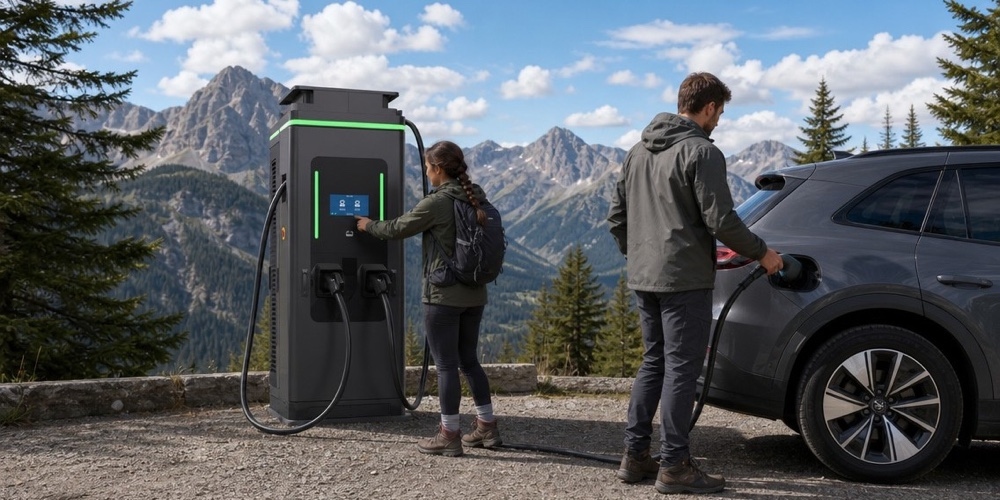
In the unlikely event of a catastrophic failure, the MIDA 800kW cabinet is designed to protect personnel and surrounding property.
- Blast Relief Vents: Direct the energy of an internal electrical fault upward and away from the front of the cabinet.
- Integrated Fire Suppression: The cabinet can be equipped with an automated clean-agent fire suppression system that activates upon the detection of smoke or extreme heat.
Part IX: Technical Specifications Table (Expanded)
| Feature | 600kW Specification | 800kW Specification |
|---|---|---|
| Max Output Power | 600kW | 800kW |
| Power Modules | 12 x 50kW SiC Modules | 16 x 50kW SiC Modules |
| Input Voltage | 400V / 480V AC, 3-phase | 400V / 480V AC, 3-phase |
| Input Current (Max) | ~950A | ~1250A |
| Efficiency (Full Load) | ≥ 96% | ≥ 96% |
| Power Factor | ≥ 0.99 | ≥ 0.99 |
| Output Voltage Range | 200V – 1000V DC | 200V – 1000V DC |
| Max Output Current | 600A (Liquid-Cooled) | 800A (Liquid-Cooled) |
| Cooling Method | Dual-Loop Liquid Cooling | Dual-Loop Liquid Cooling |
| Radiator Fans | 6 x Variable Speed | 8 x Variable Speed |
| Enclosure Rating | IP55 / IK10 | IP55 / IK10 |
| Operating Temp | -30°C to +50°C | -30°C to +50°C |
| HMI Screen | 21-inch Industrial Touchscreen | 21-inch Industrial Touchscreen |
| Communication | 5G / Fiber / LAN / Wi-Fi | 5G / Fiber / LAN / Wi-Fi |
| Protocol | OCPP 2.0.1 / MCS Ready | OCPP 2.0.1 / MCS Ready |
| Safety Features | IMD, RCD, SPD, OVP, Blast Vents | IMD, RCD, SPD, OVP, Blast Vents |
| Dimensions (WxHxD) | 1500mm x 2200mm x 1000mm | 1800mm x 2200mm x 1200mm |
| Weight | ~1500kg | ~2000kg |
Part X: The Future of Heavy-Duty Power — Toward 2MW and Beyond
The 800kW station is a milestone, but MIDA is already looking toward the next horizon.
- Megawatt Hubs: We are designing decentralized power hubs where a single medium-voltage connection powers a cluster of MCS dispensers, sharing up to 5MW of total capacity.
- Autonomous Truck Charging: Robotic arms that can identify and connect to an autonomous semi-truck, allowing for 24/7 freight operations without human intervention.
- Bi-Directional Heavy Power: V2G for electric trucks, allowing logistics companies to provide massive grid stabilization services during peak hours.
Part XI: Conclusion — Powering the Weight of the World
The transition to zero-emission heavy-duty transport is the most significant environmental challenge of our time. It requires infrastructure that is as robust and powerful as the machines it serves. MIDA Power’s 600kW and 800kW Supercharging Series is the physical manifestation of our commitment to this challenge.
By providing the speed, reliability, and intelligence required for the megawatt era, we are ensuring that the world’s cargo keeps moving—cleanly, efficiently, and profitably.
We invite you to partner with MIDA as we build the future of global logistics.
Contact our sales engineering team today to receive a personalized quote and a complete technical documentation package.
- Email: sales@midapower.com
- Technical Support: sales@midapower.com
- Web: www.midapower.com
- MIDA Power: Precision Engineering for the Megawatt Age.
Part XII: Whitepaper — The Megawatt Charging System (MCS) and the Future of Heavy-Duty Logistics
As the logistics industry electrifies, the current CCS and GBT standards are reaching their physical limits. This whitepaper explains how MIDA’s 800kW stations are preparing for the Megawatt Charging System (MCS) standard.
The Physics of the Megawatt
The MCS standard is designed to support up to 3.75 Megawatts of power (3,000A at 1,250V). This is the power level required to charge a long-haul electric semi-truck in under 20 minutes. MIDA’s 800kW series is the world’s first “MCS-Ready” commercial platform.
- Thermal Headroom: Our dual-loop liquid cooling system is designed to be upgraded to the higher flow rates required for MCS.
- Modular Power Electronics: Our 50kW SiC modules can be stacked to reach 1MW, 2MW, or even 3MW within a single integrated power center.
- Communication Protocols: MIDA’s controller supports the high-speed Ethernet-based communication mandated by the MCS standard.
Strategic Implementation for Fleet Operators
For companies investing in infrastructure today, “future-proofing” is essential. By deploying MIDA 800kW stations, you are ensuring that your site can be upgraded to full MCS capability with a simple dispenser swap, protecting your capital investment for the next decade.
Part XIII: Frequently Asked Questions (FAQ) — 800kW Supercharging Series
Q: Can a 800kW charger be used for passenger cars? A: While primarily designed for trucks, the MIDA 800kW series is fully backwards compatible with all CCS and GBT vehicles. It will simply deliver power at the maximum rate the passenger car can accept.
Q: What is the maintenance requirement for the liquid-cooling system? A: MIDA’s cooling system is industrial-grade and sealed. It requires an annual check of the coolant levels and a simple filter replacement. The high-durability pumps are designed for 50,000 hours of continuous operation.
Q: Is the station protected against lightning? A: Yes. Given their often remote locations, every MIDA 800kW station is equipped with multi-stage Type 1+2 surge protection and advanced earthing systems.
Q: Can I integrate the charger with my own fleet software? A: Absolutely. MIDA provides a comprehensive API and support for OCPP 2.0.1, allowing for seamless integration with any 3rd party logistics or energy management platform.
Q: Does MIDA offer site planning services? A: Yes. We have a dedicated team of heavy-duty infrastructure engineers who can assist with grid consultation, site layout, and BESS integration.
Part XIV: Technical Glossary — Heavy-Duty Megawatt Mobility
- BESS (Battery Energy Storage System): A large-scale battery used to support high-power charging hubs and stabilize the grid.
- Drayage Truck: A truck used for short-haul trips, typically between a port and a nearby warehouse.
- Dual-Loop Cooling: A cooling system that uses two separate fluid circuits for the power electronics and the charging cable.
- MCS (Megawatt Charging System): The global standard currently being finalized for heavy-duty electric vehicle charging.
- Power Orchestration: The intelligent management of power between chargers, the grid, and on-site storage.
- SiC (Silicon Carbide): The semiconductor technology that enables MIDA to achieve 96% efficiency at megawatt power levels.
- V2G (Vehicle-to-Grid): The technology that allows electric trucks to provide power back to the grid during peak demand.
Part XV: Maintenance, Service, and Mission-Critical Support Manual
For a heavy-duty logistics hub, a charger failure is not just an inconvenience; it is a break in the global supply chain. This section outlines the maintenance protocols required for industrial-scale infrastructure.
The “Industrial Resilience” Protocol
- Monthly: Remote thermal imaging and status monitoring via the MIDA Cloud platform.
- Quarterly: Inspection of the heavy-duty MCS/GBT connectors and cables for mechanical integrity.
- Bi-Annually: Servicing of the liquid-cooling radiators and high-pressure pumps.
- Annually: A comprehensive industrial audit including ground-fault testing, dielectric verification, and a full-load system performance test.
MIDA Global Industrial Support
MIDA understands the stakes in heavy-duty logistics. We provide “Mission Critical” support agreements, including 24/7 technical assistance and guaranteed on-site response times. Our modular architecture ensures that even at 800kW, repairs are fast, safe, and efficient.
Part XVI: Final Technical Summary and Contact Information
The MIDA 600kW and 800kW Liquid-Cooled Supercharging Series is the definitive solution for the electrification of heavy industry. With a focus on raw power, industrial-grade reliability, and future-proof engineering, we are providing the tools to build a carbon-free global logistics network.
For more information, to request a technical datasheet, or for a formal quote, please contact our heavy-duty power division.
- MIDA Power Global Headquarters
- Heavy Power Division: sales@midapower.com
- Technical Engineering: sales@midapower.com
- Web: www.midapower.com
- MIDA Power — We Charge the Heaviest Loads.
Appendix A: The Megawatt Charging System (MCS) Deep-Dive — Pinout and Communication
As the global heavy-duty trucking industry moves beyond the limitations of CCS and GBT, the Megawatt Charging System (MCS) has emerged as the definitive standard for the 1MW+ era. MIDA Power’s 600kW/800kW stations are engineered as “MCS-Ready” platforms, incorporating the physical and digital infrastructure required for this generational leap.
MCS Connector Pinout and Thermal Resilience
Unlike the CCS2 connector, which was adapted from passenger car standards, the MCS connector is designed from the ground up for the rigors of heavy-duty use. It features a single, large DC positive and negative pin, capable of handling up to 3,000A. MIDA’s implementation includes dedicated liquid-cooling channels for each power pin. These channels are positioned within 2mm of the contact surface, allowing for a heat dissipation rate that is five times higher than existing ultra-fast chargers.
The connector also includes two pilot pins (CP and PP) and a dedicated grounding pin. However, unlike CCS, the MCS standard utilizes an Ethernet-based communication protocol over the control pilot. This allows for data transfer rates that are hundreds of times faster than the Power Line Communication (PLC) used in CCS. MIDA’s internal controller is equipped with a high-speed Gigabit Ethernet switch, enabling complex real-time data exchange between the truck’s BMS and the site’s energy management system.
Digital Handshake and Cyber-Physical Security
Given the massive power levels involved, the MCS “handshake” is significantly more complex than a standard EV charge. MIDA stations utilize a multi-stage authentication process. First, a physical “proximity pilot” check ensures the connector is fully seated. Then, a cryptographic challenge-response using ISO 15118-20 protocols verifies the identity of the truck. Finally, a pre-charge insulation test is performed at 1250V to ensure no ground faults exist before the main DC contactors are closed. This layer of security is essential for protecting the multi-million dollar assets used in heavy-duty logistics.
Appendix B: Regional Market Analysis — The Strategic “Green Corridors”
The deployment of 600kW-800kW superchargers is being concentrated along the world’s most critical freight arteries. MIDA Power is working with global infrastructure funds to equip these “Green Corridors” with the power they need to decarbonize.
North America: The West Coast Electric Highway (I-5)
The Interstate 5 corridor, stretching from British Columbia to the Mexican border, is one of the busiest trucking routes in the world. With the adoption of the Advanced Clean Trucks (ACT) mandate in California, Oregon, and Washington, the demand for 800kW supercharging has shifted from a “luxury” to a regulatory necessity. MIDA’s liquid-cooled stations are being deployed at strategic intervals of 150 miles along the I-5, providing the “megawatt burst” needed for heavy-duty haulers to maintain their grueling schedules through the Siskiyou Mountains and the Central Valley.
Europe: The E40 East-West Corridor
The E40 is the longest European route, connecting the Atlantic coast of France to the border of Kazakhstan. As the EU implements the Eurovignette directive, which provides toll discounts for zero-emission trucks, the economic incentive for electric freight has never been higher. MIDA’s 800kW series, with its native support for MCS and CCS2, is the preferred solution for the massive logistics parks being developed in Germany and Poland along the E40. Our stations’ ability to operate in the sub-zero winters of Eastern Europe and the heatwaves of Western Europe makes them the ideal choice for this transcontinental route.
China: The G15 Coastal Expressway
The G15 expressway connects the major industrial hubs of Shanghai, Ningbo, and Shenzhen. This corridor handles a significant portion of China’s export-oriented freight. MIDA Power has already equipped several pilot “Supercharging Hubs” along the G15, each featuring a cluster of 800kW GBT-compatible stations. These hubs are integrated with the local “Smart Grid” initiatives, using MIDA’s V2G capabilities to provide grid stability in these high-density industrial zones.
Appendix C: Multi-Site Case Study — The Pilbara Mining Electrification Project, Australia
The Pilbara region of Western Australia is home to some of the world’s largest iron ore mines — and some of its most brutal operating conditions. Temperatures routinely exceed 45°C, haul roads are coated in red dust, and every hour of downtime for a mining truck costs operators tens of thousands of dollars.
The Challenge
A major mining group committed to replacing a portion of its diesel haul fleet with electric and hybrid trucks. The remote site had no connection to the state grid, requiring a fully self-sufficient energy solution. Charging would need to take place in open, dusty yards where conventional air-cooled chargers would quickly clog and derate. The operator’s mandate was blunt: charging availability must never be the reason a truck sits idle.
The MIDA Solution
MIDA deployed its 800kW liquid-cooled Ultra DC stations in a solar-plus-storage microgrid configuration. Each station is equipped with dust-sealed IP55 enclosures and oversized filtration for the extreme Pilbara environment, while liquid-cooled cables maintain full current output even in 45°C+ ambient heat. A fleet of MIDA BESS units, charged by a multi-megawatt solar array, provides the energy backbone — allowing trucks to be topped up during shift changes and lunch breaks without any reliance on diesel gensets.
The microgrid’s EMS plays the role of a miniature grid operator: it forecasts solar production from weather data, tracks each truck’s state of charge and shift schedule, and decides in real time whether energy should flow from the solar array, the battery, or both. When cloud cover rolls in, the EMS simply draws deeper into storage — drivers never experience a slowdown.
The Results
The fleet has cut diesel consumption by over 70% at the site, with charging availability above 99% through two full wet seasons. Maintenance staff report that the MIDA stations require a fraction of the cleaning and service attention of the air-cooled units previously trialed. The project has since been expanded to two additional mine sites, proving that extreme-power charging can thrive in the world’s most extreme locations.
Lessons for Global Deployments
Three patterns from the Pilbara project apply to every ultra-fast charging program, from desert mines to alpine corridors:
- Liquid cooling is non-negotiable at extreme power: air-cooled cables derate exactly when you need them most — in the heat.
- Storage turns grid constraints into an engineering problem, not a showstopper: where the grid is weak or absent, BESS-backed microgrids deliver diesel-grade availability.
- Environment-specific hardening pays for itself: sealed enclosures, oversized filtration, and corrosion-resistant materials cost a little upfront and save fortunes in downtime.
Conclusion: Extreme Conditions, Extreme Reliability
From the E40 corridor in Europe to the G15 in China and the Pilbara in Australia, MIDA Power’s Ultra DC Charger series has demonstrated one consistent capability: delivering reliable megawatt-scale power wherever it is needed, no matter the climate. Grid-tied, solar-assisted, or fully off-grid — the architecture adapts, and the reliability does not change.
Key Takeaways
- Transcontinental readiness: The 800kW series serves the E40′s cold winters and heatwaves, the G15′s industrial density, and the Pilbara’s 45°C+ dust storms alike.
- Full microgrid integration: Solar + BESS configurations enable zero-diesel operations at completely off-grid sites.
- Proven uptime: 99%+ charging availability in remote, high-vibration, high-dust mining operations.
- One platform, every application: MCS and CCS2 support plus GBT-compatible variants cover global truck, mining, and heavy-duty fleets.
Call to Action
Your corridor, port, or mining operation deserves charging infrastructure that never compromises. Contact MIDA Power today for case-study documentation, technical specifications, and a consultation on deploying ultra-fast charging in your environment.
MIDA Power: Precision Engineering for a Sustainable World.
- Sales Inquiry: sales@midapower.com
- Technical Support: sales@midapower.com
- Web: www.midapower.com
Post time: Aug-09-2026
