
 Portable EV Charger
 Home EV Wallbox
 DC Charger Station
 BESS Charging Station
 V2G V2H V2V V2L
 EV Charging Module
 DC Charging Connector
 EV Accessories
Introduction: The Importance of Professional Installation
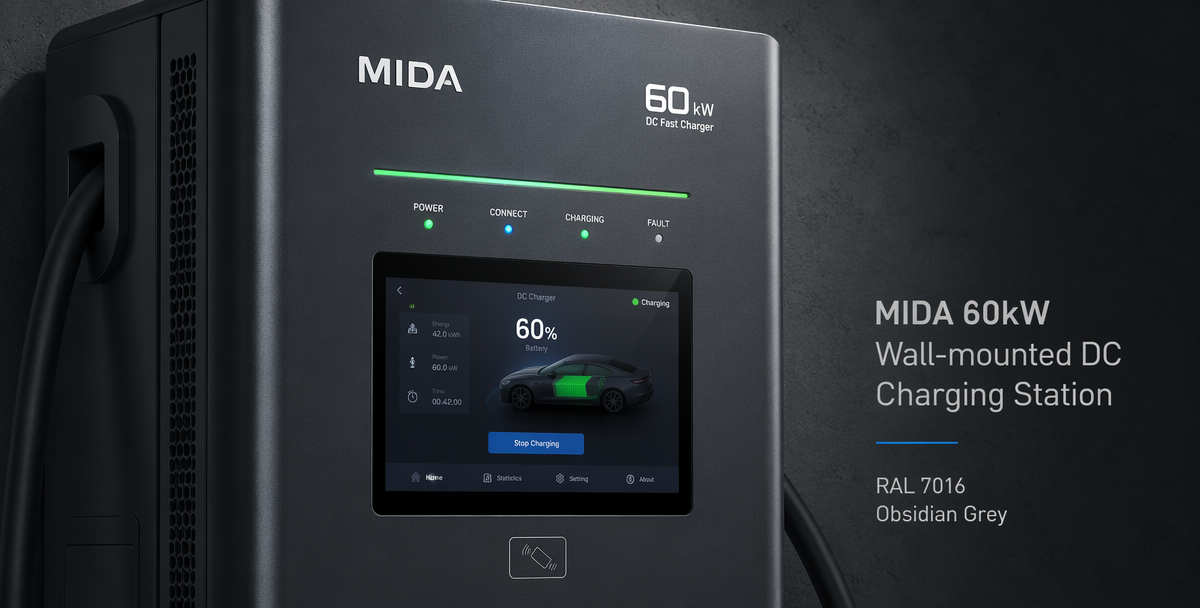
As the adoption of electric vehicles (EVs) accelerates, businesses from hotels to fleet operators are recognizing the value of providing DC fast charging. However, the success of a charging station is determined long before the first vehicle plugs in. Professional installation and strategic site planning are the twin pillars of a successful EV charging project. This guide explores the best practices for installing MIDA’s 40kW, 60kW, and 80kW wall-mounted DC stations to ensure safety, efficiency, and maximum space utilization.
Step 1: Electrical Capacity and Grid Assessment
Before selecting a physical location, a thorough assessment of the site’s electrical infrastructure is mandatory. MIDA’s DC chargers are high-power devices that require a robust 3-phase supply.
Power Requirements
For an 80kW charger, the peak current draw can exceed 120A. It is recommended to install a dedicated sub-panel with a Molded Case Circuit Breaker (MCCB) rated at 1.25 times the rated current of the charger. For example, a 60kW unit typically requires at least a 125A breaker to handle sustained full-load charging.
Grounding (Earthing) Protocol
MIDA chargers include a sophisticated grounding monitoring system. The grounding resistance must be strictly less than 4Ω. In areas with poor soil conductivity, additional ground rods or specialized grounding backfill may be required. The charger will refuse to start if it detects an inadequate ground connection, protecting both the vehicle and the operator from potential electrical faults.
Step 2: Strategic Site Selection
The “Wall-mounted” factor is MIDA’s greatest advantage, allowing for creative site planning that floor-standing units cannot match.
Space Optimization
In parking garages or tight urban parking lots, every square foot is valuable. Mounting the charging unit on a wall or a structural pillar keeps the floor area clear, preventing vehicle collisions and simplifying maintenance.
Cable Management and Accessibility
Choose a location that allows the 5-meter (or optional 7-meter) charging cable to reach the vehicle inlet easily, regardless of whether the vehicle is parked head-in or backed-in. The holster for the charging gun should be positioned at a height of 1.2 to 1.4 meters for ADA compliance and ergonomic ease of use.
Step 3: Physical Installation and Mounting
The MIDA WY series is designed for ease of installation, but its weight (typically between 60kg to 90kg depending on the power rating) requires a solid mounting surface.
Mounting Surfaces
Reinforced concrete walls are ideal. If mounting on brick or block walls, use heavy-duty expansion bolts or through-bolts with a backing plate. For locations without a suitable wall, MIDA offers a specialized steel pedestal, converting the unit into a slim, floor-standing station.
Environmental Considerations
While the units are rated IP54 for outdoor use, providing an overhead canopy can extend the life of the unit by protecting it from direct UV radiation and extreme precipitation. Ensure that there is at least 30cm of clear space around the air intake and exhaust vents to prevent thermal throttling.
Step 4: Cabling and Fire Safety
Correct cabling is the difference between a reliable system and a fire hazard. MIDA recommends using copper-core armored cables (such as the YJV-0.6/1kV series) for their durability and excellent thermal properties.
Cable Entry and Sealing
Cables should enter the charger from the bottom through designated glands. After installation, it is critical to use industrial-grade fireproof sealant (fire clay) to seal all entry points. This not only prevents moisture ingress but also keeps rodents out—a common but overlooked cause of short circuits in outdoor electrical equipment.
Step 5: Commissioning and Load Management
Once physical installation is complete, the commissioning phase begins. MIDA chargers support dynamic load balancing via RS485 or Ethernet. If multiple chargers are installed on a single site, they can “talk” to each other to ensure the total power draw never exceeds the building’s capacity, avoiding expensive grid upgrades.
Conclusion: Future-Proofing Your Site
Installing a MIDA wall-mounted DC station is an investment in the future. By following these strategic site planning and installation guidelines, you ensure that your charging infrastructure is safe, efficient, and ready to scale. Whether you are installing a single 40kW unit for a private garage or a cluster of 80kW stations for a commercial fleet, the key to success lies in professional planning and MIDA’s superior engineering.
Post time: Jul-28-2026
