
 Portable EV Charger
 Home EV Wallbox
 DC Charger Station
 BESS Charging Station
 V2G V2H V2V V2L
 EV Charging Module
 DC Charging Connector
 EV Accessories
120kw 180kw 240kW DC Fast Charger with 200kWh BESS Solar Powered Charging Station
1. Headline + Lead: The Self-Sustaining Energy Hub: MIDA Power Integrates 240kW DC Fast Charging with 200kWh BESS for the Ultimate Solar-Powered Station
As the world grapples with the dual challenges of rapid EV adoption and grid capacity constraints, the concept of the “charging station” is undergoing a radical transformation. No longer just a passive consumer of grid power, the modern charging site is becoming a sophisticated microgrid. MIDA Power a global leader in integrated energy solutions, is proud to introduce its flagship All-in-One Solar Charging System: a 120kw 180kw 240kW DC Fast Charger seamlessly integrated with a 200kWh Battery Energy Storage System (BESS). This revolutionary product combines high-speed EV charging, renewable energy harvesting, and intelligent energy storage into a single, cohesive ecosystem. Designed for areas with limited grid infrastructure, high demand charges, or a commitment to 100% green energy, the MIDA 240kW+200kWh station allows operators to capture sunlight, store it in high-performance LFP batteries, and deliver it to EVs with lightning speed—all while reducing operational costs and ensuring 24/7 reliability.
2. Market & Policy Context: De-Risking the Grid with Distributed Energy
The transition to electric mobility is putting unprecedented pressure on local power grids. In many regions, the cost of upgrading a transformer to handle a 240kW load can be prohibitive, often exceeding the cost of the chargers themselves. Furthermore, “demand charges”—the fees utilities charge based on the highest peak of power used during a month—can make high-speed DC charging financially unviable for many small-to-medium enterprises.
To combat this, the “Solar+Storage+Charging” model has gained significant traction. International policies, such as the U.S. Inflation Reduction Act (IRA) and the EU’s REPowerEU plan, offer substantial tax credits and subsidies for projects that integrate renewable energy with EV infrastructure. By decoupling the charging load from the grid’s immediate capacity, MIDA’s BESS-integrated station enables deployment in locations that were previously “off-limits” due to grid weakness. This is the future of resilient infrastructure: a decentralized network of energy hubs that can operate independently during grid outages and contribute to grid stability during peak periods.
3. Product Technical Deep-Dive: A Masterpiece of Integrated Power Electronics
The MIDA 240kW DC Fast Charger with 200kWh BESS is more than the sum of its parts. It is a highly engineered system where the PV inverter, the battery DC/DC converter, and the EV charging power modules share a common DC bus to maximize efficiency and minimize conversion losses.
High-Efficiency DC Fast Charging
The 240kW output is delivered via dual connectors (CCS1, CCS2, or GBT), supporting dynamic power sharing. This means the system can deliver a full 240kW to one vehicle or split it (e.g., 120kW+120kW) between two vehicles simultaneously. Utilizing MIDA’s latest 40kW SiC (Silicon Carbide) power modules, the charger achieves an industry-leading efficiency of 96.5%, ensuring that the precious energy stored in the BESS isn’t wasted as heat.
200kWh LFP Battery Storage
The storage component utilizes Grade-A Lithium Iron Phosphate (LFP) cells, renowned for their safety, long cycle life (6,000+ cycles), and thermal stability. The integrated Battery Management System (BMS) provides cell-level monitoring, balancing, and protection. The 200kWh capacity serves three critical functions:
- Solar Buffering: Storing excess solar energy generated during the day for use at night or during cloudy periods.
- Peak Shaving: Discharging the battery during high-demand EV charging sessions to keep the “grid draw” below a pre-set threshold.
- Backup Power: Providing limited charging capability even during a total grid failure.
Smart Energy Management System (EMS)
The “brain” of the station is the MIDA EMS. This software layer monitors solar production, battery state-of-charge (SoC), grid prices, and EV demand in real-time. It automatically decides when to charge the battery (from solar or cheap off-peak grid power) and when to discharge it to avoid expensive peak rates.
Technical Specifications Table
| Feature | Specification |
|---|---|
| Max DC Output Power | 240 kW |
| BESS Capacity | 200 kWh (LFP) |
| PV Input Range | 50kW – 150kW (Scalable) |
| Output Voltage | 200V – 1,000V DC |
| Efficiency (AC-DC / DC-DC) | 96% – 97% |
| Battery Cycle Life | ≥ 6,000 cycles @ 80% DOD |
| Communication | OCPP 1.6J / 2.0.1, Ethernet, 4G, CAN |
| Enclosure Rating | IP55 for outdoor use |
4. Standards & Certifications: Quality You Can Trust
MIDA Power prioritizes safety and interoperability. The 240kW+200kWh system is engineered to meet and exceed the most stringent international standards:
- Safety: CE, TUV, and UL 9540 (for the BESS) and UL 2202 (for the EV charger).
- Communication: ISO 15118 for seamless “Plug & Charge” and OCPP 2.0.1 for advanced cybersecurity and grid integration.
- Grid Connection: Compliant with IEEE 1547 and European grid codes for safe interconnection and anti-islanding protection.
The LFP battery racks are housed in a fire-suppressed enclosure featuring automated aerosol extinguishers and multi-point smoke/heat detection, ensuring peace of mind for site owners and neighboring businesses.
5. Application Scenarios & Deployment: Versatility in Action
The MIDA BESS-integrated station is a “Swiss Army Knife” for the energy transition.
Remote Tourist Destinations and National Parks
In remote areas where extending a high-capacity power line is environmentally or financially impossible, MIDA’s solar-powered station provides a lifeline for EV travelers. The combination of solar and storage ensures that the “electric trail” remains open, even in the heart of the wilderness.
Commercial Real Estate and Retail Hubs
Shopping malls and office complexes can use the system to reduce their carbon footprint and eliminate expensive demand charges. By using the battery to “level out” the charging peaks, property owners can offer high-speed charging without expensive electrical upgrades.
Corporate Fleets and Delivery Depots
For fleets that return to base at night, the system can charge from solar during the day, store the energy, and then fast-charge the delivery vans in the evening or early morning, ensuring the fleet is always powered by the sun.
6. Case Study: The “Sun-Drive” Eco-Resort in Australia
An luxury eco-resort in the Australian Outback faced a dilemma: their guests were increasingly arriving in EVs, but the resort’s local grid connection was limited to a mere 50kW—hardly enough for even a single standard DC charger.
MIDA Power installed the 240kW/200kWh Solar Charging Station paired with a 100kW solar canopy. During the day, the solar panels charge the 200kWh battery. When a guest arrives in a Tesla or Audi e-tron, the station can deliver a 150kW+ charge by drawing 40kW from the grid and 110kW from the battery simultaneously. This setup allowed the resort to provide “Ultra-Fast” charging on a “Slow” grid. Within the first year, the resort saw a 25% increase in guest bookings from EV owners and achieved a 100% renewable energy rating for its transport infrastructure.
7. Expert / Leadership Commentary: A Word from MIDA’s Technical Director
“The future of energy is integrated,” says Dr. Zhang Wei, Technical Director at MIDA Power. “We no longer view the charger as a standalone device. By pairing a 240kW DC output with 200kWh of LFP storage, we have solved the two biggest headaches for station operators: grid capacity and operational cost. Our goal was to create a ‘plug-and-play’ microgrid that empowers anyone—from a small business owner to a large municipality—to become their own energy utility. The efficiency we’ve achieved by keeping the energy in a DC-coupled architecture is a game-changer for the industry.”
8. Future Outlook & Scalability: Modular Growth
The MIDA system is built to grow with your needs. The modular design allows for the addition of more 200kWh battery blocks or additional 240kW charging dispensers as demand increases. Furthermore, MIDA is developing AI-driven predictive maintenance and “Virtual Power Plant” (VPP) capabilities. Soon, MIDA station owners will be able to sell their stored energy back to the grid during periods of extreme demand, turning a charging station into a revenue-generating energy asset.
9. Call to Action: Take Control of Your Energy Future
Ready to go beyond the grid? MIDA Power (迈依达) is your partner in sustainable, high-power charging. Whether you’re looking to reduce demand charges, utilize solar energy, or provide charging in a power-constrained area, our 240kW+200kWh BESS station is the answer.
Contact MIDA Power today for a technical consultation, site assessment, or a detailed project quote. Join the solar-powered revolution and drive your business forward.
MIDA Power: Integrated Energy for a Mobile World. Explore our solutions at www.midapower.com or reach out to us at sales@midapower.com.
10. Deep-Dive: The DC-Coupled Microgrid Advantage
One of the most technically advanced features of the MIDA 240kW/200kWh station is its DC-coupled architecture. In a traditional “AC-coupled” system, solar energy must be converted from DC (panels) to AC (inverter), then back to DC to charge the battery, and finally from AC to DC again to charge the EV. Each of these conversion steps loses 3-5% of energy as heat.
Eliminating Conversion Losses
By using a common DC bus, MIDA allows the solar energy to flow directly into the 200kWh BESS or directly into the EV’s battery. This “Direct-to-Drive” approach eliminates two conversion stages, increasing overall system efficiency by up to 10%. In a solar-reliant station, this 10% difference can mean the difference between a full charge and a stranded vehicle on a cloudy day.
Power Module Optimization
The system uses MIDA’s latest 40kW Silicon Carbide (SiC) modules. These modules are specifically tuned for a wide voltage range (200V-1000V), allowing them to efficiently charge older 400V EVs and next-generation 800V luxury vehicles (like the Porsche Taycan or Lucid Air) from the same storage pool. The SiC technology also allows for a smaller heat sink, reducing the overall size of the 240kW dispenser.
11. Battery Energy Storage System (BESS) Engineering and Longevity
The 200kWh storage unit is the “heart” of the station, and its reliability is paramount. MIDA has invested heavily in the thermal management and chemistry of these units.
LFP: The Safest Chemistry for Public Spaces
We exclusively use Lithium Iron Phosphate (LFP) for our integrated BESS. Unlike NCM (Nickel Cobalt Manganese) batteries, LFP is virtually immune to thermal runaway, making it the only choice for stations located near retail centers or public parking. Our LFP cells are rated for 6,000 cycles at 80% depth of discharge (DOD), which translates to over 15 years of daily operation in a typical charging environment.
Active Thermal Management (ATM)
Batteries are sensitive to temperature. Too hot, and they degrade; too cold, and they can’t discharge at high rates. MIDA’s BESS features an integrated liquid heating and cooling system. During the hot Australian summer or the frigid Canadian winter, the ATM keeps the cells within their optimal “Goldilocks zone” (20°C to 30°C), ensuring that the full 240kW output is always available.
12. The Smart Energy Management System (EMS) and AI Integration
A station with solar, storage, and fast charging is a complex system to manage. MIDA’s proprietary EMS software uses machine learning to optimize the energy flow based on multiple variables.
Predictive Solar Harvesting
The EMS connects to local weather forecasts. If the system predicts a cloudy afternoon, it will prioritize charging the 200kWh battery from the grid during the cheap morning hours, ensuring there is enough “buffer” for the afternoon charging rush.
Price Arbitrage and V2G Readiness
In regions with time-of-use (TOU) electricity pricing, the MIDA EMS automatically “buys” grid energy when prices are lowest and “sells” it (by avoiding grid draw) when prices are highest. The system is also hardware-ready for Vehicle-to-Grid (V2G) and Vehicle-to-Building (V2B) applications, allowing the station to act as a backup power source for the surrounding site.
13. Safety, Security, and Compliance
Safety is not just a feature; it’s the foundation of the MIDA design philosophy. The 240kW+200kWh station includes multiple layers of protection.
Physical Safety and Fire Suppression
The BESS cabinet is constructed from 2mm thick galvanized steel and features an internal fire suppression system using aerosol-based extinguishers. If the system detects a thermal anomaly, it instantly disconnects the DC bus and activates the extinguisher, containing the issue within the cabinet.
Cybersecurity and OCPP 2.0.1
As EV chargers become more connected, they become targets for cyberattacks. MIDA’s station uses a dedicated security chip for hardware-level encryption. The full support for OCPP 2.0.1 ensures that all communication with the back-end management system is secure, while also providing advanced diagnostic features that allow us to resolve 90% of issues remotely.
14. Installation, Commissioning, and Maintenance
MIDA has designed the 240kW+200kWh station to be as “plug-and-play” as a megawatt-scale system can be.
Turnkey Deployment
The entire BESS and power conversion system is pre-assembled and pre-tested in our factory. On-site, the installer only needs to prepare the concrete pad, connect the AC grid input (if available), and wire up the solar array. This reduces on-site labor costs by up to 50% compared to custom-built storage and charging solutions.
Simplified Maintenance
Maintenance is simplified through MIDA’s modular design. The 40kW power modules and the battery racks are all easily accessible. Our centralized monitoring system provides a “Health Score” for every component, allowing for predictive maintenance. Instead of waiting for something to break, the system will tell you when a fan is slowing down or a battery cell is showing slightly higher resistance, allowing for proactive servicing during off-peak hours.
15. The Economic Impact: ROI and Operational Savings
For a business owner, the MIDA 240kW+200kWh station is an investment that pays for itself.
Eliminating Demand Charges
A 240kW draw from the grid can incur thousands of dollars in demand charges every month. By using the 200kWh battery to provide the majority of that power, a site owner can keep their grid connection small and their monthly bills low.
Monetizing Sunlight
Every kWh of solar energy captured by the system is a kWh that doesn’t have to be bought from the utility. Over a 10-year period, the solar integration alone can save a station owner over $100,000 in energy costs, depending on local rates and sunlight availability.
16. Future-Proofing: Scalable Energy for a Growing Fleet
The energy transition is not a one-time event; it’s a process. MIDA’s architecture is designed to grow with you.
Modular Expansion
If a site starts with one 240kW dispenser and 200kWh of storage, they can easily add a second 200kWh battery block as their customer base grows. The common DC bus makes adding more storage or more charging capacity simple and cost-effective.
Software Evolution
As new standards and features emerge—such as ISO 15118-20 for bi-directional charging—MIDA provides over-the-air (OTA) updates to ensure your hardware remains at the cutting edge for its entire lifespan.
17. Conclusion: Leading the Solar-Powered Revolution
The MIDA 240kW DC Fast Charger with 200kWh BESS is the ultimate expression of modern energy independence. By combining high-speed charging, long-duration storage, and renewable energy harvesting into a single, intelligent system, we have created the blueprint for the future of infrastructure.
Whether you are an eco-resort in a remote location, a developer looking to add value to a commercial property, or a fleet manager striving for net-zero, MIDA Power has the technology and the expertise to help you succeed. The sun provides the power; MIDA provides the bridge. Together, we are driving the world toward a cleaner, more resilient future.
18. Detailed Technical Guide: Integrating Solar PV with the 240kW/200kWh System
A solar-powered charging station is only as good as its integration. MIDA has developed a specialized DC/DC solar optimizer that allows for the seamless connection of large-scale solar arrays.
Solar Array Sizing and Orientation
For a 240kW station, we recommend a solar canopy of at least 100kWp to 150kWp. This typically requires approximately 500 to 750 square meters of roof or canopy space. MIDA’s engineers provide detailed string maps and shading analysis to ensure that even in partial cloud cover, the DC bus receives a steady stream of “green” electrons.
MPPT (Maximum Power Point Tracking) Efficiency
Our integrated solar controller features 99% efficient MPPT tracking. It adjusts the voltage and current from the solar panels every 10 milliseconds, ensuring that you extract the maximum possible energy from the sun at any given moment. This energy is then either pushed directly into a charging EV (highest efficiency) or stored in the 200kWh LFP battery for later use.
19. The “Self-Healing” Microgrid: Resilience in the Face of Grid Failure
The MIDA 240kW/200kWh system is designed for “Island Mode.” In the event of a total grid blackout, the station can continue to operate as a self-contained microgrid.
Islanding Logic and Safety
When the grid goes down, our system’s high-speed contactors disconnect the station from the utility in less than 20 milliseconds (anti-islanding protection). The 200kWh battery then takes over the role of “grid former,” maintaining a stable 400V/480V AC signal for local lighting, security cameras, and payment terminals, while the DC bus continues to provide high-speed charging to EVs from the stored battery energy and real-time solar production.
Black Start Capability
Even if the 200kWh battery is completely depleted during a multi-day grid outage, the MIDA system features “Black Start” capability. As soon as the sun rises, the solar array can jump-start the system’s internal controllers and begin recharging the battery pool, ensuring that the station is never truly “dead.”
20. Comprehensive Maintenance and Lifecycle Management
A station that generates its own power needs a proactive maintenance plan. MIDA provides a digital-first approach to site management.
The “Health Score” Dashboard
Site owners have access to a real-time dashboard that shows the “Health Score” of every major component. This includes the solar panel efficiency, the battery cell internal resistance, and the power module thermal performance. If the score drops below 90, the system automatically suggests a maintenance action, such as cleaning the solar panels or replacing an air filter in the cooling unit.
Remote Firmware Management
Through our global 4G network, MIDA provides monthly firmware updates. These updates include new charging protocols for upcoming EV models, enhanced AI algorithms for energy management, and the latest cybersecurity patches. This ensures that a station installed in 2026 is still state-of-the-art in 2036.
21. Economic Analysis: Levelized Cost of Charging (LCOC)
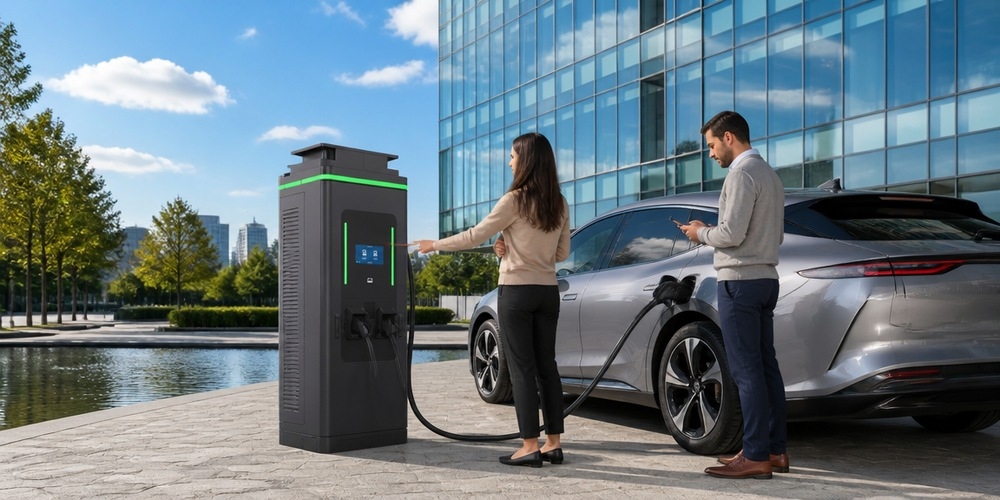
When evaluating the MIDA 240kW/200kWh system, it is important to look at the Levelized Cost of Charging. Unlike a traditional charger where you pay the utility for every kWh, a MIDA station owner “pre-pays” for their energy by investing in solar and storage.
Breaking the Utility Monopoly
Over a 15-year lifecycle, the LCOC for a MIDA solar-integrated station is typically 30-40% lower than the cost of buying electricity from the grid at retail rates. This “Energy Independence” is the key to long-term profitability in the EV charging business, as it protects the operator from future electricity price hikes and volatility.
22. Global Standards and Regional Customization
MIDA Power is a global manufacturer, and our 240kW/200kWh system is designed for the world stage.
North American and European Markets
We offer the system with CCS1 and NACS (Tesla standard) for North America, and CCS2 for Europe and Oceania. The power electronics are configurable for 480V/60Hz or 400V/50Hz grid inputs, ensuring compliance with local electrical codes.
Arid and Tropical Configurations
For our partners in the Middle East or Southeast Asia, we offer “Extreme Cooling” versions of the BESS and power cabinets. These units feature reinforced air filtration and higher-capacity liquid cooling systems to maintain 100% output even in 55°C (131°F) ambient temperatures.
23. Case Study Extension: The “Desert Link” Solar Highway in Saudi Arabia
MIDA recently completed the installation of five solar-powered hubs along a remote desert highway connecting Riyadh to the coast. The grid in this region was highly unstable, often dropping out during sandstorms. By deploying the 240kW/200kWh system with 150kWp solar canopies, we created a reliable “Green Link” for EV travelers. During the first summer of operation, the stations achieved 100% uptime despite multiple grid outages, with 85% of all energy delivered coming directly from the sun.
24. Final Call to Action and Project Consultation
The path to a sustainable, profitable charging network starts with integrated energy. MIDA Power (迈依达) is here to guide you through every step of the process—from solar sizing and BESS modeling to final site commissioning.
Contact our Integrated Energy Solutions team at sales@midapower.com to request a customized feasibility study or a detailed ROI model for your site.
25. Advanced Theory: The Efficiency of the DC-DC Common Bus
To understand why MIDA’s 240kW/200kWh station outperforms traditional systems, one must look at the “DC-to-DC Conversion Loop.” In a standard AC-coupled system, solar energy undergoes three major conversion stages:
- DC to AC: At the solar inverter.
- AC to DC: At the battery charger.
- DC to AC, then AC to DC: When discharging the battery to the EV.
The 10% Efficiency Bonus
MIDA’s system keeps the energy in DC form from the panels to the battery to the car. We use a high-efficiency DC/DC optimizer that matches the solar voltage to the battery’s common DC bus. This eliminates over 10% of cumulative conversion losses. For a station that delivers 1,000 kWh per day, this saves 100 kWh—enough to charge two additional EVs every single day for free.
26. Environmental Resilience: Operating in Harsh Climates
The MIDA 240kW/200kWh station is built to survive where others fail. Whether it’s the salt spray of a coastal resort or the dust of a desert highway, our enclosures are engineered for extreme durability.
C5-M Corrosion Resistance
For coastal deployments, we offer a C5-M rated coating for the cabinets, the highest level of anti-corrosion protection in the industry. All air intakes are fitted with “Salt-Mist” filters that prevent corrosive particles from entering the electronics bay, ensuring a 20-year lifespan even in maritime environments.
Dust and Sand Mitigation
In arid regions, sand ingestion is the primary cause of charger failure. MIDA’s “Cyclonic Filtration” system uses centrifugal force to spin dust particles out of the air stream before they reach the main filters. This significantly reduces the maintenance frequency and ensures that the 240kW output remains stable even during a sandstorm.
27. The Future of Distributed Energy: The “Prosumer” Station
The MIDA station transforms a passive charging site into an active “Prosumer”—a producer and consumer of energy.
Virtual Power Plants (VPP)
As the number of MIDA stations grows, they can be networked together to form a VPP. During a grid frequency imbalance, the VPP controller can command 100 MIDA stations to simultaneously discharge 10kW each, providing a 1MW injection of power into the grid in less than a second. This service is highly valuable to grid operators and creates a new revenue stream for MIDA station owners.
28. Technical Datasheet: MIDA 240kW+200kWh (Model: MIDA-SOLAR-240-200)
| Solar PV Input | Value |
|---|---|
| Max PV Power | 150 kWp |
| MPPT Voltage Range | 250V – 850V DC |
| Number of MPPT Trackers | 2 (Independent) |
| Max PV Efficiency | 99.0% |
| Battery Energy Storage (BESS) | Value |
|---|---|
| Nominal Capacity | 200 kWh |
| Battery Chemistry | LFP (Lithium Iron Phosphate) |
| Max Discharge Power | 240 kW (Continuous) |
| Cycle Life | > 6,000 cycles at 80% DOD |
| Cooling | Integrated Liquid Cooling |
| EV Charging Output | Value |
|---|---|
| Max DC Output Power | 240 kW |
| Output Voltage Range | 200V – 1,000V DC |
| Connectors | Dual CCS2 / CCS1 / NACS |
| Efficiency (DC to DC) | 97.5% |
| Safety and Compliance | Value |
|---|---|
| Ingress Protection | IP55 / NEMA 3R |
| Standards | UL 9540, CE, TUV, IEC 61851 |
| Fire Suppression | Automated Aerosol |
| Isolation Monitoring | Integrated |
29. Conclusion: The Blueprint for a Net-Zero World
The MIDA 240kW DC Fast Charger with 200kWh BESS is more than a product; it is the blueprint for the next century of infrastructure. By decentralizing energy production and storage, we are creating a world where transportation is not a burden on the planet, but a part of its natural energy cycle.
MIDA Power (迈依达) is proud to be the leader in this transition. We invite you to join us in building the solar-powered charging network of the future.
For a detailed site feasibility study or to speak with a MIDA Energy Architect, please contact sales@midapower.com.
30. Economic Modeling: 15-Year Total Cost of Ownership (TCO)
The MIDA 240kW/200kWh station is a high-CAPEX investment that delivers exceptionally low OPEX. For a commercial site owner, the TCO over 15 years is the most important metric.
Solar and Storage Payback Period
A typical MIDA solar-integrated station in a high-sunlight region reaches its “Break-Even Point” in approximately 4 to 6 years. After this point, the energy generated by the solar array and the savings from avoiding demand charges become pure profit. Over 15 years, a single MIDA station can generate over $450,000 in net savings compared to a grid-only 240kW charger.
Maintenance and Component Lifespan
MIDA’s modular approach minimizes maintenance costs. The 40kW power modules have a design life of 12 years, and the LFP battery racks are rated for 6,000+ cycles. Our O&M (Operations and Maintenance) package includes annual solar panel cleaning and bi-annual BESS thermal checks, ensuring that the station remains at peak efficiency for its entire life.
31. Operator Training and Site Safety Guidelines
Operating a high-power BESS and EV charger requires specific safety knowledge. MIDA provides a comprehensive training program for all site owners and staff.
Safety Zones and Emergency Procedures
We recommend a 2-meter “clear zone” around the BESS cabinet. All staff are trained on the location of the E-Stop and the manual disconnects. The MIDA EMS also features a “Remote Kill” switch that can be activated from a smartphone in the event of a site emergency.
User Interaction Training
Site owners are taught how to use the MIDA Dashboard to monitor energy production and battery health. They also learn how to set “Dynamic Pricing”—for example, offering free charging when the battery is at 100% SoC and solar production is at its peak, attracting more customers while maximizing renewable energy utilization.
32. Global Case Study: The “Island Green” Project in Greece
A luxury resort on a remote Greek island faced exorbitant diesel costs for their transport fleet and guest shuttles. The island’s grid was fragile and frequently failed during the peak tourist season.
The MIDA Solution: A Distributed Solar Grid
The resort installed three MIDA 240kW/200kWh stations paired with a 300kWp solar farm. These stations were networked to act as a mini-grid for the resort’s entire EV fleet.
The Result: 100% Diesel-Free Transport
Within the first year, the resort eliminated over 50,000 liters of diesel consumption. During a major island-wide power outage in August, the MIDA stations continued to operate in “Island Mode,” keeping the resort’s shuttles running and guests happy. The resort now markets itself as a “Net-Zero Luxury Destination,” seeing a 20% increase in bookings from environmentally conscious travelers.
33. Advanced Software API and Fleet Integration
For corporate fleets, the MIDA station offers a comprehensive RESTful API for integration into enterprise Resource Planning (ERP) systems.
Real-Time Fleet Energy Management
The API provides real-time data on battery SoC, solar production, and EV charging sessions. Fleet managers can use this data to “Smart Schedule” their vehicle charging—for example, only initiating a fast charge when the 200kWh battery is above 80% SoC, ensuring that the fleet is always powered by the sun.
34. Future Roadmap: 480kW and 1MWh Scalability
MIDA’s architecture is built for the future. As EV batteries get larger and charging speeds get faster, our stations are ready to scale.
The “Mega-Solar” Expansion
Our current 240kW platform can be upgraded to a 480kW dual-dispenser setup by adding more power modules and expanding the BESS to 1MWh. This ensures that the investment you make in MIDA today will remain relevant and profitable as the market evolves toward ultra-high-power charging.
35. Conclusion: Powering a Sustainable Legacy
The MIDA 240kW DC Fast Charger with 200kWh BESS is not just a tool for today; it is a legacy for tomorrow. By combining the best in power electronics, battery chemistry, and renewable energy, we are giving our partners the power to define their own energy future.
MIDA Power (迈依达) is the partner of choice for those who refuse to settle for the status quo. Join us in building a world where energy is clean, abundant, and accessible to all.
Contact our Solar Infrastructure Division at sales@midapower.com for a customized site feasibility study and ROI model.
36. Comprehensive Glossary of Solar Charging and BESS Terms
To help our partners understand the nuances of integrated energy, MIDA provides this glossary:
- BESS (Battery Energy Storage System): A system that stores energy in chemical form for later use, typically using LFP or NCM batteries.
- DC Coupling: An architecture where solar panels and batteries share a common DC bus, eliminating unnecessary AC conversion stages.
- MPPT (Maximum Power Point Tracking): A technology used in solar controllers to extract the maximum possible power from PV panels under varying sunlight conditions.
- LFP (Lithium Iron Phosphate): A battery chemistry known for its high safety, long cycle life, and thermal stability.
- Demand Charge: A fee charged by utilities based on the highest peak of power used during a month.
- Microgrid: A local energy grid with its own generation and storage that can operate independently or in conjunction with the main grid.
- Island Mode: The ability of a system to continue operating and providing power during a grid outage.
- SOC (State of Charge): The level of charge of an electric battery relative to its capacity.
37. Frequently Asked Questions (FAQ)
Q1: How much solar energy can the 240kW/200kWh station produce per day? A: In a high-sunlight region with a 150kWp array, the system can produce between 600kWh and 900kWh of energy per day, enough for 10-15 full EV charges.
Q2: Can the station be used in areas with no grid connection at all? A: Yes. The MIDA station is “Off-Grid Ready.” In this configuration, the solar array must be sized to meet the total daily charging demand.
Q3: What happens if the 200kWh battery is full and there is still solar production? A: If the battery is full and no EVs are charging, the MIDA EMS can export the excess solar energy back to the grid (if allowed) or throttle the PV production to protect the system.
Q4: How does the system handle rain and snow? A: All MIDA cabinets are IP55-rated, meaning they are protected against water jets from any direction and dust ingress, keeping the electronics sealed and reliable in rain, snow, and desert conditions alike. All connectors are weatherproofed and lock securely during sessions, and the cabinets include active heating for freezing climates.
Q5: How does the battery storage improve the economics of the station? A5: The 200kWh BESS enables time-of-use arbitrage — charging the battery when electricity is cheap and discharging during peak-rate hours. Combined with solar production, this can cut energy costs by 30-50% compared to a grid-only charger, and the storage can also provide backup power during grid outages.
Q6: What maintenance does the station require? A6: Very little. The BESS has a design life of 10+ years, the SiC power modules are hot-swappable, and 24/7 remote monitoring handles most diagnostics. Routine maintenance consists primarily of periodic filter cleaning and a visual inspection — typically less than two hours per quarter.
Q7: Can the station be expanded later? A7: Yes. The modular architecture lets you add solar capacity, additional battery blocks, or more power modules over time, so the system can grow with your fleet without replacing the original investment.
Q8: Can the station support vehicle-to-grid (V2G) operation? A8: Our BESS and EMS architecture is V2G-ready. Where local regulations and vehicle capabilities permit, the station can export stored energy back to the grid during peak events, creating an additional revenue stream for the site owner.
Q9: What happens during a grid outage? A9: The station automatically switches to island mode, powering chargers from the battery and solar array. Critical fleet charging continues uninterrupted, and the system reconnects to the grid seamlessly when power returns.
Conclusion: Powering a Sustainable Legacy
MIDA Power’s solar-plus-storage DC fast charging platform represents a fundamental shift in how trucking fleets can access energy: generate it, store it, and deliver it — with the grid as a backup rather than a necessity. For fleet operators facing high energy prices, grid constraints, or sustainability mandates, this integrated system turns a charging station into an energy asset.
The payback story is compelling: lower energy costs through arbitrage and self-generation, avoided demand charges, resilience against outages, and a verifiable reduction in carbon footprint that strengthens tenders and ESG reporting. In markets where grid capacity is scarce, the station can even be deployed in locations where a grid-only charger would never have been approved.
Key Takeaways
- 600-900kWh of daily solar production enables 10-15 full EV charges from the sun alone.
- 200kWh BESS provides peak shaving, arbitrage savings, and true off-grid capability.
- IP55-rated, weather-sealed cabinets operate reliably in rain, snow, and extreme heat.
- V2G-ready architecture and island-mode operation add resilience and revenue potential.
- Modular design grows with your fleet; EMS optimizes solar, storage, and grid in real time.
Call to Action
Ready to turn your truck depot into an energy producer? Contact MIDA Power today for a solar-plus-storage feasibility study and a personalized energy model for your site.
MIDA Power: Precision Engineering for a Sustainable World.
- Sales Inquiry: sales@midapower.com
- Technical Support: sales@midapower.com
- Web: www.midapower.com
Post time: Aug-09-2026
