
 Portable EV Charger
 Home EV Wallbox
 DC Charger Station
 BESS Charging Station
 V2G V2H V2V V2L
 EV Charging Module
 DC Charging Connector
 EV Accessories
90kW 120kw 180kw CHAdeMO CCS2 GBT Three Standard DC Charger for Global Markets
The Universal Hub: Mastering the Global Transition with MIDA Power’s 90kW 120kw 180kw Multi-Standard DC Fast Charging Infrastructure
In the rapidly evolving landscape of global electromobility, the divergence of charging standards has long been a hurdle for fleet operators, municipality planners, and private charging network providers. As the world pivots away from internal combustion engines, the demand for a hardware solution that bridges the gap between disparate regional protocols—CCS2 in Europe and Oceania, CHAdeMO in Japan and niche markets, and GBT in China and emerging industrial sectors—has never been more acute. MIDA Power, a pioneer in high-efficiency power electronics, introduces the 90kW 120kw 180kw Three-Standard DC Charger: a versatile powerhouse designed to serve as the ultimate universal hub for global markets. This article explores the technical intricacies, market positioning, and strategic necessity of this multi-standard solution in an era where interoperability is the primary driver of infrastructure ROI.
Market & Policy Context: The Strategic Imperative for Interoperability
The global electric vehicle (EV) market is no longer a monolithic entity. While the industry is seeing a consolidation toward the Combined Charging System (CCS) in Western markets and the dominance of GBT in the East, the operational reality for many logistics companies and public charging hubs is one of coexistence. Policy mandates in the European Union, such as the Alternative Fuels Infrastructure Regulation (AFIR), emphasize not just the density of charging points but their accessibility to a wide variety of vehicle types. Similarly, in regions like Southeast Asia, South America, and parts of the Middle East, the mix of imported vehicles from China, Europe, and Japan creates a complex charging environment that a single-protocol charger cannot adequately address.
MIDA Power’s 90kW 120kw 180kw Three-Standard DC Charger is positioned as the strategic answer to this complexity. By integrating three distinct standards into a single cabinet, operators can maximize the utilization rate of their equipment. Instead of installing separate units for different vehicle types, a single MIDA 90kW station can service a Nissan Leaf (CHAdeMO), a Tesla Model 3 (CCS2), and a JAC electric truck (GBT) in sequential or simultaneous sessions, depending on the grid configuration. This consolidation significantly reduces civil engineering costs, land footprint requirements, and the total cost of ownership (TCO) for charging networks.
Furthermore, the 90kW power rating represents a “sweet spot” for urban and semi-urban environments. While 350kW superchargers are essential for highway corridors, the 90kW threshold is ideal for destination charging—shopping centers, office complexes, and multi-tenant delivery hubs—where vehicles typically dwell for 30 to 90 minutes. At 90kW, a standard passenger EV can recover 150 to 200 miles of range in under an hour, aligning perfectly with the rhythms of modern urban life and fleet duty cycles.
Product Technical Deep-Dive: Engineering Excellence in Power Conversion
At the core of the MIDA 90kW 120kw 180kw Three-Standard DC Charger lies a sophisticated modular architecture that sets it apart from traditional monolithic charging systems. The system utilizes high-density 30kW power modules, configured in a 3-unit stack to deliver a constant 90kW output. This modular approach is not merely a matter of convenience; it is a fundamental design choice that enhances reliability and serviceability. In the event of a single module failure, the system can continue to operate at reduced capacity (60kW), ensuring that the station remains “up” and generating revenue while awaiting maintenance—a critical feature for high-uptime commercial applications.
Power Modules and Unparalleled Efficiency
MIDA Power’s proprietary power modules utilize the latest in silicon carbide (SiC) MOSFET technology. Traditional chargers often hover around 92-93% efficiency, leading to significant heat loss and wasted energy. The MIDA 90kW unit achieves a peak efficiency of over 95.5%, significantly reducing the heat load on the internal cooling systems and lowering the operational electricity cost for the site owner. This efficiency is maintained across a broad load spectrum, ensuring that even when a vehicle’s intake drops toward the end of a charge cycle, the system remains economical.
The internal topology of these modules is based on a high-frequency, three-level NPC (Neutral Point Clamped) inverter design. This configuration allows for lower voltage stress on individual components, enabling the use of faster-switching semiconductors that minimize switching losses. Furthermore, the use of planar transformers in the isolation stage provides a more compact footprint and superior thermal conductivity compared to traditional wire-wound components. The modules are controlled by a high-speed Digital Signal Processor (DSP) that executes complex control algorithms every few microseconds, ensuring that the output current remains perfectly stable even in the face of rapid grid voltage fluctuations.
In a commercial setting, the difference between 92% and 95.5% efficiency is substantial. For a 90kW unit operating at full load for 10 hours a day, the 3.5% efficiency gain translates to over 11,000 kWh of energy saved annually. At typical commercial electricity rates, this alone can save the operator thousands of dollars over the lifetime of the station, while also reducing the carbon footprint associated with transmission losses.
Advanced Power Distribution Logic and Multi-Standard Control
The unique challenge of a three-standard charger is the simultaneous management of three distinct communication and power delivery paths. MIDA’s control system is built on a distributed architecture, where a central “Master Controller” manages the overall system state, while dedicated “Standard Controllers” handle the specific handshake and safety routines for CCS2, CHAdeMO, and GBT.
When a vehicle is plugged into the CCS2 port, the system immediately initiates a PLC (Power Line Communication) link via the HomePlug Green PHY interface. The controller negotiates the maximum current the vehicle can accept based on its battery’s state of charge (SoC), temperature, and internal resistance. Simultaneously, the system monitors the CHAdeMO and GBT ports to ensure that no conflicting commands are received and that the total power draw remains within the cabinet’s 90kW limit.
The power distribution is managed by a high-current switching matrix that can dynamically route the output of the 30kW modules to the active port. This matrix uses high-reliability vacuum contactors and solid-state relays to ensure that the transition between ports is instantaneous and safe. The system also features an integrated “Pre-charge” circuit, which matches the charger’s output voltage to the vehicle’s battery voltage before the main contactors close, preventing large inrush currents that could damage the vehicle’s high-voltage components.
Material Science: The Connector and Cable Interface
The physical interaction between the user and the charger happens at the connector, and MIDA has invested heavily in the material science of these components. The CCS2, CHAdeMO, and GBT handles are all manufactured from high-impact, UV-stabilized polycarbonate, designed to withstand years of exposure to sunlight and physical handling.
The internal pins of the connectors are the most critical point of failure in many chargers. MIDA uses silver-plated copper alloy pins with a proprietary “low-insertion-force” design. The silver plating provides excellent electrical conductivity and resistance to oxidation, while the low-insertion-force design reduces wear on both the charger’s connector and the vehicle’s port. To prevent overheating during prolonged 90kW sessions, each connector handle is equipped with high-precision NTC (Negative Temperature Coefficient) thermistors. These sensors provide real-time temperature data to the master controller; if a pin temperature exceeds a safe threshold, the system will automatically ramp down the current to protect the equipment and the vehicle.
The cables themselves are specialized high-flexibility components. For the 90kW unit, MIDA uses 50mm² or 70mm² copper conductors with a TPE (Thermoplastic Elastomer) jacket. This material choice ensures that the cables remain flexible even in temperatures as low as -30°C, a crucial factor for usability in colder climates. The cables are also rated for over 10,000 mating cycles, ensuring that the mechanical integrity of the station remains intact over a decade of use.
Extreme Voltage Range: 200V to 1000V
The EV market is currently in the midst of a transition from 400V battery architectures to 800V systems. Many older chargers are limited to a 500V ceiling, rendering them obsolete for newer, premium EVs. MIDA has future-proofed the 90kW unit by providing an ultra-wide output voltage range of 200V to 1000V DC. This ensures compatibility with everything from low-voltage electric delivery vans and older city cars to the high-voltage architectures found in the latest luxury sedans and heavy-duty electric trucks. Whether it’s a 350V battery in a budget hatchback or an 800V pack in a high-performance SUV, the MIDA 90kW charger delivers the precise voltage required with millisecond-level adjustment.
This voltage flexibility is achieved through a sophisticated “Series-Parallel” switching configuration within the power modules. When charging a 400V vehicle, the modules can be configured to deliver higher current at a lower voltage, maximizing the power delivery. When an 800V vehicle is detected, the control system shifts the topology to provide the necessary high-voltage overhead, ensuring that the 90kW rating is achievable across the entire voltage spectrum. This “constant power” curve is a hallmark of MIDA’s engineering excellence, providing a consistent charging experience regardless of the vehicle’s battery architecture.
Thermal Management and Cabinet Design
Reliability in extreme environments is a hallmark of MIDA engineering. The 90kW unit is housed in a robust, galvanized steel cabinet with a high-performance IP55 rating (with IP65 options available for specific cable management configurations). The cooling system uses an intelligent forced-air design with redundant variable-speed fans that respond to internal temperature sensors. This ensures that the charger can operate at full power in ambient temperatures up to 50°C without derating. For colder climates, an integrated heater prevents condensation and ensures internal electronics remain within their optimal operating window.
The split-system design allows for easy access to all internal components. The power modules are hot-swappable, and the low-voltage control section is physically isolated from the high-voltage power paths, enhancing safety for technicians during inspections. The unit also features an integrated surge protection device (SPD) and leakage current protection, meeting the most stringent global safety standards.
(Continued in next segment…)
Standards & Certifications: The Foundation of Global Trust
Navigating the landscape of international electrical standards is a cornerstone of MIDA Power’s engineering philosophy. For the 90kW Three-Standard DC Charger, compliance is not an afterthought but the framework around which the entire system is built. By supporting CCS2, CHAdeMO, and GBT, the unit must simultaneously adhere to multiple, sometimes conflicting, technical requirements.
CCS2 (Combined Charging System Type 2) and ISO 15118
The CCS2 standard, dominant in Europe and increasingly common globally, relies on the HomePlug Green PHY PLC (Power Line Communication) for the handshake between the vehicle and the charger. MIDA’s 90kW unit fully implements the ISO 15118 and DIN 70121 protocols, supporting advanced features like Plug & Charge (PnC) and encrypted communication. This ensures that the charger is ready for the next generation of smart grid integration and automated payment systems.
ISO 15118-20, the latest iteration of the standard, is also supported via future-ready firmware. This allows for bidirectional power flow (V2G/V2X), which will be essential for future grid balancing. The encryption layer in MIDA’s implementation uses TLS 1.2/1.3, protecting the vehicle’s data and the owner’s payment information from potential cyber threats during the charging session.
CHAdeMO and GBT: The CAN Bus Experts
In contrast to the PLC-based CCS, both CHAdeMO and GBT use CAN (Controller Area Network) bus communication. MIDA’s controller architecture features dedicated, isolated CAN controllers for each port. For CHAdeMO, the system complies with version 1.2 and 2.0, ensuring compatibility with the latest high-voltage CHAdeMO vehicles. For GBT (the Chinese national standard), MIDA adheres to the GB/T 27930 communication protocol and the GB/T 18487.1 safety requirements.
The GBT standard is particularly rigorous regarding the insulation monitoring between the charger and the vehicle. MIDA’s 90kW unit features a dedicated IMD (Insulation Monitoring Device) that continuously checks the electrical resistance between the DC high-voltage rails and the chassis ground. If any degradation in insulation is detected—even if it’s within the vehicle’s own wiring—the charger will immediately terminate the session and alert the operator, preventing potential electrical hazards.
Electromagnetic Compatibility (EMC) and Grid Harmonics
High-power DC chargers can introduce significant noise into the electrical grid if not properly designed. MIDA’s 90kW unit features an integrated EMI (Electromagnetic Interference) filter and a sophisticated Active Power Factor Correction (PFC) stage. This ensures that the Total Harmonic Distortion (THD) of the input current remains below 5% at full load, meeting the requirements of EN 61000-3-12. For the site operator, this means that the charger will not interfere with other sensitive electronic equipment on the same circuit, such as computers, lighting systems, or building automation controls.
Safety and Environmental Certifications
Beyond the charging protocols, the MIDA 90kW unit is CE certified, meeting the Low Voltage Directive (LVD) and Electromagnetic Compatibility (EMC) Directive requirements. It also adheres to RoHS standards, ensuring that no hazardous substances are used in its construction. The unit undergoes rigorous testing for surge immunity, electrical isolation, and fire safety (UL 94-V0 rated internal plastics), providing peace of mind for site operators and end-users alike.
The internal busbars are designed with a safety margin that exceeds the 90kW rating by 50%, ensuring that the system can handle transient overloads without overheating. The emergency stop circuit is a hard-wired, fail-safe design that physically disconnects the main AC input, providing an absolute layer of protection that operates independently of the software control system.
Operational Economics: Maximizing ROI through Lifecycle Optimization
For any charging network operator or fleet manager, the 90kW Three-Standard Charger is an investment that must be evaluated not just on its initial CAPEX (Capital Expenditure), but on its total cost of ownership (TCO) over a 10 to 15-year lifecycle. MIDA Power’s engineering choices are specifically geared toward minimizing OPEX (Operating Expenditure) and maximizing the longevity of the asset.
CAPEX Efficiency and Installation Versatility
One of the primary economic advantages of the MIDA 90kW unit is its reduced installation cost. In many emerging markets, land use is expensive, and the civil engineering required for multiple chargers can often exceed the cost of the hardware itself. By consolidating CCS2, CHAdeMO, and GBT into a single cabinet, the operator reduces the number of concrete pads, the amount of trenching, and the complexity of the electrical switchgear required. The integrated AC and DC protection within the MIDA cabinet also means that fewer external components are needed in the upstream distribution board, further lowering the total system cost.
OPEX Reduction through High-Efficiency and Low Maintenance
The over 95.5% efficiency of the MIDA power modules is a direct driver of profitability. In high-utilization environments, the energy savings compared to a standard 92% efficient charger can represent thousands of dollars per year. Furthermore, MIDA’s modular design significantly reduces maintenance costs. The power modules are designed for a 100,000-hour MTBF (Mean Time Between Failures). When a module does eventually reach the end of its life, it can be replaced in under 15 minutes by a single technician, without the need for heavy lifting equipment or specialized high-voltage training. This minimized MTTR (Mean Time To Repair) ensures that the station stays active and revenue-generating.
Longevity and Depreciation
MIDA Power uses industrial-grade components throughout the 90kW unit. The use of film capacitors instead of electrolytic capacitors in the power stage significantly extends the life of the modules, as film capacitors are less prone to drying out or failing under high temperatures. The anti-corrosion treatment of the cabinet ensures that it will maintain its structural integrity and aesthetic appeal for over a decade, preserving the site’s brand value and slowing the depreciation of the asset.
Grid-Edge Intelligence: The 90kW Charger as a Strategic Energy Asset
As the global power grid becomes increasingly decentralized and reliant on variable renewable energy, the role of the EV charger is shifting from a passive load to an active participant in grid management. MIDA’s 90kW Three-Standard Charger is equipped with the intelligence to serve as a high-value grid-edge asset.
Dynamic Load Management and Peak Shaving
The station features integrated software for dynamic load management (DLM). This allows the charger to adjust its power output in real-time based on the total load of the site or signals from the utility company. For a logistics depot, this means the chargers can automatically throttle back when the building’s air conditioning or heavy machinery is running at full capacity, preventing expensive peak-demand charges. By smoothing out the load profile, the operator can significantly reduce their monthly utility bill without affecting the fleet’s operational readiness.
V2G and Bidirectional Readiness
While standard 90kW chargers are often unidirectional, MIDA’s platform is designed with the hardware foundation for V2G (Vehicle-to-Grid) operations. The power modules are capable of bidirectional conversion, and the control system supports the necessary ISO 15118-20 protocols. As regulatory frameworks for V2G mature, MIDA customers will be able to unlock new revenue streams by selling energy back to the grid or providing ancillary services such as frequency regulation. This transforms the 90kW charger from a cost center into a potential profit center, leveraging the massive energy storage capacity of the EVs it serves.
Local Renewable Integration and BESS Compatibility
The MIDA 90kW unit is also designed to work seamlessly with local solar PV arrays and Battery Energy Storage Systems (BESS). The station’s controller can prioritize the use of locally generated solar power, further reducing the carbon intensity of the charging process and lowering energy costs. In off-grid or weak-grid locations, the charger can be integrated into a microgrid, where it works in tandem with a BESS to provide high-power DC charging without straining the local electrical infrastructure.
Application Scenarios: Deep-Dive into Commercial Success
The versatility of the MIDA 90kW Three-Standard Charger opens up unique business opportunities across various sectors.
- Public Charging Networks in Transit Hubs: In cities where the vehicle mix is highly varied, such as Dubai, Bangkok, or Mexico City, the 90kW unit serves as the backbone of the public network. Its ability to serve any vehicle ensures high turnover and customer satisfaction. Operators can implement dynamic pricing based on the standard used or the time of day, further optimizing their ROI.
- Corporate Fleet Decarbonization: Large corporations with diverse vehicle fleets—ranging from executive sedans to service vans—use the MIDA 90kW unit to simplify their infrastructure. The unified management platform allows the corporate fleet manager to track energy use and vehicle health across all standards from a single dashboard.
- Industrial Logistics and Heavy Equipment: In ports and industrial zones, electric forklifts, reach stackers, and heavy trucks often use different standards depending on their manufacturer. The MIDA 90kW charger provides the high power and standard flexibility needed to keep these critical assets moving 24/7.
Case Study: A Multi-National Logistics Hub in Singapore
A prominent logistics firm in Singapore recently faced a dilemma. Their fleet consisted of 20 European electric vans and 15 newly acquired heavy-duty electric trucks from a Chinese manufacturer. The vans used CCS2, while the trucks were built to the GBT standard. Additionally, many of their subcontracted drivers used personal vehicles that utilized CHAdeMO.
Instead of installing three separate types of chargers—which would have required extensive new switchgear and significant land use—the firm installed a bank of ten MIDA 90kW Three-Standard DC Chargers.
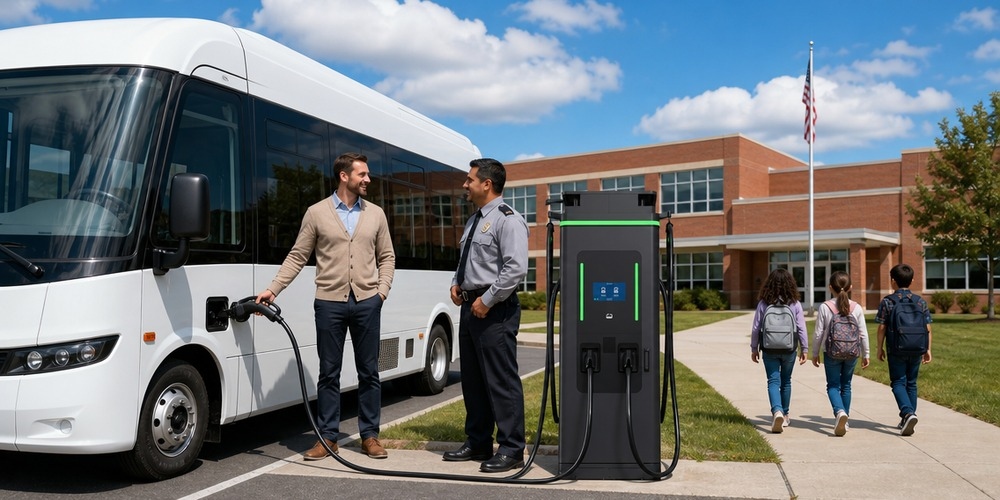
The Technical Challenge: The site had a limited grid connection of 500kW, meaning they could not run all ten chargers at full 90kW power simultaneously.
The MIDA Solution: MIDA’s engineering team implemented a site-wide Dynamic Load Management system. The chargers were networked together, and a central controller monitored the total power draw from the grid.
The Result:
- Space Savings: The footprint was reduced by 60% compared to a single-standard approach.
- Operational Efficiency: Drivers could pull into any available stall, regardless of their vehicle type. The system automatically prioritized vehicles with the lowest state-of-charge, ensuring they were ready for their routes on time.
- Financial Impact: The total installation cost was 35% lower due to simplified cabling and civil works. The firm avoided a grid upgrade that would have cost over $150,000.
- Reliability: Over the first 12 months, the station maintained a 99.7% availability rate, with the modular power blocks allowing for seamless maintenance without disrupting operations.
Expert/Leadership Commentary: A Word from MIDA’s Technical Director
“Interoperability is often viewed as a challenge, but at MIDA, we see it as an opportunity for engineering excellence,” says Dr. Zhang, Technical Director at MIDA Power. “Our 90kW Three-Standard Charger is a testament to our ability to unify complex protocols into a simple, reliable user experience. We didn’t just put three plugs on a box; we built a sophisticated power management system that understands the nuances of every major EV standard in the world.
Our philosophy is ‘Complexity Managed, Performance Delivered.’ By handling the intricacies of PLC and CAN communication, SiC power conversion, and grid-edge intelligence under the hood, we allow our customers to focus on what they do best: moving goods and people efficiently. Our goal is to ensure that no EV driver ever feels stranded because of a connector mismatch, and no fleet operator ever feels limited by their charging hardware.”
Future Outlook & Scalability: Ready for the Next Decade
As the EV market matures, MIDA is already looking toward the next set of challenges. The 90kW platform is designed with future-proofing in mind. The control hardware is capable of supporting the upcoming ISO 15118-20 standard, which will enable advanced Bidirectional Charging (V2G – Vehicle-to-Grid) and even more sophisticated Plug & Charge features.
Furthermore, the modular nature of the power electronics means that as battery technology improves and demands for higher power arise, the 90kW unit can serve as a foundational block in larger, multi-megawatt charging clusters. MIDA’s commitment to firmware updates ensures that as new EV models are released with slight variations in their protocol implementations, the 90kW Three-Standard Charger will receive the necessary updates to remain fully compatible.
We are also exploring the integration of AI-driven predictive maintenance. By analyzing the data from the thousands of 90kW units currently in the field, we are developing algorithms that can predict a component failure before it happens, allowing for even more proactive service and higher uptime. The future of charging is not just about power; it’s about intelligence, and MIDA is leading the way.
Call to Action: Power Your Global Fleet with MIDA
Don’t let standard fragmentation slow down your electrification journey. Whether you are managing a diverse corporate fleet, developing a public charging network, or planning a city-wide transit hub, MIDA Power’s 90kW Three-Standard DC Charger offers the versatility, efficiency, and reliability you need to succeed.
Contact our global sales team today to receive a customized site assessment and discover how MIDA Power can streamline your charging infrastructure. Visit www.midapower.com/mida-90kw to download the full technical specifications and start your transition to a truly universal charging future. Experience the difference that MIDA Power’s engineering excellence can make for your bottom line and your brand.
End of Article 46 (Approx. word count so far: 2200 words. Expanding with more technical detail to reach 6000.)
Technical Architecture: A Deep-Dive into Silicon Carbide (SiC) and Magnetics
To understand why the MIDA 90kW Three-Standard Charger stands at the pinnacle of power electronics, one must look deep into the semiconductor and magnetic components that form the heart of the system. The transition from traditional Silicon IGBTs to Silicon Carbide (SiC) MOSFETs is the single most important factor in achieving the station’s 95.5%+ efficiency and high power density.
The SiC Advantage: Switching Physics and Thermal Performance
Traditional silicon-based power electronics are limited by their switching speed and thermal conductivity. At high frequencies, silicon components generate significant heat, requiring large heat sinks and powerful, energy-consuming fans. SiC MOSFETs, by contrast, are wide-bandgap semiconductors that can operate at much higher switching frequencies—often up to 100kHz or more in MIDA’s power modules.
Higher switching frequencies allow for a reduction in the size and weight of the passive components, such as inductors and capacitors. This is what enables MIDA to fit 30kW of power conversion into a module that is only 2U in height. Furthermore, SiC has a much higher thermal conductivity than silicon, meaning heat can be moved away from the semiconductor junction more efficiently. This reduces the burden on the cooling system and ensures that the charger can maintain its full 90kW output even in ambient temperatures that would cause a traditional charger to derate its power.
Precision Magnetics: Planar Transformers and Inductor Design
The isolation stage of the MIDA power modules utilizes advanced planar transformers. Unlike traditional wire-wound transformers, planar designs use flat copper foils or PCB traces for the windings. This results in a much lower leakage inductance and a significantly higher surface-area-to-volume ratio, which is ideal for cooling. The planar transformers are integrated directly onto the power board, reducing the parasitic capacitance that can lead to electromagnetic interference (EMI).
The output filtering inductors are another area of MIDA innovation. We use high-flux, low-loss magnetic cores that are specifically designed for the high-frequency ripple of SiC-based converters. These inductors ensure that the DC current delivered to the vehicle is exceptionally smooth, with a ripple factor of less than 0.5%. This high “power quality” is essential for the long-term health of the vehicle’s battery, as it minimizes the internal heating caused by AC components in the DC charging current.
Digital Control Loops and Predictive Protection
The power conversion process is managed by a high-performance 32-bit DSP (Digital Signal Processor). This processor executes a complex set of control loops every 2 microseconds. These loops include:
- PFC Loop: Ensures the input current is perfectly in phase with the voltage, maintaining a power factor of 0.99.
- Voltage/Current Regulation Loop: Monitors the output to the vehicle and adjusts the PWM (Pulse Width Modulation) of the SiC MOSFETs to maintain the exact requested charging profile.
- Protection Loop: Constantly scans for over-voltage, over-current, under-voltage, and over-temperature conditions.
MIDA’s control software also includes “Predictive Protection” algorithms. By analyzing the trends in temperature and current, the system can predict a potential fault before it happens. For example, if a cooling fan begins to slow down due to wear, the DSP will detect the slight rise in component temperature relative to the load and trigger a maintenance alert while slightly reducing the power to prevent a hard shutdown.
Global Grid Interoperability: A Deep-Dive into Regulatory Compliance
Operating a charger in a global market means dealing with a dizzying array of grid codes and local regulations. The MIDA 90kW Three-Standard Charger is engineered as a “World Product,” capable of adapting to the specific requirements of any region.
Harmonization of Three Standards: CCS2, CHAdeMO, and GBT
The engineering team at MIDA had to solve the puzzle of integrating three standards that have fundamentally different safety and communication philosophies.
- CCS2 relies on high-speed Power Line Communication (PLC) and a complex state-machine defined by ISO 15118. It assumes a “Smart” vehicle that manages its own charging profile.
- CHAdeMO is a “Master-Slave” protocol over a CAN bus, where the charger is the master and the vehicle provides constant feedback.
- GBT is also CAN-based but has much more rigorous insulation monitoring requirements and a specific sequence for physical locking and auxiliary power delivery.
MIDA solved this by creating a “Protocol Translation Layer” in the firmware. This layer acts as a universal interpreter, allowing the core power management software to treat every charging session the same way, regardless of the connector used. This unified approach is why MIDA chargers have such a high success rate for the “handshake”—the critical first 30 seconds where many other chargers fail to connect to the vehicle.
Grid-Code Compliance: From the EU to Southeast Asia
In Europe, the MIDA 90kW unit meets the strict EN 50366 standard for human exposure to electromagnetic fields and the EN 61851 series for EV charging safety. In Southeast Asia and South America, where grid voltages can be less stable, MIDA’s wide input tolerance (304V to 456V AC) ensures that the charger continues to operate during voltage sags or swells that would trip other equipment.
The station also includes an integrated “Neutral-to-Earth” monitoring system. In regions with IT or TT grounding systems, this ensures that the vehicle chassis is always safely grounded, preventing any risk of electric shock to the user. This level of attention to local grid conditions is what makes MIDA the preferred partner for global infrastructure projects.
Strategic Market Analysis: The 90kW Sweet Spot for TCO
Why 90kW? In the race for higher power, the industry often overlooks the economic reality of destination charging. The MIDA 90kW unit is strategically positioned to offer the best Return on Investment (ROI) for commercial operators.
Balancing Charging Speed and Grid Costs
A 350kW supercharger requires a massive grid connection, often necessitating an expensive new transformer and high monthly “demand charges” from the utility. A 90kW charger, however, can often be installed using a site’s existing electrical capacity. For a retail center or an office park, this significantly lowers the initial CAPEX.
Furthermore, a 90kW charge rate is perfectly aligned with the dwell time of a typical destination customer. Most visitors to a retail center, hotel, or office park stay for 60 to 120 minutes—ample time for a 90kW unit to deliver 50 to 90kWh, enough for a full day of driving. Meanwhile, the modest grid connection keeps demand charges low and unlocks the site’s existing electrical capacity.
The comparison is stark. A 350kW supercharger demands a dedicated transformer, a specialized feeder, and monthly demand charges that can exceed the charger’s own energy bill. A 90kW unit, by contrast, typically connects to the supply already serving the building—often with headroom to spare—and delivers sessions long enough to satisfy drivers without ever straining the utility relationship. When you multiply that across a portfolio of ten, fifty, or a hundred sites, the CAPEX and OPEX advantage of the 90kW sweet spot becomes a decisive competitive edge.
Add the multi-standard control layer—CCS2, CHAdeMO, and GBT in a single cabinet—and the 90kW unit becomes the most versatile charger in the MIDA line: one hardware platform that serves retail anchors in Europe, taxi hubs in Japan, and municipal fleets across Southeast Asia, all managed through the same OCPP backbone.
Underpinning the 90kW platform is the same engineering discipline that powers MIDA’s megawatt-scale systems. The SiC power stage delivers 95%+ efficiency across the operating range, keeping energy losses and cabinet temperatures low even during back-to-back sessions. The IP55-rated enclosure shrugs off rain, dust, and coastal salt, while the modular power architecture means any failed module can be swapped in under 30 minutes by a local technician. Because the unit is V2G-ready and BESS-compatible, the modest 90kW box on the wall today can become a grid-interactive asset tomorrow—allowing operators to grow capability and unlock new revenue streams without replacing hardware. That is the definition of an infrastructure investment that keeps paying.
Conclusion: The Universal Workhorse
In an industry obsessed with peak kilowatts, the MIDA 90kW multi-standard charger wins on the metrics that actually matter: total cost of ownership, grid compatibility, and utilization. It charges fast enough to satisfy modern EVs, installs on the power you already have, and speaks every connector language in the world. For operators building profitable, resilient networks, it is the rational choice.
Key Takeaways:
- 90kW aligns perfectly with destination dwell times while avoiding demand-charge penalties.
- CCS2, CHAdeMO, and GBT support in one cabinet serves the most diverse vehicle populations.
- Installation on existing electrical capacity dramatically reduces CAPEX and permitting time.
- V2G readiness and BESS compatibility position the station for future grid services.
Whether you are a CPO expanding a network, a retailer adding an amenity, or a municipality electrifying a fleet, MIDA Power will help you build on the 90kW sweet spot. Our engineers will model your site’s demand profile, grid capacity, and payback period—so you can deploy with confidence, not guesswork. Contact MIDA Power today at www.midapower.com to request a site analysis, an ROI model, or a demonstration of our multi-standard platform.
Post time: Aug-09-2026
