
 Portable EV Charger
 Home EV Wallbox
 DC Charger Station
 EV Charging Module
 DC Charging Connector
 EV Accessories
V2G technology and its current status at home and abroad
What is V2G technology?
V2G technology refers to the bidirectional transmission of energy between vehicles and the power grid. V2G, short for “Vehicle-to-Grid,” allows electric vehicles to charge via the power grid while simultaneously feeding stored energy back into the grid. The primary purpose of V2G technology is to enhance the zero-emission driving capabilities of electric vehicles and provide power supply support and regulation services to the power grid.
Through V2G technology, electric vehicles can function as energy storage devices, feeding surplus electricity back into the grid for use by other consumers. During peak grid demand periods, V2G technology enables the release of stored vehicle energy back into the grid, assisting in load balancing. Conversely, during periods of low grid demand, electric vehicles can draw energy from the grid to recharge. Electric vehicles absorb electricity during periods of low grid load and release it during periods of high grid load, thereby earning profits from the price differential. If V2G is fully realised, every electric vehicle could be regarded as a miniature power bank: plugging in during low grid load automatically stores energy, while during high grid load, the energy stored in the vehicle’s power battery can be sold back to the grid to earn the price difference.
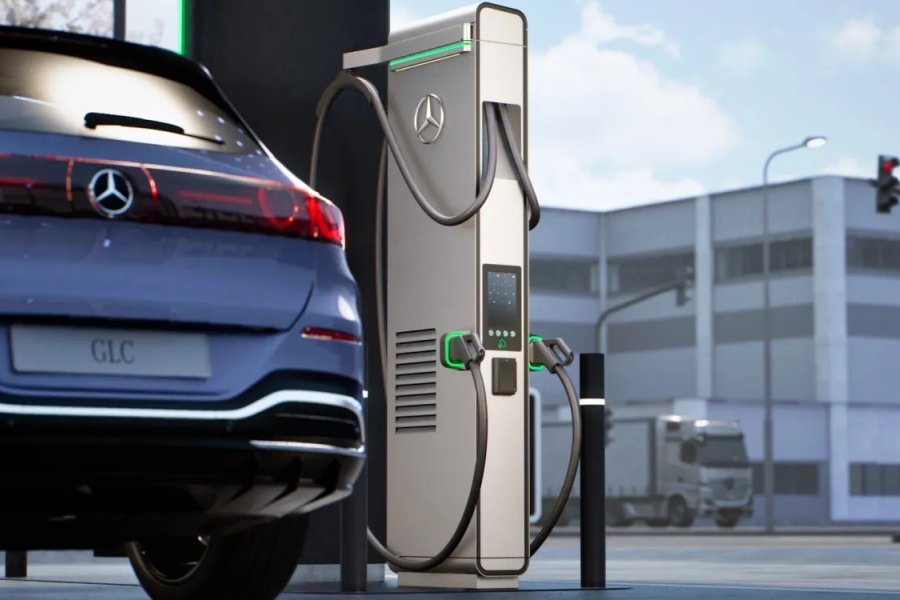
Current Status of V2G in China China possesses the world’s largest electric vehicle fleet, presenting immense market potential for vehicle-to-grid (V2G) interaction. Since 2020, the state has introduced multiple policies to advance V2G technology, with renowned institutions such as Tsinghua University and Zhejiang University conducting in-depth research. On 17 May, the National Development and Reform Commission and the National Energy Administration issued the Implementation Opinions on Accelerating the Construction of Charging Infrastructure to Better Support New Energy Vehicles in Rural Areas and Rural Revitalisation. The document proposes: encouraging research into key technologies such as bidirectional interaction between electric vehicles and the grid (V2G) and coordinated control of photovoltaic power generation, energy storage, and charging. It also explores establishing integrated charging infrastructure providing photovoltaic power generation, energy storage, and charging in rural areas where charging pile utilisation rates are low. Implementation of peak-off-peak electricity pricing policies will incentivise users to charge during off-peak hours. By 2030, demand (capacity) charges shall be waived for centralised charging and battery swapping facilities operating under a two-part tariff system. Constraints on distribution network construction investment efficiency for grid enterprises shall be relaxed, with full recovery incorporated into transmission and distribution tariffs. Application case: Shanghai hosts three V2G demonstration zones involving over ten EVs, discharging approximately 500 kWh monthly at a revenue rate of ¥0.8 per kWh. In 2022, Chongqing completed a 48-hour full-response charging/discharging cycle for an EV, absorbing 44 kWh cumulatively. Additionally, other regions within China are actively exploring V2G pilot initiatives, such as the Beijing Renji Building V2G demonstration project and the Beijing China Re Centre V2G demonstration project. In 2021, BYD commenced a five-year programme to deliver up to 5,000 V2G-enabled medium and heavy-duty pure electric vehicles to Levo Mobility LLC. Overseas V2G Landscape Countries in Europe and America have placed particular emphasis on V2G technology, introducing explicit policy support at an early stage. As far back as 2012, the University of Delaware launched the eV2gSM pilot project, aimed at evaluating the potential and economic value of electric vehicles providing frequency regulation services to the PJM grid under V2G conditions to mitigate the inherent intermittency of renewable power. To enable the University of Delaware’s relatively low-power electric vehicles to participate in the frequency regulation market, the pilot lowered the minimum power requirement for frequency regulation service providers from 500 kilowatts to approximately 100 kilowatts. In 2014, with support from the US Department of Defence and the California Energy Commission, a demonstration project commenced at Los Angeles Air Force Base. In November 2016, the Federal Energy Regulatory Commission (FERC) proposed regulatory amendments to facilitate the entry of energy storage and distributed energy resource (DER) integrators into electricity markets. Overall, US pilot validation appears relatively comprehensive, with complementary policy mechanisms likely to be finalised within the next one to two years, thereby propelling V2G into substantive commercial operation. In the European Union, the SEEV4-City programme commenced in 2016, allocating €5 million to support six projects across five countries. This initiative focuses on enabling microgrids to integrate renewable energy through V2H, V2B, and V2N applications. In 2018, the UK government announced funding of approximately £30 million for 21 V2G projects. This funding aims to test relevant technological R&D outcomes while simultaneously identifying market opportunities for such technologies.
Technical Difficulties and Challenges of V2G Technology Device Compatibility:
Compatibility between different vehicles, batteries, and power grids presents a significant challenge. Ensuring high compatibility in communication protocols and charging/discharging interfaces between vehicles and the grid is essential for effective energy transfer and interaction. Grid Adaptability: Integrating a large number of electric vehicles into grid energy interaction systems may pose challenges to existing grid infrastructure. Issues requiring resolution include grid load management, grid reliability and stability, and the grid’s flexibility in accommodating EV charging demands. Technical Challenges: V2G systems must overcome multiple technical hurdles, such as rapid charging and discharging technologies, battery management control systems, and grid interconnection techniques. These challenges demand continuous experimentation and research and development. Vehicle Battery Management: For electric vehicles, the battery serves as a critical energy storage device. Within V2G systems, precise control over battery management is essential to balance grid demands with considerations for battery longevity. Charging/Discharging Efficiency and Speed: Achieving highly efficient charging and discharging processes is crucial for the successful application of V2G technology. Advanced charging technologies must be developed to enhance energy transfer efficiency and speed while minimising energy losses. Grid Stability: V2G technology involves integrating electric vehicles as part of the grid, imposing heightened demands on grid stability and security. Potential issues arising from large-scale vehicle grid integration must be addressed to ensure the reliability and stability of the power system. Market Mechanisms: The commercial model and market mechanisms for V2G systems also present challenges. Careful consideration and resolution are required for balancing stakeholder interests, establishing reasonable tariff structures, and incentivising user participation in V2G energy exchange.
Application Advantages of V2G Technology:
Energy Management: V2G technology enables electric vehicles to feed electricity back into the grid, facilitating bidirectional energy flow. This aids in balancing grid loads, enhancing grid stability and reliability, and reducing reliance on polluting energy sources such as traditional coal-fired power generation. Energy Storage: Electric vehicles can function as part of distributed energy storage systems, storing surplus electricity and releasing it when required. This aids in balancing grid loads and provides additional power support during peak periods. Revenue Generation: Through V2G technology, vehicle owners can connect their electric vehicles to the grid, selling electricity back and earning corresponding income or incentives. This provides an additional revenue stream for EV owners. Reduced Carbon Emissions: By diminishing reliance on conventional polluting energy sources, V2G-enabled electric vehicles can lower carbon dioxide and other greenhouse gas emissions, yielding positive environmental impacts. Enhanced Grid Flexibility: V2G technology facilitates dynamic grid management, improving stability and reliability. It enables flexible adjustments to the grid’s supply-demand balance based on real-time conditions, thereby boosting the grid’s adaptability and operational efficiency.
Post time: Sep-13-2025
