
 Portable EV Charger
 Home EV Wallbox
 DC Charger Station
 BESS Charging Station
 V2G V2H V2V V2L
 EV Charging Module
 DC Charging Connector
 EV Accessories
Quick Answer
Solving grid capacity pressure for fast charging stations requires a multi-layered approach: Battery Energy Storage Systems (BESS) act as a buffer to shave peak loads, Dynamic Load Balancing optimizes power distribution across multiple dispensers, and Smart Charging Algorithms shift demand based on grid signals. By integrating storage, operators can deploy ultra-fast chargers (360kW+) even on grids limited to 100kW, significantly reducing infrastructure upgrade costs and grid fees.
Key Takeaways
- BESS Buffering: Storage systems discharge during peak sessions, allowing high-power charging without exceeding grid limits.
- Peak Shaving: Reduces demand charges by capping the maximum power drawn from the utility.
- Dynamic Load Sharing: MIDA’s smart allocation logic distributes power between guns based on real-time vehicle BMS requests.
- Efficiency: SiC-based PCS (Power Conversion Systems) achieve ≥97.1% efficiency, minimizing energy waste.
- Compliance: Fully compatible with ISO 15118-20 for V2G and smart grid interaction.
- Future-Proofing: Supports 1000V high-voltage platforms and liquid cooling for 500A+ charging.
- Revenue: Integrated systems enable demand response participation, turning energy management into a profit center.
Deep Dive: Solving the Grid Bottleneck
1. The Challenge: Peak Demand vs. Grid Infrastructure
As EV adoption scales, the demand for 360kW and 480kW ultra-fast chargers is surging. However, many urban and highway locations face grid constraints, where local transformers cannot support simultaneous high-power sessions. Traditional grid upgrades are slow, expensive, and often involve complex regulatory approvals.
2. BESS as the “Power Reservoir”
Integrating Battery Energy Storage Systems (BESS) allows station operators to “store” energy during low-demand periods and “release” it when a vehicle connects.
- Example: A site with a 100kW grid connection can support a 360kW charging session by drawing 100kW from the grid and 260kW from the BESS.
- TCO Benefit: This eliminates the need for massive transformer upgrades, which can cost upwards of $100,000 per site.
3. Dynamic Load Balancing & Smart Charging
MIDA’s 480kW DC fast charger stations utilize intelligent power modules that can be dynamically allocated. If two cars are charging, the system prioritizes the one with the lower State of Charge (SoC) or distributes power equally, ensuring the total draw never exceeds the site’s limit.
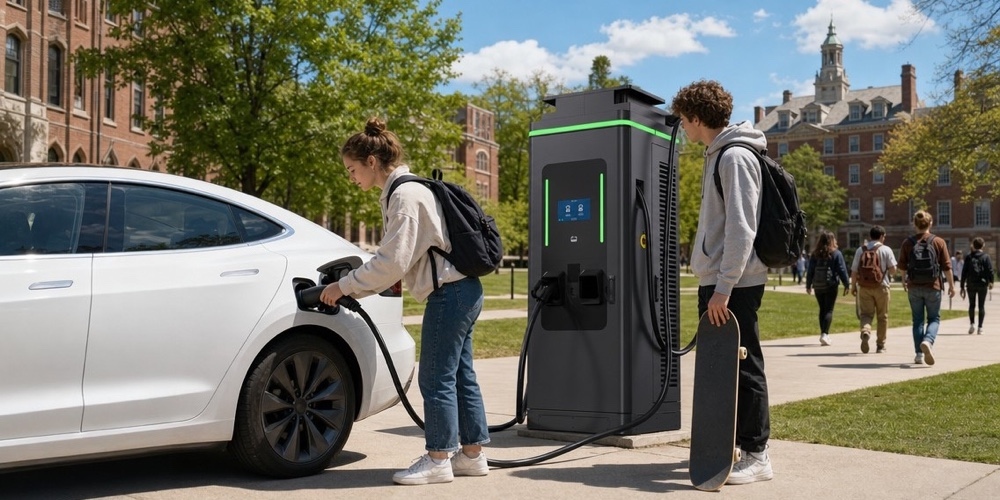
4. Solar Integration & Micro-grids
Combining solar-plus-storage EV charging systems creates a micro-grid environment. Solar energy directly powers the chargers or charges the BESS, further reducing reliance on the grid and lowering carbon intensity.
| Solution | Primary Benefit | ROI Impact |
|---|---|---|
| BESS Integration | Peak Shaving | High (Avoids grid fees) |
| Load Balancing | Maximizes Uptime | Medium (Improved UX) |
| Solar PV | Free Energy | Long-term (OpEx reduction) |
| V2G/V2H | Grid Services | New Revenue Stream |
FAQ
1. What is the most cost-effective way to handle grid limits? BESS integration is the most effective solution, as it allows for peak shaving and avoids the high costs of grid expansion.
2. Can I install a 360kW charger on a 150kW grid? Yes, by using a BESS-integrated solution, you can buffer the power and provide 360kW output while only drawing 150kW from the utility.
3. Does smart charging affect the charging speed? Smart charging optimizes speed based on the grid’s health and the car’s BMS, ensuring the fastest possible charge within safety and capacity limits.
4. How does BESS help reduce electricity bills? It helps by reducing “demand charges”—the fees based on your highest power usage—by capping peak draw from the grid.
5. Is MIDA’s solution compatible with solar? Absolutely. MIDA offers integrated BESS charging stations designed for seamless solar DC coupling.
6. What standards do these systems follow? They are fully compliant with IEC 61851-23 and support ISO 15118-20 for advanced grid communication.
7. Can these systems provide backup power? Yes, our V2G charging solutions support islanding mode for backup power during outages.
Post time: Aug-14-2026
