
 Portable EV Charger
 Home EV Wallbox
 DC Charger Station
 BESS Charging Station
 V2G V2H V2V V2L
 EV Charging Module
 DC Charging Connector
 EV Accessories
Quick Answer
The commercial pathway for Vehicle-to-Grid (V2G) charging is shifting from experimental pilots to scalable revenue models. By utilizing ISO 15118-20 compliant bidirectional DC chargers, EV fleets and private owners can sell energy back to the grid during peak hours or provide frequency regulation services. This “Shared Charging” model turns EVs into mobile energy storage assets, significantly reducing the Total Cost of Ownership (TCO) for fleet operators and providing a crucial stabilization tool for utilities.
Key Takeaways
- Bidirectional Power Transfer (BPT): Enables EVs to both draw and discharge power, compliant with ISO 15118-20.
- Revenue Generation: Operators can earn through peak shaving, demand response, and grid frequency regulation.
- Grid Stability: V2G helps balance the grid as renewable energy penetration (wind/solar) increases.
- Technical Readiness: SiC-based bidirectional modules achieve high efficiency in both charging and discharging cycles.
- Fleet Optimization: V2B (Vehicle-to-Building) reduces commercial demand charges by using EV batteries as building backups.
- Standards: Supported by IEC 61851-23:2023 and the latest CCS2/NACS protocols.
- Ecosystem: Requires coordination between EV manufacturers, charger OEMs (like MIDA), and utilities.
Deep Dive: The Commercial Potential of V2G
1. From V2L to V2G: The Evolution of Bidirectional Charging
While Vehicle-to-Load (V2L) is now common in passenger cars for powering camping gear, the real commercial value lies in V2G charging solutions. V2G allows for a sophisticated interaction where the vehicle acts as a distributed energy resource (DER).
2. Monetizing the Battery: Business Models
The “Shared Charging” economy thrives on three main pillars:
- Arbitrage: Charging at night (low rates) and discharging during peak hours (high rates).
- Ancillary Services: Providing fast-response frequency regulation to the grid, which is often more lucrative than simple energy sales.
- Demand Charge Management: Using BESS-integrated charging stations and V2B to ensure a commercial building never exceeds its power quota.
3. Technical Requirements: The MIDA Advantage
MIDA’s bidirectional EV power modules use Silicon Carbide (SiC) technology to ensure that the round-trip efficiency of energy is maximized. This is critical because every percentage of loss during discharge directly eats into the operator’s profit.
- Wide Voltage Range: Supports 150V to 1000V, ensuring compatibility with current 400V and future 800V/1000V vehicle architectures.
- Communication: Full implementation of the ISO 15118-20 stack for secure “Plug & Charge” and bidirectional handshake.
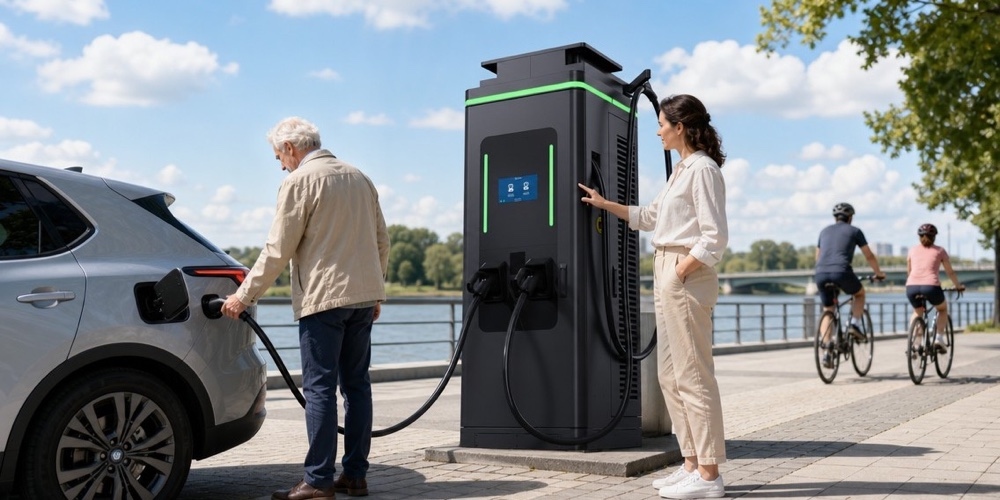
4. Grid Interaction and Smart Infrastructure
To scale V2G, chargers must be integrated into a solar-plus-storage EV charging system. This allows the charging station to manage local generation (solar), local storage (BESS), and mobile storage (EVs) as a single virtual power plant (VPP).
| Feature | V2L (Vehicle-to-Load) | V2G (Vehicle-to-Grid) |
|---|---|---|
| Target | Appliances/Tools | Utility Grid / Building |
| Complexity | Low (Single-phase) | High (Three-phase, Sync) |
| Standards | Proprietary | ISO 15118-20 / IEC 61851 |
| Profit | Convenience | Revenue Generation |
FAQ
1. Can any EV do V2G? No, the EV must have a bidirectional onboard charger (for AC V2G) or support bidirectional DC charging (for DC V2G), along with the necessary communication protocols.
2. How much can I earn from V2G? Earnings vary by market and utility incentives, but fleet operators in active V2G markets can see thousands of dollars in savings or revenue per vehicle annually.
3. Does V2G damage the car battery? Modern BMS and smart V2G algorithms minimize cycle wear. Often, the revenue generated far outweighs the marginal battery degradation.
4. What is the difference between V2G and V2B? V2G sends power to the public grid, while V2B (Vehicle-to-Building) uses the car to power a specific building, usually to avoid peak demand charges.
5. Is MIDA’s hardware ready for V2G? Yes, our latest V2G charging solutions are built on the ISO 15118-20 standard and are ready for commercial deployment.
6. Do I need a special connector for V2G? Standard CCS2, NACS, and CHAdeMO connectors support V2G, provided the internal hardware and software are bidirectional.
7. How do utilities view V2G? Utilities increasingly see V2G as a valuable tool for grid stabilization and a way to avoid costly peaking plant operation.
Post time: Aug-14-2026
