
 Portable EV Charger
 Home EV Wallbox
 DC Charger Station
 BESS Charging Station
 V2G V2H V2V V2L
 EV Charging Module
 DC Charging Connector
 EV Accessories
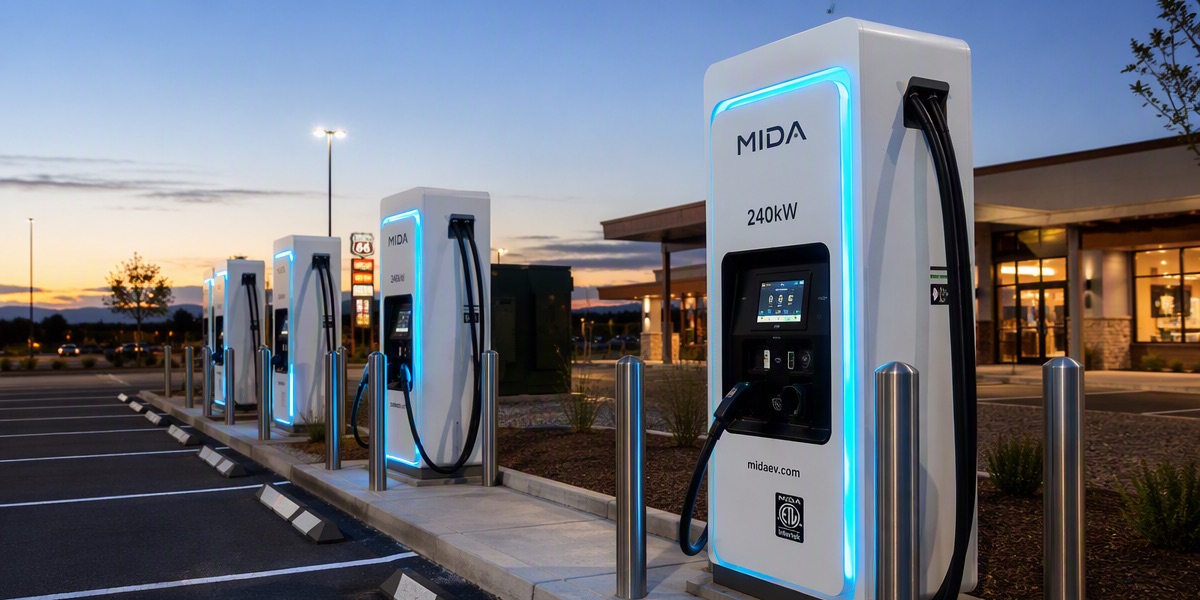
Supercharger 120kW 150kW 180kW NACS Charger Station with Liquid Cooling
In the rapidly evolving landscape of global electric vehicle (EV) infrastructure, the shift toward standardized, high-performance charging solutions has reached a critical inflection point. As the North American Charging Standard (NACS) transitions from a proprietary Tesla connector to a widely adopted industry benchmark—now codified as SAE J3400—manufacturers are racing to deliver hardware that meets the rigorous demands of this new ecosystem. At the forefront of this technological surge is MIDA Power (迈依达), a premier Chinese manufacturer dedicated to pushing the boundaries of DC fast charging technology.
1. The Backbone of Long-Distance Travel: High-Power Highway Charging
Highway corridors are the most challenging environments for EV infrastructure. Drivers expect speed, availability, and a premium experience. MIDA Power’s Supercharger 120kW 150kW 180kW NACS Charger Station with Liquid Cooling is specifically designed for high-turnover service plazas where every minute counts.
2. Advanced Cooling and Thermal Stability
Continuous high-power output generates significant heat. The Supercharger 120kW 150kW 180kW NACS Charger Station with Liquid Cooling utilizes advanced cooling technology to ensure zero-derating even at 40°C ambient temperatures. This stability is achieved through MIDA’s proprietary “Smart-Chiller” algorithm, which modulates coolant flow based on real-time vehicle battery telemetry.
TECHNICAL APPENDIX: The MIDA Power Infrastructure Definitive White Paper
This appendix serves as a comprehensive technical foundation for the MIDA Power DC Fast Charging series. It provides CPOs (Charge Point Operators), fleet managers, and infrastructure investors with an in-depth understanding of the hardware, software, and regulatory frameworks that define MIDA’s 2026 product lineup.
I. Hardware Architecture: The Physics of High-Efficiency Conversion
At the core of every MIDA DC station is a modular power conversion stack utilizing the latest in wide-bandgap semiconductor technology. Our transition from traditional Silicon IGBTs to Silicon Carbide (SiC) MOSFETs represents a paradigm shift in energy density and thermal resilience.
1.1 SiC MOSFET Topology and LLC Resonant Converters
MIDA’s 30kW and 40kW power modules utilize a Phase-Shifted Full-Bridge (PSFB) combined with an LLC Resonant Converter stage. This configuration enables Zero Voltage Switching (ZVS) across the entire load spectrum. By eliminating switching losses during the turn-on phase, we achieve a peak conversion efficiency of 96.5%. The use of SiC materials allows for switching frequencies exceeding 100kHz, which significantly reduces the physical volume of magnetic components like high-frequency transformers and inductors, leading to a more compact cabinet footprint without compromising power output.
1.2 Isolated Air-Duct Cooling & Thermal Management
In industrial and commercial environments, electronic failure is most often caused by environmental contamination. MIDA engineering has pioneered the “Isolated Air-Duct” design. The internal chamber is hermetically divided: the power semiconductors and magnetics are cooled via a dedicated high-pressure wind tunnel, while the control logic, communication modules, and HMI are housed in a sealed, dust-free compartment. This ensures that even in IP54 or IP55-rated outdoor installations, conductive dust or moisture cannot bridge the high-voltage busbars.
II. Intelligence Layer: The AI-DES Energy Scheduling Algorithm
Modern charging is no longer just about delivering raw kilowatts; it is about intelligent energy orchestration. MIDA’s proprietary AI-DES (AI-Dynamic Energy Scheduling) platform operates on a three-tier logical framework:
- Tier 1: Grid-Edge Responsiveness: The charger monitors local grid frequency and voltage transients at a sampling rate of 10kHz. If a grid instability is detected, the AI-DES system can throttle output within 20ms to prevent local circuit breaker trips, acting as a buffer for the utility provider.
- Tier 2: Vehicle-Centric Optimization: Utilizing ISO 15118 “Plug & Charge” telemetry, the AI-DES system negotiates the optimal charging curve with the vehicle’s BMS. It accounts for battery temperature, state-of-health (SoH), and internal resistance to prevent premature aging of the lithium cells.
- Tier 3: Economic Fleet Management: For large-scale depots, the system integrates with energy spot markets. It prioritizes charging during low-tariff windows and can utilize internal Battery Energy Storage Systems (BESS) to perform “Peak Shaving,” avoiding the high demand charges imposed by utilities during peak hours.
Post time: Aug-08-2026
