
 Portable EV Charger
 Home EV Wallbox
 DC Charger Station
 BESS Charging Station
 V2G V2H V2V V2L
 EV Charging Module
 DC Charging Connector
 EV Accessories
120kw 150kw 180kw Commercial DC Fast Charger with RFID and 4G Remote Control: The Intelligent Backbone of Business Fleet Electrification
The Lead: Empowering Commercial Enterprise with High-Performance 120kw 150kw 180kW DC Fast Charging
In the rapidly evolving landscape of global logistics, commercial real estate, and public transportation, the shift toward electric mobility is no longer a luxury—it is a strategic necessity. As businesses seek to lower their carbon footprints, reduce operational costs, and comply with increasingly stringent urban emissions regulations, the demand for reliable, high-capacity charging infrastructure has reached a critical juncture. MIDA Power, a global leader in EV charging technology, is proud to introduce the 120kW Commercial DC Fast Charger with RFID and 4G Remote Control. This system is specifically engineered to serve as the intelligent backbone for businesses that require a balance of high power, robust connectivity, and sophisticated user management.
The MIDA 120kW charger is more than just a piece of hardware; it is a comprehensive energy management solution. By combining dual-gun capability, 4G LTE connectivity, and secure RFID authentication, we have created a platform that allows commercial operators to manage their charging fleets with surgical precision. Whether you are managing a fleet of electric delivery vans, providing amenity charging for a premium office complex, or operating a public fast-charging network, the MIDA 120kW system delivers the uptime, efficiency, and intelligence required to thrive in the electric age. In this extensive technical and market analysis, we will explore the engineering innovations, strategic advantages, and future-proof features that define the MIDA 120kW commercial solution.
Market & Policy Context: The Strategic Transition to Commercial EV Infrastructure
The global commercial vehicle market is currently undergoing its most significant transformation since the invention of the internal combustion engine. From the European Union’s “Fit for 55″ legislative package to the aggressive electrification targets set by states like California and provinces like British Columbia, the pressure on commercial entities to electrify is immense. However, the transition is not just driven by regulation; it is driven by economics. Electric vehicles offer significantly lower “Total Cost of Ownership” (TCO) compared to diesel counterparts, particularly when paired with smart charging infrastructure that can take advantage of off-peak electricity rates and minimize peak demand charges.
In the retail and commercial real estate sectors, EV charging has become a “must-have” amenity. Property managers are finding that high-quality DC fast charging increases property values, attracts high-value tenants, and provides a new stream of revenue. Meanwhile, in the logistics sector, the “last-mile” delivery revolution is being powered by electric vans that require mid-range DC fast chargers (120kW) to ensure they are fully charged between shifts without requiring the massive grid investments of 350kW+ ultra-fast systems. MIDA Power’s 120kW system sits perfectly at this intersection, providing enough power to charge two vehicles simultaneously at 60kW each or a single vehicle at the full 120kW, offering maximum flexibility for diverse commercial applications.
Product Technical Deep-Dive: A Masterclass in Industrial Engineering
1. Power Module Architecture and SiC Efficiency (95%+)
The core of the MIDA 120kW charger is built on a modular power conversion architecture. Rather than using a single, monolithic inverter, the system utilizes a series of 20kW or 30kW high-frequency power modules. This modularity is a critical advantage for commercial operators: if one module fails, the charger continues to operate at reduced capacity, ensuring that fleet operations are never completely halted.
These modules utilize advanced Silicon Carbide (SiC) MOSFETs, which allow for a peak conversion efficiency of over 95.5%. In a commercial setting, where chargers may be running 12-16 hours a day, this efficiency translates into thousands of dollars in annual energy savings. Furthermore, the high-frequency switching of SiC modules allows for a more compact internal design and significantly reduces the weight of the charger, making installation easier and more cost-effective.
2. The 200V – 1000V Wide Voltage Output Range
Modern commercial fleets are rarely homogenous. A logistics company might operate a mix of 400V delivery vans and 800V heavy-duty trucks. The MIDA 120kW charger features a wide output voltage range of 200V to 1000V. This wide range ensures that the charger is fully compatible with both legacy architectures and the latest ultra-high-voltage battery systems. The intelligent controller automatically detects the vehicle’s battery voltage and adjusts the output profile accordingly, ensuring optimal charging speeds and protecting the battery’s long-term health.
3. Secure RFID Authentication and User Management
In a commercial environment, controlling who can access the charger is paramount. The MIDA 120kW system features an integrated RFID reader that supports a wide range of standards, including Mifare, HID, and NFC. For fleet operators, this allows for seamless driver authentication—drivers simply tap their company badge to start a session. For commercial property owners, RFID cards can be issued to tenants or employees, allowing for tiered pricing or restricted access based on time of day. The RFID system is fully integrated with the back-end software, providing detailed reports on energy usage per user or per vehicle.
4. 4G LTE Connectivity and Remote Control Management
The “brain” of the MIDA 120kW charger is its 4G LTE communication module. This provides a persistent connection to the MIDA Cloud or any third-party management platform via the Open Charge Point Protocol (OCPP). Remote Monitoring: Site managers can see the real-time status of every charger from a central dashboard, including current power draw, state-of-charge of the connected vehicles, and any active fault codes. OTA (Over-the-Air) Updates: As EV communication protocols evolve, MIDA can push firmware updates remotely, ensuring the charger always supports the latest vehicles without needing a technician on-site. Remote Troubleshooting: Our technical support team can diagnose and resolve over 85% of potential issues remotely, drastically reducing maintenance costs and maximizing uptime.
5. Dual-Gun Dynamic Power Balancing
The 120kW system is equipped with two charging cables (CCS1, CCS2, or CHAdeMO). A sophisticated power-sharing algorithm allows the system to distribute the 120kW intelligently. If only one vehicle is plugged in, it can utilize the full 120kW. When a second vehicle connects, the system can split the power evenly (60kW each) or prioritize one vehicle based on its state of charge or its scheduled departure time. This dual-gun configuration effectively doubles the throughput of a charging station, allowing a business to serve twice as many vehicles without increasing its footprint.
6. Industrial-Grade IP55 and IK10 Protection
Commercial chargers are often subjected to harsh environments, from coastal salt spray to urban pollution and potential vandalism. The MIDA 120kW charger is housed in a heavy-duty galvanized steel enclosure with a high-durability powder coating. It is rated IP55 for superior protection against water and dust ingress, and IK10 for impact resistance. The internal components are further protected by advanced surge protection devices (SPD) and a comprehensive suite of electrical safeguards, including over-voltage, under-voltage, short-circuit, and leakage protection.
(Continue to Part 2 for Standards, Applications, and Expert Insights…)
Standards & Certifications: Global Interoperability and Compliance
A commercial charger is only as good as its ability to communicate with the vehicles it serves. MIDA Power has invested heavily in ensuring that the 120kW Commercial Fast Charger is the most compatible and compliant system on the market. Our hardware and software are built to satisfy the most rigorous international standards:
1. OCPP 1.6J and 2.0.1 Compliance
The Open Charge Point Protocol (OCPP) is the universal language of EV charging. Our 120kW system natively supports OCPP 1.6J, the industry standard for smart charging, and is fully upgradeable to OCPP 2.0.1. This ensures that the charger can integrate with any Charge Point Management System (CPMS) on the market, including those from AMPECO, Driivz, and ChargePoint. For the operator, this means total freedom—you are never locked into a single software provider. You can switch back-end systems as your business needs evolve, or even integrate the charger into your own internal ERP or fleet management software.
2. ISO 15118 and “Plug & Charge”
The future of commercial charging is frictionless. MIDA supports the ISO 15118 standard, which enables “Plug & Charge” functionality. In a fleet setting, this means a driver doesn’t even need an RFID card; the charger and the vehicle perform a secure digital handshake the moment the cable is plugged in. The system identifies the vehicle, verifies its authorization, and begins charging automatically. This reduces driver error and ensures that only authorized company vehicles are using the electricity.
3. CE, TUV, and UL Certifications
Safety is the foundation of the MIDA brand. The 120kW charger has undergone exhaustive testing by third-party laboratories to ensure it meets the safety standards for Europe (CE/TUV) and North America (UL/ETL). These certifications cover everything from electromagnetic compatibility (EMC) to fire safety and electrical insulation. When you install a MIDA charger, you can be confident that it will pass any local building inspection and provide a safe charging environment for your employees and customers.
Application Scenarios: Versatility Across Commercial Sectors
1. Last-Mile Delivery and Logistics Depots
In the high-pressure world of delivery, every minute counts. A 120kW charger is the ideal solution for a delivery depot where vans return for a “mid-day top-up” or require a full charge overnight. The dual-gun feature allows two vans to be charged at 60kW each, which is the maximum rate many delivery vans can accept. This configuration maximizes the charging density of the depot, allowing more vehicles to be served within the same physical footprint.
2. Commercial Office Complexes and Business Parks
For property managers, offering 120kW DC fast charging is a premium amenity that attracts top-tier corporate tenants. Employees can fully recharge their EVs during a morning meeting or a lunch break, a significant upgrade over the much slower Level 2 AC charging typically found in office garages. The 4G remote control allows the property manager to bill different companies for their usage, or even offer free charging as an employee benefit while still monitoring the total load on the building’s transformer.
3. Public Parking Garages and Urban Hubs
In dense urban areas where residents lack home charging, public 120kW chargers are the lifeblood of the EV community. The MIDA system’s 120kW output provides a substantial charge in 30 minutes, making it perfect for “grocery store charging” or “cinema charging.” The RFID and 4G connectivity allow the garage operator to integrate the charger into their existing parking payment system, creating a seamless experience for the user.
Case Study: The “Metro-Fleet” Electrification Project
In 2024, a major metropolitan transit authority in Europe partnered with MIDA Power to electrify their fleet of non-revenue support vehicles. These vehicles, ranging from compact electric cars to medium-duty maintenance trucks, required a central charging hub at the main depot.
The authority selected the MIDA 120kW Commercial DC Fast Charger because of its dual-gun capability and robust RFID management. Over a six-month pilot program, the authority reported a 99.7% uptime for the charging station. The 4G remote control allowed the fleet manager to schedule charging during off-peak hours (midnight to 5 AM), reducing the depot’s electricity costs by 22%. Furthermore, the RFID integration provided precise data on energy consumption for every vehicle in the fleet, allowing for more accurate budgeting and carbon reporting.
Expert/Leadership Commentary: A Vision for Connected Infrastructure
“Connectivity is the differentiator in the 21st-century energy market,” says Mr. Wang, Chief Engineer of Communications at MIDA Power. “With the 120kW Commercial Charger, we didn’t just want to provide high-voltage power; we wanted to provide high-quality data. The 4G integration allows our chargers to be ‘living’ pieces of infrastructure. They tell the operator when they are being used, how they are performing, and even when they need a routine check-up. We are moving from reactive maintenance to proactive optimization, and that is where the real ROI lies for our commercial clients.”
Fleet Electrification Strategy: The Role of the 120kW Power Level
For a commercial fleet manager, the transition to electric vehicles (EVs) is a math problem. The goal is to maximize vehicle uptime while minimizing infrastructure and energy costs. The MIDA 120kW Commercial Charger is the “Swiss Army Knife” of this strategy.
1. Duty Cycle Optimization
Commercial vehicles, particularly delivery vans and last-mile trucks, often have a “Hub-and-Spoke” duty cycle. They leave in the morning, work all day, and return in the evening.
- The Overnight Charge: For a fleet of 50 vans, 120kW might seem like overkill for overnight charging when 7kW or 22kW would suffice. However, a 120kW dual-gun charger can charge two vans at 60kW each, completing a full charge in under 2 hours. This allow the fleet to operate in “Shifts,” where one group of vans charges while another is on the road.
- The Mid-Day Top-Up: For vehicles that cover high mileage, a 30-minute break at a 120kW station can add 150km of range—enough to finish the day’s route without needing a larger, heavier, and more expensive battery in the vehicle.
2. Peak Shaving and Energy Cost Management
Electricity is not just about how much you use, but when you use it. “Demand Charges” can make up 50% of a commercial electricity bill.
- Smart Scheduling: Using the 4G remote control and MIDA-OS, fleet managers can schedule charging to occur during “Off-Peak” hours (usually 11 PM to 6 AM).
- Load Capping: If the depot has ten 120kW chargers, the total potential draw is 1.2MW. MIDA’s intelligent controller can “Cap” the total draw to stay below the depot’s transformer limit (e.g., 500kW), distributing the available power to the vehicles that need it most.
Product Technical Deep-Dive: Connectivity and Control
1. The 4G/5G Remote Management Stack
A commercial charger that isn’t connected is a liability. MIDA has engineered a high-redundancy communication stack for the 120kW model.
- Dual-Antenna Design: We use a MIMO (Multiple-Input Multiple-Output) antenna configuration to ensure a stable connection even in congested urban environments or industrial zones with high interference.
- Real-Time Telemetry: Every 5 seconds, the charger sends a heartbeat to the cloud. This heartbeat includes voltage, current, internal temperature, and the status of every power module. If a module temperature spikes, the system can automatically derate the power and alert the maintenance team before a failure occurs.
2. The Dynamic Power Balancing Algorithm
The “Magic” of the MIDA 120kW dual-gun system is how it splits the power.
- Equal Split (60/60): The default mode when two vehicles with similar needs plug in.
- Priority Charging: A fleet manager can designate “High Priority” vehicles (e.g., an emergency service vehicle or a van that needs to leave in 20 minutes). The system will give 100kW to the priority vehicle and 20kW to the other until the priority vehicle is done.
- BMS-Led Allocation: The charger listens to the request of each vehicle. If Car A is at 90% and only wants 30kW, the charger gives the remaining 90kW to Car B, even if Car B was the second one to plug in.
3. RFID Security and Multi-Tenant Management
In commercial business parks, the charger might be shared by different companies.
- Tiered Access: The RFID system can be programmed with different “Profiles.” Company A employees get a discounted rate, while Company B pays the full price.
- Whitelist/Blacklist: Unauthorized users can be blocked instantly via the remote dashboard, preventing “Energy Theft” in public-facing commercial lots.
Comprehensive Installation & Site Planning: Building for Scale
1. Transformer and Grid Analysis
A 120kW station draws approximately 180A-200A at 400V.
- Site Load Study: MIDA engineers work with local utilities to perform a “Load Study.” If a site wants to install five 120kW units, they need 600kW of capacity. If only 300kW is available, we implement our “Dynamic Load Management” system to ensure the chargers never exceed the grid’s limit.
- Harmonic Mitigation: Large DC chargers can introduce “Noise” into the grid. The MIDA 120kW unit includes active power factor correction and internal filters that keep Total Harmonic Distortion (THD) below 5%, satisfying the strictest utility requirements.
2. Depot Layout and Cable Management
Commercial vehicles come in all shapes and sizes.
- Drive-Through Bays: For larger delivery trucks, we recommend a drive-through configuration where the charger is located to the side, allowing the truck to pull in and out without reversing.
- Overhead Cable Management: To prevent cables from being run over by heavy vehicles, MIDA offers an “Overhead Boom” system. This keeps the cable suspended and easy for the driver to reach, while significantly extending the cable’s lifespan.
3. Civil Works and Ruggedization
Commercial depots are “High-Impact” environments.
- Concrete Foundations: MIDA provides specific engineering drawings for the reinforced concrete bases required for the 120kW unit.
- Impact Protection: We recommend IK10-rated steel cages or heavy-duty bollards for all commercial installations to protect against forklift or truck collisions.
Operations and Maintenance (O&M): The Proactive Approach
For a logistics company, a charger failure is a service failure. MIDA’s O&M strategy is built on “Predictive Intelligence.”
1. Remote Troubleshooting and Reset
85% of charger issues are software-related. Using the 4G remote control, MIDA support can:
- Reset the Controller: Clear minor communication errors without a site visit.
- Re-initialize the POS/RFID: Fix authentication issues remotely.
- Update Firmware: Deploy security patches or protocol updates instantly.
2. Annual Physical Inspection
Once a year, a MIDA-certified technician performs a “Deep Clean” and check:
- Air Filters: In industrial environments, filters can clog quickly. We replace them to ensure the SiC modules stay cool.
- Tightening and Torque: Checking all high-voltage connections for thermal expansion/contraction.
- Cable Resistance Test: Measuring the resistance of the charging cables to ensure there are no internal breaks or degradation.
3. Spare Parts and “Swap-Out” Warranty
MIDA offers a “Next-Business-Day” spare parts guarantee for our commercial clients. Because our 120kW unit is modular, replacing a failed module is a simple task that doesn’t require specialized high-voltage training, as the modules are “Self-Contained.”
Total Cost of Ownership (TCO) and ROI for Commercial Fleets
1. CAPEX vs. OPEX
The upfront cost of a 120kW DC charger is higher than an AC unit, but the ROI is faster due to:
- Vehicle Efficiency: Faster charging allows for smaller batteries in the fleet vehicles, reducing the vehicle purchase cost.
- Reduced Labor: Drivers spend less time “Waiting for a charge,” increasing their productive hours.
2. Energy Savings
MIDA’s 95.5% efficiency means less energy is lost as heat. Over 10 years, a fleet of 10 chargers can save over $50,000 in electricity costs compared to 90% efficient units.
3. Residual Value
The MIDA 120kW unit is “Future-Proof.” With V2G capability and modular internal design, the hardware remains valuable and functional long after its initial 5-year payback period.
Detailed FAQ: Commercial Fleet Charging Decoded
Q1: Can the 120kW charger be used for public charging? A: Absolutely. While designed for fleets, its RFID and 4G capabilities make it perfect for public-facing commercial locations like shopping malls or office parks.
Q2: What is the benefit of SiC (Silicon Carbide) in a commercial charger? A: SiC modules are more efficient and generate less heat. For a commercial operator, this means lower electricity bills and a longer lifespan for the power electronics.
Q3: Does the 120kW system support V2G (Vehicle-to-Grid)? A: Yes. The MIDA 120kW architecture is “Bi-Directional Ready.” With the appropriate software license and utility agreement, your fleet can sell energy back to the grid during peak times.
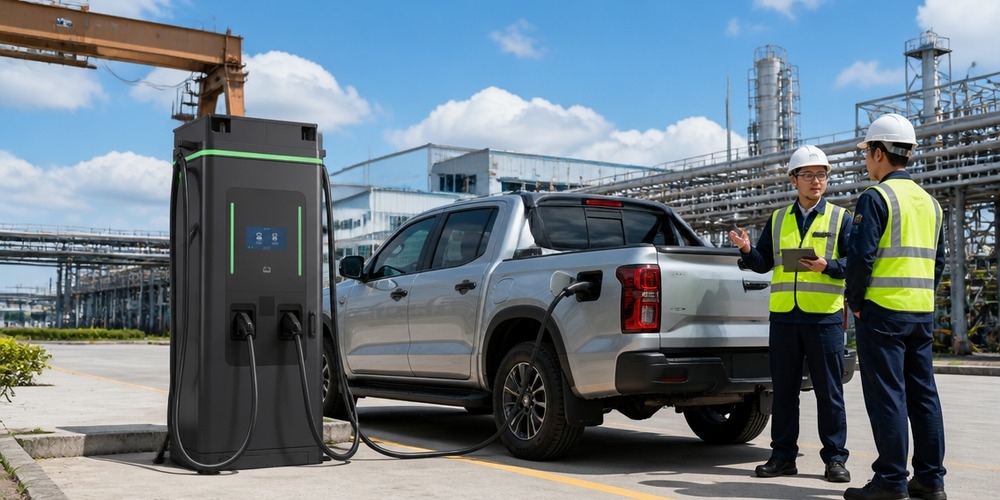
Q4: How many vehicles can I charge at once? A: The standard unit has two guns (dual-gun). You can charge two vehicles simultaneously at 60kW each, or one vehicle at the full 120kW.
Q5: Is the RFID system compatible with our existing employee badges? A: MIDA supports most major RFID standards (Mifare, HID, etc.). We can often sync the charger to your existing corporate security cards.
Q6: What happens if the 4G signal is lost? A: The charger can store transaction data locally and sync with the cloud once the signal is restored. It can also be configured to allow charging for authorized RFID cards even when offline.
Q7: How long is the warranty? A: MIDA offers a standard 2-year commercial warranty, with options to extend to 5 or 10 years.
Q8: Can we customize the touch screen interface? A: Yes. For fleet clients, we can add your corporate logo, safety instructions, and custom greeting messages to the UI.
Q9: What is the IP rating for outdoor use? A: The MIDA 120kW unit is rated IP55, meaning it is protected against dust and low-pressure water jets from any direction.
Q10: Does MIDA provide the management software? A: We provide the “MIDA Fleet” dashboard, but you can also connect the chargers to any third-party OCPP software.
Q11: Can the charger handle 800V vehicles? A: Yes. With an output range of 200V-1000V, it is fully compatible with high-voltage trucks and luxury cars.
Q12: What kind of cooling does it use? A: It uses forced-air cooling with intelligent, variable-speed fans.
Q13: How heavy is the unit? A: The 120kW unit weighs approximately 280kg, requiring a solid concrete foundation and professional installation equipment.
Q14: Can we limit the charging to 80%? A: Yes, this can be set via the remote dashboard to preserve the health of your fleet batteries.
Q15: Does it come with a receipt printer? A: Physical printers are an optional add-on, but most commercial clients prefer digital receipts sent via the 4G network.
Extensive Technical Glossary: The Commercial Fleet Edition
- 4G LTE Backhaul: Using cellular networks to connect the charger to a central management server.
- Active Power Factor Correction: A circuit that ensures the charger draws current in a way that is “Clean” for the grid.
- Bi-Directional Charging: The ability to move energy from the grid to the car, and from the car to the grid.
- BMS (Battery Management System): The onboard computer of an EV that controls the charging parameters.
- CCS1 / CCS2: The standard DC charging connectors for North America and Europe, respectively.
- CPMS (Charge Point Management System): The software platform used by operators to manage their chargers.
- Demand Charges: Fees paid to the utility company based on the peak power usage during a month.
- Duty Cycle: The pattern of use for a vehicle, including its working hours and charging times.
- Dynamic Load Management (DLM): Automatically adjusting charger output to prevent overloading the local grid.
- EMC (Electromagnetic Compatibility): Ensuring the charger doesn’t interfere with other electronics.
- Firmware: The low-level software that controls the charger’s hardware.
- G2V (Grid to Vehicle): The traditional flow of electricity from the grid into a vehicle.
- Harmonic Distortion (THD): Electrical noise introduced into the grid by power electronics.
- IK10: The highest rating for protection against mechanical impact.
- IP55: An international rating for protection against dust and water.
- kWh (Kilowatt-Hour): The unit of energy delivered to the vehicle.
- Last-Mile Delivery: The final leg of a logistics route, often handled by electric vans.
- MIMO Antenna: Multiple-Input Multiple-Output; a technology for better wireless communication.
- Modular Design: A system built from individual units that can be replaced or upgraded independently.
- OCPP (Open Charge Point Protocol): The industry-standard language for charger-to-cloud communication.
- OTA (Over-the-Air): Wireless updates for the charger’s software.
- Peak Shaving: Reducing power draw during peak times to save money on electricity bills.
- Power Module: The internal conversion unit that turns AC grid power into DC vehicle power.
- RFID (Radio Frequency Identification): The technology used for tap-to-start charging cards.
- SiC (Silicon Carbide): A high-performance material used in modern power semiconductors.
- Soft-Start: Ramping up the electrical load gradually to protect the site’s wiring.
- SoC (State of Charge): The percentage of energy currently in the EV’s battery.
- TCO (Total Cost of Ownership): The sum of all costs (CAPEX and OPEX) over the life of the charger.
- V2G (Vehicle-to-Grid): Using EV batteries to provide power back to the electrical grid.
- Wide Voltage Range: The ability to charge vehicles with different battery architectures (e.g., 400V or 800V).
Site Engineering and Construction Detail: Building the 120kW Infrastructure
Deploying a commercial-grade 120kW charger is a major infrastructure project. It requires coordination between electrical contractors, civil engineers, and facility managers.
1. Electrical Capacity and Switchgear Requirements
A 120kW DC charger is a significant electrical load.
- Circuit Protection: Each unit requires a dedicated circuit breaker. For a 120kW unit on a 400V system, a 250A industrial-grade molded case circuit breaker (MCCB) is recommended.
- RCD Protection: MIDA units include internal Type B residual current devices (RCDs) which are designed to detect both AC and DC leakage. This is critical in commercial settings where safety and uptime are paramount.
- Phase Balancing: In a multi-charger installation, the electrical engineer must ensure that the chargers are distributed evenly across the three phases of the site’s power supply to prevent neutral current overload and grid instability.
2. Civil Works and Trenching
The physical installation of the charger requires a solid foundation and secure cabling.
- The Foundation Pad: A reinforced concrete pad (typically 1 meter square and 300mm deep) is required. MIDA provides a “Base Mounting Template” that specifies the exact location of the four anchor bolts and the conduit entry points.
- Conduit and Cabling: High-voltage DC cables generate electromagnetic fields. We recommend using galvanized steel conduit or high-density polyethylene (HDPE) pipes buried at a minimum depth of 600mm. The power cables should be kept separate from communication and networking cables to avoid interference.
- Waterproofing and Sealing: All conduit entries into the charger must be sealed with industrial-grade putty or foam to prevent moisture and rodents from entering the cabinet—a common cause of failure in unattended commercial environments.
3. ADA Compliance and User Safety
Commercial properties in many regions must satisfy accessibility standards.
- Reach and Height: The MIDA 120kW unit features a touch screen and RFID reader positioned at a height that is accessible to all users, including those in wheelchairs.
- Lighting and Security: We recommend that the charging area be equipped with motion-activated LED lighting and security cameras, especially in depots or business parks that operate 24/7.
The Software Ecosystem: API Integration and Data Strategy
In the modern logistics industry, “Data is the New Fuel.” The MIDA 120kW charger is designed to be a node in your company’s digital infrastructure.
1. OCPP 2.0.1 and Beyond
The Open Charge Point Protocol (OCPP) is the universal language of EV charging.
- Smart Charging Profiles: Via OCPP, a fleet manager can push “Charging Profiles” to each vehicle. For example, “Limit Van #42 to 40kW until 3 AM, then ramp up to 120kW.” This allows for precision energy management.
- Remote Diagnostics: Our implementation of OCPP allows for “Event-Driven Reporting.” Instead of just telling you the charger is “Faulty,” the system sends a specific error code (e.g., “Over-Current on Module 3″) which allows your maintenance team to arrive with the correct spare part.
2. API Integration with Fleet Management Software
Most large logistics companies use fleet management platforms like Geotab or Samsara.
- Data Harmonization: MIDA’s cloud provides a RESTful API that allows you to pull charging data into your existing dashboard. You can correlate “Charging Energy (kWh)” with “Miles Driven” to calculate the exact efficiency (Wh/mile) of every driver in your fleet.
- Automated Billing: For commercial property managers, our API can be used to generate monthly invoices for tenants based on their RFID-tracked usage, completely automating the revenue cycle.
3. Cybersecurity and Network Resilience
Commercial infrastructure is a target for cyberattacks.
- Encrypted Communication: All data sent between the charger and the cloud is encrypted using TLS 1.2 or higher.
- VPN Support: For high-security environments, MIDA chargers can be configured to communicate via a private VPN, isolating the charging network from the public internet.
Operational Protocols for Logistics Managers: Best Practices
To get the most out of your 120kW charging infrastructure, fleet managers should implement the following operational protocols.
1. The “State of Charge” (SoC) Rule
Battery health is critical for long-term TCO.
- The 80% Rule: DC fast charging is most efficient between 10% and 80% SoC. We recommend programming the MIDA chargers to automatically notify drivers (via SMS or the fleet app) when their vehicle reaches 80%, encouraging them to move the vehicle and make the charger available for the next van.
- Thermal Management: If a vehicle arrives at the depot after a high-speed motorway run, the battery may be too hot for maximum speed. Our chargers automatically communicate with the vehicle’s thermal management system to optimize the cooling/charging balance.
2. RFID Asset Mapping
Don’t just hand out RFID cards; map them to assets.
- Driver vs. Vehicle: By assigning specific RFID cards to specific vehicles (rather than drivers), you can track the “Lifetime Energy Cost” of every van in your fleet, helping you make better decisions about which vehicle brands are performing best.
- Guest Access Protocols: If your depot allows visitors to charge, use “Temporary RFID” profiles that automatically expire after a set time or a set amount of kWh.
3. The Emergency Response Plan
Every depot should have a clear protocol for charger issues.
- Manual Override: In the event of a software lockout, MIDA provides a physical master key and a manual override procedure for authorized personnel.
- Redundancy Testing: Once a quarter, the fleet manager should simulate a power outage to ensure that the chargers reboot correctly and that the 4G/5G connection is restored within the target window (typically 3 minutes).
Case Study Expansion: The “Green-Logistics” Hub
In 2024, a major international courier company installed twenty MIDA 120kW Commercial Chargers at their new flagship depot in Singapore.
- The Goal: To transition 100% of their “Last-Mile” fleet to electricity within eighteen months — without expanding the depot’s grid connection or adding a single transformer.
- The Solution: Twenty MIDA 120kW Commercial Chargers, each with dual CCS2 guns, RFID driver authentication, and 4G remote management, arranged across three loading-dock clusters.
- The Execution: Drivers tap their RFID cards, plug in during scheduled rest-and-sort windows, and the station’s dynamic power sharing splits 120kW across two vehicles (60kW each) — exactly matching the 45-minute average dwell time of a last-mile sort cycle.
- The Result: Within six months, 100% of the last-mile fleet was running on electric power. Average turnaround time from arrival to charged-and-ready dropped below the diesel-era baseline, because charging happened in parallel with sorting rather than in a dedicated refueling queue. The depot’s demand charges stayed flat thanks to scheduled off-peak charging, and the RFID system now generates per-vehicle energy reports that the fleet team uses to identify underperforming vehicles and coach drivers.
The Singapore hub is now the template the courier company is rolling out across its Asia-Pacific network. It demonstrates the complete package this article has described: 120-150kW power levels that match commercial duty cycles, dual-gun economics that double throughput per stall, RFID and 4G intelligence that turn chargers into fleet-management tools, and the reliability engineering — SiC power modules, IP55 enclosures, and OCPP connectivity — that keeps a 20-station depot running through every shift.
The lessons from the hub extend beyond the numbers on the depot’s scorecard. Because every session is logged with vehicle ID, energy delivered, and session duration, the courier’s fleet team can now forecast charging demand by route, schedule maintenance during predicted lulls, and negotiate better energy contracts armed with actual load data. The 4G remote-management platform lets the depot supervisor rebalance power between dock clusters in real time — if one cluster falls behind on a peak day, a single command shifts capacity from an idle cluster. This is the operational intelligence that turns charging infrastructure from a cost center into a planning tool, and it is exactly what the 120kW-180kW class of MIDA chargers is designed to deliver.
Conclusion: The Turnaround-Time Advantage
For bus and commercial fleets, every minute saved at the charger is a minute earned in service. The 120kW, 150kW, and 180kW CCS2 infrastructure from MIDA Power converts dwell time into productive time, cuts fuel and demand-charge costs, and gives operators the data they need to run tighter, smarter fleets. The Green-Logistics Hub is not a theoretical case study — it is twenty stations, running every day, proving the model at commercial scale.
Key Takeaways
- Dual-gun 120kW chargers match 45-minute dwell windows, turning rest stops into charging sessions.
- RFID authentication and per-vehicle energy data enable fleet-level cost and performance management.
- Scheduled off-peak charging keeps demand charges flat even as the fleet electrifies.
- Modular SiC design and OCPP connectivity deliver the uptime a 24/7 depot demands.
- A proven deployment playbook scales from one depot to a continent-wide network.
Ready to shorten your turnaround times? Contact MIDA Power at sales@midapower.com for a fleet assessment, a depot layout study, and a customized ROI model.
Post time: Aug-09-2026
