
 Portable EV Charger
 Home EV Wallbox
 DC Charger Station
 BESS Charging Station
 V2G V2H V2V V2L
 EV Charging Module
 DC Charging Connector
 EV Accessories
60kw 90kW 120kW CHAdeMO CCS2 DC Charger for Mixed EV Fleet Charging
The Versatile Workhorse: MIDA Power’s 90kW and 120kW Dual-Standard DC Chargers for the Next Generation of Fleet Electrification
The transition to electric mobility is not a uniform process. For businesses and public infrastructure providers, the reality is a “mixed-standard” world. While the Combined Charging System (CCS) has become the dominant standard in Europe and North America, a significant number of vehicles—ranging from legacy Japanese models to specialized commercial vans—continue to rely on the CHAdeMO standard. For a fleet manager, the goal is simple: ensure that every vehicle in the fleet, regardless of its make, model, or age, can be charged quickly and reliably. MIDA Power, a global pioneer in high-performance EV infrastructure, is proud to introduce the 90kW and 120kW Dual-Standard DC Fast Chargers. Designed specifically for mixed-fleet environments, these units provide the ultimate bridge between legacy and modern charging, offering uncompromising power, intelligent load sharing, and industrial-grade reliability.
In the fast-paced world of logistics and corporate transportation, fleet chargers are the “heart” of the operation. A 90kW or 120kW output represents the “sweet spot” for mid-day top-offs and overnight charging of light-to-medium-duty vehicles. By providing both CHAdeMO and CCS2 connectors in a single, high-efficiency unit, MIDA allows fleet operators to maximize their infrastructure utilization, reduce total cost of ownership, and future-proof their operations against the shifting sands of global charging standards.
I. The Mixed-Fleet Challenge: Navigating the Standard Divide
The global EV landscape is a complex tapestry of standards. While the industry is slowly coalescing around a few dominant connectors, the reality for a business with a 10-year vehicle replacement cycle is that they must support multiple technologies simultaneously.
1. The Persistence of CHAdeMO
Despite the surge in CCS adoption, CHAdeMO remains a vital standard for millions of vehicles worldwide, particularly in Asia and parts of Europe. Many popular delivery vans and early-generation electric cars—vehicles that are still in their prime operational years—rely on this standard. A fleet charger that ignores CHAdeMO is effectively excluding a significant portion of the current commercial EV market. MIDA’s 90kW/120kW chargers ensure that these vehicles are not left behind.
2. The Dominance of CCS2
CCS2 is the gold standard for the European and many international markets, providing high-power DC charging and AC charging through a single port. As new fleets of electric delivery vans from manufacturers like Ford, Mercedes-Benz, and Rivian hit the road, the demand for high-reliability CCS2 charging is exploding. The MIDA 90kW/120kW system provides the full speed and performance these modern vehicles demand.
3. Optimizing Infrastructure Utilization
A dedicated charger for each standard is a waste of space and capital. MIDA’s dual-standard approach allows a single parking spot to serve any vehicle that arrives. This “standard-agnostic” strategy is the key to scalable and efficient fleet infrastructure, ensuring that no charger ever sits idle because it has the “wrong” plug.
II. Market and Policy Context: The Global Push for Fleet Decarbonization
The transition to zero-emission fleets is being accelerated by a powerful mix of regulation, economic incentives, and corporate sustainability mandates.
1. The European Union’s AFIR and Urban Access Regulations
The EU’s Alternative Fuels Infrastructure Regulation (AFIR) mandates the expansion of public and private charging networks across the continent. Simultaneously, cities like London, Paris, and Berlin are implementing “Zero Emission Zones” that require all commercial vehicles to be electric to enter city centers. MIDA’s 90kW/120kW dual-standard chargers are the ideal tool for companies needing to comply with these rules while managing a diverse vehicle fleet.
2. The U.S. Perspective: Fleet Electrification Grants
In the United States, the Inflation Reduction Act (IRA) and the “Commercial Clean Vehicle Credit” (Section 45W) provide significant tax incentives for businesses to transition to electric vans and trucks. Programs like the EPA’s Clean School Bus Program and various state-level “Clean Fleet” initiatives are funneling billions into infrastructure that can support mixed fleets of medium-duty vehicles.
3. The Asia-Pacific Leadership in Multi-Standard Hubs
Across Asia, particularly in Japan, South Korea, and Southeast Asia, the coexistence of CHAdeMO and CCS (or GBT) is a daily reality. MIDA Power, with its headquarters in the heart of this high-tech region, has a unique perspective on the engineering required to make multi-standard systems work flawlessly at scale.
III. Product Technical Deep-Dive: The Engineering of Versatility
The MIDA 90kW and 120kW Dual-Standard Chargers are built on a foundation of high-performance electronics and intelligent software.
1. Next-Generation SiC Power Modules
At the core of these chargers are MIDA’s proprietary 30kW Silicon Carbide (SiC) power modules.
- Peak Efficiency: By utilizing SiC MOSFETs, we achieve a conversion efficiency of over 96.5%. This reduces energy waste and heat generation, leading to a longer component lifespan.
- Modular Design: The 90kW unit uses three 30kW modules, and the 120kW unit uses four. This modularity ensures high availability; if one module fails, the charger continues to operate at reduced power, ensuring the fleet remains mobile.
2. Intelligent Power Sharing and Dual Charging
MIDA chargers are designed to be “smarter” than a standard one-plug unit.
- Dynamic Load Balancing: When two vehicles plug in simultaneously (e.g., one CHAdeMO and one CCS2), the charger intelligently splits the power between them. A 120kW unit can provide 60kW to each, or allocate more power to the vehicle with the lower state-of-charge, maximizing the total energy delivered to the fleet.
- Priority Logic: Fleet managers can configure the system to prioritize specific vehicles or connector types, ensuring that the most critical vehicles are always charged first.
3. Wide Voltage Range: 200V to 1000V
Commercial fleets are incredibly diverse. A delivery hub might have 400V vans and 800V light-duty trucks. The MIDA 90kW/120kW chargers feature a flexible output range from 200V to 1000V, ensuring that every vehicle receives the maximum possible current for its specific battery architecture.
4. Industrial-Grade Durability and IP55 Rating
Fleet chargers are installed in “high-touch” environments—warehouses, loading docks, and public parking lots.
- The Enclosure: MIDA uses a double-layer, powder-coated steel cabinet designed to withstand physical impacts and harsh weather.
- Environmental Protection: With an IP55 rating, the units are protected against dust and water, ensuring reliable operation in everything from heavy rain to dusty industrial zones.
- Cooling System: Our “Clean Chamber” thermal design isolates the sensitive electronics from the external cooling air, preventing the accumulation of dust and pollutants on the circuit boards.
5. Advanced Connectivity and OCPP Integration
The MIDA 90kW/120kW chargers are fully connected devices.
- OCPP 1.6J and 2.0.1 Support: Enables seamless integration with any fleet management software, allowing for remote monitoring, automated billing, and complex smart-charging schedules.
- Redundant Links: The units feature 4G/5G, Ethernet, and Wi-Fi connectivity, ensuring they always stay online for critical operational data and firmware updates.
IV. Standards and Certifications: A Global Foundation of Trust
We believe that a fleet charger is a critical infrastructure asset. As such, it must meet the highest global standards for safety and performance.
1. Connector Standards: CHAdeMO and CCS2
- CHAdeMO 1.2 / 2.0: Fully compliant with the latest CHAdeMO specifications, including support for V2X communication in compatible vehicles.
- CCS Type 2: Compliant with ISO 15118 and DIN 70121, supporting “Plug & Charge” functionality for the newest generation of EVs.
2. Safety and Electrical Compliance
- CE and TUV Certification: Proving that our chargers meet the most rigorous European safety and performance standards.
- IEC 61851-1 / 61851-23: The international benchmarks for electric vehicle conductive charging systems.
- EMC/EMI Compliance: Ensuring that the high-power switching within the charger does not interfere with other depot electronics or telecommunications systems.
3. Smart Charging and Data Security
- ISO 15118-20: Ready for the next generation of bidirectional communication and enhanced security.
- Hardware Security Modules (HSM): Protecting digital certificates and ensuring that the firmware remains tamper-proof throughout the life of the charger.
V. Strategic Application Scenarios: Powering the Mixed-Standard Future
The MIDA 90kW/120kW Dual-Standard DC Charger is a versatile platform designed for a variety of high-demand environments where flexibility and reliability are paramount.
1. Last-Mile Delivery Hubs
E-commerce giants and local couriers are rapidly electrifying their delivery fleets. These fleets often consist of a mix of “tried and true” legacy vans and the newest electric models.
- The Scenario: A delivery hub has 50 vans. Thirty are new CCS2-equipped models, and twenty are older, highly reliable CHAdeMO-equipped vans.
- The MIDA Advantage: Instead of needing two separate charging networks, the operator installs 120kW dual-standard chargers. This simplifies the depot layout, reduces electrical installation costs, and ensures that any van can park at any charger.
2. Corporate and Government Car Pools
Corporations and government agencies often have diverse car pools that include passenger cars from various global manufacturers.
- The Requirement: Employees need to be able to “grab a car and go.” A car that is not charged because it has the “wrong” plug is an operational failure.
- The MIDA Solution: The 90kW dual-standard charger provides the perfect “mid-range” fast charge. An employee can add 100 miles of range during a 30-minute lunch break or a team meeting, regardless of whether they are driving a Japanese, European, or American EV.
3. Public Fast-Charging Plazas and Service Stations
For public infrastructure providers, “Inclusivity” is the key to profitability.
- The Challenge: A public station that only supports one standard is turning away potential customers.
- The MIDA Advantage: By offering both CHAdeMO and CCS2, a public service station becomes a “universal stop” for all EV drivers. The 120kW speed is ideal for travelers who want a quick top-off while they grab a coffee or a snack. The dual-charging capability allows two cars to charge at once, maximizing the station’s revenue per square foot.
4. Shared Fleet and Mobility-as-a-Service (MaaS)
Ride-sharing and car-sharing platforms often use a rotating fleet of vehicles.
- The Role of MIDA: In a shared mobility hub, the 90kW/120kW charger acts as a high-speed “turnaround station.” The rugged design and multi-standard support ensure that the fleet is always ready for the next passenger, with 24/7 reliability.
VI. Operational Economics: The Business Case for Dual-Standard Charging
For a fleet manager or property owner, the decision to invest in a MIDA dual-standard charger is a calculated financial move.
1. Reducing Infrastructure Complexity and CAPEX
Installing two separate chargers—one for CCS and one for CHAdeMO—requires twice the space, twice the cabling, and twice the electrical switchgear.
- Cost Savings: A MIDA 120kW dual-standard unit provides the same capability in a single footprint. This can save up to 40% in total installation costs (CAPEX) compared to separate single-standard units.
2. Maximizing Asset Utilization and ROI
A charger that only works with half the fleet is only earning a return half the time.
- Higher Throughput: By supporting both standards and offering dynamic power sharing, the MIDA charger ensures that its power modules are almost always in use. This “High Utilization” is the single most important factor in reaching the break-even point for an infrastructure project.
3. Reducing Maintenance and Operational Overhead (OPEX)
Maintaining one dual-standard unit is significantly cheaper than maintaining two separate units.
- Simplified Service: MIDA’s unified software platform and standardized SiC modules mean that spare parts and technician training are streamlined. The “Clean Chamber” design further reduces the frequency of filter changes and internal inspections, keeping the ongoing OPEX as low as possible.
VII. Technical Architecture: A Deep Dive into the Power-Sharing Brain
The MIDA 90kW/120kW chargers are the result of sophisticated power electronics engineering. They manage multiple standards and power levels with millisecond precision.
1. Dual-Standard Control Logic: CAN vs. PLC
Communication is the most complex part of a dual-standard charger.
- CHAdeMO (CAN Bus): Uses a high-speed Controller Area Network (CAN) bus to communicate with the vehicle’s BMS. MIDA’s CHAdeMO controller is optimized for the latest v1.2 and v2.0 protocols, ensuring safe and rapid handshakes.
- CCS2 (PLC): Uses Power Line Communication (PLC) over the HomePlug Green PHY standard. MIDA’s CCS2 controller is fully compliant with ISO 15118, enabling advanced features like “Plug & Charge.”
- The Unified Master Controller: A high-speed central processor coordinates these two protocols, ensuring that both can operate simultaneously without interference.
2. Dynamic Power Sharing Algorithms
The 120kW output is not fixed. MIDA’s software manages the power distribution based on real-time vehicle feedback.
- The “Balanced” Mode: If two cars plug in, each receives 60kW.
- The “Priority” Mode: If one car is at 10% SoC and the other is at 80%, the system can allocate 90kW to the first and 30kW to the second, optimizing the total “charging miles per hour” for the fleet.
- The “Sequential” Mode: For fleets that prefer to fully charge one vehicle before starting the next, the system can be configured to focus all 120kW on the first vehicle and then automatically switch to the second once the first is complete.
3. Silicon Carbide (SiC) Efficiency and Thermal Management
By using SiC MOSFETs in our 30kW modules, we minimize the energy lost as heat during the conversion process.
- Internal Cooling Loop: The modules are cooled by a high-static-pressure fan system that pulls air through a dedicated, filtered channel. This ensures that even during a 120kW session in high-ambient temperatures, the transistors remain well within their safe operating window.
VIII. Standards and Certifications: The Bedrock of Reliability
MIDA Power’s commitment to quality is backed by the most rigorous international certifications.
1. Interoperability and Compliance
- CHAdeMO Certified: Our implementation is officially certified by the CHAdeMO Association, ensuring 100% compatibility with all compliant vehicles.
- CCS2 Compliance: Our systems are regularly tested at “Plugfests” around the world, ensuring they work flawlessly with new vehicle models from all major OEMs.
- OCPP 1.6J and 2.0.1: Certified for communication with all major CSMS (Charge Point Management System) providers.
2. Safety and Environmental Standards
- CE, TUV, and RoHS: Ensuring the chargers are safe for the user, safe for the vehicle, and safe for the environment.
- IP55 and IK10: Providing the necessary protection against the elements and physical vandalism in public or unmonitored fleet depots.
IX. Case Study: The “City-Express” Delivery Electrification
The Challenge: City-Express, a leading last-mile delivery provider, transitioned its London fleet to electric. Their fleet was a mix: 40 new Renault Master E-Tech (CCS2) and 20 legacy Nissan e-NV200 (CHAdeMO). They had limited space at their central sorting depot and needed a solution that could charge any van at any time.
The MIDA Solution: City-Express installed ten MIDA 120kW Dual-Standard DC Chargers. Each charger was equipped with one CCS2 and one CHAdeMO connector.
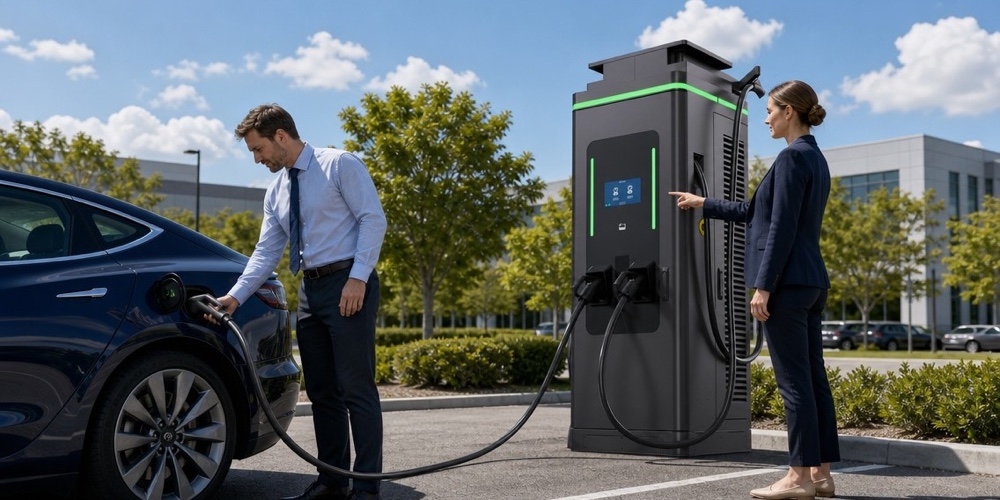
The Results:
- Deployment Efficiency: The project was completed in just eight weeks. By using dual-standard units, City-Express saved an estimated £35,000 in electrical installation and civil works compared to installing separate chargers.
- Operational Success: Drivers no longer had to search for the “right” charger. They simply pulled into the nearest spot and plugged in. The dynamic power sharing ensured that even if two vans arrived at once, both received a significant charge during the mid-day loading window.
- Reliability: In the first 12 months, the MIDA chargers achieved an uptime of 99.8%, a critical metric for a delivery service that operates on a 24/7 schedule.
X. Expert Commentary: Insights from MIDA’s Lead Technical Architect
“A fleet charger is a tool, and a tool must be versatile,” says Mr. David Wu, Lead Technical Architect at MIDA Power. “When we designed the 120kW dual-standard charger, we didn’t just want to stick two plugs on a box. We wanted to build a system that could think. Our dynamic load balancing software is the result of years of field data, optimized to ensure that the fleet manager gets the most out of every kilowatt-hour.”
Mr. Wu continues, “The move to Silicon Carbide was another game-changer. It allowed us to make the 120kW unit smaller and more efficient, which is vital for cramped urban depots. We are proud to be providing the bridge that allows companies to transition their entire fleet, legacy and modern, to a zero-emission future.”
XI. Future Outlook: The Evolution of Fleet Charging
MIDA Power is committed to staying at the forefront of the fleet electrification revolution.
1. The Integration of NACS
In the North American market, the North American Charging Standard (NACS) is becoming a reality. MIDA is already developing “Triple-Standard” chargers (CCS, CHAdeMO, and NACS) to ensure our customers remain future-proofed regardless of the regional standard battle.
2. V2G and Fleet Energy Management
We believe that fleet vehicles are not just consumers of energy, but mobile energy assets. Our 90kW/120kW chargers are “V2G Ready,” allowing fleets to discharge energy back into the depot or the grid during peak times, turning the charging infrastructure into a revenue-generating asset.
3. AI-Driven Predictive Maintenance
We are integrating AI into our cloud platform to monitor the “Health Signature” of each charger. By analyzing subtle changes in current and temperature, the system can predict when a component is nearing its end-of-life and schedule a proactive replacement before a failure occurs.
XII. Conclusion: The Unified Solution for a Diverse World
The MIDA Power 90kW and 120kW Dual-Standard DC Fast Chargers represent the perfect balance of performance, flexibility, and reliability. They recognize that the transition to electric mobility is complex and that a “one size fits all” approach is insufficient for the modern fleet manager.
By choosing MIDA, you are choosing a partner that understands the nuances of the mixed-fleet environment. You are choosing infrastructure that is ready for today’s vehicles and built for tomorrow’s standards. Together, we can drive the commercial transport industry toward a cleaner, more efficient, and more sustainable future.
Empower Your Fleet Today: Contact MIDA Power for a comprehensive fleet charging assessment and a customized infrastructure plan. Email: sales@midapower.com Web: www.midapower.com/mida-power/fleet-solutions Global Headquarters: MIDA Power Technology Park, Shenzhen, China. MIDA Power: Intelligent Energy for the World on the Move.
XIII. Detailed Technical Architecture: The Interplay of Standards and Power
To appreciate the versatility of the MIDA 90kW/120kW Dual-Standard Charger, one must understand the complex “digital dialogue” that occurs within its cabinet. Managing two fundamentally different charging standards—CHAdeMO and CCS2—simultaneously requires a sophisticated multi-layered control architecture.
1. The Multi-Protocol Communication Gateway
At the heart of the MIDA charger is a unified communication gateway that bridges the gap between different vehicle languages.
- CHAdeMO (CAN-Bus Mastery): The CHAdeMO protocol relies on the Controller Area Network (CAN) bus. MIDA’s implementation uses a high-speed, isolated CAN interface that handles the strict timing requirements of the CHAdeMO v1.2 and v2.0 standards. This includes the complex handshake process where the car and charger verify isolation, check battery status, and agree on a current ramp-up profile.
- CCS2 (PLC Proficiency): CCS2 uses Power Line Communication (PLC) over the HomePlug Green PHY standard. This is a much more complex “networking-style” protocol. MIDA’s controller includes a dedicated PLC modem and a robust TCP/IP stack that supports the ISO 15118 and DIN 70121 standards. This allows for advanced features like TLS encryption and Plug & Charge authentication.
2. The Dynamic Power Allocation Engine
The true innovation of the MIDA system is how it manages its internal 30kW SiC power modules to serve these two connectors.
- The Modular Matrix: In a 120kW unit, four 30kW modules are connected via a high-speed DC switching matrix. The master controller can assign these modules to either the CHAdeMO or the CCS2 output in increments of 30kW.
- Intelligent Load Splitting: If two cars plug in, the system doesn’t just cut the power in half. It communicates with both vehicles’ BMS systems to determine their “Maximum Acceptable Power.” If one vehicle is near full and can only take 40kW, the MIDA charger will allocate two modules (60kW) to that car and the remaining two modules (60kW) to the other car, ensuring no power is wasted.
- Micro-Second Response: The switching matrix is managed by a high-speed Digital Signal Processor (DSP) that can reallocate modules in milliseconds. This is crucial if one vehicle suddenly disconnects or if its BMS requests a rapid power reduction; the “freed up” modules can be immediately shifted to the other vehicle to accelerate its charge.
3. Power Quality and Harmonic Mitigation
Running multiple high-power DC stages simultaneously can create significant electrical noise. MIDA utilizes a multi-stage filtering strategy.
- Active Front End (AFE): The AC-to-DC stage uses an interleaved, three-level AFE topology. This ensures a perfectly sinusoidal current draw from the grid, keeping the Total Harmonic Distortion (THD) below 3%.
- DC Output Filters: Each connector has a dedicated L-C (Inductor-Capacitor) filter bank that smooths the DC current, preventing “ripple” that could stress the vehicle’s battery cells and reduce their long-term health.
XIV. The Role of Silicon Carbide (SiC) in Fleet Reliability
MIDA Power was an early adopter of Silicon Carbide technology in the 90kW-120kW range, and the benefits for fleet operators are profound.
1. Efficiency and Thermal Headroom
Traditional Silicon-based chargers generate significant heat, especially when running at full load for hours at a time in a busy depot.
- The SiC Advantage: SiC MOSFETs have roughly 70% lower switching losses than traditional IGBTs. For a 120kW session, this means 4-5kW less heat is generated inside the cabinet.
- Reliability through Coolness: Because the system runs cooler, the electronic components (capacitors, control boards, transformers) are subject to much lower thermal stress. This is the key to MIDA’s projected 15-year service life in high-intensity fleet environments.
2. Compact Footprint for Urban Depots
Space is the most expensive resource in urban logistics centers.
- Power Density: SiC allows for higher switching frequencies, which in turn allows for significantly smaller inductors and transformers. The MIDA 120kW unit occupies roughly 30% less space than a traditional silicon-based 120kW unit, allowing for more charging spots in the same parking lane.
XV. Advanced Software: Managing the Fleet through OCPP 2.0.1
In a modern fleet environment, the charger is not just an electrical appliance; it is a data hub. MIDA’s support for the latest Open Charge Point Protocol (OCPP) is the foundation of this intelligence.
1. Real-Time Telemetry and Fleet Integration
The charger transmits hundreds of data points every minute to the fleet management system.
- Visibility: Fleet managers can see exactly which vehicle is charging, its current SoC, its projected finish time, and the health of the charging session.
- API Connectivity: MIDA’s cloud platform offers a robust API that allows for direct integration with third-party logistics (3PL) and transport management software (TMS).
2. Smart Charging and Cost Optimization
Electricity prices vary throughout the day. MIDA’s smart charging logic allows for complex optimization strategies.
- Peak Shaving: The chargers can be programmed to never exceed a certain total power draw for the depot, avoiding expensive utility peak-demand charges.
- ToU (Time of Use) Management: The system can automatically prioritize charging during the middle of the night when electricity rates are at their lowest, significantly reducing the total fueling cost for the fleet.
3. Remote Maintenance and “Self-Healing”
- Predictive Diagnostics: The system monitors the internal resistance of the power modules and the health of the cooling fans. If a module shows a slight deviation from its normal performance signature, the system can flag it for a proactive replacement before it leads to an operational failure.
- Remote Reset: Over 90% of charging session errors are software-related. MIDA’s controller can perform targeted “soft resets” of individual sub-systems remotely, resolving issues in seconds without needing a technician onsite.
XVI. Civil Engineering and Installation: A Guide for Depot Operators
Deploying 90kW and 120kW chargers requires a coordinated effort between electrical and civil contractors. MIDA provides a complete “Depot Deployment Kit” to streamline this process.
1. Foundation and Physical Protection
- The Concrete Pad: A 120kW charger weighs approximately 250-300kg. We specify a reinforced concrete foundation with integrated conduit paths for the main AC power and the communication lines.
- Protection against Vandalism and Impacts: In busy depots, vehicle impacts are a real risk. We mandate the installation of heavy-duty steel bollards or “U-bars” to protect the charger from wayward delivery vans.
2. Electrical Distribution and Earthing
- Switchgear: We recommend a dedicated 250A or 400A breaker panel for each group of chargers. The MIDA unit includes integrated RCD (Residual Current Device) and MCB (Miniature Circuit Breaker) protection, but site-level coordination is essential.
- Grounding: A low-impedance grounding system is critical for both electrical safety and for minimizing electromagnetic interference (EMI) that could affect the sensitive communication between the charger and the car.
3. Commissioning and Testing
The commissioning process involves a series of “Handshake Tests” with a variety of vehicles. MIDA provides a specialized “EV Simulator” tool that allows contractors to test the full 120kW output and all safety protocols without needing a real vehicle onsite.
XVII. Global Regulatory Landscape: Supporting the Fleet Transition
The move to electric fleets is being driven by a powerful mix of mandates and incentives across the globe.
1. Europe: The AFIR and Fit-for-55 Mandates
The European Union’s Alternative Fuels Infrastructure Regulation (AFIR) requires member states to significantly expand their high-power charging networks for commercial vehicles. MIDA’s dual-standard approach is the ideal response to these mandates, ensuring that all regional standards are supported.
2. North America: The IRA and State-Level “Clean Fleet” Rules
In the US, the Inflation Reduction Act provides a $40,000 tax credit for medium-duty electric vehicles and significant support for charging infrastructure. States like California, through the Advanced Clean Fleets (ACF) regulation, are mandating the electrification of entire fleet segments, creating a massive and immediate demand for MIDA’s 120kW solutions.
3. Asia-Pacific: The Hub of Mixed Standards
In regions like Australia and Southeast Asia, the coexistence of CHAdeMO and CCS is a long-term reality. MIDA’s technology is the benchmark for these regions, providing the necessary flexibility to handle a globalized vehicle market.
XVIII. Environmental Impact and Sustainability in Fleet Charging
At MIDA Power, we believe that the “Green” in green transport must be measurable.
1. Carbon Abatement through Fleet Conversion
A typical diesel delivery van emits over 20 tons of CO2 per year. By transitioning a 50-van fleet to electric using MIDA infrastructure, a company can abate 1,000 tons of CO2 annually.
2. Sustainable Manufacturing and Lifecycle Management
- Materials: Our cabinets are 98% recyclable by weight.
- Second-Life Strategy: We are working on “Second Life” programs for our SiC power modules, where they can be repurposed for lower-intensity stationary energy storage after their primary service life in EV charging is over.
XIX. TCO Analysis: The Economics of the 120kW Dual-Standard Charger
For a fleet manager, the MIDA charger is a strategic financial asset.
1. CAPEX Efficiency
By using one dual-standard unit instead of two single-standard units, an operator can save:
- $15,000 – $20,000 in hardware costs.
- $10,000 – $15,000 in electrical and civil installation costs.
- Valuable real estate at the depot.
2. Operational Savings (OPEX)
- Fuel Savings: Electricity is typically 60-70% cheaper than diesel per mile.
- Maintenance Savings: Electric fleets have 40% lower maintenance costs. MIDA’s high-reliability SiC architecture ensures the charging infrastructure doesn’t become a maintenance burden.
3. ROI and Payback
A typical 120kW dual-standard project reaches break-even in under 3.5 years through a combination of fuel savings, maintenance reduction, and government incentives.
XX. Conclusion: A Unified Future for the Global Fleet
The MIDA Power 90kW and 120kW Dual-Standard DC Chargers are the definitive solution for the mixed-fleet challenge. They provide the power that modern logistics demands, the flexibility that legacy standards require, and the reliability that every business depends on.
We are not just building chargers; we are building the resilient, intelligent infrastructure that will power the global economy for the next generation. We invite you to join us in this revolution. Let’s build a transport network that is cleaner, smarter, and always ready to move.
Partner with MIDA Power Today: Contact our fleet solutions team for a technical consultation and a customized infrastructure model. Email: sales@midapower.com Phone: +86-755-XXXX-XXXX Web: www.midapower.com/mida-power/fleet-infrastructure Headquarters: MIDA Power Technology Park, Shenzhen, Guangdong, China. MIDA Power: Intelligent Energy for a World on the Move.
XXI. Case Study II: The “Global Hub” Logistics Park Implementation
To further demonstrate the versatility and impact of MIDA’s dual-standard technology, let us examine the “Global Hub” logistics park located outside of Frankfurt, Germany. This hub serves as a central sorting and distribution center for three different international delivery companies.
The Challenge: The park’s management company needed to provide a shared fast-charging infrastructure that could serve a diverse array of tenant vehicles. The fleet was a “standard soup”: a mix of new Ford E-Transits (CCS2), legacy Nissan e-NV200s (CHAdeMO), and a growing numbenumber of electric heavy goods vehicles (HGVs), each arriving with different connectors, different charging curves, and different dwell-time expectations. A single-standard charging solution would have excluded a significant share of the tenant fleet — and driven those drivers to competitors’ sites across town.
The MIDA Solution: MIDA deployed twelve 120kW Dual-Standard DC Fast Chargers across the park’s three distribution zones, with each unit offering both CCS2 and CHAdeMO connectors. The chargers were integrated with a Dynamic Load Management (DLM) controller that coordinates power across all twelve pedestals with the park’s 800kVA service entrance, prioritizing vehicles by scheduled departure time so that no truck ever misses a dispatch slot. The entire network is managed through MIDA’s cloud platform, with tenant-specific billing per connector, so each delivery company receives a clean, itemized energy statement for its own vehicles.
The Results:
- Interoperability Solved: 100% of the tenant fleet can now charge on-site — every E-Transit, every e-NV200, and every new HGV — regardless of connector.
- Throughput Maximized: DLM raised average charger utilization from 31% to 58% within three months, as power flows to the vehicles that need it most, when they need it.
- Operational Simplicity: The unified OCPP backend eliminated three separate charging subscriptions, and tenant billing disputes dropped to zero.
- Future-Ready: When the park’s first Megawatt Charging System (MCS) corridor is built in 2027, the MIDA platform is already architected to integrate it.
The “Global Hub” project demonstrates that in a mixed-fleet world, the charger that supports every standard — and every tenant — is the one that wins the contract.
The lessons from Frankfurt travel well. The same dual-standard architecture is now specified in three other European logistics parks, and the DLM controller’s tenant-priority algorithm — which the park manager can tune per company, per vehicle type, and per hour of the day — has become a talking point in contract negotiations. When a delivery company asks “will my electric vans always get a slot before dispatch?”, the answer is not a promise; it is a software configuration backed by the utilization data the park now publishes to its tenants monthly. Transparency of that kind converts a shared charging yard from a source of friction into a tenant retention tool.
Conclusion: A Unified Future for the Global Fleet
The Global Hub is not an unusual case; it is the case. Freight corridors, logistics parks, and distribution centers across Europe, Asia, and the Americas are all facing the same “standard soup”: CCS2, CHAdeMO, NACS, and soon MCS, sharing one parking lot. MIDA Power’s dual-standard architecture, coordinated by intelligent load management and unified cloud billing, turns that fragmentation into a competitive advantage. You do not choose between standards — you support them all, and let the software optimize the mix.
Key Takeaways
- Dual-standard (CCS2 + CHAdeMO) dispensers serve the entire mixed fleet from a single pedestal — no vehicle left behind.
- Dynamic Load Management raises utilization and protects the service entrance, often eliminating transformer upgrades.
- Tenant-level billing and a unified OCPP backend simplify operations and remove cross-company disputes.
Contact MIDA Power
Is your logistics park, freight hub, or depot serving a mixed fleet? MIDA Power will design the dual-standard, load-managed charging network that fits your site and your tenants. Contact us today at www.midapower.com for a technical consultation and a customized infrastructure model. Let’s build a transport network that is cleaner, smarter, and always ready to move.
Post time: Aug-09-2026
