
 Portable EV Charger
 Home EV Wallbox
 DC Charger Station
 BESS Charging Station
 V2G V2H V2V V2L
 EV Charging Module
 DC Charging Connector
 EV Accessories
Navigating the 800V Era: How MIDA’s 1000V High-Voltage Chargers Future-Proof Your Infrastructure Investment
The Paradigm Shift: From 400V to 800V and Beyond
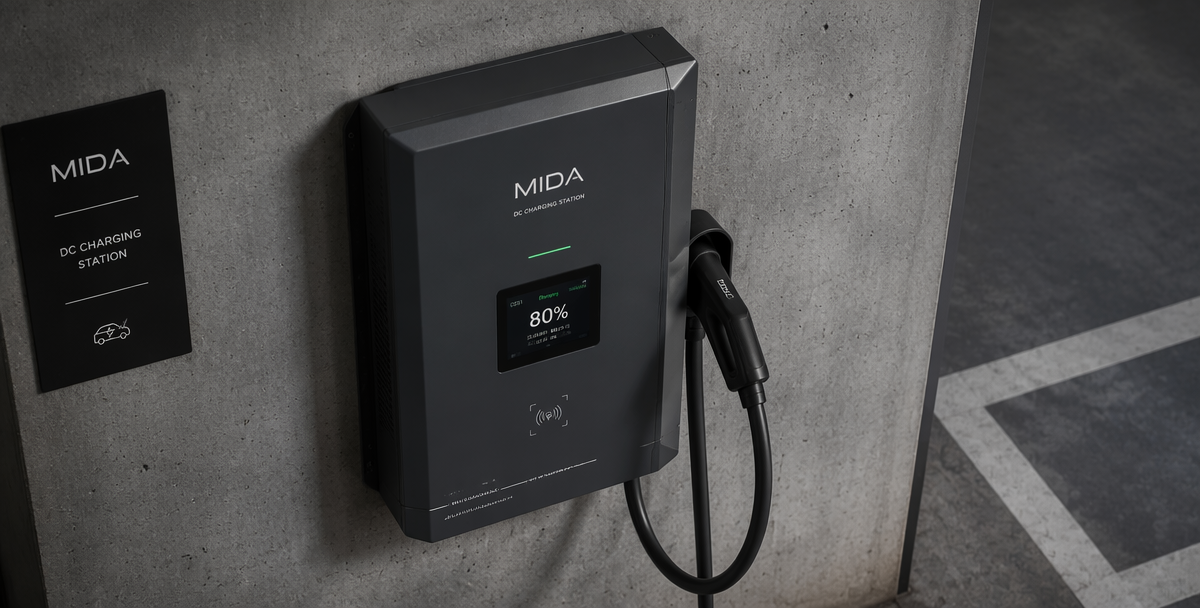
For the better part of the last decade, the electric vehicle (EV) industry has operated on a 400V battery architecture. This was a logical starting point, balancing performance with the costs of power electronics. However, we have reached the limits of 400V systems. To achieve the “10-minute charge” that consumers demand, automakers are rapidly pivoting toward 800V and 1000V architectures. Brands like Porsche, Hyundai, Kia, and Lucid have already launched high-voltage platforms, and the commercial trucking industry is following suit. MIDA New Energy’s 40kW-80kW wall-mounted DC chargers are designed to be the bridge to this high-voltage future.
1. The Physics of Speed: Why Higher Voltage Wins
To understand why the industry is moving to 800V/1000V, we must look at the fundamental formula for power: Power (Watts) = Voltage (Volts) × Current (Amperes).
1.1 The I²R Heat Problem
- The Challenge: In a 400V system, to deliver 80kW of power, the charger must push 200 Amps of current. Heat generated in a conductor is proportional to the square of the current (P = I²R). High current generates significant heat, requiring thick, heavy, liquid-cooled cables that are expensive and difficult for users to handle.
- The High-Voltage Solution: By increasing the voltage to 800V, the same 80kW of power can be delivered with only 100 Amps of current. This leads to lighter, more flexible cables, less energy waste, and significantly lower thermal stress on the vehicle’s battery cells and the charger’s internal circuitry.
- System Efficiency: 800V systems can achieve up to 30% reduction in charging losses compared to 400V systems at the same power level.
1.2 MIDA’s 1000V Ceiling: Beyond 800V
While “800V” is the buzzword, many vehicles operate at voltages between 700V and 920V. MIDA chargers are designed with a 1000V output limit, providing a critical safety margin and ensuring compatibility even as next-generation batteries push past the 800V mark into the 900V+ territory.
2. The 1000V Wide-Voltage Advantage: One Charger for All
The biggest risk for an infrastructure investor is “obsolescence.” A charger installed today that can only output 500V will be unable to charge an 800V vehicle at its native speed, or in some cases, at all.
2.1 The “Universal” Charging Curve
MIDA’s WY series features an ultra-wide output range from 150V to 1000V.
- Low Voltage (150V-400V): Perfect for older EVs (like the early Nissan Leaf), electric motorcycles, and small urban delivery vans.
- High Voltage (400V-1000V): Ideal for the latest luxury sedans (Porsche Taycan, Lucid Air, Audi e-tron GT) and high-performance platforms (Hyundai E-GMP, Kia EV6).
- Constant Power Region: The MIDA UR100060A module maintains its full 60kW output from 300V to 1000V. This means a car with a 400V battery gets 60kW, and a car with an 800V battery also gets 60kW. Traditional chargers often see their power halved when charging lower-voltage batteries.
3. SiC (Silicon Carbide): The Engine of High-Voltage Efficiency
Delivering 1000V from a compact wall-mounted unit is an engineering challenge that traditional silicon-based electronics could not meet. MIDA has solved this by integrating Silicon Carbide (SiC) semiconductors.
3.1 Wide Bandgap (WBG) Physics
SiC is a wide-bandgap material, meaning it has a much higher dielectric breakdown strength than silicon.
- Size Reduction: SiC allows for much smaller power modules. The UR100060 is 50% smaller than an equivalent silicon-based module.
- Switching Efficiency: SiC reduces switching losses by up to 80%. This is crucial at high voltages where switching losses normally dominate the efficiency profile.
- Peak Performance: The SiC-based MIDA charger maintains >95% efficiency even when operating at the edge of its 1000V envelope.
4. Connectivity and Protocol Longevity: NACS, CCS, and ISO 15118
Future-proofing isn’t just about voltage; it’s about communication.
4.1 The Connector Wars: NACS vs. CCS
The charging landscape is shifting.
- NACS (North American Charging Standard): Tesla’s standard is now being adopted by Ford, GM, and Rivian. MIDA offers factory-integrated NACS cables with native support for the Tesla communication protocol.
- CCS1 & CCS2: The global standards for North America and Europe. MIDA’s modular connector design allows the cables to be swapped if the local market standard shifts, protecting the underlying power cabinet investment.
- Dynamic Switching: MIDA’s controller can detect whether it is talking to a CCS or NACS vehicle and switch protocols automatically.
4.2 ISO 15118-20: Plug & Charge and Beyond
MIDA’s hardware is ready for the latest ISO 15118-20 standard.
- Plug & Charge: No more RFID cards. The car identifies itself to the charger, handles the security handshake, and bills the owner’s account automatically.
- Advanced Security: ISO 15118-20 uses TLS 1.3 encryption, ensuring that the communication between the car and the charger (which includes payment data) is hacker-proof.
5. V2X: The Bidirectional Future of High-Voltage Energy
The 800V era will also be the era of the “Mobile Battery.” Vehicles will not just take power; they will give it back.
5.1 Bidirectional Energy Flow
With optional bidirectional power modules, MIDA wall-mounted units can support:
- V2G (Vehicle-to-Grid): Helping utilities balance the grid during peak loads by pulling energy from parked EVs.
- V2B/V2H (Vehicle-to-Building/Home): Using an electric truck to power an office building during a blackout or to reduce energy costs by using stored solar power at night.
- High-Voltage Advantage in V2X: Discharging an 800V battery is significantly more efficient than discharging a 400V battery, as the conversion losses are lower.
6. Strategic Advice for Infrastructure Investors
If you are planning an EV charging project today, follow these three rules to protect your investment:
- Never buy 500V-limited hardware. It is the equivalent of buying a 3G phone in a 5G world. Within 3-5 years, 800V will be the mainstream standard.
- Prioritize Power Density. As real estate costs rise, the ability to mount a powerful 80kW unit on a wall (rather than a floor cabinet) is a massive competitive advantage.
- Ensure Modularity. Choose systems like MIDA where power modules can be easily upgraded or replaced. The WY series is designed for a 15-year service life with modular swappable components.
7. Conclusion: Leading the 800V Revolution
The move to high-voltage EV charging is not a trend; it is a fundamental shift in the physics of mobility. MIDA New Energy’s 1000V-capable wall-mounted DC chargers are the definitive solution for this new era. By combining high-voltage capability with SiC efficiency and modular design, MIDA provides the tools that businesses and fleet operators need to invest with confidence. Don’t just build for today’s cars; build for the cars of the next decade. Navigate the 800V era with MIDA.
Post time: Jul-28-2026
