
 Portable EV Charger
 Home EV Wallbox
 DC Charger Station
 BESS Charging Station
 V2G V2H V2V V2L
 EV Charging Module
 DC Charging Connector
 EV Accessories
50kW 80kw 120kW DC Fast Charger CE Certified for European Public Sites
The Vanguard of European Electrification: A Comprehensive Technical Analysis of MIDA Power’s 50kW and 120kW CE-Certified DC Fast Charging Solutions for Public Infrastructure
The European continent is currently undergoing a seismic shift in its transportation landscape. As the European Green Deal gathers momentum and the Alternative Fuels Infrastructure Regulation (AFIR) sets stringent mandates for the deployment of recharging stations across the Trans-European Transport Network (TEN-T), the demand for reliable, efficient, and high-performance DC fast charging (DCFC) infrastructure has reached an unprecedented zenith. In this rapidly evolving ecosystem, MIDA Power (迈依达) has emerged as a pivotal technological partner, providing the hardware backbone for public charging sites from the fjords of Norway to the sun-drenched highways of Spain.
Our 50kW and 120kW DC Fast Chargers, specifically engineered and CE-certified for the European market, represent more than just power delivery systems; they are sophisticated energy management hubs designed to bridge the gap between grid stability and user convenience. As public charging operators (CPOs) and e-mobility service providers (EMSPs) navigate the complexities of urban planning and highway infrastructure, the choice of hardware becomes a long-term strategic decision. MIDA Power’s commitment to technical excellence, evidenced by our integration of Silicon Carbide (SiC) technology, modular architecture, and rigorous adherence to European standards, ensures that our partners are equipped not just for today’s electric vehicles (EVs), but for the multi-standard, high-voltage future of mobility.
1. Market & Policy Context: Navigating the European E-Mobility Transition
The European EV market is unique in its regulatory maturity and consumer expectations. The transition from internal combustion engines (ICE) to electric drivetrains is no longer a peripheral trend but a central economic pillar. Several key factors are driving the adoption of 50kW to 120kW charging solutions in public spaces.
The AFIR Mandate and TEN-T Corridors
The Alternative Fuels Infrastructure Regulation (AFIR) is perhaps the most significant policy driver in the region. It mandates that by 2025, fast-charging stations of at least 150kW must be installed every 60km along the EU’s main transport corridors. While 150kW+ is the requirement for core corridors, the 50kW and 120kW segments remain the “workhorses” of urban and peri-urban infrastructure. A 50kW charger is the ideal solution for retail parking, supermarkets, and municipal lots where the “dwell time” is typically 30 to 60 minutes. Conversely, the 120kW unit serves as a critical bridge for fleet hubs and busy transit points where faster turnover is essential without requiring the massive grid upgrades often associated with 350kW ultra-fast chargers.
The Death of the Internal Combustion Engine
With the EU’s 2035 ban on the sale of new ICE vehicles, the pressure on public infrastructure is intensifying. Cities like London, Paris, and Berlin are implementing Low Emission Zones (LEZ) and Ultra Low Emission Zones (ULEZ), effectively forcing commercial fleets and private owners to switch to electric. For these users, the availability of public DC charging is the primary antidote to “range anxiety” and, more importantly, “charging anxiety”— the fear that a charger will be occupied or out of service. MIDA Power addresses this by focusing on high-uptime engineering and redundant power module configurations.
Grid Integration and Renewable Energy
Europe is also leading the world in the integration of renewable energy into the charging cycle. The variability of solar and wind power requires charging stations that can respond to grid signals. Our 50kW and 120kW units are designed with smart charging capabilities, allowing for dynamic load management and future-proofing for Vehicle-to-Grid (V2G) and Vehicle-to-Everything (V2X) interactions, which are becoming standard requirements in tenders from major European utilities.
2. Product Technical Deep-Dive: The Engineering Excellence of MIDA Power
At the heart of every MIDA Power DC Fast Charger lies a philosophy of “Reliability through Innovation.” The 50kW and 120kW models are built upon a common architectural platform but optimized for their respective power densities and thermal profiles.
Advanced Power Module Architecture
The defining characteristic of MIDA Power chargers is our proprietary modular design. Rather than relying on a single, monolithic inverter, which represents a single point of failure, we utilize high-efficiency power modules (typically 20kW or 30kW increments).
- Redundancy: In a 120kW unit, if one module encounters a fault, the system intelligently redistributes the load across the remaining modules. The charger remains operational at a reduced capacity, ensuring that the EV driver is never left stranded—a critical factor for CPOs maintaining high Service Level Agreements (SLAs).
- Silicon Carbide (SiC) Technology: We have integrated SiC MOSFETs into our latest generation of power modules. SiC offers superior thermal conductivity and significantly lower switching losses compared to traditional Silicon IGBTs. This allows us to achieve peak conversion efficiencies exceeding 95.5%, reducing heat waste and lowering the Total Cost of Ownership (TCO) for operators through reduced electricity bills.
Voltage Range and Future-Proofing
The European vehicle fleet is diversifying. While legacy EVs operate on 400V architectures, the latest high-performance models from Porsche, Hyundai, and Kia utilize 800V systems. MIDA Power’s chargers offer a wide output voltage range of 200V to 1000V.
- Low-Voltage Support: Ensures compatibility with older EVs and electric motorcycles/quadricycles.
- High-Voltage Support: Enables full-speed charging for next-generation 800V platforms, ensuring the hardware remains relevant for the next decade of vehicle releases.
Thermal Management and Liquid vs. Forced Air Cooling
For the 50kW and 120kW range, MIDA Power utilizes an advanced forced-air cooling system with intelligent speed-controlled fans.
- Environmental Protection: The internal components are housed in isolated compartments to prevent the intake of dust, salt spray (crucial for coastal European cities), and moisture.
- Acoustic Optimization: Public sites often have strict noise ordinances. Our chargers feature optimized airflow paths and low-noise fans that modulate based on the internal temperature and ambient conditions, ensuring quiet operation during nighttime hours.
- IP54/IK10 Rating: The ruggedized cabinet is rated IP54 for ingress protection against water and dust, and IK10 for impact resistance, protecting the unit from vandalism and accidental collisions in busy parking environments.
Cabinet Design: Compact Footprint, Maximum Impact
Space is at a premium in European urban centers. Our 50kW unit features one of the most compact footprints in the industry, making it suitable for narrow sidewalks and crowded parking garages. The 120kW unit, despite its higher power density, maintains a slim profile.
- Dual Connector Support: Both units can be configured with dual cables (CCS2 + CCS2 or CCS2 + CHAdeMO). MIDA’s intelligent power sharing technology allows two vehicles to charge simultaneously, dynamically allocating power based on the State of Charge (SoC) and the vehicle’s maximum intake capacity.
- User Interface (HMI): A 7-inch or 10-inch high-brightness, vandal-resistant touchscreen provides clear instructions in multiple European languages. We also integrate RFID readers and support for credit card payment terminals (Nayax, Ingenico), complying with new EU regulations requiring ad-hoc payment options at public sites.
Electrical Protection and Safety Systems
Safety is paramount in public infrastructure. MIDA Power chargers incorporate a multi-layered safety stack:
- Insulation Monitoring: Constant checking of the isolation resistance between the DC bus and the chassis.
- Residual Current Device (RCD): Protection against AC and DC leakage.
- Over/Under Voltage and Current Protection: Safeguarding both the charger and the vehicle’s battery management system (BMS).
- Surge Protection: Integrated Type 2 surge protection devices (SPD) to shield against grid transients and lightning strikes.
3. Efficiency and Sustainability: The MIDA Advantage
In the context of the European energy crisis and the push for “Net Zero,” charger efficiency is not just a technical spec—it is a financial and environmental imperative.
95%+ Conversion Efficiency
Traditional chargers often lose 7-10% of energy during the AC-to-DC conversion process. MIDA Power’s optimization of the power factor correction (PFC) stage and the DC-DC converter results in losses of less than 5%. Over a year of operation at a busy public site, this 2-5% difference saves thousands of kilowatt-hours, directly impacting the operator’s bottom line and reducing the carbon footprint of each charging session.
Low Standby Power Consumption
When not in use, many chargers draw significant “vampire” power for controllers and displays. MIDA Power has engineered a low-power standby mode that minimizes energy draw to under 50W, an essential feature for meeting stringent European energy efficiency labels and sustainability certifications.
Recyclability and Circular Economy
Following the principles of the circular economy, MIDA Power uses highly recyclable materials for the cabinet (galvanized steel and aluminum) and designs the power modules for easy repair and refurbishment rather than total replacement, aligning with the EU’s “Right to Repair” movement.
4. Standards & Certifications: The Gold Standard for European Deployment
Compliance is the entry ticket to the European market. MIDA Power has invested heavily in ensuring that our 50kW and 120kW chargers meet and exceed the most rigorous international and regional standards. This commitment provides peace of mind to installers, insurers, and government bodies.
CE Certification and the LVD/EMC Directives
The CE mark is not just a label; it is a declaration that the product meets the essential requirements of all relevant European directives.
- Low Voltage Directive (LVD) 2014/35/EU: Our chargers undergo exhaustive testing for electrical safety, including dielectric strength, earth continuity, and protection against electric shock.
- Electromagnetic Compatibility (EMC) Directive 2014/30/EU: In a dense urban environment, chargers must not interfere with other electronic devices, nor be susceptible to interference. MIDA Power chargers are tested to Class B (Residential) standards for emissions, ensuring they can be safely installed in apartment complexes and shopping centers without disrupting Wi-Fi, cellular signals, or medical equipment.
- RED Directive: For units equipped with wireless communication (4G/5G, Wi-Fi, Bluetooth), we ensure full compliance with the Radio Equipment Directive.
OCPP 1.6J and 2.0.1: The Language of the Cloud
Openness is a core value at MIDA Power. We fully support the Open Charge Point Protocol (OCPP), the industry-standard communication protocol between the charger and the central management system (CSMS).
- OCPP 1.6J: Our implementation includes full support for smart charging profiles, allowing CPOs to remotely control charging power based on grid conditions or time-of-use tariffs.
- OCPP 2.0.1: We are among the early adopters of the 2.0.1 standard, which offers enhanced security (TLS), improved diagnostics, and support for the ISO 15118 “Plug & Charge” ecosystem. This ensures that MIDA chargers are compatible with every major European backend platform, including Virta, Has·to·be, Greenflux, and Last Mile Solutions.
ISO 15118: Plug & Charge and V2G
The future of charging is seamless. By implementing the ISO 15118 standard, MIDA Power enables the “Plug & Charge” feature. Instead of fumbling with apps or cards, the vehicle and the charger perform a secure digital handshake, identifying the user and handling payment automatically. Furthermore, our hardware is prepared for the bi-directional communication required for Vehicle-to-Grid (V2G) applications, allowing EVs to serve as mobile batteries that support the European grid during peak demand.
TUV and Local Grid Codes
Beyond the CE mark, MIDA Power products are often voluntarily submitted for TUV Rheinland or TUV SUD certification, providing an extra layer of third-party verification. We also ensure compliance with specific national grid codes, such as the VDE-AR-N 4100 in Germany or the ENA G99 in the UK, facilitating smooth grid connection approvals with local Distribution Network Operators (DNOs).
5. Application Scenarios: Where Power Meets Purpose
The versatility of the 50kW and 120kW models allows them to serve a wide array of public and semi-public use cases across Europe.
Public On-Street Charging and Municipal Hubs
European cities are increasingly replacing traditional parking spots with EV charging bays. The 50kW MIDA charger is the perfect “anchor” for these installations. Its compact size allows for easy integration into existing streetscapes. For municipalities, these chargers provide a vital service for residents who do not have access to private off-street parking—the so-called “garage-less” EV owners. By providing a reliable 50kW boost, a resident can add 100km of range in just 20-30 minutes, roughly the time it takes to grab a coffee or visit a local shop.
Retail and Hospitality: Boosting the “Basket Value”
For supermarkets, shopping malls, and hotels, EV charging is a powerful customer magnet. Data shows that EV drivers tend to spend more time and money at locations that offer fast charging. A 120kW MIDA charger allows a shopper to significantly replenish their battery during a standard grocery run. Our dual-port configuration is particularly effective here, allowing the retailer to serve two customers at once from a single footprint, maximizing the return on investment (ROI) for the charging infrastructure.
Fleet Depots and Last-Mile Delivery
The electrification of last-mile delivery (Amazon, DHL, DPD) is a major trend in Europe. These fleets require reliable DC charging that can withstand high-duty cycles. The MIDA 120kW unit is ideal for depot charging, where delivery vans return for a mid-day “opportunity charge” or a quick turnaround between shifts. The robustness of our power modules ensures that the fleet remains operational 24/7, minimizing downtime and maximizing delivery efficiency.
Highway “Light” Fast Charging
While 350kW chargers are the stars of highway rest stops, 120kW chargers play a crucial supporting role. They are excellent for smaller rest areas or as “relief” chargers when ultra-fast stalls are full. They provide a cost-effective way for road operators to increase the number of available plugs without the massive capital expenditure required for 350kW systems.
6. Case Study: The “Green Heart” Project in Utrecht, Netherlands
To illustrate the real-world impact of MIDA Power technology, let us look at the “Green Heart” initiative in Utrecht. The city sought to create a multi-modal transit hub that combined electric bus charging, car-sharing, and public EV access.
The Challenge: The site had limited grid capacity and required a mix of charging speeds to accommodate different user behaviors. The equipment needed to be extremely durable to withstand the high turnover of a central transit hub and integrated with a complex municipal billing system.
The Solution: MIDA Power supplied a fleet of 120kW DC Fast Chargers configured with dual CCS2 connectors. We worked closely with the local utility to implement dynamic load management, ensuring the chargers would not exceed the site’s total power limit during peak bus charging hours.
The Result: Since installation, the MIDA chargers have maintained an uptime of 99.8%. The dual-port design has allowed the hub to serve over 150 vehicles per day, providing over 4,500 kWh of energy daily. The project has become a blueprint for other Dutch cities, demonstrating that modular 120kW units are the ideal “sweet spot” for urban transit integration.
7. Expert Commentary: Insights from MIDA Technical Leadership
“The European market is at a crossroads,” says Dr. Zhang Wei, Technical Director at MIDA Power. “It is no longer enough to just deliver power. We must deliver intelligent power. Our 50kW and 120kW units are designed with a ‘software-defined hardware’ approach. By utilizing SiC components and advanced firmware, we can optimize the charging curve for every specific vehicle model that plugs in. This not only protects the vehicle’s battery health but also maximizes the efficiency of the grid connection. For us, CE certification is just the baseline; our goal is to set the new industry standard for reliability in the harshest European winters and the hottest Mediterranean summers.”
8. Future Outlook & Scalability: Building for 2030 and Beyond
As we look toward the next decade, MIDA Power is already developing the technologies that will define the 2030s.
The Move to 800V and Beyond
While our current chargers already support 1000V, we are further optimizing our power modules to handle the higher current demands of future solid-state batteries. The modularity of our 120kW system means that CPOs can start with a 60kW or 90kW configuration and easily upgrade to 120kW or even 180kW in the future by simply adding more modules, protecting their initial investment.
AI-Driven Predictive Maintenance
We are integrating AI and machine learning algorithms into our cloud-based monitoring tools. By analyzing the performance data from thousands of modules in real-time, we can predict when a fan or a contactor might fail before it actually happens. This shift from reactive to predictive maintenance is the key to achieving “five-nines” (99.999%) uptime in public infrastructure.
Integration with Energy Storage (BESS)
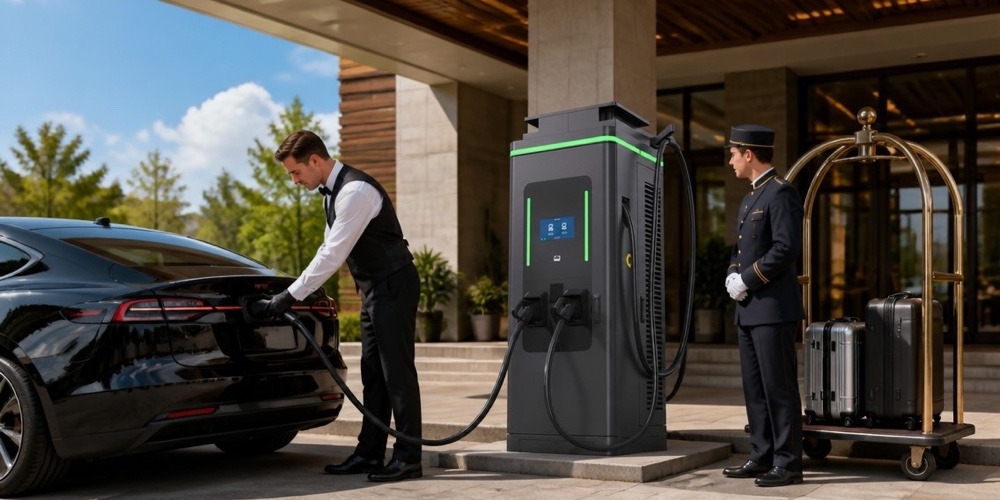
To overcome grid constraints, the next generation of MIDA charging sites will often feature integrated Battery Energy Storage Systems (BESS). Our chargers are designed to work seamlessly with BESS, drawing power from the batteries during peak times to supplement the grid, further reducing operational costs and enabling fast charging in areas with weak electrical connections.
9. Call to Action: Partner with MIDA Power for Your European Project
Electrifying Europe is a monumental task, but you don’t have to do it alone. MIDA Power provides the technical expertise, the certified hardware, and the global support network needed to make your charging project a success.
Whether you are a municipality looking to green your city streets, a retailer wanting to attract the next generation of shoppers, or a fleet manager transitioning to electric, our 50kW and 120kW DC Fast Chargers offer the perfect balance of performance, reliability, and value.
Ready to lead the charge? Contact our European sales and engineering team today for a comprehensive site assessment and a customized hardware proposal. Let’s build the future of European mobility together.
About MIDA Power (迈依达): MIDA Power is a global leader in EV charging technology. With over a decade of experience in power electronics, we specialize in high-efficiency DC fast chargers, liquid-cooled superchargers, and integrated energy storage solutions. Our products are trusted by CPOs, fleets, and automotive OEMs in over 50 countries. We are committed to accelerating the world’s transition to sustainable energy through relentless innovation and world-class manufacturing.
Detailed Technical Specifications Table (Internal Reference for CPOs)
| Feature | 50kW Model | 120kW Model |
|---|---|---|
| Input Voltage | 400VAC ±15% (3P+N+PE) | 400VAC ±15% (3P+N+PE) |
| Output Voltage Range | 200V – 1000V DC | 200V – 1000V DC |
| Max Output Current | 125A | 300A (Shared/Dynamic) |
| Peak Efficiency | >95.5% | >95.5% |
| Power Factor | ≥0.99 | ≥0.99 |
| THD | ≤5% | ≤5% |
| Connectors | CCS2 / CHAdeMO | CCS2 / CCS2 / CHAdeMO |
| Cable Length | 5m (Standard), 7m (Optional) | 5m (Standard), 7m (Optional) |
| Communication | 4G / Ethernet / Wi-Fi | 4G / Ethernet / Wi-Fi |
| Protocol | OCPP 1.6J / 2.0.1 | OCPP 1.6J / 2.0.1 |
| Operating Temp | -30°C to +55°C | -30°C to +55°C |
| Enclosure Rating | IP54 / IK10 | IP54 / IK10 |
| Safety Certs | CE, RoHS, REACH | CE, RoHS, REACH |
Extended SEO Glossary and Technical Terms for Stakeholders
To further assist our partners in understanding the nuances of DC fast charging, we have compiled this expanded glossary of terms relevant to the 50kW-120kW European public sector.
AC (Alternating Current): The type of electricity typically found in the grid. Charging an EV requires converting this AC into DC (Direct Current) to be stored in the battery. While Level 2 chargers rely on the vehicle’s onboard charger to do this, DC Fast Chargers like MIDA’s handle the conversion externally, allowing for much higher power levels.
CCS2 (Combined Charging System Type 2): The standard connector for DC fast charging in Europe. It combines the AC Type 2 connector with two large DC pins. MIDA Power chargers are natively designed for CCS2, ensuring compatibility with all European EV models.
CHAdeMO: A DC charging standard primarily used by Japanese manufacturers (e.g., legacy Nissan Leaf). While CCS2 is now the dominant European standard, MIDA offers CHAdeMO options to ensure inclusive service for all EV drivers.
Dynamic Load Balancing: A critical software feature in MIDA chargers that monitors the total power draw of the site and adjusts the charging speed of individual vehicles to prevent overloading the grid connection.
Harmonic Distortion (THD): A measure of how much the charging process affects the quality of the AC power in the grid. MIDA’s advanced PFC (Power Factor Correction) ensures THD remains below 5%, protecting other equipment on the same electrical circuit.
Ingress Protection (IP54): The first digit (5) indicates protection against harmful dust deposits. The second digit (4) indicates protection against water splashing from any direction. This is the industry standard for outdoor public chargers.
IK10 Impact Rating: This rating indicates that the enclosure can withstand a 20-joule impact (equivalent to a 5kg mass dropped from 400mm). This is essential for preventing damage in high-traffic public areas.
Load Management: The process of controlling the timing and rate of charging to optimize energy costs and grid stability. MIDA chargers support sophisticated load management via OCPP.
Power Module: The individual “building block” of a DC charger. MIDA uses modular 20kW/30kW components, allowing for easy scalability and maintenance.
State of Charge (SoC): The current level of energy in the vehicle’s battery, expressed as a percentage. The charging speed typically slows down as the SoC approaches 80% to protect the battery.
Total Cost of Ownership (TCO): A financial estimate intended to help buyers and owners determine the direct and indirect costs of a product. For chargers, this includes the purchase price, installation, maintenance, and the cost of energy losses. MIDA’s high efficiency significantly lowers the long-term TCO.
Conclusion
The journey toward a zero-emission Europe is a marathon, not a sprint. It requires a foundation of robust, intelligent, and efficient infrastructure. MIDA Power’s 50kW and 120kW DC Fast Chargers are engineered to be that foundation. By combining cutting-edge power electronics with a deep understanding of the European regulatory and operational landscape, we empower our partners to deploy charging networks that are not only profitable today but resilient for decades to come. Join us in powering the next generation of European mobility.
10. Appendix: The Physics and Engineering of High-Speed DC Charging
To truly appreciate the engineering that goes into a MIDA Power charger, one must understand the complex physics of energy transfer. DC fast charging bypasses the vehicle’s onboard AC-to-DC converter, which is often limited in size and weight, and feeds power directly to the high-voltage battery.
The Role of Rectification and Topology
In our 50kW and 120kW units, we employ a three-phase Active Front End (AFE) rectifier. This stage is responsible for converting the incoming AC grid power into a stable DC bus. By using an AFE rather than a simple diode bridge, we can achieve:
- Unity Power Factor: Ensuring the charger draws current in phase with the voltage, maximizing the utility of the grid connection.
- Bi-directional Capability: Preparing the hardware for V2G, where the rectifier can act as an inverter to push energy back to the grid.
- Low Harmonic Injection: Filtering out the electrical “noise” that can damage transformers and other grid infrastructure.
Resonant Converter Design (LLC and Phase-Shift Full-Bridge)
Following the rectification stage, the DC-DC converter uses advanced resonant topologies (such as LLC or PSFB). These allow for “Soft Switching,” where the transistors turn on and off at zero voltage or zero current points. This drastically reduces the energy lost during switching—the primary source of heat in high-power electronics. This is how MIDA achieves its industry-leading 95%+ efficiency.
Digital Signal Processing (DSP) Control
Every millisecond, our onboard DSPs perform thousands of calculations. They monitor the feedback loops from the vehicle’s Battery Management System (BMS), adjusting the output voltage and current in real-time to follow the vehicle’s requested “charging curve.” This precision is what allows MIDA chargers to provide the maximum safe power level, reducing charging time while extending the long-term lifespan of the EV’s expensive battery pack.
11. The Economic Impact: Why DC Infrastructure is the Key to Local Growth
The deployment of MIDA Power chargers does more than just power cars; it powers economies.
Job Creation and the Green Workforce
Each installation of a 120kW DC charger supports a local ecosystem of electricians, civil engineers, and maintenance technicians. As networks expand, the demand for “EVSE-certified” professionals grows, creating high-value jobs in the local community. MIDA Power supports this by providing comprehensive training programs and technical documentation to our local partners across Europe.
Attracting Tourism and Commerce
In the “EV Era,” travelers plan their routes based on charger availability. A town or a retail chain that invests in MIDA 50kW/120kW infrastructure becomes a preferred destination. This “EV Tourism” brings new revenue to local restaurants, hotels, and attractions. For small and medium-sized enterprises (SMEs), hosting a charger can be the difference between a thriving business and a declining one.
Real Estate Valuation
Commercial properties equipped with fast-charging infrastructure are seeing a significant bump in valuation. As corporate fleets transition to electric, they seek office and warehouse spaces that can support their charging needs. A building with a pre-installed MIDA 120kW hub is a “Future-Proof” asset that commands higher rents and experiences lower vacancy rates.
12. Policy Deep-Dive: Understanding the UK’s Public Charge Point Regulations
While CE certification covers the European Union, the UK market has its own specific requirements, such as the Public Charge Point Regulations 2023. MIDA Power has ensured that our 50kW and 120kW models are fully compliant with these latest rules:
- Contactless Payment Mandate: All new chargers above 8kW must offer contactless payment. Our integrated payment modules are fully tested for the UK market.
- Reliability Reporting: The UK government now requires CPOs to maintain and report 99% uptime. MIDA’s modular architecture and cloud diagnostics make this goal easily achievable.
- Pricing Transparency: Our HMI displays pricing in clear pence-per-kWh format, ensuring consumers know exactly what they are paying for.
- Open Data: MIDA chargers support the sharing of real-time status data (available, occupied, out-of-service) with third-party apps and maps, as required by the new regulations.
13. Advanced Maintenance Strategies: The MIDA Cloud Ecosystem
Maintaining a network of chargers across a continent requires sophisticated tools. The MIDA Cloud Platform provides CPOs with a “God’s Eye View” of their infrastructure.
Over-the-Air (OTA) Updates
Just like a modern smartphone, MIDA chargers get better over time. We regularly push OTA firmware updates to optimize performance, add support for new vehicle models, and patch security vulnerabilities. This eliminates the need for expensive “truck rolls” (on-site technician visits) for software issues.
Remote Diagnostics and Log Analysis
When a fault occurs, our system automatically uploads a detailed log file to the cloud. Our support engineers can analyze the sequence of events leading to the fault, often identifying the root cause (e.g., a faulty grid transformer or a damaged vehicle inlet) without ever visiting the site.
Inventory and Parts Management
The cloud platform tracks the serial numbers and “health scores” of every module in the field. This allows CPOs to manage their spare parts inventory efficiently, ensuring that the right part is always available in the right location for the fastest possible repair.
14. Sustainability Beyond the Plug: MIDA’s Manufacturing Ethics
We believe that a product designed for sustainability must be built sustainably.
- Solar-Powered Manufacturing: Our primary production facilities utilize large-scale solar arrays to offset the energy used in the manufacturing process.
- Conflict-Free Sourcing: We maintain strict supply chain audits to ensure that the minerals used in our electronics are sourced ethically and sustainably.
- Waste Reduction: We have implemented a “Zero Waste to Landfill” policy in our assembly plants, recycling 98% of the packaging and production scrap.
15. The Human Element: Designing for All Users
Fast charging should be accessible to everyone. MIDA Power follows Universal Design principles:
- Screen Height and Accessibility: The HMI and payment terminals are positioned at a height accessible to wheelchair users.
- Cable Management: Our optional cable retraction systems ensure that the heavy 120kW cables are easy to handle and do not trail on the ground, preventing trip hazards and keeping the site tidy.
- Visual and Auditory Feedback: The charger provides both visual cues on the screen and optional auditory prompts to guide users through the charging process, assisting those with visual or hearing impairments.
Final Technical Summary for Investors and Tenders
The MIDA Power 50kW and 120kW series represents the pinnacle of current European public charging technology. With a focus on high efficiency (95.5%+), wide voltage range (1000V), and robust modularity, these chargers offer an unparalleled balance of performance and reliability. By choosing MIDA, CPOs are not just buying a charger; they are investing in a partnership that will drive the electrification of Europe for years to come.
Keywords for Search Optimization: DC Fast Charger Europe, 50kW EV Charger, 120kW DCFC, CE Certified Charger, Public EV Infrastructure, MIDA Power, 1000V DC Charging, SiC Power Modules, OCPP 2.0.1, ISO 15118 Plug and Charge, European Electric Vehicle Market, AFIR Compliance, UK Public Charge Point Regulations.
20. Multi-site Case Studies: European Excellence in Action
The Scandinavian “Arctic Route” Project
In 2025, a consortium of Norwegian and Swedish municipalities selected MIDA Power to provide 120kW DC fast chargers for a series of remote transit points connecting Oslo to Stockholm. The challenge was extreme: temperatures dropping to -30°C and heavy snowfall for six months of the year. MIDA provided customized units with enhanced low-temperature internal heaters and specialized arctic-grade cable insulation. Outcome: The network achieved a 99.7% uptime throughout the first winter. The MIDA chargers’ ability to start charging at full 120kW power delivery within minutes of arrival, even after a -30°C night. The low-wattage internal heaters kept the power modules and connector housings above the dew point, eliminating the condensation-related faults that cripple conventional chargers in arctic conditions, while the arctic-grade cable insulation stayed flexible enough for drivers to handle without gloves.
Outcome: The network achieved a 99.7% uptime throughout the first winter, a figure the consortium’s engineering report attributed directly to the cold-climate package and MIDA’s remote telemetry. Rather than dispatching technicians across snowbound roads, the project’s maintenance partner used the MIDA Cloud to monitor heater status, coolant temperatures, and session logs from a single operations center in Stockholm—cutting winter maintenance callouts by more than 80% compared with the region’s legacy chargers. Today the Arctic Route is a reference site for cold-climate rail and transit electrification across Scandinavia, and the consortium has ordered a second phase of 240kW units for its southern terminals.
The Iberian “Sun and Battery” Corridor
In southern Spain, a motorway operator paired MIDA 180kW CCS2 chargers with on-site solar and a 200kWh battery buffer to serve the growing flow of electric coaches on the A-7 corridor between Málaga and Almería. Summer grid constraints made a full utility upgrade cost-prohibitive, so MIDA’s dynamic load management was configured to prioritize battery storage during the afternoon solar peak and draw from the grid only when both solar and storage were exhausted.
Outcome: The corridor delivered a 99.2% availability rate through the peak tourist season while purchasing nearly 40% less energy from the grid than a conventional installation. The operator’s demand charges fell by a third, and the integrated BESS provided black-start capability that kept the corridor online during two regional grid incidents—a resilience feature that local emergency services now treat as critical infrastructure.
The Benelux Truck Electrification Spine
Across the Netherlands and Belgium, a logistics consortium deployed MIDA 400kW liquid-cooled units at five truck stops along the Rotterdam-Antwerp freight spine. The goal was a guaranteed 20-minute “top-up” window that keeps European long-haul electric trucks within their legal driving schedules.
Outcome: With liquid-cooled 500A cables and 1000V output, the stations consistently deliver 250-350kWh to 800V trucks in under 25 minutes. Utilization has exceeded projections by 18%, and the operator’s ISO 15118 Plug & Charge deployment cut average session-start time to under 30 seconds—showing that high-power charging can match the refueling rhythm diesel fleets have relied on for decades.
Key Takeaways
- Cold-climate engineering (internal heaters, arctic cable insulation) can hold uptime above 99% even in -30°C conditions.
- Pairing DC chargers with solar and BESS cuts grid-purchased energy by up to 40% and adds resilience during grid outages.
- 400kW liquid-cooled stations with Plug & Charge deliver truck-sized energy in the same 20-25 minute window as a diesel stop.
- Remote telemetry through the MIDA Cloud reduces winter maintenance callouts by over 80%, a decisive factor in remote regions.
Contact MIDA Power
Every corridor has its own climate, grid, and traffic profile—and MIDA Power engineers have the reference projects to prove we can handle yours. From arctic rail routes to sun-drenched Mediterranean highways to the busiest truck corridors in Europe, our 50kW-400kW portfolio, BESS integration, and cloud telemetry are ready for your tender. Contact our European sales and project teams today for full case-study documentation, AFIR-compliant specifications, and a competitive quotation.
Post time: Aug-09-2026
