
 Portable EV Charger
 Home EV Wallbox
 DC Charger Station
 BESS Charging Station
 V2G V2H V2V V2L
 EV Charging Module
 DC Charging Connector
 EV Accessories
ISO 15118-20 was officially published in 2022. In July 2026, ISO 15118-20 ushered in its revised version: ISO 15118-20:2022/AMD 1:2026.
Full name: ISO 15118-20:2022/Amd 1:2026 Road vehicles — Vehicle to grid communication interface — Part 20: 2nd generation network layer and application layer requirements — Amendment 1: AC DER service, MCS service, and improved security concept
From the title, it appears to be merely an Amendment, but upon thoroughly reading the entire revised document, one will realize that it is not a mere textual correction. Instead, it represents the first significant upgrade for industrial applications since the release of ISO 15118-20 in 2022.
Why does an international standard that has only been published for a few years need to be revised? Does this mean that ISO 15118-20 is not yet mature?
The release of a standard does not mean that the industry has already completed its development
Once a standard is truly implemented in a practical application environment, many issues that were undetectable during the laboratory phase will gradually surface.
For example:
- Differences in understanding of protocol implementation among different enterprises;
- Interoperability issues between different devices;
- Demand changes in actual energy service scenarios;
- Improvement of security and authentication mechanisms.
Therefore, international standards typically undergo a process of development: formulation, publication, application, feedback, revision, and reapplication. This is the development pattern of all mature technological systems.
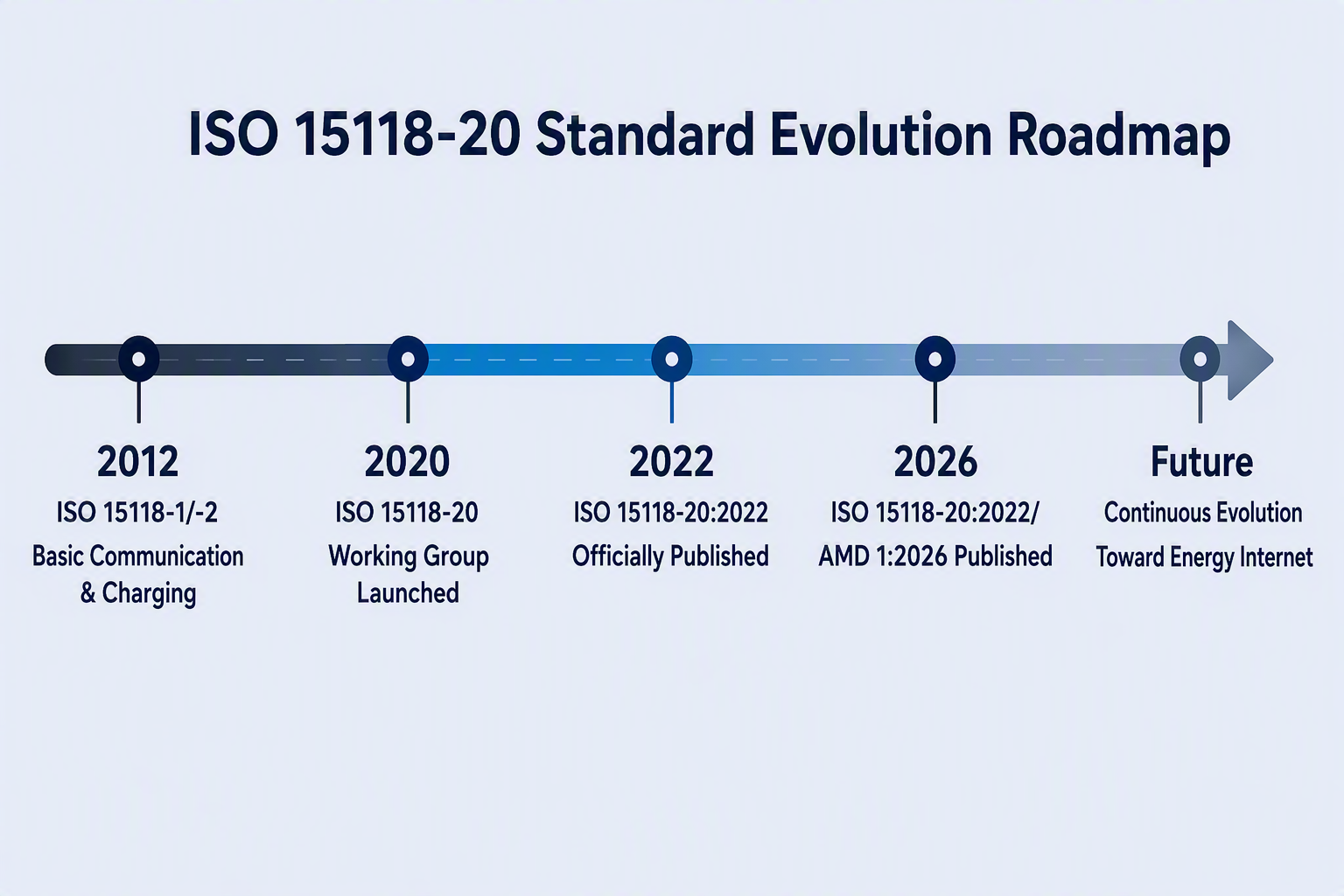
The Evolution Path of ISO 15118-20 Standard
What changes has Amendment 1 to ISO 15118-20 brought about?
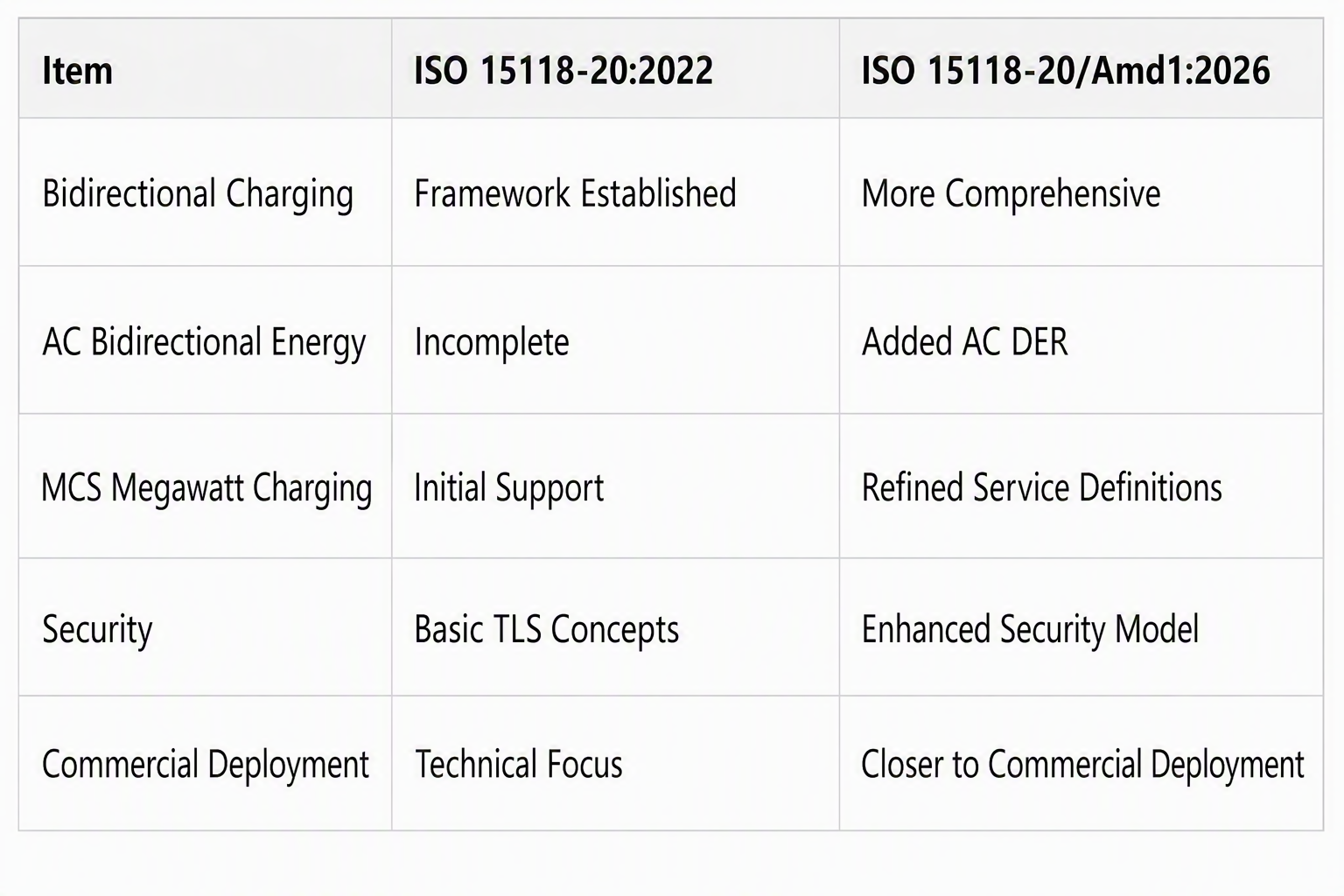
Three new directions have been added to the core:
The biggest difference between ISO 15118-20:2022 and Amendment 1:2026 is:
Part I: Normative References – Expansion of the Standard System
Amendment 1 has added two new normative reference standards:
- ISO 15118-10:2025
- IEC 61851-23-3:2025
This is the most easily overlooked yet crucial change in the entire revision.
ISO 15118-20 was originally established primarily around PLC communication, while ISO 15118-10 defines the physical and data link layer requirements for Single Pair Ethernet (10BASE-T1S); IEC 61851-23-3 is the first to systematically specify MCS DC charging equipment.
In other words, from this moment on, ISO 15118-20 will not only serve CCS, but also officially serve megawatt-scale charging systems.
Part 2: Over ten new terms have been added – ISO 15118 is now entering the power grid field, including:
These terms share a common characteristic: most of them originate not from the automotive industry, but from the field of grid-connected control. This indicates that ISO 15118 has begun to incorporate control concepts from distributed energy standards such as IEEE 1547. In the past, vehicles were merely objects of charging. In the future, vehicles will be regarded as energy resources capable of participating in grid frequency regulation, voltage regulation, and demand response. This represents one of the most significant strategic changes brought about by Amendment 1.
Part 3: MCS Officially Becomes Part of ISO 15118
This part is the most important content of the entire revision.
- Introduce MCS sleep mechanism
- Mandatory adoption of 10BASE-T1S:
- No longer compatible with ISO 15118-2
Part IV: PKI Security System Enters the Engineering Stage
This revision has virtually rewritten the entire Online Certificate Status Protocol (OCSP) and certificate verification process.
The main changes include:
Firstly, new Requirements V2G20-3000 and 3001 have been added, requiring that the validity period of all certificates must be fully contained within the validity period of the issuer’s certificate, and EVCC and SECC are required to conduct checks during verification.
Secondly, suggestions on the size of newly added certificates.
Thirdly, comprehensively update the OCSP verification logic.
Including the SECC certificate, Vehicle Certificate, Contract Certificate, and OEM Provisioning Certificate, multiple requirements have been replaced, requiring that the OCSP signature certificate be consistent with the corresponding Root CA, and further standardizing the trust relationship between different certificate chains.
Although these modifications do not directly affect application layer messages, they determine whether Plug & Charge can truly achieve global interconnectivity in the future.
Part 5: TLS handshake logic is more stringent
- The sending conditions for the certificate_authorities extension in ClientHello;
- How does ServerHello select a Certificate Chain;
- Public SECC and Private SECC adopt different strategies respectively;
- The certificate request method in CertificateRequest is further clarified;
- How does EVCC automatically select the most suitable certificate chain based on the Distinguished Name.
These modifications all revolve around one goal: to reduce interoperability issues during cross-Root CA deployment and enhance compatibility among different PKI systems.
Part VI: AC DER Service – ISO 15118 Firstly Supports Distributed Energy Resource Services on the AC Side
Unlike the significant increase in communication requirements for MCS, the modifications related to AC DER primarily focus on basic capability development. The aim is to enable ISO 15118 to support the communication of AC Distributed Energy Resource (AC DER) services, rather than redesigning a new communication protocol.
Unlike traditional AC Charging Service, AC DER Service no longer focuses solely on the charging process, but rather on the information exchange capabilities of vehicles as distributed energy resources participating in the operation of the AC power grid.
- Add requirements related to the operating status of DER;
- Add description of DER control capability;
What does ISO 15118-20:2022/AMD 1:2026 really mean?
If all the modifications are put together, it will be found that they all revolve around three directions.
Therefore, Amendment 1 formally incorporates the practical industry experience of the past few years into the international standard. This makes ISO 15118-20 capable of supporting MCS, V2G, and the global PKI ecosystem for the first time. It also signifies that, starting from 2026, the industry has truly entered the second-generation ecosystem construction phase of ISO 15118. This marks a watershed moment for the next-generation product architecture.
Post time: Sep-20-2026
