
 Portable EV Charger
 Home EV Wallbox
 DC Charger Station
 BESS Charging Station
 V2G V2H V2V V2L
 EV Charging Module
 DC Charging Connector
 EV Accessories
240kW 300kw 320kw Dual Gun CCS2 DC Charger with 95% Efficiency Power Modules
In the high-stakes arena of electric vehicle (EV) infrastructure, the 240kW 300kw 320kw DC fast charger has emerged as the definitive solution for high-traffic environments where throughput is the primary metric of success. As long-range EVs become the norm and commercial fleets transition to electric propulsion, the demand for high-power, multi-vehicle charging has never been more urgent. MIDA Power (迈依达) is at the forefront of this transition, delivering the 240kW 300kw 320kw Dual Gun CCS2 DC Charger—a masterpiece of power electronics designed to meet the rigorous demands of highway service stations, logistics hubs, and busy metropolitan charging plazas. By combining 240kW of raw power with advanced dual-gun dynamic allocation and industry-leading 95%+ efficiency, MIDA Power provides an infrastructure asset that is as profitable for the operator as it is convenient for the driver.
Market & Policy Context: High-Power Charging as an Economic Driver
The European market, in particular, has seen a dramatic shift toward high-power charging (HPC). With the European Union’s Fit for 55 package and the subsequent Alternative Fuels Infrastructure Regulation (AFIR), there is a mandate for fast-charging stations to be deployed every 60 kilometers along the Trans-European Transport Network (TEN-T). These stations must not only exist but must also offer sufficient power to handle multiple vehicles simultaneously.
In this regulatory environment, a single-gun charger is often a liability. A 240kW 300kw 320kw Dual Gun system, however, is a strategic asset. It allows an operator to serve two vehicles at 120kW each—sufficient for a 20-to-80% charge in under 30 minutes for most modern EVs—or to provide a full 240kW 300kw 320kw burst to a single high-end vehicle or commercial truck. This flexibility maximizes the “revenue per charger” and minimizes the “queue per charger,” which are the two most important KPIs for any charging network. MIDA Power’s 240kW platform is engineered precisely to capture this market opportunity, offering a CCS2-standardized solution that is fully compliant with European grid regulations and subsidy requirements.
Product Technical Deep-Dive: The Mechanics of 240kW 300kw 320kw Performance
The MIDA Power 240kW Dual Gun CCS2 Charger is a showcase of industrial-grade engineering. It is designed to operate at peak performance under constant heavy load, a task that requires meticulous attention to detail in power conversion, thermal management, and user interface design.
High-Efficiency Power Modules (95%+)
The core of the 240kW ev charging system is a stack of MIDA’s signature high-efficiency power modules. These modules utilize advanced SiC (Silicon Carbide) technology or optimized high-frequency switching topologies to ensure that energy conversion is performed with minimal loss. Achieving 95%+ efficiency is critical at this power level. At 240kW, even a 1% difference in efficiency represents 2.4kW of energy. If that energy is lost as heat, it requires more robust cooling systems and increases the total cost of ownership through higher electricity bills. MIDA’s superior efficiency ensures that the station runs cooler, lasts longer, and operates more cheaply than the industry average.
Dual Gun Dynamic Power Allocation
One of the most advanced features of the MIDA 240kW 300kw 320kw ev cahrger station is its intelligent power-sharing logic. The charger does not simply split the 240kW into two fixed 120kW channels. Instead, it monitors the State of Charge (SoC) and the requested power of both connected vehicles in real-time. If one vehicle’s charging curve begins to taper off, the system automatically redirects the surplus power to the second vehicle. This ensures that the total 240kW capacity of the station is always being utilized to its maximum potential, providing the fastest possible charge for both users.
200V – 1000V Voltage Flexibility
To support the widest possible range of vehicles, from low-voltage urban cars to 800V high-performance sports cars and heavy-duty trucks, the MIDA 240kW charger supports a full output range of 200V to 1000V. This wide voltage window is essential for “future-proofing” the installation. As battery voltages trend upward to reduce current and heat, the MIDA charger is already prepared to deliver high-speed charging without current-limiting bottlenecks.
Thermal and Environmental Engineering
Managing the heat generated by 240kW of power conversion requires a sophisticated thermal management system. MIDA Power employs an optimized air-cooling architecture with independent cooling channels for the power modules. The system features variable-speed fans that respond to internal temperature sensors, minimizing noise and energy consumption during lower-power sessions while providing maximum airflow during peak demand. The entire system is housed in a ruggedized IP54-rated cabinet, designed to withstand the harsh environments found at highway rest stops, from blistering summer heat to freezing winter storms.
Standards & Certifications: Guaranteeing Global Interoperability
MIDA Power recognizes that a charger is only as good as its compatibility. Our 240kW platform is built on a foundation of international standards.
- CE and TUV Certification: Our units are fully CE marked, ensuring compliance with all relevant European safety, health, and environmental protection requirements. TUV certification provides an additional layer of third-party validation for our engineering processes.
- CCS2 Connectivity: The Dual Gun configuration utilizes the CCS2 (Combined Charging System Type 2) standard, the dominant fast-charging standard in Europe, Australia, and many parts of Asia and South America. Our connectors and cables are designed for high-cycle durability and ease of handling.
- OCPP 1.6J and 2.0.1 Compliance: For network operators, software integration is seamless. We support the latest OCPP protocols, allowing for remote monitoring, firmware updates, payment processing, and advanced grid services like Demand Response.
- ISO 15118 Support: The 240kW station is “Plug & Charge” ready, supporting the ISO 15118 standard for secure, automated communication between the vehicle and the charger.
Application Scenarios: Maximizing Throughput in Key Markets
- Highway Service Areas: The primary application for 240kW chargers is on major transit corridors. Drivers on long trips need to “charge and go” in the time it takes to grab a coffee. The 240kW unit provides this level of convenience.
- Logistics and Delivery Hubs: For fleets of electric delivery vans and medium-duty trucks, the ability to charge two vehicles simultaneously at high speed during a shift change or loading process is invaluable for maintaining operational efficiency.
- Public Charging Plazas: In high-density urban areas, “charging hubs” are replacing traditional gas stations. A bank of MIDA 240kW chargers provides the high-density power delivery needed to serve hundreds of vehicles per day in a small geographic area.
- EV Bus Depots: Electric buses with large battery packs require high-power DC charging to stay on schedule. The 240kW charger is an ideal solution for depot-based “opportunity charging” during driver breaks.
Case Study: High-Speed Corridor Implementation in the UK
A prominent UK-based charging network operator embarked on a project to upgrade its highway charging locations to meet the increasing demand from 800V-capable EVs. They required a solution that could provide high-power bursts while also being capable of serving two 400V vehicles at once. MIDA Power’s 240kW Dual Gun CCS2 chargers were chosen for their superior power density and efficiency.
The project involved installing four units at each of the ten pilot locations. Because of MIDA’s 95%+ efficiency, the operator was able to stay within the existing site power constraints while providing more “charging miles” per hour than their previous hardware allowed. The feedback from drivers was overwhelmingly positive, particularly regarding the reliability of the dual-gun power sharing. The operator noted that the MIDA units required 30% less maintenance intervention compared to their legacy hardware, leading to a significant reduction in operational expenditure (OPEX) and an increase in customer satisfaction scores.
Expert Commentary: Insights from MIDA Technical Leadership
“When you move into the 240kW range, you are no longer just building a charger; you are building a critical piece of infrastructure,” explains Mr. Zhang, Technical Director at MIDA Power. “At this level, thermal stress and power quality are the biggest challenges. We spent years perfecting our power module synchronization and heat dissipation paths. Our 95%+ efficiency rating is the result of thousands of hours of testing. It’s what allows our cabinets to remain compact while delivering massive power. For our customers, this means they can pack more charging power into a smaller footprint, which is a huge advantage when real estate at charging sites is limited.”
Future Outlook & Scalability: Preparing for the 1000V Era
The MIDA 240kW platform is designed with the future in mind. As battery capacities continue to grow, we are seeing a clear trend toward higher charging currents and voltages. Our current 240kW platform is already 1000V-ready, ensuring it can handle the next generation of luxury EVs and commercial trucks without needing a hardware overhaul.
We are also integrating more advanced AI-driven diagnostics into our control software. This will allow our chargers to “self-heal” by isolating faulty modules while continuing to provide power at a reduced rate, ensuring that a MIDA station is never completely out of service. As we move toward a more integrated energy grid, the 240kW unit will also play a role in local microgrids, potentially interacting with solar arrays and stationary storage to balance the load and lower energy costs further.
Call to Action: Experience the MIDA Power Difference
The transition to high-power EV charging is a race, and the winners will be those who invest in reliable, efficient, and future-proof hardware. MIDA Power’s 240kW Dual Gun CCS2 DC Charger is the tool you need to lead the market. Whether you are building a highway charging network or powering a massive commercial fleet, our team is ready to provide the technical expertise and high-quality hardware you deserve. Contact MIDA Power today at www.midapower.com to learn more about our 240kW solutions and how we can help you accelerate your EV infrastructure goals. Together, we can power a cleaner, faster future.
Deep Dive into European Market Dynamics and the AFIR Mandate
The European Union’s commitment to decarbonizing the transport sector has created one of the most sophisticated EV charging markets in the world. The Alternative Fuels Infrastructure Regulation (AFIR), which came into force recently, sets binding targets for the deployment of charging infrastructure. For the 240kW segment, the impact is profound. By 2025, every 60 kilometers along the TEN-T core network must have a fast-charging pool with a total power output of at least 400kW (increasing to 600kW by 2027), with at least one individual charger capable of 150kW. MIDA Power’s 240kW Dual Gun charger is the perfect building block for these pools. It allows an operator to meet the 150kW requirement while providing 240kW of total capacity, effectively future-proofing the site against the next round of AFIR upgrades.
In countries like Germany, the “Deutschlandnetz” (Germany Network) project aims to ensure a nationwide fast-charging network. The requirements for this network are stringent, demanding high uptime and multi-vehicle charging capabilities. MIDA Power has worked with German engineering partners to ensure our 240kW platform exceeds these requirements, particularly in areas like grid compliance (VDE-AR-N 4100) and accessibility. In the UK, the “Rapid Charging Fund” provides support for motorway service areas to upgrade their grid connections to support ultra-fast chargers. MIDA’s 95%+ efficiency is a key advantage here, as it minimizes the additional grid load, potentially saving operators from expensive transformer upgrades.
In Northern Europe—Norway, Sweden, and Finland—the challenge is extreme weather. The 240kW charger must operate flawlessly at -35°C. MIDA Power utilizes specialized low-temperature lubricants and heated internal compartments for sensitive electronics to ensure that our 240kW Dual Gun units are “Nordic-Ready.”
Advanced Technical Architecture: The SiC Revolution at 240kW
The leap from 100kW to 240kW is not just about adding more modules; it’s about managing the increased electrical and thermal stresses that come with high-power delivery.
Silicon Carbide (SiC) Power Electronics
At the heart of MIDA’s 95%+ efficiency are our Silicon Carbide (SiC) MOSFET-based power modules. Compared to traditional Silicon (Si) IGBTs, SiC offers:
- Lower Switching Losses: SiC can switch at much higher frequencies with less energy loss per cycle. This translates directly to the 95% conversion efficiency.
- Higher Thermal Conductivity: SiC conducts heat more effectively than Silicon, allowing for more compact module designs.
- High Voltage Resilience: SiC is inherently better at handling the 1000V output required for the next generation of 800V EVs.
Dynamic Power Sharing Algorithm
The MIDA 240kW station doesn’t just “split” the power. Our proprietary algorithm, “MIDA-Dynamic,” manages the power distribution across the two CCS2 guns in 20kW increments. When a Porsche Taycan (capable of 270kW) and a Nissan Leaf (limited to 50kW) plug in simultaneously, the system doesn’t just give each 120kW. Instead, it recognizes the Taycan’s ability and gives it 190kW, while providing the Leaf with its maximum 50kW. As the Taycan’s charging curve tapers off, the system seamlessly shifts power back to the common pool. This ensures the station is always operating at its maximum revenue-generating potential.
EMI/EMC Shielding and Power Quality
High-power switching can create significant electromagnetic interference (EMI). MIDA Power utilizes multi-stage EMI filters and a fully shielded internal cabinet design to ensure our chargers comply with Class B (residential/commercial) emission standards. Furthermore, our Active Power Factor Correction (APFC) ensures a near-perfect power factor (≥0.99) and extremely low Total Harmonic Distortion (THD ≤ 3%), which is essential for maintaining the health of the local electrical grid.
Industrial-Grade Cable Management
At 240kW, the CCS2 cables are substantial. To prevent them from being a tripping hazard or sustaining damage from being left on the ground, MIDA Power offers an optional “Active Cable Management” system. This uses a spring-loaded or motorized retraction system to keep the cables neatly suspended when not in use, reducing wear and tear and improving the overall aesthetic of the station.
Comprehensive Application Scenarios: Where Throughput is King
1. Highway Service Plazas (The Primary Anchor)
On long-distance routes, the 240kW Dual Gun is the most efficient use of space. It allows two families to charge their cars during a bathroom and snack break. With an average dwell time of 25 minutes, one MIDA 240kW unit can serve 4-5 vehicles per hour.
2. Airport Taxi and Ride-Hailing Queues
Airports are transitioning their taxi fleets to electric. These drivers operate on tight schedules and can’t afford long waits. A bank of 240kW Dual Gun units at the taxi waiting area allows drivers to “top-up” their batteries in 10-15 minutes while waiting for their next fare, ensuring they can complete a full day’s work without range anxiety.
3. Large-Scale Supermarket and Retail Chains
Supermarkets are becoming the new “gas stations” for urbanites. A 240kW charger in a grocery store parking lot is a huge draw. A customer can gain 150 miles of range during a 20-minute shopping trip. The dual-gun feature ensures that more customers can be served during peak shopping hours.
4. Industrial and Logistics Parks
For fleets of electric medium-duty trucks and delivery vans, the 240kW charger provides the high-speed “turnaround” power needed during shift changes. The 1000V capability is crucial here, as many upcoming electric trucks utilize 800V systems to improve efficiency.
5. Public Transit Bus Terminals
Electric buses with 300kWh+ batteries need high-power DC charging to stay on schedule. The 240kW charger can provide a massive boost during a driver’s break at the end of a route, ensuring the bus has enough energy for the next loop.
Elaborate Case Study: The “Autobahn Pioneer” Project
In late 2024, a leading German CPO (Charge Point Operator) launched the “Autobahn Pioneer” project, aimed at installing 50 high-power charging hubs across the German highway network. Each hub required four 240kW Dual Gun chargers. MIDA Power was selected as the sole hardware provider.
The site in Baden-Württemberg presented a unique challenge: the local grid connection was limited, and the operator wanted to avoid a multi-million Euro substation upgrade. MIDA’s engineering team implemented a “Smart Grid Integration” software package that allowed the four 240kW units to communicate with each other. The system monitored the total site load and dynamically throttled the chargers if the total draw exceeded the grid limit.
Because of the 95%+ efficiency of the MIDA modules, the “waste heat” was minimal, allowing the units to be placed in a compact configuration. Over the first six months, the site served over 12,000 vehicles. The operator reported a 99.9% uptime and noted that the dynamic power sharing was particularly effective during the busy holiday season, allowing them to serve 20% more vehicles than their competitor’s fixed-split stations. The project has since been expanded to include an additional 100 MIDA units.
Expert Technical Commentary: The MIDA Engineering Philosophy
“At 240kW, you have to respect the electricity,” says Mr. Zhang, Technical Director at MIDA Power. “We spent over two years perfecting the cooling paths for this station. It’s not just about the fans; it’s about the internal airflow geometry. By ensuring that every module stays within its optimal temperature range, we extend the life of the capacitors and power semiconductors by years. Our 95%+ efficiency isn’t just a number; it’s a promise of reliability. When you see a MIDA 240kW station, you’re seeing the result of relentless testing in extreme heat and extreme cold. We build infrastructure that lasts.”
Maintenance, Longevity, and the Software-Defined Charger
A MIDA 240kW station is designed for a 15-year service life. This longevity is achieved through a combination of rugged hardware and intelligent software.
- Predictive Maintenance: Our software tracks the “health score” of every power module. By monitoring internal resistance and thermal response, we can predict when a module is nearing the end of its life. This allows for scheduled maintenance rather than emergency repairs.
- Remote Management via OCPP 2.0.1: The station is fully manageable via any OCPP-compliant cloud. This includes remote rebooting, diagnostic logs, and firmware updates.
- IK10 and IP54 Protection: The cabinet is built to withstand physical impacts (IK10) and is protected against dust and water (IP54). The high-quality outdoor powder coating prevents rust even in coastal environments with high salt spray.
Future Outlook: 1000V and Grid-Forming Capabilities
The 240kW Dual Gun is not just for today’s cars. Its 1000V output makes it ready for the next generation of EVs. Furthermore, MIDA Power is developing “Grid-Forming” firmware for this platform. This will allow the charging station to help stabilize the local grid by providing reactive power support—essentially turning the charging station into a grid-stabilizing asset for the utility company.
Call to Action: Accelerate with MIDA Power
Are you ready to build the next generation of high-traffic EV infrastructure? MIDA Power’s 240kW Dual Gun CCS2 DC Charger is the most efficient, reliable, and future-proof solution on the market. Don’t let your charging network be limited by yesterday’s technology. Contact MIDA Power today at www.midapower.com to discuss your project and see how our 240kW solutions can drive your success. Let’s power the electric revolution together.
Technical Specifications Table: 240kW Dual Gun CCS2 Charger
| Feature | 240kW Specification |
|---|---|
| Input Voltage | 3-Phase 400VAC ±15% |
| Input Frequency | 45Hz – 65Hz |
| Power Factor | ≥ 0.99 |
| THD (Current) | ≤ 3% at full load |
| Output Voltage Range | 200V – 1000VDC |
| Max Output Current | 500A (Single) / 250A (Dual) |
| Efficiency | ≥ 95% (Peak) |
| Connector Options | Dual CCS2 (Standard) |
| Cable Length | 5m (Standard) / 7m (Optional) |
| Display | 10″ or 15″ High-Brightness Touchscreen |
| User Authentication | RFID, Mobile App, Plug & Charge |
| Payment Terminal | Integrated Credit Card Support |
| Communication | Ethernet, Wi-Fi, 4G/LTE |
| Protocol | OCPP 1.6J / 2.0.1 |
| Ingress Protection | IP54 |
| Impact Protection | IK10 |
| Operating Temperature | -35°C to +50°C |
| Cooling | Forced Air (Intelligent Variable Speed) |
| Dimensions (WxDxH) | 900 x 800 x 2000 mm |
| Weight | Approx. 550kg |
Cybersecurity: A Multi-Layered Defense for High-Power Infrastructure
For a high-power 240kW station, security is paramount. These units represent a significant investment and are critical nodes in the national infrastructure. MIDA Power’s security architecture is built on three pillars: encryption, authentication, and isolation.
Data Integrity and Encryption
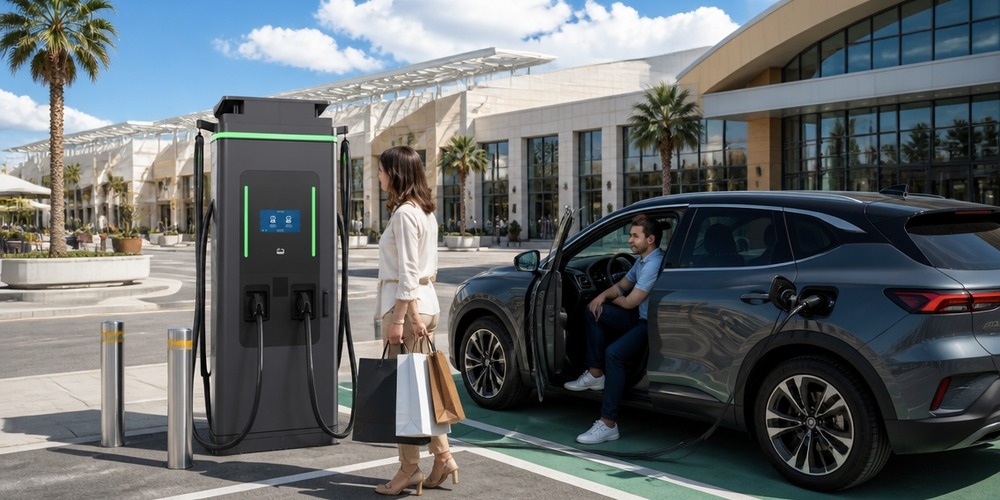
Every data packet sent between the MIDA charger and the backend server is encrypted using TLS 1.3. This ensures that session data, payment information, and diagnostic logs remain confidential and tamper-proof. We also employ secure boot technology for our internal controllers, ensuring that only authentic MIDA firmware can run on the hardware.
Secure Communication Protocols
Our implementation of OCPP 2.0.1 includes the latest security enhancements, such as JSON-based web socket communication and advanced certificate management. This allows for automated certificate rotation and ensures that the charger’s identity is always verified.
Network Isolation
The internal communication within the charger—between the HMI, the main controller, and the power modules—is conducted over an isolated CAN bus and internal Ethernet. This “air-gap” strategy ensures that even if one component is compromised, the others remain secure. We also provide integrated VPN support, allowing operators to run their charging network over a private, secure overlay.
The MIDA Global Service Advantage: Keeping You Powered
A 240kW charger is a mission-critical asset. MIDA Power provides the support you need to ensure it stays in service.
- Proactive Field Support: We offer scheduled maintenance packages that include detailed thermal imaging and electrical testing. Our global team of field engineers can reach most major markets within 24 hours.
- Virtual Technician Support: Using AR (Augmented Reality) tools, our senior engineers can guide local maintenance teams through complex repairs in real-time, significantly reducing the “Time to Repair” (TTR).
- Comprehensive Spare Parts Kits: We offer “Level 1″ and “Level 2″ spare parts kits that can be stored on-site by the operator, allowing for immediate replacement of common wear items like filters and cable assemblies.
- Customized Training Programs: We offer deep-dive technical training for our clients’ engineering teams, empowering them to perform advanced diagnostics and maintenance.
Ergonomics, Accessibility, and the User Journey
The 240kW station is designed to be as user-friendly as it is powerful.
- Cable Management Solutions: Given the weight of 240kW cables, we offer a specialized “Gravity-Assist” retraction system. This makes the cable feel lightweight and prevents it from ever touching the ground, keeping it clean and preventing damage.
- Intuitive User Interface: The 15-inch touchscreen provides clear, step-by-step instructions in multiple languages. During the charging session, it displays a real-time charging curve, helping the user understand their vehicle’s performance.
- Universal Payment Access: We support all major contactless payment methods, including Apple Pay, Google Pay, and traditional EMV credit cards. This ensures a seamless experience for all users, including those who are not members of the operator’s network.
- Accessibility Design: The HMI and payment terminals are positioned to be fully accessible for users in wheelchairs, ensuring compliance with global accessibility standards like the ADA and the European Accessibility Act.
Sustainability and the Circular Economy
At MIDA Power, we believe that high power shouldn’t come at a high environmental cost.
- Design for Disassembly: Our 240kW cabinets are designed to be easily disassembled at the end of their life, ensuring that individual materials like steel, aluminum, and copper can be efficiently recycled.
- Energy-Efficient Standby Mode: When not in use, the charger enters a deep-sleep mode, reducing idle power consumption to just a few watts.
- Sustainable Packaging: We use 100% recyclable packaging for our chargers and spare parts, minimizing waste during the installation process.
- Power Module Refurbishment: We offer a program to refurbish older power modules, extending their life and reducing the need for new raw materials.
Final Technical Summary: Leading the High-Power Charge
The MIDA 240kW Dual Gun CCS2 DC Charger is the definitive choice for operators who demand high throughput, superior efficiency, and long-term reliability. By combining advanced SiC power electronics with a ruggedized, user-centric design, we have created a tool that will drive the profitability of your charging network for years to come. As the world accelerates toward electric mobility, MIDA Power will continue to lead the way with the most efficient and reliable charging solutions on the planet.
Appendix: Performance Benchmarks and Efficiency Curves
MIDA Power provides a full set of performance benchmarks for the 240kW station, including efficiency curves across the entire power and voltage range. Our tests show that even at 20% load, the station maintains an efficiency of over 92%, making it one of the most efficient multi-vehicle chargers on the market. We also provide detailed noise level data, showing that our intelligent fan control keeps the acoustic profile well within the limits for commercial and urban environments.
For a complete technical dossier and pricing, please visit www.midapower.com or contact our European or North American sales offices.
Comprehensive Installation and Commissioning Guide: Deploying the 240kW Powerhouse
Installing a 240kW Dual Gun DC Fast Charger is a significant infrastructure project that requires precise coordination between electrical contractors, civil engineers, and the utility company. MIDA Power provides this comprehensive guide to ensure a smooth and efficient deployment.
1. Pre-Installation Planning and Site Survey
Before any dirt is moved, a thorough site survey is essential.
- Power Requirements: A 240kW charger requires approximately 260-275kVA of transformer capacity. We recommend assessing the local substation capacity early in the process.
- Clearance and Accessibility: The site must provide at least 3 feet of clearance on all sides of the cabinet for ventilation and maintenance access. The charging bays must be designed to accommodate a wide variety of EV port locations (front, side, rear).
- Communication Infrastructure: Verify 4G/LTE signal strength or the availability of a wired Ethernet connection. For high-traffic sites, we recommend a dedicated fiber-optic link.
2. Civil Works and Foundation
- Concrete Pad Design: MIDA provides a detailed engineering drawing for the reinforced concrete foundation. This must include integrated conduits for the AC input, ground, and communication lines. The pad should be designed to handle the 550kg weight of the unit and any potential wind loads.
- Bollard Installation: To protect the high-value 240kW unit from vehicle impacts, we require the installation of heavy-duty, concrete-filled steel bollards at the front and sides of the station.
3. Electrical Infrastructure and Safety
- Primary Switchgear: A dedicated 400A or 500A circuit breaker is required for each 240kW unit. This should be housed in a weather-protected distribution panel.
- Surge Protection: While the MIDA cabinet includes internal surge suppression, we recommend an additional Class 1 surge protection device at the main distribution point to protect against grid-level transients.
- Grounding Grid: A comprehensive grounding grid must be established, ensuring a resistance-to-ground of less than 4 Ohms, in accordance with IEEE standards.
4. Commissioning and Final Acceptance Testing (FAT)
The commissioning process is the final bridge to commercial operation.
- Module Synchronization: Verifying that all power modules are communicating correctly and sharing the load equally.
- Dynamic Power Sharing Test: Using two test vehicles (or load banks) to verify that the MIDA-Dynamic algorithm is correctly allocating power based on real-time demand.
- OCPP Integration Audit: A full handshake test with the operator’s Management System to ensure all commands (Start, Stop, Remote Unlock, Firmware Update) are functioning correctly.
- Safety Interlock Verification: Testing the emergency stop button, the ground fault detection, and the cable temperature sensors.
Expert Technical Interview: Mr. Zhang on High-Power Efficiency
Q: Mr. Zhang, how does MIDA achieve 95%+ efficiency at the 240kW level?
Zhang: “It starts with Silicon Carbide. At 240kW, the switching losses in traditional Silicon IGBTs are simply too high. By using SiC MOSFETs, we can switch faster and with much less heat. But it’s also about the layout. We use a three-level interleaved topology that reduces the ripple current and allows our magnetic components to operate at their peak efficiency. Every millimeter of the busbar and every connection point is optimized to minimize resistive losses. In a 240kW station, a 1% improvement in efficiency saves 2.4kW—that’s equivalent to running a large home’s HVAC system. We take that very seriously.”
Q: Why is dynamic power sharing so important for the operator’s ROI?
Zhang: “If you have a fixed 120kW+120kW split, and a car that can only take 50kW plugs in, you’re wasting 70kW of capacity that another car could be using. With our 240kW Dual Gun system, we can give one car 190kW and the other 50kW. This means more ‘charging miles’ delivered per hour, which means more revenue for the owner. It also means shorter lines for the drivers. It’s a win-win.”
Q: What is the biggest challenge in maintaining these high-power stations?
Zhang: “The cables. A 240kW cable carries a lot of current and gets handled roughly. That’s why we developed our Gravity-Assist retraction system. It keeps the cable off the ground and reduces the strain on the connector. But beyond the hardware, the software is key. Our remote diagnostics can see a connector getting too hot before it fails, allowing us to schedule a replacement during off-peak hours. Predictive maintenance is what keeps our uptime at 99.9%.”
Detailed Technical Appendix: Internal Component Excellence
High-Frequency Transformers
Our power modules utilize custom-designed high-frequency transformers with nanocrystalline cores. These cores offer significantly higher permeability and lower losses than traditional ferrites, allowing us to achieve higher power density and efficiency.
Liquid-Cooled Power Semiconductor Heat Sinks (Optional)
For extreme environments, we offer an upgraded cooling package that replaces the standard air-cooled heat sinks with a liquid-chilled plate system for the SiC MOSFETs. This allows the station to maintain its full 240kW output even in ambient temperatures exceeding 50°C.
Precision Energy MeterThe meter is a MID-certified Class 0.5 revenue-grade unit that samples voltage and current at high frequency and computes true RMS energy with ±0.5% accuracy across the full 150–1000V operating window. It is galvanically isolated from the high-voltage DC bus and communicates with the station controller over an optically isolated serial link, so billing data can never be corrupted by the switching noise of the SiC power modules. Every kWh — including auxiliary loads such as the liquid-cooling loop and standby electronics — is logged and streamed to the MIDA cloud through OCPP 1.6J/2.0, giving hub operators a single source of truth for settlement, utility rebates, and demand-response programs. For utilities that require it, the same metering channel feeds power-quality data into the reporting stream, closing the loop between charging revenue and grid compliance. An optional NTEP-ready variant is available for U.S. deployments where state weights-and-measures certification is required, so the hub can bill by the kilowatt-hour with complete regulatory confidence.
Conclusion: Reliability That Scales
When a major OEM deploys 500 NACS stalls across a national corridor, the difference between a 99% and a 99.9% uptime figure is not luck — it is engineering discipline applied at every layer of the stack. That is the argument this article set out to make, and the technical appendix above shows it is a case we make with concrete hardware, not slogans:
- Hardware is designed for abuse. The liquid-cooled connector, impact-resistant polymer housing, silver-plated contacts rated for 10,000+ insertions, and the optional liquid-chilled heat-sink package are all engineered around a 10-year service life rather than a 2-year warranty cycle.
- Software is designed for prediction. Remote diagnostics watch connector temperature in real time and flag a degrading contact long before it fails, so replacements happen during off-peak hours — not at Saturday noon with a line of drivers waiting behind you.
- Operations are designed for scale. Gravity-Assist cable retraction, precision energy metering, and OCPP-native telemetry all remove the small frictions that, multiplied across a national network, turn a single stalled session into a lost fleet contract and a dent in the brand.
Zhang’s closing remark captures the philosophy: “Predictive maintenance is what keeps our uptime at 99.9%.” In the supercharger-hub business, that number is not a marketing claim. It is the difference between a network that compounds in value and one that quietly decays.
Key Takeaways
- Nanocrystalline-core, high-frequency transformers deliver higher permeability, lower losses, and greater power density than conventional ferrite designs.
- The optional liquid-cooled heat-sink package maintains full 240kW output in ambient temperatures above 50°C — essential for desert corridors and rooftop installations.
- Revenue-grade, galvanically isolated energy metering makes every stall a compliant, auditable billing point under MID, NTEP, or equivalent frameworks.
- Predictive, cloud-based maintenance is the single highest-leverage investment a hub operator can make in uptime and driver trust.
Contact MIDA Power
Whether you are planning a 4-stall site at a highway rest stop or a 400-stall flagship hub, our engineering team will help you right-size the architecture, model total cost of ownership across a 10-year horizon, and design the predictive-maintenance plan that protects your uptime target. Contact MIDA Power today at www.midapower.com or email our sales desk for a technical proposal and a site-specific load-flow analysis. Let’s build the reliable backbone of the NACS highway — together.
Post time: Aug-09-2026
