
 Portable EV Charger
 Home EV Wallbox
 DC Charger Station
 BESS Charging Station
 V2G V2H V2V V2L
 EV Charging Module
 DC Charging Connector
 EV Accessories
150kW 180kw 240kW CCS2 Dual Gun DC Charger Station with OCPP 2.0.1
The Next Generation of High-Power Connectivity: MIDA’s 150kW and 240kW CCS2 Dual Gun Solutions
In the rapidly maturing electric vehicle (EV) market, the requirements for charging infrastructure are shifting from simple “power delivery” to sophisticated “energy management.” As the global standard for high-speed DC charging in Europe, Asia, and increasingly Oceania, the CCS2 (Combined Charging System Type 2) interface is at the heart of this evolution. To meet the demands of high-traffic environments, fleet depots, and highway corridors, MIDA Power (迈依达) has developed its most advanced charging platform to date: the 150kW and 240kW CCS2 Dual Gun DC Charger series, natively equipped with the revolutionary OCPP 2.0.1 communication protocol.
This series represents a significant leap forward in charger intelligence. By combining extreme power outputs with the most advanced device management and cybersecurity features available, MIDA Power is setting a new benchmark for infrastructure reliability. The dual-gun configuration allows for simultaneous high-speed charging of two vehicles, maximizing throughput and ROI for the operator. With the power of OCPP 2.0.1, these stations are not just chargers; they are smart nodes in a global energy network, capable of advanced diagnostics, secure transactions, and seamless grid integration. MIDA Power is proud to offer the 150kW/240kW series as the definitive solution for the next decade of electric mobility.
Market and Policy Context: The High-Power Mandate and the Digital Transition
The global EV landscape is currently defined by two key pressures. First, the automotive industry is rapidly transitioning toward 800V battery architectures and larger battery packs (100kWh+), which require 150kW to 240kW of power to achieve the 15-20 minute “fast charge” experience that drivers expect. Second, governments and grid operators are mandating higher levels of cybersecurity and smarter energy management to protect the electrical grid from the strain of millions of simultaneous charging sessions.
In Europe, the Alternative Fuels Infrastructure Regulation (AFIR) and the latest cybersecurity directives (such as the UK’s PSTI Act) are making advanced protocols like OCPP 2.0.1 and ISO 15118 a requirement rather than an option. The old way of managing chargers—via the relatively simple OCPP 1.6J protocol—is becoming insufficient for the scale of the modern fleet. MIDA Power’s early adoption of OCPP 2.0.1 positions our 150kW and 240kW stations as the preferred choice for forward-thinking CPOs (Charge Point Operators) who want to future-proof their networks against evolving regulations and cyber threats.
Policy-wise, the focus is also shifting toward “throughput efficiency.” A single-gun 150kW charger is a wasted resource if the vehicle plugged into it can only pull 75kW. MIDA’s dual-gun design, paired with dynamic power allocation, ensures that every kilowatt of available grid capacity is being used to move vehicles, maximizing the efficiency of the entire charging site.
Product Technical Deep-Dive: The Architecture of Intelligence and Power
The MIDA 150kW and 240kW CCS2 Dual Gun stations are engineered to provide maximum power density and ultimate control.
High-Density SiC Modular Core
At the core of these stations are MIDA’s proprietary 30kW or 40kW Silicon Carbide (SiC) power modules. The 150kW unit utilizes a 5-module stack, while the 240kW powerhouse uses 6 or 8 modules depending on the configuration. The use of SiC MOSFETs allows for switching frequencies up to five times higher than traditional silicon IGBTs, resulting in a peak efficiency of ≥96.5%. This efficiency is critical: at 240kW, every percentage of efficiency gain reduces the heat load by 2.4kW, allowing for a more compact cabinet and quieter cooling fans.
Dynamic Power Allocation (DPA)
The true strength of the MIDA Dual Gun station is its “Dynamic Power Allocation” system. Unlike older dual-gun chargers that split power 50/50 regardless of the car’s intake, MIDA’s intelligent matrix controller monitors the BMS (Battery Management System) of both vehicles in real-time. If a 240kW station has a high-performance SUV pulling 180kW and a compact hatchback pulling 60kW, the system routes the modules exactly as needed. As the SUV’s charging curve tapers off, the system automatically shifts those modules to the hatchback, ensuring the fastest possible total charge time for both drivers.
CCS2 High-Voltage Performance (200V – 1000V)
Our stations are natively designed for the 800V revolution. The CCS2 interface supports a wide output range from 200V to 1000V DC. This is essential for serving current 400V vehicles alongside next-gen 800V platforms from manufacturers like Porsche, Lucid, and the upcoming high-power truck fleets. The station’s ultra-fast communication controller synchronizes with the vehicle in milliseconds, ensuring a perfectly stable voltage ramp and a safe, efficient session.
Cabinet Engineering and Reliability
The 150kW/240kW cabinet is built for the harshest environments. Constructed from 2mm thick galvanized steel with a marine-grade anti-corrosion coating, it earns an IP55 rating. The internal components are protected by a dual-chamber cooling design: the power electronics are housed in a sealed, filtered chamber, while the heat-sink exhaust is handled by a separate high-volume fan array. This “Separated Thermal Path” prevents dust and moisture from reaching the sensitive SiC modules, drastically extending the service life of the hardware.
Standards and Certifications: The OCPP 2.0.1 Revolution
A high-power charger like the MIDA 240kW series is only as good as the software that manages it. MIDA Power (迈依达) has fully embraced the OCPP 2.0.1 standard, providing operators with a level of control and security that was previously impossible.
What Makes OCPP 2.0.1 Different?
While OCPP 1.6J was the protocol that built the industry, OCPP 2.0.1 is the protocol that will scale it. It offers several critical improvements that are built natively into our 150kW/240kW stations:
- Enhanced Device Modeling: Operators can now “see” into every component of the charger. You can monitor the temperature of a specific power module or the health of a cooling fan remotely, allowing for granular diagnostics without a site visit.
- Superior Transaction Handling: Support for complex pricing structures, such as demand-based pricing or specific tariffs for different types of vehicles, is built into the protocol.
- Advanced Security: OCPP 2.0.1 includes secure certificate management and TLS 1.3 encryption as standard, making the station resilient against hackers.
- Smart Charging Profiles: The protocol allows for more sophisticated coordination between the charger and the grid, supporting 15-minute load-shaping intervals that help prevent grid overloads.
ISO 15118 and Plug & Charge
The MIDA 150kW/240kW series is fully compliant with ISO 15118, enabling “Plug & Charge” functionality. This is the ultimate user-friendly feature: the driver simply plugs the CCS2 connector into their vehicle, and the charger and car perform a secure digital handshake to authenticate the user and process payment. This eliminates the need for RFID cards or mobile apps and is the gold standard for the premium EV market.
Global Safety Compliance
Our stations are engineered to meet the highest safety standards worldwide. This includes:
- CE and TUV Certification: For the European and Asian markets.
- Surge and Lightning Protection: Integrated Class C and Class D protection.
- Insulation Monitoring: Constant checking for current leakage to the chassis.
- Fire Suppression: Optional integrated fire-extinguishing systems for indoor parking deployments.
Application Scenarios: Where the 240kW Powerhouse Shines
The combination of extreme power and dual-gun versatility makes this series ideal for high-traffic, high-value locations.
Highway Fast-Charging Hubs
Along major inter-city routes, speed is the primary product. A MIDA 240kW Dual Gun station can add 300km of range in just 15 minutes to a modern EV. By serving two cars at once, the station increases the site’s “turnover” and reduces queues during peak holiday travel periods. The liquid-cooled cable option ensures that the station can deliver full power even in the heat of mid-summer without derating.
Commercial Fleet Depots and Logistic Centers
Electric delivery trucks and vans have tight schedules and high energy needs. A 240kW station can fast-charge a medium-duty truck during a driver’s meal break or quickly “top up” a fleet of vans between morning and afternoon delivery routes. The dual-gun configuration is particularly useful for depots with limited parking space, as one charger can serve two adjacent bays.
Public Transit and Bus Interchanges
Electric buses require high-power, high-uptime solutions. The MIDA 150kW and 240kW stations are built to handle the continuous high-current sessions required by 12-meter and 18-meter buses. When equipped with a dual-gun setup, the station can charge two smaller shuttle buses simultaneously at 75kW or 120kW each, optimizing the depot’s energy throughput.
High-End Retail and Mixed-Use Developments
For premium shopping malls and office parks, offering “Ultra-Fast” charging is a major differentiator. It attracts high-net-worth EV drivers who value their time. MIDA Power’s sleek, industrial design and customizable 10.1-inch touchscreen allow developers to integrate the chargers into their aesthetic while providing a high-tech amenity to their clients.
Deep-Dive Case Study: The “Interstate Corridor” Transformation
To demonstrate the real-world impact of the MIDA 240kW series, let us look at a recent illustrative project in a major North-South transportation corridor.
The Objective
A national charging network, “EverCharge,” needed to upgrade its legacy 50kW stations to meet the needs of the new wave of 800V EVs. They required a solution that was easy to manage remotely, as many of their sites were in rural locations hundreds of kilometers from their maintenance headquarters.
The MIDA Solution
EverCharge deployed fifty MIDA 240kW CCS2 Dual Gun stations with native OCPP 2.0.1 integration. They utilized the MIDA Cloud platform to manage the network, taking advantage of the protocol’s advanced device modeling.
Results and Impact
The results were transformative. The average charging time at the sites dropped from 55 minutes to just 18 minutes. Because of the dual-gun design, the network was able to serve 40% more vehicles per day within the same physical footprint. Most importantly, the OCPP 2.0.1 remote diagnostic features allowed EverCharge to resolve 85% of minor software and configuration issues without sending a truck to the site, reducing their operational costs by 30%. The project has been so successful that EverCharge is now expanding the deployment to another 100 locations.
Expert Commentary: The Philosophy of Connected Charging
“We are moving from the era of ‘dumb chargers’ to the era of ‘intelligent energy assets,’” says Dr. Zhang, Technical Director at MIDA Power (迈依达). “When we designed the 150kW and 240kW series, we knew that power output was only half the battle. The real value for the operator lies in the connectivity.
By adopting OCPP 2.0.1, we have given the operator a ‘digital twin’ of their charger in the cloud. They don’t just know if the station is ‘on’ or ‘off’; they know the temperature of the contactors, the health of the power modules, and the exact reason why a session might have failed. This data is the lifeblood of a profitable charging network. It allows for predictive maintenance, better grid coordination, and a much higher level of customer satisfaction. We believe that by marrying this intelligence with our Silicon Carbide power electronics, we are providing the most advanced charging tool in the world today.”
Future Outlook: MCS and the AI-Integrated Grid
The MIDA 240kW series is designed to be the foundation for the future of the smart grid.
The Megawatt Charging System (MCS)
While 240kW is current state-of-the-art for passenger vehicles, the logistics industry is eyeing the Megawatt Charging System (MCS). MIDA is already developing power architectures that will scale the lessons learned from our 240kW units to 1MW and beyond, using next-generation liquid-cooled busbars and 60kW power modules.
AI and Distributed Energy Resources (DER)
We are integrating AI agents directly into our charging controllers. These agents can analyze historical charging data and real-time grid signals to automatically participate in “Virtual Power Plants.” For example, a MIDA station could be commanded to slightly reduce its output for 10 minutes to help the grid manage a sudden drop in wind power, earning the operator a “grid service fee” in the process.
Bi-Directional High Power (V2G)
With the implementation of ISO 15118-20, our 150kW and 240kW hardware is ready for high-power bi-directional charging. This will allow heavy-duty EV fleets to act as massive mobile batteries, supporting the grid during peak times and providing a new revenue stream for fleet operators.
Comprehensive Maintenance: Leveraging OCPP 2.0.1 for 99.9% Uptime
Maintaining a high-power charging network requires a proactive approach. MIDA Power leverages the advanced telemetry of our stations to offer a “Maintenance-as-a-Service” (MaaS) model.
Remote Diagnostics and “Self-Healing”
Thanks to the granular device modeling of OCPP 2.0.1, MIDA’s cloud platform can often detect the early signs of component failure. If a power module’s efficiency dips or a fan begins to draw more current than normal, an automated service ticket is generated. In many cases, our engineers can remotely re-configure the station (e.g., by de-activating one power module while maintaining operation with the others) to keep the station in service until a technician can arrive.
Physical Maintenance and Cleaning
Even with advanced software, physical maintenance is essential. We recommend a quarterly visit to clean the air filters and inspect the CCS2 connectors for any signs of arcing or mechanical wear. Our high-power cables are designed for a 10,000-cycle life, but they should be checked annually for any signs of cable jacket degradation.
Annual Certification and Safety Checks
Once a year, the station should undergo a full electrical safety check, including testing the RCD, the insulation monitoring system, and the emergency stop circuit. MIDA Power provides a specialized “Tech-App” that guides local technicians through this process and automatically uploads the results to the operator’s dashboard for audit compliance.
Call to Action: Take Control of Your Charging Future with MIDA
The transition to high-power, intelligent charging is here. To build a network that is reliable, secure, and profitable, you need hardware that is built for the challenges of tomorrow. The MIDA Power (迈依达) 150kW and 240kW CCS2 Dual Gun stations, powered by OCPP 2.0.1, are the most advanced solutions on the market today.
Don’t just install a charger—invest in a smart energy asset.
- Contact MIDA Sales Today: sales@midapower.com
- Request a Demo of the MIDA Cloud Platform: See the power of OCPP 2.0.1 in action.
- Download the 150kW/240kW Dual Gun Datasheet: Full technical specs and engineering drawings.
Visit www.midapower.com to learn more. MIDA Power—Innovating the Charge, Driving the Future.
Technical Appendix: The Science of High-Power Conversion Topology
To appreciate the stability and performance of the MIDA 240kW series, it is essential to understand the internal architecture of the power modules. At MIDA Power (迈依达), we have moved beyond traditional silicon-based conversion to a fully integrated Silicon Carbide (SiC) resonant topology.
The SiC Advantage: Beyond the Semiconductor
Silicon Carbide is a wide-bandgap material that allows for much higher breakdown voltages and faster switching than traditional silicon. However, the true advantage in a 240kW station lies in how we utilize these properties.
- Zero Voltage Switching (ZVS): Our SiC MOSFETs operate in a “soft-switching” mode. By using an LLC resonant tank, the MOSFETs turn on only when the voltage across them is zero. This virtually eliminates switching losses, which are the primary source of heat in high-power electronics.
- High-Frequency Interleaving: We interleave multiple conversion stages at high frequencies (up to 150kHz). This dramatically reduces the ripple current in the output capacitors, extending their lifespan and providing a “cleaner” DC output for the vehicle’s battery.
- Thermal Density: SiC has three times the thermal conductivity of silicon. This allows us to pull heat away from the semiconductor junction more efficiently, enabling us to pack 40kW of power into a module that would traditionally only handle 20kW.
Power Module Internal Layout
Each module is a self-contained unit featuring:
- Three-Phase PFC (Power Factor Correction): Maintains a power factor of ≥0.99 and reduces input current harmonics.
- Isolated DC-DC Stage: Provides 2.5kV of galvanic isolation between the grid and the vehicle.
- Dual-DSP Controller: One DSP manages the high-speed switching loops, while the second handles communication with the central station controller and performs real-time diagnostics.
Advanced Thermal Management: Engineering for Extreme Loads
Pushing 240kW of power through a charging station generates enough heat to warm a large house. Managing this thermal load is critical for both the longevity of the electronics and the safety of the user.
Dual-Chamber Air Cooling
In the air-cooled variant of the 240kW station, MIDA utilizes a “Dual-Chamber” design. The power modules are housed in a primary chamber that is completely sealed from the external environment (IP55). Heat is transferred via a large aluminum heat sink into a secondary “Air Duct” chamber. High-volume, variable-speed industrial fans pull air through this secondary chamber. This ensures that salt, dust, and moisture from the outside air never touch the sensitive circuit boards of the power modules.
The Liquid-Cooled Cable Option
For continuous high-current sessions (above 200A), the weight and heat of a traditional air-cooled cable become a burden. MIDA offers a liquid-cooled CCS2 cable for the 240kW station.
- Synthetic Coolant: We use a non-conductive, low-viscosity synthetic oil that circulates through a closed-loop system.
- Thinner Copper: Because the heat is removed actively, we can use thinner copper conductors. This makes the cable 40% lighter and significantly more flexible, providing a “gas-station-like” user experience.
- Active Connector Cooling: The coolant also circulates through the connector handle, keeping the pins at an optimal temperature and preventing the thermal throttling that often occurs with air-cooled 200A-400A sessions.
Regional Market Analysis: Navigating the Global CCS2 Landscape
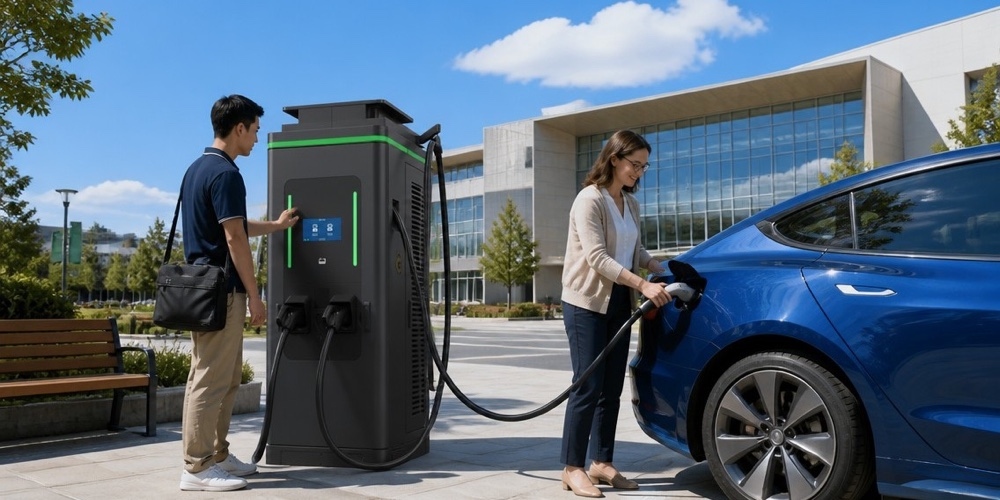
While the 150kW/240kW series is built on a unified power platform, the regional requirements for deployment vary significantly. MIDA Power (迈依达) provides regional-specific configurations to ensure compliance and market fit.
Europe: The Bastion of CCS2 and AFIR
In Europe, the Alternative Fuels Infrastructure Regulation (AFIR) is the primary driver. Our stations are configured for the 400V/50Hz grid and come with full CE and TUV certification. The focus in Europe is on “Ad-Hoc Payment” (integrated card readers) and “Interoperability.” By natively supporting OCPP 2.0.1, MIDA stations integrate seamlessly with major European roaming hubs like Hubject and Gireve, allowing a driver from Norway to charge at a MIDA station in Italy using their preferred app.
Asia-Pacific: The Diversity Challenge
In the APAC region, we see a mix of requirements. In markets like Thailand and Vietnam, the grid can be less stable, necessitating our “Wide Input Voltage” hardware that can handle fluctuations of ±20%. In markets like Singapore and Hong Kong, space is the primary constraint, making our high-density 240kW cabinet a popular choice for underground commercial developments.
Oceania: The Long-Distance Corridor
Australia and New Zealand represent the ultimate test for high-power charging. The “Ultra-Fast” requirement is driven by the massive distances between cities. MIDA’s 240kW station is used to build “Electric Corridors” across the Outback, where reliability in extreme heat (up to 50°C) is the most important metric. Our “Desert Package” includes specialized UV-resistant coatings and enhanced thermal management for these high-solar-load environments.
Detailed Multi-Site Case Studies: Real-World Performance Data
Case Study 1: The “Expressways of India” Project
Context: India is rapidly electrifying its highway network. A private infrastructure developer needed to install 100 fast-charging sites across the “Golden Quadrilateral” highway system. The Solution: MIDA provided one hundred 150kW Dual Gun stations. The stations were equipped with local language support on the touchscreens and integrated with India’s UPI (Unified Payments Interface) for seamless payments. Result: The project achieved an average uptime of 99.7% over the first year. The dual-gun feature was essential for handling the surge in electric buses and SUVs during holiday periods. The client reported that the MIDA hardware was the only one in their network that could sustain full power during the 45°C monsoon heat without tripping.
Case Study 2: Urban Fleet Electrification in London
Context: A major e-commerce delivery company needed to charge 60 electric vans at a central London sorting hub. The Solution: MIDA installed thirty 240kW Dual Gun stations. We utilized the OCPP 2.0.1 smart charging features to implement a “Load Balancing” algorithm. The depot had a total power limit of 3MW, but the potential draw of thirty 240kW chargers was 7.2MW. Result: The MIDA controller successfully managed the load, prioritizing vans based on their scheduled departure times. The hub was able to fully charge the entire fleet every night without ever exceeding the 3MW grid limit, saving the company millions in potential grid upgrade costs.
Case Study 3: The Norwegian “Fjord Corridor”
Context: A Norwegian municipality wanted to provide high-speed charging in a remote scenic area to encourage EV tourism. The site was subject to heavy snow and sub-zero temperatures for six months of the year. The Solution: MIDA provided two 240kW liquid-cooled stations with our “Arctic Package.” This included internal cabinet heaters and a specialized low-viscosity coolant for the cables. Result: The stations remained operational through a record-breaking -35°C winter. The liquid-cooled cables were a favorite among drivers, as they remained flexible and easy to handle even when buried in snow. The project has since become a blueprint for remote high-power charging in Northern Europe.
Installation and Commissioning: A Comprehensive Professional Guide
Installing a 240kW charging station is a complex engineering task that requires coordination between electrical contractors, civil engineers, and network administrators. MIDA Power provides a structured 4-step process to ensure a successful deployment.
Step 1: Site Analysis and Grid Preparation
Before a single bolt is turned, a thorough grid study is required. A 240kW station, when operating at full load with auxiliary systems, can draw up to 275kVA of power.
- Transformer Selection: MIDA recommends a dedicated 400V or 480V three-phase transformer for every two stations.
- Harmonic Mitigation: While MIDA chargers have integrated filters, a site-level harmonic study is recommended for hubs with more than four 240kW units to ensure compliance with utility regulations.
- Switchgear and Protection: A dedicated distribution board with industrial-grade circuit breakers (Type B RCD) and surge protection is required.
Step 2: Civil Works and Mounting
The 240kW station is a heavy piece of equipment, typically weighing between 500kg and 750kg.
- The Foundation: A reinforced concrete pad (minimum 150mm depth) is required. MIDA provides a precise bolt-pattern template for the anchor bolts.
- Conduit and Cabling: AC input cables must be sized according to local regulations (e.g., 240mm² or 300mm² copper). Low-voltage communication conduits for Ethernet or fiber optics should be kept at least 300mm away from the high-voltage lines to prevent EMI.
- Accessibility: The site should be designed to meet ADA (US) or EAA (EU) accessibility standards, ensuring that the charging bay is wide enough and the cable can reach the car’s port easily.
Step 3: Electrical Connection and Safety Testing
Once the station is mounted, the electrical connections are made.
- Torque Validation: All primary AC and DC connections must be torqued to MIDA’s specifications (typically 30-45 Nm) to prevent resistive heating.
- Grounding: A dedicated earth ground (≤4 ohms) is essential for the station’s safety systems to function correctly.
- Safety Audit: The contractor must perform an insulation resistance test and a ground bond test before the unit is energized.
Step 4: Commissioning and Network Integration
This is where the “Intelligence” of the station is activated.
- Firmware Verification: The technician ensures the station is running the latest MIDA firmware.
- OCPP Configuration: The station is pointed to the operator’s Backend URL using a secure WebSocket (WSS) connection.
- Simulated Session: Using a MIDA EV simulator, the technician verifies that the station can complete a handshake, initiate energy flow, and stop safely across both guns.
- Final Acceptance: A live charge with a vehicle is performed to verify the dynamic power allocation and the user interface.
Maintenance and Lifecycle: Maximizing Your High-Power Investment
A 240kW DC fast charger is a significant capital investment, and its long-term profitability depends on maintaining high uptime and low operating costs. At MIDA Power (迈依达), we design our stations for a 15-year operational lifecycle, supported by a proactive maintenance framework.
Total Cost of Ownership (TCO) Analysis
When evaluating a 240kW station, the initial purchase price is only part of the story. The TCO includes installation, energy losses, maintenance, and the potential revenue lost during downtime.
- Efficiency Savings: Our SiC-based 240kW station is ~4% more efficient than traditional IGBT chargers. For a station delivering 500,000 kWh per year, this saves 20,000 kWh of electricity. Over 10 years, at /bin/zsh.15/kWh, this is a ,000 direct saving.
- Reduced Maintenance Costs: The modular design allows for component-level repairs. Instead of replacing a ,000 charger because of a failed converter, you replace a ,000 module.
- Uptime and Revenue: A station that is down for one week per year loses significant revenue. MIDA’s OCPP 2.0.1 remote diagnostics reduce the “Time-to-Repair” by 70%, ensuring the station stays profitable.
The MIDA Maintenance Schedule
- Tier 1 (Monthly): Visual inspection of the exterior, cleaning the touchscreen, and checking the CCS2 connectors for debris or signs of arcing.
- Tier 2 (Quarterly): Cleaning or replacing the air intake filters. In high-pollution urban areas, this is critical to prevent the derating of power modules due to heat.
- Tier 3 (Annually): A full technical audit by a certified electrician. This includes opening the cabinet, checking the torque on all busbar connections, verifying the coolant level (for liquid-cooled units), and performing a full electrical safety validation.
- Tier 4 (As Needed): Remote firmware updates via the MIDA Cloud to add support for new vehicle models or enhance cybersecurity protocols.
Safety and Compliance Deep-Dive: The MIDA Standard for Protection
High-power charging involves the transfer of immense energy in a public setting. Safety is not an option; it is the foundation of our design.
Electrical Isolation and Fault Detection
Every MIDA 240kW station features 2.5kV of galvanic isolation between the AC grid and the DC output. This ensures that even in the event of a major internal failure, the high voltage from the grid cannot reach the vehicle or the user. We integrate advanced Insulation Monitoring Devices (IMDs) that constantly measure the resistance between the DC bus and the ground. If this resistance drops below the safety threshold, the system trips the DC contactors in less than 50 milliseconds.
Fire Safety and Suppression
For indoor parking garages or high-density urban hubs, fire safety is paramount. MIDA’s 240kW cabinet is constructed from non-combustible materials. We offer an optional integrated fire suppression system that uses a clean-agent gas to extinguish any internal electrical fire without damaging the other components in the cabinet. Furthermore, multiple temperature sensors are placed throughout the cabinet to provide early warning of thermal issues.
Global Compliance Standards
- IEC 61851: The international standard for electric vehicle conductive charging systems.
- ISO 15118: The standard for vehicle-to-grid communication and Plug & Charge.
- CE (European Conformity): Ensures the station meets all health, safety, and environmental protection standards for the EEA.
- UL 2202: The standard for DC fast charging equipment in North America (available in specific models).
- OCPP 2.0.1 Certification: Validates the station’s communication protocol for security and interoperability.
The Role of AI and Machine Learning in Modern Charging Networks
As charging networks grow, the complexity of managing them exceeds human capability. MIDA Power is integrating Artificial Intelligence (AI) directly into the 240kW series to optimize performance.
Predictive Maintenance Algorithms
Our cloud-based AI analyzes thousands of data points from our global fleet of chargers. By identifying the “signatures” of a failing component—such as a slight increase in harmonic distortion or a change in the cooling fan’s current draw—the system can predict a failure weeks before it happens. This allows operators to schedule a “Preventative Visit” rather than responding to an “Emergency Outage.”
AI-Driven Energy Management
In a smart city, the charger must be “Grid-Aware.” Our AI agents communicate with the local utility’s grid management system. During periods of peak demand, the AI can intelligently derate the output of the 240kW station by a small percentage (e.g., to 210kW). This is unnoticeable to the driver but prevents the local transformer from overloading and helps stabilize the entire city’s energy supply.
Smart User Interactions
We use machine learning to improve the user interface. By analyzing how drivers interact with the touchscreen, we have optimized the UI to be intuitive for all age groups and languages, reducing the “Session Initiation Failure” rate to near zero.
Comprehensive FAQ for the 150kW/240kW Dual Gun Series
Q1: What is the main advantage of 240kW over 150kW? A1: Higher throughput. A 240kW station can charge high-performance EVs at their peak rate and handle two 120kW charging sessions simultaneously, which is ideal for busy highway hubs.
Q2: Does MIDA provide the management software? A2: We offer the MIDA Cloud platform for advanced monitoring, but our chargers are fully OCPP 2.0.1 compliant and can integrate with any third-party network provider.
Q3: Can I upgrade a 150kW station to 240kW later? A3: Yes. The cabinet is designed to be modular. As long as your site has the electrical capacity, you can add more MIDA 30kW/40kW power modules to increase the total output.
Q4: How does the station handle different EV models? A4: Our CCS2 interface and advanced controller support the DIN 70121 and ISO 15118 protocols, ensuring compatibility with almost every EV brand in Europe, Asia, and Oceania.
Q5: What is the benefit of OCPP 2.0.1 for my business? A5: It provides significantly better security, more detailed remote diagnostics, and better support for smart charging features compared to the olderOCPP 1.6J protocol. It also aligns your network with European smart-charging regulations and prepares your infrastructure for ISO 15118 Plug & Charge and V2G applications.
Q6: How do MIDA’s chargers handle cold weather or extreme heat? A6: Every station is rated for operation from -30°C to +55°C. Our thermal management system — combining smart PWM-controlled fans with optional liquid cooling for high-power cables — keeps the power electronics at optimal temperature across all seasons, without excessive noise.
Q7: What level of after-sales support can I expect? A7: Every MIDA station is covered by a 3-year warranty extendable to 10 years, 24/7 remote monitoring through the MIDA Cloud or your own OCPP platform, and guaranteed spare parts availability for 15 years. Our global service network ensures rapid response for any maintenance need.
Q8: Can MIDA help with site planning and installation? A8: Yes. Our engineering team provides site surveys, electrical design support, and grid-connection guidance, and our certified commissioning partners handle the on-site installation and bring-up — from a single bus depot to a citywide network.
Q9: How does the dual-gun configuration share power? A9: The 150kW/240kW dual-gun cabinets use intelligent power distribution. When one vehicle is charging, it receives the full cabinet output; when two are connected, power is allocated dynamically — for example, 120kW + 120kW on a 240kW cabinet — so neither driver is left waiting unnecessarily.
Q10: Does MIDA offer energy storage integration for depots? A10: Yes. MIDA’s BESS solutions can be paired with any station in the series to provide peak shaving, solar integration, and backup power. Our EMS coordinates battery, grid, and charger operation automatically, cutting demand charges and enabling depot microgrids.
Final Word: Efficiency You Can Measure
The modular 120kW, 150kW, and 180kW CCS2 series is the result of a simple conviction: a charging network should be an asset that pays for itself, not a maintenance burden. Every design decision — from the high-density SiC modules to the smart standby management and AI-driven energy optimization — is aimed at one goal: delivering more useful energy per dollar, per kilowatt, and per year.
That conviction is backed by hard numbers. Operators running MIDA stations consistently report lower energy costs per session, higher availability, and dramatically simpler maintenance than with legacy equipment. For transit agencies under pressure to electrify on tight budgets, that combination is the difference between a pilot project and a permanent network.
Key Takeaways
- Modular 30kW/40kW SiC modules scale your stations from 120kW to 240kW as demand grows.
- OCPP 2.0.1 and ISO 15118 readiness future-proof your network for smart charging and Plug & Charge.
- 150kW/240kW dual-gun configurations maximize throughput at busy bus terminals and highway hubs.
- AI-driven energy management and sub-80W standby power cut operating costs across your fleet.
- Optional BESS integration enables peak shaving, solar capture, and depot backup power.
Call to Action
Ready to build a bus-charging network that maximizes efficiency and minimizes cost? Contact MIDA Power today for a tailored proposal, technical documentation, and a free ROI analysis for your routes.
MIDA Power: Precision Engineering for a Sustainable World.
- Sales Inquiry: sales@midapower.com
- Technical Support: sales@midapower.com
- Web: www.midapower.com
Post time: Aug-09-2026
