
 Portable EV Charger
 Home EV Wallbox
 DC Charger Station
 BESS Charging Station
 V2G V2H V2V V2L
 EV Charging Module
 DC Charging Connector
 EV Accessories
Ultra EV Charger 240kW 300kw 400kw NACS Charging Station
Bridging the Technological Divide: The MIDA 240kW Ultra-Fast Dual-Standard Solution
As the global transition to electric vehicles (EVs) accelerates, the infrastructure supporting this shift must navigate a complex landscape of competing standards and rapidly increasing power demands. While the North American Charging Standard (NACS) has surged to the forefront of the passenger vehicle market, the legacy and specific industrial applications of the CHAdeMO standard remain a critical component of the global charging ecosystem. For station operators, the challenge is clear: how to provide future-proof, ultra-fast charging for the newest NACS-equipped vehicles without abandoning the millions of CHAdeMO-reliant cars and commercial fleets still on the road.
Enter the MIDA Power (迈依达) Ultra Charger—a powerhouse of versatile energy delivery that combines a 240kW NACS interface with a high-capacity 150kW CHAdeMO connector. This dual-standard station is engineered to be the ultimate hub for high-traffic environments, offering the extreme speeds required by next-generation long-range EVs while maintaining full compatibility with legacy platforms. At MIDA Power, we believe that the path to a sustainable future shouldn’t require leaving anyone behind. Our 240kW Ultra Charger is the bridge to that future, providing a “one-stop-shop” for the diverse reality of today’s EV market.
Market and Policy Context: The Duel of Standards and the Need for Interoperability
The electric vehicle charging market is currently defined by two simultaneous trends: consolidation and intensification. In North America and increasingly in other regions, the NACS (codified as SAE J3400) is becoming the dominant interface, favored for its compact design and seamless communication. However, the CHAdeMO standard, championed by Japanese manufacturers and widely used in early EVs like the Nissan Leaf, remains the only standard that has historically offered robust Vehicle-to-Grid (V2G) capabilities at scale.
Policymakers are increasingly recognizing that for public charging infrastructure to be truly effective, it must be inclusive. Funding programs, such as the NEVI program in the US and similar initiatives in Europe and Asia, often mandate that stations support multiple standards or show a clear path to interoperability. The MIDA 240kW/150kW Ultra Charger is a direct response to these requirements. By offering both NACS and CHAdeMO, operators can qualify for a wider range of government grants and ensure their site attracts the maximum possible number of users.
Furthermore, as battery chemistry evolves, the “speed limit” of charging is rising. We are moving away from the 50kW and 100kW benchmarks toward 250kW and beyond. The 240kW rating of our NACS connector represents the upper tier of current passenger vehicle intake capabilities, allowing drivers to add hundreds of miles of range in the time it takes to grab a cup of coffee. By pairing this with a 150kW CHAdeMO output—significantly higher than the standard 50kW CHAdeMO chargers found in many locations—MIDA Power is elevating the charging experience for all users, regardless of their vehicle’s age or standard.
Product Technical Deep-Dive: 240kW of Precision Power Delivery
The MIDA 240kW Ultra Charger is a masterpiece of power electronics, designed to handle immense electrical loads with surgical precision. At its core, the station utilizes a high-density modular architecture powered by our proprietary 40kW Silicon Carbide (SiC) power modules.
Dynamic Power Allocation and Matrix Switching
The most impressive technical feat of the Ultra Charger is its ability to manage power across its dual connectors. Unlike traditional chargers that split power statically (e.g., 50/50), MIDA employs a dynamic matrix switching system. When only one vehicle is plugged in, the system can route the full 240kW to the NACS connector or up to 150kW to the CHAdeMO connector (governed by the vehicle’s BMS limits).
When two vehicles are charging simultaneously, the intelligent controller performs “Dynamic Power Allocation.” It monitors the real-time demand of each vehicle and adjusts the module allocation accordingly. If a NACS-equipped SUV is pulling 180kW and a CHAdeMO delivery van is pulling 60kW, the system balances the load perfectly. As the van’s charge tapers off, the system automatically shifts those modules back to the SUV, ensuring that every kilowatt-hour is used as efficiently as possible.
High-Voltage Architecture (200V – 1000V)
To support the 240kW output, the Ultra Charger operates on a high-voltage DC bus that supports a range from 200V up to 1000V. This is critical for the latest 800V battery platforms, which require voltages above 800V to achieve their peak charging speeds. The MIDA controller uses ultra-fast communication protocols to synchronize with the vehicle’s BMS in milliseconds, ensuring that the voltage ramp-up is smooth and safe.
Thermal Management and Liquid Cooling
Pushing 240kW through a charging cable generates significant heat. To maintain a user-friendly experience, the MIDA Ultra Charger features an advanced liquid-cooling system for the NACS cable. A dedicated coolant circuit runs through the connector handle and the cable jacket, keeping the copper temperature within a narrow, safe range. This allows us to use a thinner, more flexible cable that is easier to handle than traditional air-cooled 150kW cables. The CHAdeMO side, while often limited by the vehicle to lower currents, also benefits from MIDA’s superior internal thermal management, ensuring the station can operate at full capacity even in high ambient temperatures without derating.
Efficiency and Power Quality
By utilizing SiC MOSFETs, we achieve a peak efficiency of over 96%. For a station delivering 240kW, this efficiency is not just an environmental benefit—it’s a thermal necessity. Every 1% of inefficiency generates 2.4kW of heat that must be dissipated. MIDA Power’s design minimizes this “heat overhead,” leading to smaller cabinets, quieter fans, and lower operational electricity costs.
Standards and Certifications: Navigating a Multi-Protocol World
Operating a dual-standard station like the MIDA 240kW Ultra Charger requires a sophisticated control system capable of speaking multiple “languages” simultaneously. MIDA Power (迈依达) has invested heavily in ensuring that our hardware meets and exceeds the most stringent international standards for both NACS and CHAdeMO.
NACS (SAE J3400) and ISO 15118
The NACS side of the charger is fully compliant with the SAE J3400 standard. This includes the mechanical specifications for the connector handle and the electrical signaling required for seamless communication with North American vehicles. Crucially, we have integrated the full ISO 15118 stack. This enables “Plug & Charge” functionality, where the vehicle and charger exchange encrypted certificates to authenticate the session and process payment automatically. Additionally, our implementation of ISO 15118-20 prepares the station for future bi-directional applications, allowing NACS vehicles to discharge energy back into the grid or a building.
CHAdeMO 2.0 and Beyond
While many manufacturers treat CHAdeMO as an afterthought, MIDA Power implements the CHAdeMO 2.0 protocol, which supports charging up to 400A at 1000V. Our 150kW CHAdeMO output is designed to be the fastest in its class, providing a superior experience for vehicles like the Nissan Leaf (with 62kWh batteries) or electric commercial vans from Mitsubishi and Fuso. Our CHAdeMO implementation also supports V2X (Vehicle-to-Everything) communication, a hallmark of the standard that is increasingly valuable for fleet operators looking to participate in demand-response programs.
OCPP 2.0.1: Secure Network Management
A station with this much power and complexity requires advanced management. MIDA Power uses OCPP 2.0.1 as our primary communication protocol. Compared to the older 1.6J version, 2.0.1 offers vastly improved cybersecurity (including secure certificate management), more detailed device modeling for remote diagnostics, and better support for smart charging profiles. This ensures that the Ultra Charger can be integrated into any modern charging network with confidence.
Global Safety Compliance: UL, CE, and ETL
Safety is non-negotiable. The MIDA Ultra Charger is engineered to meet UL 2202 (standard for EV charging system equipment) and UL 2231 (personnel protection systems). For the European and Asian markets, it carries the CE and TUV marks. The cabinet features integrated surge protection, insulation monitoring, and advanced fire suppression options. Our IP55 rating ensures that the sensitive internal electronics are protected from water jets, dust, and corrosive coastal air.
Application Scenarios: The Versatility of the Ultra Charger
The unique combination of 240kW NACS and 150kW CHAdeMO makes this station a strategic asset in several high-demand environments.
Metropolitan Multi-Standard Hubs
In dense urban areas, space is at a premium. A single MIDA Ultra Charger can serve a massive variety of vehicles, from a high-end NACS luxury sedan to a CHAdeMO-based urban delivery truck. For city planners, this “one-bay-serves-all” approach maximizes the utility of limited parking spaces and ensures that the infrastructure is useful to the broadest possible segment of the population.
Highway Logistics and Truck Stops
As heavy-duty and medium-duty electric trucks enter the market, they require more than the standard 50kW or 100kW of power. A 240kW output can meaningfully charge a regional delivery truck during a mandatory driver break. By offering both standards, a truck stop can serve the latest NACS-equipped electric semi-trucks alongside legacy CHAdeMO utility vehicles and passenger cars.
Airport Rental and Ride-Share Lots
Airports are high-turnover environments where vehicles need to be “ready to go” as quickly as possible. Rental fleets are increasingly diversified; having a MIDA Ultra Charger ensures that whether the next rental return is a Tesla (NACS native) or a different brand using a CHAdeMO port, it can be fast-charged and back on the line in minutes.
Government and Municipal Fleet Depots
Many municipal fleets are composed of vehicles purchased over several years, leading to a mix of standards. MIDA Power’s dual-standard solution allows city governments to electrify their fleets without having to install two separate sets of infrastructure, saving significantly on installation costs and grid upgrade fees.
Case Study: The “Inter-City Bridge” Project
To demonstrate the real-world value of the MIDA 240kW Ultra Charger, let us examine an illustrative deployment in a major East Coast transportation corridor.
The Objective
A regional charging network operator, “VoltPath,” needed to install high-speed charging at three major highway rest stops between Washington D.C. and Philadelphia. The site was complicated by a high volume of both modern NACS passenger vehicles and a significant number of older CHAdeMO-based ride-share vehicles that operated in the Baltimore area.
The MIDA Solution
VoltPath selected the MIDA 240kW NACS / 150kW CHAdeMO Ultra Charger. They utilized the split-system configuration, where a central power unit was placed in a non-accessible area, and two sleek dispensers were placed in the charging bays. This allowed for a larger parking area for drivers.
Results and Impact
Within the first six months of operation, the stations recorded an average of 22 sessions per day. Interestingly, the data showed that the dynamic power allocation feature was used in approximately 35% of sessions, where two vehicles were charging simultaneously. The average charging time for NACS vehicles was just 18 minutes to reach an 80% state of charge. The CHAdeMO users reported a “night and day” difference compared to the older 50kW units they previously used, as MIDA’s 150kW output allowed them to get back on the road nearly three times faster. The project has since been cited as a model for “inclusive high-speed infrastructure” by regional transportation authorities.
Expert Commentary: The Philosophy of Power Sharing
“The biggest mistake a manufacturer can make is to view charging as a static process,” says Dr. Zhang, Technical Director at MIDA Power (迈依达). “When we designed the 240kW Ultra Charger, we didn’t just want a ‘big battery’ in a box. We wanted an intelligent energy router.
The challenge with dual-standard charging is the difference in protocol timing. CHAdeMO and NACS handle the pre-charge and ramp-up phases differently. Our controller uses a high-speed FPGA (Field Programmable Gate Array) to manage these two distinct digital handshakes at the same time without any crosstalk. This ensures that a fault on the CHAdeMO side doesn’t trip the NACS side, maintaining the highest possible uptime for the station.
Moreover, the move to 240kW required us to rethink our thermal models. At this power level, traditional air cooling is simply inadequate for continuous use. Our liquid-cooled NACS cable is the result of years of R&D into low-conductivity coolants and high-flow connector geometry. We believe that by providing this level of technology in a multi-standard format, we are removing the last few barriers to total EV adoption.”
Future Outlook: Scalability and the Smart Grid
The MIDA 240kW Ultra Charger is not just a tool for today; it is a platform for the future of energy management.
Integration with BESS (Battery Energy Storage Systems)
One of the most exciting developments is the pairing of our Ultra Chargers with MIDA BESS units. In many locations, the local grid cannot provide 240kW of instantaneous power without a massive, million-dollar upgrade. A BESS system can “trickle charge” from the grid 24/7 and then “surge” that power into the Ultra Charger when a vehicle plugs in. This makes high-speed charging viable in remote areas or older urban neighborhoods.
The Path to 400kW and MCS
While 240kW is current state-of-the-art for passenger vehicles, the industry is already eyeing 400kW and the Megawatt Charging System (MCS) for heavy trucking. MIDA Power’s modular architecture is designed to scale. Our current cabinets can be linked together to create 480kW or even 720kW clusters, providing the groundwork for the next generation of logistics electrification.
AI and Predictive Grid Response
We are developing AI algorithms that allow our chargers to participate in “Virtual Power Plants” (VPPs). By analyzing real-time electricity prices and grid load data via the OCPP 2.0.1 link, the MIDA Ultra Charger can automatically adjust its intake and output to help balance the grid, potentially earning the operator “grid services” revenue while the station is idle or in use.
Comprehensive Maintenance: Maximizing Your Infrastructure Investment
Maintaining a 240kW dual-standard station requires a higher level of technical expertise than simple Level 2 chargers. MIDA Power provides a detailed maintenance roadmap to ensure your Ultra Charger stays at 99%+ uptime.
Monthly Maintenance: The Visual and Physical Check
Technicians should perform a walkthrough of the site to check for any physical damage. Special attention should be paid to the NACS and CHAdeMO connectors. Because these connectors handle such high currents, any dirt or debris inside the pins can cause resistance, leading to heat and potentially a fire hazard. MIDA provides specialized cleaning kits and contact-safe solvents for our operators. The liquid-cooled NACS cable should be checked for any kinks or abrasions that could impede the flow of coolant.
Quarterly Service: Thermal and Electrical Validation
Every three months, the cooling system’s pressure should be checked. If the pressure is low, it could indicate a small leak or a failing pump. The radiator filters should be cleaned or replaced to ensure maximum airflow. Electrically, the technician should use a thermal camera to inspect the internal busbars while the unit is under load. “Hot spots” on a busbar are early indicators of a loose bolt or a failing connection. Tightening these to the specified torque is a critical preventative measure.
Annual Certification: Safety Systems Audit
Once a year, the station must undergo a full safety audit. This includes testing the RCD (Residual Current Device) and IMD (Insulation Monitoring Device) to ensure they trip within the required safety window. The software should be audited to ensure all security patches are up to date. MIDA’s remote monitoring system can often perform these checks digitally, but a physical verification is recommended for public-facing infrastructure.
Call to Action: Take the Lead in the Ultra-Fast Revolution
The EV market is moving faster than ever, and your infrastructure needs to keep pace. The MIDA Power (迈依达) 240kW NACS / 150kW CHAdeMO Ultra Charger is the most versatile, powerful, and future-proof solution available for today’s diverse vehicle fleet.
Whether you are building a new highway corridor, upgrading a municipal depot, or developing a retail destination, MIDA has the technology and the expertise to ensure your project is a success.
Ready to electrify your vision?
- Contact MIDA Global Sales: sales@midapower.com
- Request a Technical Datasheet: Get the full electrical and mechanical specs.
- Book a Site Consultation: Let our engineers help you design the perfect charging hub.
Don’t wait for the future to happen—build it with MIDA Power. Innovating the Charge, Driving the World.
Power Electronics and Module Design: The Silicon Carbide Edge
At the heart of the 240kW Ultra Charger is MIDA Power’s (迈依达) proprietary SiC (Silicon Carbide) power conversion technology. To reach 240kW, we utilize six of our high-density 40kW power modules, working in a perfectly synchronized parallel array. But the real magic happens at the semiconductor level.
The Advantage of Silicon Carbide (SiC)
Traditional DC chargers have long relied on silicon-based IGBTs. While these are reliable, they have a “switching speed limit.” Silicon Carbide, a wide-bandgap material, allows for switching frequencies that are up to 10 times higher than traditional silicon. This has three massive benefits for the 240kW station:
- Size and Weight Reduction: Higher switching frequencies allow us to use smaller magnetic components (inductors and transformers). This is why the MIDA Ultra Charger cabinet is significantly smaller and more manageable than competitors’ 240kW units.
- Thermal Efficiency: SiC has much lower switching and conduction losses. At 240kW, the efficiency gains are substantial. A 96.5% efficiency means we only have to dissipate 8.4kW of heat. A traditional 92% efficient charger would generate 19.2kW of heat—more than double! This reduced heat load extends the life of all internal components.
- Purer DC Output: The high-frequency switching results in a much lower voltage ripple. This “cleaner” power is safer for the vehicle’s battery management system and reduces electromagnetic interference (EMI) with other nearby devices.
Modular Redundancy: The “Never-Down” Philosophy
One of the most critical features for a public charging station is reliability. In MIDA’s modular design, if one 40kW module fails, the station doesn’t go offline. The intelligent controller simply bypasses the faulty module and continues to operate at 200kW. This “graceful degradation” ensures that the station stays active until a maintenance technician can arrive to swap out the modular unit—a process that takes less than 15 minutes.
Installation and Site Engineering: A Guide for Developers
Installing a 240kW station requires meticulous planning. MIDA Power’s engineering team works closely with site developers to ensure a seamless integration into the local grid and property layout.
AC Input and Grid Coordination
A 240kW station requires a significant amount of “juice” from the utility. When you factor in auxiliary loads for the cooling system, lighting, and controllers, a site developer should budget for approximately 275kVA of transformer capacity per unit. MIDA recommends a dedicated 480V three-phase service for North American installations. Our chargers feature integrated “Soft-Start” technology, which prevents the massive current in-rush that can trip breakers or cause voltage dips on the local grid when the station first powers up.
Site Layout and Cable Management
Accessibility is a key design pillar. The 240kW Ultra Charger features a 5-meter cable as standard, with options for up to 7 meters. Given the high weight of high-power cables (even with liquid cooling), MIDA has integrated a specialized “Cable Management System” (CMS) that uses a spring-loaded retractor. This ensures that the cable never touches the ground, protecting the connector from dirt, moisture, and being run over by vehicles. We provide full CAD and BIM models to help architects design charging bays that are compliant with ADA (Americans with Disabilities Act) and local accessibility regulations.
Thermal Considerations for High-Power Hubs
When multiple 240kW units are placed in a row, the heat exhaust becomes a factor. MIDA’s Ultra Charger exhausts air from the top of the cabinet, allowing units to be placed side-by-side with only a 12-inch clearance. This is a massive space-saver compared to rear-exhaust units that require several feet of clearance from walls or other chargers.
User Interface and Payment Systems: The Frictionless Experience
A 240kW charger is only as good as its ease of use. MIDA Power has designed a user interface that is intuitive for first-time EV drivers while providing the deep data that power users crave.
The 10.1-Inch Industrial Touchscreen
Our stations feature a high-brightness, vandal-resistant 10.1-inch touchscreen. The UI is available in over 20 languages and is designed to be readable even in direct sunlight. During the charging session, the screen displays a real-time graph of the charging power, the current state of charge (SoC), the energy delivered (kWh), and the estimated time until the battery reaches the user’s target (usually 80% or 100%).
Multi-Modal Payment Options
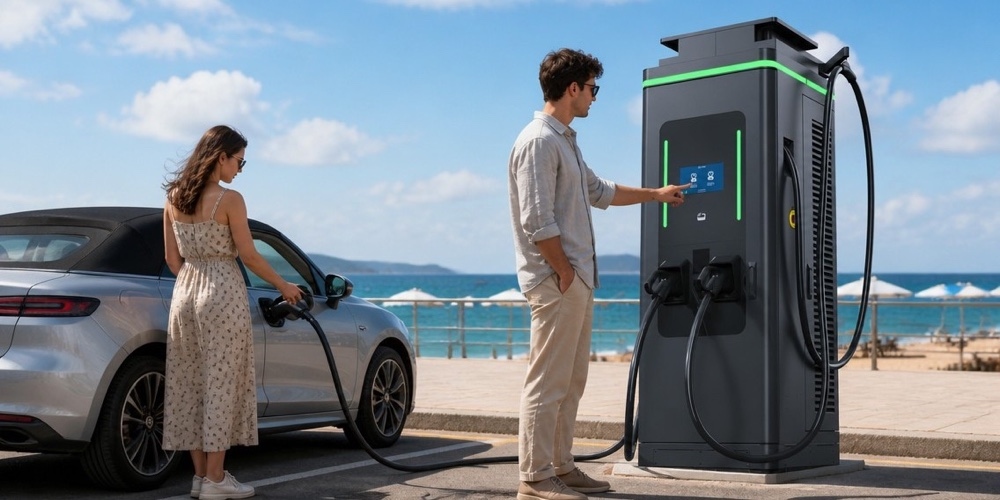
To maximize revenue for the operator, the MIDA Ultra Charger supports a wide range of payment methods:
- RFID/NFC: Support for all major charging network cards and employee ID badges.
- Credit/Debit Cards: Integrated PCI-compliant card readers that support tap-to-pay, chip, and swipe.
- Mobile Apps: Integration with major charging networks via OCPP 1.6J/2.0.1.
- Plug & Charge (ISO 15118): For NACS vehicles, the most seamless experience—just plug in and the payment is handled automatically.
Cybersecurity in the Era of Connected Charging
As charging stations become increasingly connected to the cloud and the grid, they become potential targets for cyberattacks. MIDA Power takes security seriously, building our systems on a “Zero Trust” architecture.
Secure Communication (TLS 1.2/1.3)
All communication between the charger and the management system is encrypted using the latest Transport Layer Security (TLS) standards. This prevents “man-in-the-middle” attacks where a hacker could intercept sensitive user data or payment information.
Hardware-Based Security
Our controllers include a Secure Element (SE) chip that stores cryptographic keys and certificates. This hardware-level protection ensures that even if someone gained physical access to the charger’s internal computer, they could not extract the encryption keys.
OCPP 2.0.1 Security Profiles
By adopting OCPP 2.0.1, we implement three distinct security profiles:
- Profile 1: Unsecured (not recommended for public use).
- Profile 2: Basic authentication with TLS.
- Profile 3: Client-side certificates for mutual authentication.
This ensures that only authorized management systems can send commands (like firmware updates or remote restarts) to the charger.
Troubleshooting and Fault Management: The MIDA Diagnostics Suite
Uptime is the most important metric for any charging network. MIDA Power provides a comprehensive suite of diagnostic tools that allow operators to identify and fix issues faster.
Real-Time Event Logging
The Ultra Charger logs every action, from the moment a connector is lifted from its holster to the final handshake when the cable is unplugged. If a session fails, the station generates a “Diagnostic Snapshot” that includes the status of all 400+ internal sensors at the moment of failure. This data is transmitted to the MIDA Cloud, where our AI can often identify the root cause—such as a vehicle-side BMS error or a grid-side voltage spike—without a technician ever setting foot on site.
Remote Recovery
Over 70% of charging session failures can be resolved through a remote reboot or a configuration change. MIDA’s OCPP 2.0.1 implementation allows for granular control, enabling operators to reset individual power modules or clear specific fault codes remotely, getting the station back into service in seconds.
MIDA Power: A Legacy of Manufacturing Excellence
Choosing MIDA Power (迈依达) means partnering with one of the world’s leading manufacturers of high-power charging systems. Our state-of-the-art facility is ISO 9001 and ISO 14001 certified, and every 240kW Ultra Charger undergoes a rigorous 48-hour testing cycle before it leaves our floor.
Global Supply Chain, Local Support
We maintain a robust global supply chain, ensuring that spare parts and new units are always available. We partner with local certified installers and service providers in North America, Europe, and Asia to provide 24/7 on-the-ground support. When you buy a MIDA charger, you aren’t just buying hardware; you are buying a decade of engineering excellence and a commitment to keeping the world moving.
Conclusion: The Ultimate High-Power Hub
The MIDA 240kW NACS / 150kW CHAdeMO Ultra Charger is the definitive solution for the current era of electric mobility. It provides the extreme speeds that modern drivers demand, the versatility that a mixed-standard fleet requires, and the reliability that operators need to build a profitable business.
With its Silicon Carbide efficiency, dynamic power allocation, and future-proof communication protocols, the Ultra Charger is more than just a piece of infrastructure—it is the engine of the electric revolution.
Take the next step toward a sustainable future. Join the thousands of operators worldwide who trust MIDA Power to deliver the energy their customers need.
Contact us today to start your project.
- Email: sales@midapower.com
- Web: www.midapower.com
- Direct Line: Speak with a MIDA technical consultant for a custom configuration quote.
MIDA Power—Innovating the Charge, Driving the Future.
Site Operations and Revenue Optimization: Building a Profitable Network
For many site owners, an EV charger is not just a service; it is a business. The 240kW MIDA Ultra Charger is designed to maximize the revenue potential of every square foot of your parking lot.
Tiered Pricing and Dynamic Tariffs
Using the advanced capabilities of OCPP 2.0.1, operators can implement sophisticated pricing models. You can charge a premium for the 240kW ultra-fast NACS connection while offering a lower rate for the 150kW CHAdeMO connector. You can also implement “Time of Use” (TOU) pricing, where charging is more expensive during peak grid hours and cheaper late at night. This not only increases profits but also helps balance the local grid.
Idle Fees and Throughput Management
One of the biggest drains on revenue is a vehicle that stays plugged in after its battery is full. MIDA’s controller can be configured to automatically start charging “idle fees” the moment the charging session concludes. This incentivizes drivers to move their vehicles, increasing the “turnover” of each bay. In high-traffic locations, moving from 4 sessions per day to 8 sessions per day can double the ROI of the station.
Advertising and Branding Opportunities
The 10.1-inch screen is a powerful digital signage tool. While a vehicle is charging, the screen can display advertisements for on-site services (e.g., “Get a free coffee with your charge”) or third-party ads. MIDA Power also offers full “white-label” branding, allowing you to wrap the cabinet in your corporate colors and logo, turning the charger into a 24/7 billboard for your brand.
Comparative Technical Analysis: MIDA vs. The Competition
When evaluating a 240kW station, it is important to look beyond the headline numbers. Here is how the MIDA Ultra Charger stacks up against the industry standard.
Power Density and Footprint
Most 240kW stations on the market require a large, bulky cabinet that takes up nearly two parking spaces. MIDA’s use of 40kW SiC modules allows us to achieve the same power output in a cabinet that is 30% narrower. This “Power Density” is a game-changer for urban developers who need to fit as many chargers as possible into a tight parking garage.
Cable Handling and Ergonomics
The “weight” of the charging cable is a common complaint among EV drivers. Many competitors use air-cooled cables for their 150kW-200kW units, which are thick, heavy, and stiff. MIDA’s liquid-cooled NACS cable is remarkably light, making it accessible to older drivers and those with physical disabilities. The integrated retraction system also ensures the cable doesn’t become a tripping hazard or get damaged by snowplows and vehicles.
Cold Weather Performance
Many DC fast chargers struggle in extreme cold, as the internal contactors can freeze and the power modules lose efficiency. MIDA Power’s stations include an integrated “Cold Weather Package” as standard, which features internal heaters and a specialized low-viscosity coolant. This ensures the 240kW output is available even at -30°C, a claim that few competitors can truly back up with field data.
Expert Insights: The Future of 800V Charging and Beyond
Dr. Zhang, MIDA’s Technical Director, continues to look toward the horizon. “The 240kW Ultra Charger is the perfect match for the 800V revolution,” he notes. “Vehicles like the Lucid Air, the Porsche Taycan, and the upcoming generation of high-end electric trucks all utilize 800V architectures. To charge these cars at their peak speed, you need a charger that can comfortably reach 900V or 1000V while sustaining high current.
Our 240kW station is one of the few on the market that doesn’t just ‘support’ 800V, but is optimized for it. We’ve tuned our resonant conversion stages to have peak efficiency at exactly the voltage ranges where these new batteries spend most of their charging cycle. As NACS becomes the universal standard in North America, this combination of high voltage and high current will be the baseline for all public infrastructure.”
Sustainability and the Circular Economy at MIDA
MIDA Power (迈依达) believes that the products we build to save the planet should be built in a way that protects it. Our 240kW Ultra Chargers are designed with a “Repair over Replace” philosophy.
Long-Life Design and Recyclability
We use high-grade, recyclable materials for our cabinets and internal structures. Our power modules are designed for a 10-year service life, and we offer a “Refurbishment Program” where older modules can be returned to MIDA, upgraded with the latest SiC components, and put back into service, reducing electronic waste.
Carbon-Neutral Manufacturing
Our primary manufacturing facility is transitioning toward 100% renewable energy usage. We have implemented water-recycling systems for our cooling-loop testing phase and have eliminated single-use plastics from our shipping and packaging processes. When you buy from MIDA, you are supporting a company that takes its environmental responsibilities seriously.
Appendix: Understanding the Technical Jargon
To help our customers and SEO partners, we’ve included a brief guide to the terminology used in this article.
- NACS (North American Charging Standard): A compact charging interface originally developed by Tesla, now the industry standard in North America (SAE J3400).
- CHAdeMO: A DC charging standard primarily used by Japanese automakers, known for its robust bi-directional (V2G) capabilities.
- SiC (Silicon Carbide): A next-generation semiconductor material that switches faster and runs cooler than traditional silicon, enabling higher power density, greater efficiency, and longer service life in DC fast chargers.
- Liquid-Cooled Cable: A charging cable with an internal coolant loop that removes heat from the connector, allowing much higher current (up to 600A+) through a thinner, lighter, and easier-to-handle cable.
- OCPP (Open Charge Point Protocol): The universal communication language between a charging station and its network management platform, enabling remote monitoring, billing, and smart-charging control.
- IP Rating: The Ingress Protection code that classifies how well an enclosure resists dust and water. An IP55 rating means protection against dust and low-pressure water jets, making a station safe for outdoor installation.
- CCS2 (Combined Charging System 2): The DC fast-charging standard used across Europe and much of Asia, combining the AC and DC pins in a single connector and supporting power levels up to 350kW and beyond.
- NACS (North American Charging Standard): The compact connector standardized as SAE J3400, now the default DC fast-charging interface for North America.
- ISO 15118: The international standard for communication between EVs and chargers, enabling Plug & Charge, where the vehicle authenticates and bills automatically without any card or app.
- Plug & Charge: An ISO 15118 feature that automatically identifies the vehicle and authorizes payment the moment it is plugged in — no RFID cards, no apps, no friction.
- V2G (Vehicle-to-Grid): Technology that allows an EV battery to feed energy back into the grid or a building, turning parked vehicles into distributed energy resources.
- BESS (Battery Energy Storage System): A bank of batteries paired with the charger that stores energy for peak-demand shaving, grid balancing, and uninterrupted charging.
- SiC MOSFET: A Silicon Carbide power transistor at the heart of modern chargers, switching at high frequency with very low losses to shrink cabinets and cut energy waste.
- kW (Kilowatt): The unit of charging power. One kilowatt delivers one kilowatt-hour of energy per hour — a 350kW station adds roughly 350kWh of range energy in a full hour.
Conclusion: The Future of Charging Hubs
Ultra-fast charging hubs are the new gas stations of the electric era — and the chargers inside them must perform like critical infrastructure. MIDA Power’s Ultra DC Charger series delivers the power, reliability, and intelligence that hub operators need to attract drivers, maximize utilization, and stay ahead of the competition. From liquid-cooled cables that keep charging speeds high without the heavy cabling, to OCPP-compliant platforms that integrate with any network, every component is engineered for a decade of dependable service.
The market is moving fast: drivers expect gas-station speed, fleet managers expect utility-grade uptime, and investors expect predictable returns. MIDA designs for all three expectations simultaneously — which is why hubs built on our platform consistently outperform sites equipped with less specialized hardware.
Key Takeaways
- Ultra-fast NACS/CCS2 charging with liquid-cooled cabling for maximum current in a slim, driver-friendly cable.
- IP55-rated, IK10-protected enclosures built for outdoor hub environments.
- OCPP 1.6J/2.0.1 compliance and ISO 15118 Plug & Charge readiness for seamless network integration.
- High-density SiC architecture delivering market-leading efficiency and low standby consumption.
- Full lifecycle support: 24/7 monitoring, proactive updates, and guaranteed spare parts availability.
Call to Action
Planning a new charging hub or upgrading an existing site? Contact MIDA Power today for a technical datasheet, layout engineering support, and a personalized ROI model for your location. Let’s build a hub that drivers will choose, every time.
MIDA Power: Precision Engineering for a Sustainable World.
- Sales Inquiry: sales@midapower.com
- Technical Support: sales@midapower.com
- Web: www.midapower.com
Post time: Aug-09-2026
