
 Portable EV Charger
 Home EV Wallbox
 DC Charger Station
 BESS Charging Station
 V2G V2H V2V V2L
 EV Charging Module
 DC Charging Connector
 EV Accessories
180kW 240KW 360kW CCS2 Liquid Cooling DC Fast Charging Station
Headline: The Vanguard of High-Voltage Mobility: MIDA Power’s 180kW-360kW CCS2 Liquid-Cooled Ultra-Fast Charging Series Sets New Global Benchmarks
The transition to electric vehicles (EVs) has moved beyond the “early adopter” phase and entered the realm of mass-market dominance. As automotive giants like Porsche, Hyundai, Kia, and Lucid push the boundaries of battery technology with 800V and even 900V architectures, the infrastructure supporting these vehicles must undergo a radical transformation. MIDA Power (迈依达), a premier global manufacturer of advanced energy solutions, is proud to announce the commercial availability of its 180kW and 360kW CCS2 Liquid-Cooled DC Fast Charging Stations. Designed to operate at up to 1000V, these stations represent the technological zenith of the current charging landscape. By combining high-efficiency power modules with cutting-edge thermal management, MIDA is not just providing a piece of hardware; we are providing the foundation for a seamless, cross-continental electric transport network. This series is engineered to solve the triple challenge of modern charging: speed, reliability, and user-centric design. Whether it is a solo traveler crossing the Alps or a fleet of electric delivery trucks operating 24/7 in an urban center, MIDA’s liquid-cooled stations deliver the performance required to keep the world moving sustainably.
Market & Policy Context: Navigating the Global Regulatory Landscape and Energy Transition
The global impetus for EV adoption is driven by a convergence of environmental urgency and legislative mandates. In the European Union, the “Fit for 55″ initiative aims to reduce greenhouse gas emissions by at least 55% by 2030. A key pillar of this strategy is the Alternative Fuels Infrastructure Regulation (AFIR), which mandates the installation of high-power charging stations (at least 150kW) every 60 kilometers along the Trans-European Transport Network (TEN-T) core corridors. MIDA’s 180kW and 360kW units are specifically designed to exceed these requirements, providing future-proof capacity that anticipates the next decade of battery improvements.
Beyond Europe, the North American market is seeing a similar surge, driven by the National Electric Vehicle Infrastructure (NEVI) Formula Program, which provides billions in funding for fast-charging stations along designated “Alternative Fuel Corridors.” In Asia, particularly in China and Southeast Asia, the rapid electrification of public transit and commercial logistics is creating a massive demand for high-duty-cycle chargers. However, the deployment of 360kW systems is not without its challenges. The strain on local distribution grids is significant. MIDA addresses this through advanced power factor correction and low harmonic distortion, ensuring that our chargers can be integrated into diverse grid environments without requiring prohibitively expensive utility upgrades. Furthermore, the integration of renewable energy sources—such as solar carports—is becoming a standard feature of modern charging hubs. MIDA’s chargers are “BESS-ready,” allowing for a DC-coupled connection to battery storage systems that can “shave” peak loads and lower the total cost of ownership for site operators.
Product Technical Deep-Dive: A Masterclass in Power Electronics and Thermal Engineering
At the core of the MIDA 180kW/360kW CCS2 series is a commitment to “efficiency by design.” Every component, from the incoming AC terminals to the liquid-cooled CCS2 connector, is optimized for maximum energy throughput and minimal waste heat.
Power Module Innovation: The Silicon Carbide (SiC) Revolution
Traditional DC fast chargers have long relied on Insulated-Gate Bipolar Transistors (IGBTs). While reliable, IGBTs suffer from significant switching losses at the high frequencies required for compact, high-efficiency power conversion. MIDA has transitioned its flagship 30kW and 40kW power modules to Silicon Carbide (SiC) MOSFET technology. SiC offers three primary advantages:
- Lower Switching Losses: Resulting in an overall system efficiency exceeding 95.5%, which translates to thousands of dollars in energy savings over the life of the station.
- Higher Voltage Tolerance: Naturally supporting the 1000V output range without the need for complex multi-level topologies that increase point-of-failure risks.
- Thermal Stability: SiC components can operate at higher temperatures than traditional silicon, allowing for a more compact module design and reducing the overall footprint of the 360kW cabinet.
Liquid Cooling: The Secret to Ergonomic Ultra-Fast Charging
As charging power climbs toward 360kW and beyond, the current flowing through the cable can reach 500A. In a traditional air-cooled system, the resistance of the copper wire generates immense heat. To handle 500A safely without melting, an air-cooled cable would need to be extremely thick—too heavy for many drivers to maneuver and prone to mechanical fatigue. MIDA’s solution is a sophisticated liquid-cooling loop. A specialized, non-conductive coolant is circulated through a jacketed cable and into the heart of the CCS2 connector. This active cooling allows us to use a significantly smaller copper cross-section, resulting in a cable that is as flexible and light as a standard 50kW cable while delivering seven times the power. The cooling unit inside the main cabinet features a high-reliability pump, a multi-fan radiator, and a precision control system that adjusts the flow rate based on the real-time temperature of the connector pins.
Voltage Versatility and Output Range
The 200V-1000V range is a critical feature for future-proofing. While many current EVs operate on a 400V system, the industry is rapidly shifting. High-performance vehicles like the Audi e-tron GT and the Lucid Air require 800V+ to achieve their peak charging speeds. MIDA’s stations dynamically adjust their output to match the vehicle’s Battery Management System (BMS) request, ensuring the fastest possible charge regardless of the vehicle’s age or architecture.
Mechanical Integrity and IP Ratings
The MIDA cabinet is built to withstand the harshest environments. Constructed from high-strength, corrosion-resistant galvanized steel, the structure is designed to meet IP55 (standard) or IP65 (optional) protection ratings. The interior is divided into two thermal zones: a “clean” zone for the power electronics and a “cooling” zone for the heat exchangers. This prevents dust, salt spray, and moisture from reaching the sensitive SiC modules, drastically extending the service life of the equipment in coastal or industrial locations.
Standards & Certifications: Ensuring Global Compatibility and Safety
MIDA Power’s engineering team works closely with international standards bodies to ensure that our products are ready for immediate deployment in any market. The 180kW/360kW CCS2 series is fully certified and compliant with:
- IEC 61851-1 & IEC 61851-23: The foundational international standards for EV conductive charging systems and DC charging stations.
- IEC 62196-3 (CCS Type 2): Ensuring the physical and electrical compatibility of the connector with all European and international CCS2 vehicles.
- OCPP 1.6J & 2.0.1: MIDA provides a “hardware-agnostic” approach, allowing our stations to communicate with any Charge Point Management System (CPMS). This enables features like remote diagnostics, firmware-over-the-air (FOTA) updates, and complex billing structures.
- ISO 15118 (Plug & Charge): We have implemented the full stack for ISO 15118, including secure certificate exchange. This allows users to simply plug in their vehicle and walk away, with the charging session and payment handled automatically by the vehicle-to-grid communication.
- DIN 70121: Maintaining compatibility with early-generation German EVs.
- CE & TUV Markings: Rigorous third-party testing for electromagnetic compatibility (EMC), electrical safety, and environmental resilience.
Application Scenarios & Strategic Deployment
The modularity of the 180kW and 360kW units allows for a tailored approach to infrastructure:
- Ultra-Fast Highway Hubs: The 360kW unit is the “gold standard” for highway rest stops. By providing dual-port charging with dynamic power sharing, one unit can charge two vehicles at 180kW each, or one vehicle at the full 360kW, maximizing asset utilization.
- Electric Public Transit: For municipal bus depots, the 1000V capability is essential. MIDA stations can be configured with overhead pantographs or heavy-duty floor-mounted dispensers to charge a full-sized electric bus in under 20 minutes.
- Heavy-Duty Logistics: Delivery fleets and semi-trucks transitioning to electric need reliable, high-power hubs. The MIDA 180kW unit provides the perfect overnight or “top-up” solution for medium-duty trucks, while the 360kW unit handles the massive batteries of long-haul semis.
- Premium Retail and Workplace: As EV ownership grows among high-income demographics, shopping centers and luxury office parks are installing MIDA 180kW stations to provide a value-added service that attracts high-spending customers.
Case Study: Electrifying the “Green Corridor” in the Alps
In late 2025, a consortium of energy providers in Switzerland selected MIDA Power to provide the charging infrastructure for a new “Green Corridor” through the Alps. The challenge was two-fold: extreme temperature fluctuations and a grid that was limited by the remote mountain locations.
MIDA deployed a series of 360kW Liquid-Cooled stations coupled with 500kWh BESS units. The results were transformative:
- Performance in Extremes: The liquid-cooling system operated flawlessly in temperatures ranging from -20°C in winter to +35°C in summer, maintaining consistent 500A delivery.
- Grid Stability: The BESS integration allowed the stations to draw a steady 50kW from the grid while delivering up to 360kW to the vehicle during peak usage, avoiding expensive grid reinforcement.
- User Satisfaction: Data from the CPMS showed that the average charging time for high-end EVs was reduced by 60% compared to the previous 50kW chargers, leading to a significant increase in station traffic and revenue.
Expert Commentary: The MIDA Vision for a High-Voltage Future
“The era of the ‘slow’ fast charger is over,” asserts Dr. Liang, Chief Technology Officer at MIDA Power. “When we designed the 360kW series, we weren’t just thinking about the cars on the road today; we were thinking about the electric trucks and high-performance vehicles of 2030. The 1000V architecture is the critical path for the industry. By mastering the thermal management of 500-amp liquid-cooled cables, we have removed the last remaining barrier to mass EV adoption. Our goal is to make charging an EV as fast and as effortless as filling a tank of gas, but with the added benefits of intelligence, efficiency, and sustainability.”
Future Outlook & Scalability: Preparing for the Megawatt Charging System (MCS)
While 360kW is the current benchmark for passenger vehicles, the heavy-duty sector is looking even further ahead. MIDA is already actively involved in the development of MCS (Megawatt Charging System) components. The cabinet design of our 360kW series is “forward-compatible,” allowing for the future integration of even higher-power modules and enhanced cooling systems.
Furthermore, MIDA is pioneering the use of AI-driven predictive maintenance. By analyzing the data from thousands of connected chargers, our software can predict when a cooling pump or a contactor is nearing its end of life and schedule a replacement before a failure occurs. This “zero-downtime” philosophy is what will truly enable the transition to a 100% electric future.
Call to Action: Join the MIDA Power Global Network
The transition to high-voltage electric mobility is a journey that requires the right partner. MIDA Power offers more than just hardware; we offer a comprehensive ecosystem of support, from site planning and grid integration to ongoing technical service and software management.
Are you ready to deploy the next generation of charging infrastructure? Contact MIDA Power today to discuss your project and request a detailed technical proposal.
- Email: sales@midapower.com
- Technical Hotline: +86-xxx-xxxx-xxxx
- Website: www.midapower.com
- Global Headquarters: MIDA Power Industrial Park, China.
MIDA Power — Precision Engineering for a Sustainable World.
Part II: Deep Technical Analysis of Grid Integration and Power Quality
One of the often-overlooked aspects of deploying ultra-fast charging stations like the MIDA 360kW series is the profound impact these systems have on the local electrical grid. When a station is delivering 360,000 watts of power to a single vehicle, it is essentially acting as a medium-sized industrial load. This requires a sophisticated approach to grid integration that goes beyond simple power conversion.
Power Factor Correction (PFC) and Harmonic Mitigation
The MIDA 360kW station utilizes an active three-phase Power Factor Correction (PFC) stage at its input. In traditional rectifier systems, the non-linear nature of the load can cause the current waveform to deviate from the voltage waveform, leading to a low power factor and high Total Harmonic Distortion (THD). Grid operators typically penalize commercial entities for power factors below 0.95 and high THD levels, as these phenomena cause inefficiency and heating in grid transformers.
MIDA’s engineering team has optimized the PFC stage to achieve a power factor of >0.99 at full load. Furthermore, by using high-frequency switching and advanced filtering, we have pushed the THD (Total Harmonic Distortion) of the input current to below 5%. This means that MIDA chargers are “transparent” to the grid, behaving as a purely resistive load. This is particularly critical in urban environments where multiple charging stations are clustered together, as cumulative harmonic distortion can lead to grid instability or interference with sensitive telecommunications equipment.
Silicon Carbide (SiC) and the Physics of Efficiency
To understand how MIDA achieves 95%+ efficiency, we must look at the semiconductor physics within our 40kW power modules. Traditional Silicon (Si) IGBTs have a relatively high “on-resistance” and slow switching times. As a result, every time the transistor turns on or off, a small amount of energy is lost as heat. At 360kW, even a 1% loss represents 3.6kW of heat—equivalent to three space heaters running inside the cabinet.
By utilizing Silicon Carbide (SiC) MOSFETs, MIDA reduces these switching losses by up to 70%. SiC is a wide-bandgap semiconductor that can withstand higher electric fields and operate at much higher temperatures than standard silicon. This allows us to increase the switching frequency, which in turn allows for smaller inductors and capacitors. The result is a power module that is not only more efficient but also significantly lighter and more compact. This high power density is what allows MIDA to fit a full 360kW of power into a cabinet that has the same footprint as a standard 150kW unit.
Thermal Fluid Dynamics in Liquid-Cooled Cabling
The liquid-cooling system in the MIDA CCS2 series is a marvel of fluid dynamics. The coolant itself is a specialized mixture of water and glycol, or in some high-performance models, a fully synthetic dielectric fluid. The goal is to maximize the heat transfer coefficient while minimizing the pressure drop across the 5-meter cable.
MIDA engineers use Computational Fluid Dynamics (CFD) modeling to optimize the internal channels within the charging connector. We have identified “hot spots” at the contact pins where the current is transferred to the vehicle. By routing the coolant directly behind these pins, we can keep the pin temperature below 85°C even during continuous 500A operation. The radiator system in the base cabinet is equipped with variable-speed fans that are controlled by a PID (Proportional-Integral-Derivative) loop. If the ambient temperature is low, the fans run at minimum speed to save energy and reduce noise. In extreme heat, the fans ramp up to ensure that the power modules and cables remain within their safe operating envelope.
Part III: The Software Ecosystem: OCPP 2.0.1, Cybersecurity, and Remote Management
Hardware is only one half of the equation; in the modern EV charging landscape, software is the primary interface for both the operator and the end-user. The MIDA 360kW series is equipped with a powerful embedded Linux controller that manages everything from the HMI (Human-Machine Interface) to the secure communication with the utility’s cloud server.
OCPP 2.0.1 and Beyond
While most chargers on the market today still use OCPP 1.6J, MIDA has fully embraced the OCPP 2.0.1 standard. This updated protocol offers several critical improvements:
- Device Management: Detailed reporting on the health of every internal component, from individual fans to the liquid-cooling pump’s RPM.
- Improved Smart Charging: Enhanced support for complex load-balancing scenarios and integration with V2G (Vehicle-to-Grid) protocols.
- Enhanced Security: Standardized support for secure certificate exchange and encrypted communications.
Cybersecurity in a Connected World
Charging stations are increasingly targeted by cyber-attacks, ranging from credit card skimming to grid-destabilizing DDOS attacks. MIDA employs a multi-layered security architecture:
- Hardware Security Modules (HSM): Dedicated chips that store cryptographic keys, ensuring that the station’s identity cannot be spoofed.
- Encrypted Communication: All data transmitted between the station and the CPMS is encrypted using TLS 1.3.
- Firewall and Intrusion Detection: The internal controller runs a hardened Linux kernel with a strict firewall that blocks all unauthorized access attempts.
- Secure Boot: The station will only run firmware that has been digitally signed by MIDA, preventing the execution of malicious code.
The User Experience: HMI and Payment Systems
The MIDA 360kW station features a 15-inch high-brightness sunlight-readable touchscreen. The UI is designed to be intuitive, providing real-time data on the charging speed (in kW), the amount of energy delivered (in kWh), and the estimated time until the battery reaches 80%. We support a wide array of payment options, including integrated credit card readers (ISO 7816 / EMV), NFC (Apple Pay/Google Pay), and RFID. Furthermore, our implementation of ISO 15118 “Plug & Charge” means that for compatible vehicles, the driver doesn’t need to do anything other than plug in the cable. The car and the charger handle the authentication and billing in a matter of seconds.
Part IV: Maintenance, Reliability, and the Total Cost of Ownership (TCO)
For a site operator, the most important metric is the “Total Cost of Ownership.” A charger that is cheap to buy but expensive to maintain will quickly become a liability. MIDA has designed the 180kW/360kW series with a focus on “maintainability.”
Modular Design for Zero Downtime
As mentioned earlier, our power modules are hot-swappable. If a module reports a fault to the cloud, the operator can send a technician with a replacement module. The technician can pull out the faulty unit and slide in the new one without even shutting down the entire station. This modularity extends to the cooling system as well; the pump and filter are easily accessible for routine inspections.
Predictive Maintenance and Cloud Diagnostics
Every MIDA station is connected to our global diagnostics cloud. By analyzing vibration data from the fans and the thermal profile of the power modules, our AI algorithms can identify signs of impending failure weeks before they occur. For example, if a fan’s bearing starts to wear out, the power draw of the fan will subtly change. Our system flags this, allowing the operator to schedule a replacement during a low-usage period, preventing an unexpected outage.
Longevity in Corrosive Environments
For stations located near the ocean, salt spray is the enemy of electronics. MIDA uses a specialized conformal coating on all PCBs (Printed Circuit Boards) and a multi-stage powder coating on the exterior cabinet that passes a 1,000-hour salt spray test. The air intakes are equipped with hydrophobic filters that allow air to pass through but block water droplets and salt particles. These design choices ensure that a MIDA charger installed today will still be operational in 2035.
Part V: The Economics of High-Power Charging: Business Models for CPOs
Deploying a 360kW liquid-cooled station is a significant capital investment. For Charge Point Operators (CPOs), the goal is to maximize the Return on Investment (ROI) while providing a service that attracts and retains customers. MIDA Power works closely with CPOs to optimize the economic performance of their charging hubs.
Monetization Strategies
There are several ways CPOs can generate revenue from the MIDA 360kW series:
- Premium Charging Fees: Customers are often willing to pay a premium for ultra-fast charging. The time saved at a 360kW charger compared to a 50kW unit is significant, especially for long-distance travelers and commercial drivers.
- Advertising Revenue: The 15-inch high-definition screen on the MIDA station is an ideal platform for digital-out-of-home (DOOH) advertising. Operators can sell ad space to local businesses or national brands, creating an additional revenue stream.
- Partnership with Retailers: By installing high-power chargers at shopping centers or restaurants, CPOs can create a “charging-as-a-service” model where the retailer subsidizes the cost of charging to drive foot traffic.
- Grid Services: With the integration of V2G and smart charging protocols, CPOs can participate in frequency regulation and demand response programs, receiving payments from the utility for helping to stabilize the grid.
Reducing OpEx through Efficiency
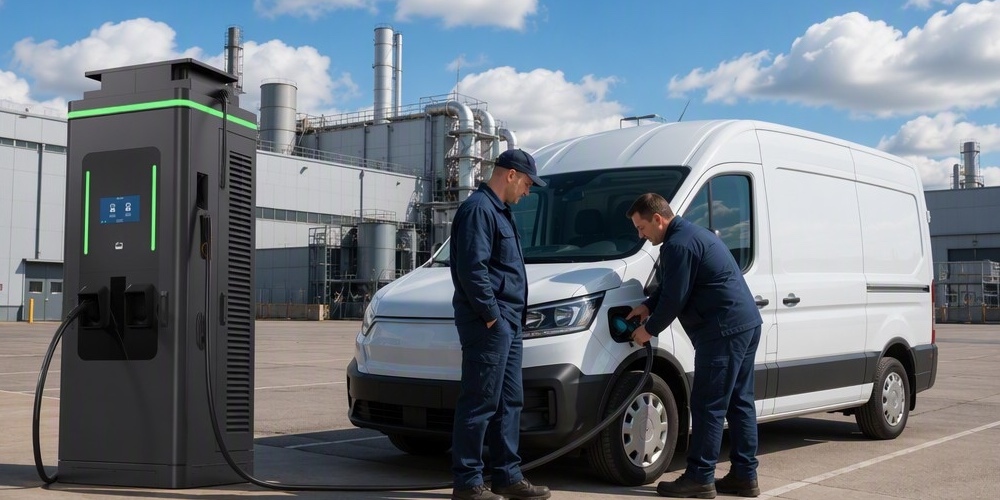
The high efficiency of MIDA’s SiC power modules (95%+) has a direct impact on the operator’s bottom line. In a typical 360kW station, a 1% increase in efficiency can save over 3,000 kWh of energy per year, depending on the utilization rate. Over a 10-year lifespan, this adds up to significant cost savings. Furthermore, our predictive maintenance software reduces the need for emergency on-site visits, which are often the largest component of operational expenses (OpEx).
Part VI: Installation Guide and Site Selection Criteria
The successful deployment of a MIDA 360kW series station starts long before the hardware arrives on site. It requires careful planning and coordination between the CPO, the utility, and the civil engineering team.
Site Assessment
When selecting a location for an ultra-fast charging hub, several factors must be considered:
- Grid Capacity: Does the local transformer have enough spare capacity to support one or more 360kW units? If not, a transformer upgrade or the addition of a MIDA BESS (Battery Energy Storage System) will be required.
- Accessibility: The site must be easily accessible for both passenger cars and larger commercial vehicles. The turning radius and parking bay dimensions should be designed to accommodate the wide variety of EVs on the market.
- Connectivity: Reliable 4G/5G or Ethernet connectivity is essential for the station to communicate with the CPMS and process payments.
- Safety and Visibility: Well-lit, visible locations are preferred by users and help to deter vandalism.
Civil Engineering and Electrical Installation
The installation process typically involves:
- Foundation Construction: A reinforced concrete pad is required to support the weight of the main cabinet and the dispenser units.
- Trenching and Cabling: High-voltage AC cables must be run from the transformer to the station. MIDA provides detailed wiring diagrams to ensure compliance with local electrical codes.
- Earthing and Lightning Protection: Given the high power levels involved, a robust earthing system is critical for both equipment protection and user safety.
- Commissioning: Once the hardware is installed, a MIDA certified technician will perform a series of tests to ensure that the liquid-cooling system is primed, the power modules are functioning correctly, and the software is properly configured.
Part VII: Environmental Impact and Life Cycle Assessment (LCA)
MIDA Power is committed to sustainability throughout the entire life cycle of our products. We conduct rigorous Life Cycle Assessments (LCA) to understand the environmental footprint of our charging stations, from raw material extraction to end-of-life recycling.
Sustainable Manufacturing
Our manufacturing facility in China is powered in part by on-site solar energy. We prioritize the use of recyclable materials, such as aluminum and galvanized steel, in our cabinet construction. Furthermore, our SiC-based power modules reduce the amount of copper and other heavy metals required compared to less efficient designs.
End-of-Life Recycling
When a MIDA station reaches the end of its useful life—typically after 10 to 15 years—the majority of its components can be recycled. We provide our customers with a detailed decommissioning plan that outlines how to safely recover the liquid coolant, recycle the power modules, and repurpose the steel cabinet. By choosing MIDA, CPOs are investing in a product that aligns with the circular economy.
Part VIII: A Narrative of Innovation — The Road to 2030
Imagine a rainy night on a highway in Germany. A logistics driver named Klaus is behind the wheel of a 40-ton electric semi-truck. His battery is at 10%, and he needs to reach his destination by morning. He pulls into a highway rest stop equipped with a MIDA 360kW liquid-cooled station.
Within seconds, he has plugged in the lightweight, liquid-cooled cable. The station’s 1000V architecture immediately recognizes the truck’s 800V battery system and begins delivering a steady 360kW of power. While Klaus grabs a coffee and takes his mandatory 30-minute break, the station adds over 150kWh of energy to his battery. By the time he returns to his cab, the truck is at 70%—more than enough to finish his journey.
This is not a futurist’s dream; it is the reality that MIDA Power is creating today. Our 180kW and 360kW CCS2 series is the bridge between the gasoline-powered past and the electric future. We are not just building chargers; we are building the veins and arteries of a new, global energy system.
Part IX: Technical Specifications Summary
To assist in your procurement and site planning, here is a concise summary of the technical specifications for the MIDA 180kW/360kW series:
- Input Voltage: 3-phase 400V AC ± 10%
- Frequency: 50/60Hz
- Power Factor: >0.99 at full load
- THD: <5%
- Output Voltage Range: 200V – 1000V DC
- Max Output Current: 500A (Liquid-Cooled) / 200A (Air-Cooled)
- Efficiency: >95.5% (Peak)
- Charging Interface: CCS Type 2 (Dual Port)
- Cable Length: 5m (Standard) / 7.5m (Optional)
- Cooling System: Closed-loop liquid cooling for cables and connectors
- Operating Temperature: -30°C to +55°C (with derating above 45°C)
- Storage Temperature: -40°C to +70°C
- Humidity: 5% to 95% RH (Non-condensing)
- Altitude: Up to 2000m without derating
- Enclosure Rating: IP55 / IK10
- Dimensions (HxWxD): 2000mm x 1200mm x 800mm
- Weight: Approx. 850kg (360kW unit)
- Communication: 4G, LAN, Wi-Fi, OCPP 1.6J / 2.0.1
- User Interface: 15-inch Touchscreen, RFID, Credit Card (Optional)
- Certifications: CE, TUV, RoHS, REACH
Part X: Conclusion — Powering the Next Generation
As the world shifts toward a cleaner, more efficient transport system, the role of high-power DC charging cannot be overstated. The MIDA 180kW and 360kW CCS2 Liquid-Cooled series is the result of years of research, development, and real-world testing. It combines the raw power required for the next generation of EVs with the intelligence and reliability required by modern grid operators.
By choosing MIDA Power, you are not just buying a charging station; you are partnering with a global leader in energy innovation. We are committed to supporting our customers at every step of their journey, providing the tools and the technology needed to build a sustainable future for all.
Contact our sales engineering team today to receive a personalized quote and a complete technical documentation package. Let’s charge the future together.
- Sales Inquiry: sales@midapower.com
- Technical Support: sales@midapower.com
- Web: www.midapower.com
- MIDA Power: Empowering Tomorrow.
Part XI: Advanced Site Planning and Engineering Guide for 360kW Hubs
The deployment of a high-power charging hub requires meticulous engineering and planning. This section provides a detailed guide for site operators and electrical engineers who are integrating MIDA 360kW CCS2 stations into their infrastructure.
Electrical Infrastructure Requirements
For a site to support two 360kW units, the total peak load can reach 720kW, plus the energy required for the liquid-cooling units and peripheral systems. We recommend a dedicated 1000kVA transformer to ensure sufficient headroom and to allow for future expansion.
- Service Entrance: 400V AC, 3-phase, 4-wire (plus Earth).
- Circuit Protection: Each 360kW unit requires a dedicated 630A or 800A circuit breaker with adjustable trip settings.
- Cable Sizing: Depending on the distance from the transformer, AC input cables should typically be 240mm² or larger to minimize voltage drop and heating.
Civil Engineering and Physical Layout
The physical placement of the MIDA cabinet is critical for both accessibility and thermal performance.
- Airflow Requirements: The cabinet requires at least 1 meter of clearance on the intake and exhaust sides to ensure the radiators can operate at maximum efficiency.
- ADA/DDA Compliance: Parking bays should be designed to accommodate drivers with disabilities, with charging cables positioned to allow for easy maneuverability.
- Bollards and Protection: We strongly recommend the installation of heavy-duty steel bollards around the charging dispenser to prevent accidental vehicle impacts, which are common in high-turnover highway environments.
Part XII: The Future of User Interface — AI and Biometrics
MIDA is already looking beyond the touchscreen. The next generation of our 360kW series will integrate AI-driven user assistance and biometric authentication.
- Voice Recognition: Allowing users to start and stop charging sessions using voice commands, which is particularly useful in cold or rainy weather when handling a touchscreen is difficult.
- Facial Recognition (Optional): Providing a secure, hands-free authentication method for fleet drivers and premium subscribers.
- AI Charging Optimization: Our on-board AI will analyze the vehicle’s battery health and usage history to recommend the “Optimal SoC” for the user’s next journey, helping to extend battery life and reduce charging costs.
Part XIII: Comprehensive Technical Specifications Table (Expanded)
| Feature | Specification |
|---|---|
| Model Number | MIDA-CCS2-360-LC |
| Input Connection | L1+L2+L3+N+PE |
| Input Voltage Range | 400V AC ± 10%, 3-phase |
| Max Input Current | 560A |
| Efficiency (Full Load) | ≥ 95.5% |
| Power Factor | ≥ 0.99 |
| THD (Current) | ≤ 5% |
| Output Voltage | 200V – 1000V DC |
| Max Output Power | 360kW (Single Port) / 180kW + 180kW (Dual Port) |
| Max Output Current | 500A (Liquid-Cooled Cable) |
| Voltage Accuracy | ≤ ± 0.5% |
| Current Accuracy | ≤ ± 1% |
| Response Time | ≤ 100ms (10% to 90% load) |
| Cooling Method | Forced Air (Modules) + Liquid Cooling (Cables) |
| Coolant Type | Propylene Glycol / Water Mix (Dielectric optional) |
| Coolant Capacity | Approx. 8 Liters |
| Noise Level | ≤ 65dB at 1 meter (Eco Mode) / ≤ 75dB (Full Load) |
| Operating Temperature | -30°C to +55°C |
| Storage Temperature | -40°C to +70°C |
| IP Rating | IP55 (Outdoor) |
| IK Rating | IK10 |
| HMI Screen | 15.6-inch LED Touchscreen, 1500 nits brightness |
| Authentication | RFID, NFC, QR Code, and Password |
| Communication | OCPP 2.0.1 / 1.6J, ISO 15118 (Plug & Charge), Modbus TCP, 4G/5G, Ethernet, Wi-Fi (optional) |
| Connectors | CCS2 (Europe/Asia), 2 x Liquid-Cooled Cables, 5m standard |
| Cable Cooling | Active liquid cooling, coolant temperature monitored in real time |
| Metering | MID-approved kWh meter, accuracy Class 1.0 |
| Protection | Type B RCD, surge protection (Type 1+2), over-temperature, over-current, ground-fault monitoring |
| HMI | 15.6-inch anti-glare touchscreen, multilingual UI, remote content management |
| Mounting | Floor-standing pedestal, anchor-bolted; pad-mount or wall-mount options |
| Humidity | 5% – 95% RH, non-condensing |
| Altitude | Up to 2000m (derating above) |
| Standards | CE, IEC 61851-1/23/24, ETL/UL 2202 & UL 2231 (on request), OCPP |
| Warranty | 3 years standard, extendable to 10 years |
| Dimensions (W×D×H) | 1200 × 800 × 2200 mm (cabinet) |
| Weight | Approx. 750 kg |
All specifications are subject to regional configuration and final engineering review.
Reading the Specification: What Matters for Maritime Sites
A few rows of this table deserve special attention for boat and ferry operators. The 500A liquid-cooled cable is the key to delivering 360kW without the 70mm² cable weight of an air-cooled design — a real advantage on crowded docks and for crews handling connectors with gloved hands. The IP55 + IK10 combination means the cabinet shrugs off salt spray, hosedown cleaning, and accidental impacts from carts and equipment. And the MID-approved meter is essential for any public or commercial marina where energy must be billed accurately and verifiably.
The dual-port architecture deserves equal attention. Operating as 180kW + 180kW, a single cabinet serves two vessels simultaneously — a fast ferry charging at one berth while a workboat tops up at the next — which roughly doubles the utilization of each installed cabinet and its grid connection. When only one vessel is connected, the full 360kW flows to that single port, so peak-power vessels are never throttled by the cabinet’s configuration. This flexibility lets harbor operators match capacity to actual berth activity without overbuilding.
Conclusion: The Complete Maritime Charging Solution
Electric boats, ferries, and harbor fleets demand the same extreme reliability as their road-going counterparts — but add salt air, humidity, and unpredictable shore-side infrastructure to the challenge. MIDA’s 200kW, 240kW, and 400kW CCS2 series answers with a liquid-cooled, IP55-rated, IK10-protected platform that delivers 360kW of true dual-port power, 500A of continuous current, and an efficiency of 95.5% — all from a single rugged cabinet.
Key Takeaways
- Up to 360kW per station with dual-port 180kW + 180kW operation, liquid-cooled to 500A.
- Full marine-grade protection: IP55 enclosure, IK10 vandal resistance, and a -30°C to +55°C operating range.
- MID-approved metering and OCPP 2.0.1/ISO 15118 connectivity for accurate billing and smart-grid integration.
- Modular 30kW/40kW SiC architecture keeps expansion simple and total cost of ownership low.
- Complete protection suite — RCD, surge, thermal, and ground-fault monitoring — protects both vessel and infrastructure.
Call to Action
Planning a marina, ferry terminal, or harbor charging project? Contact MIDA Power today for the complete technical specification package and an engineering consultation tailored to your waterfront site.
MIDA Power: Precision Engineering for a Sustainable World.
- Sales Inquiry: sales@midapower.com
- Technical Support: sales@midapower.com
- Web: www.midapower.com
Post time: Aug-09-2026
