
 Portable EV Charger
 Home EV Wallbox
 DC Charger Station
 EV Charging Module
 DC Charging Connector
 EV Accessories
New Requirements for Charging Stations: EN ISO 15118-1 Standard
The European Commission has released a decision that will have a profound impact on all electric vehicle and charging infrastructure manufacturers. From next year, charging stations must comply with the ISO 15118 series of standards. The VDE Institute has provided several adaptation testing services and is developing more testing procedures to ensure compliance with the standards.
From January 8, 2026, all public charging points must meet the requirements of the EN ISO 15118-1 to -5 series of standards. From January 1, 2027, the implementation of the EN ISO 15118-20 standard will become mandatory, including for privately or semi-publicly operated charging stations. These standards are the core foundation for future-oriented features such as “plug and play,” secure communication between vehicles and charging points, and bidirectional charging (vehicle-to-grid).
What’s the mean about EN ISO 15118-1/2 Standard ?
The VDE Testing and Certification Institute responded early to the new regulatory requirements and is currently developing standardized testing procedures. The aim is to provide comprehensive testing and reliable certification services to AC and DC charging station manufacturers from an early stage, based on the ISO 15118 standard, to ensure their products meet the specifications.
The VDE Institute’s services for ISO 15118 include interoperability and conformity testing of charging infrastructure, preparation of standardized test reports and certificates of conformity, and assessment of the integration of new features such as plug-and-play and V2G.
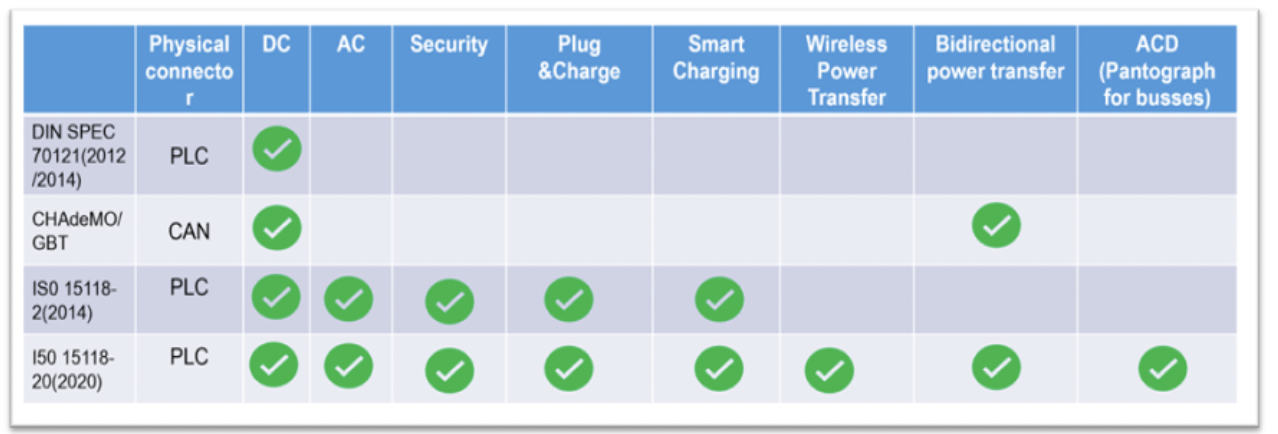
European charging pile regulations, IEC 61851-24:2014/2023 Annex C, have long clearly stated that high-level communication for DC charging piles must comply with DIN SPEC 70121:2014 or ISO 15118-2:2014 (either one or both can be supported).
This requirement presents a challenge for some domestic charging pile companies.
Physical interface differences exist. The European standard uses the CCS2 (Combined Charging System 2) interface, where AC and DC input sockets share a single interface; the Chinese standard uses the System B interface, separating AC and DC inputs. This difference can be resolved by strictly adhering to the IEC 62196 standard (which clearly specifies physical dimensions and performance requirements), making it technically relatively simple.
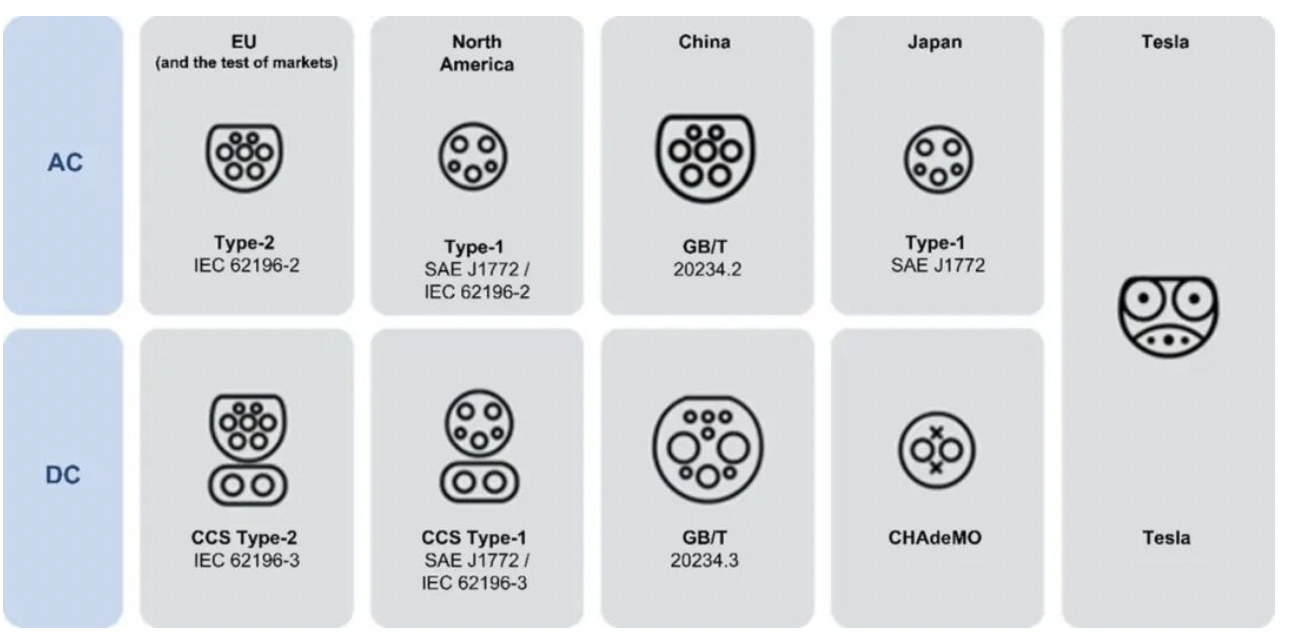
The communication method differs. This is a core technological barrier. The Chinese standard charging nozzle has separate CAN+ and CAN- signal lines, and vehicle-charging pile communication uses CAN communication; while the European standard charging nozzle does not have a CAN line, using PLC (Power Line Communication), coupling a high-frequency signal to a 12V, 1kHz PWM low-frequency pulse width modulation signal between the CP and PE lines. Compared to CAN communication, PLC communication protocol development is more difficult, and open-source documentation is scarce. Therefore, many charging pile companies purchase separate SECC (Supply Equipment Communication Controller) modules, packaging their charging information via CAN signals and sending it to the SECC module, which then communicates with the vehicle’s EVCC (EV Communication Controller) module.
However, purchasing or developing your own SECC module is only the first step. After the SECC module is installed in the charging pile, it still needs to be proven that the module, when used with the entire charging pile, complies with the European standard DIN SPEC 70121:2014 or ISO 15118-2:2014 requirements.
To save costs, many charging pile companies choose to only support DIN SPEC 70121 because purchasing SECC modules is cheaper and easier to test.
What are the key differences between the standards DIN 70121 and the ISO 15118 series for DC charging piles?
Simply supporting DIN 70121 is no longer sufficient to meet the latest EU requirements.
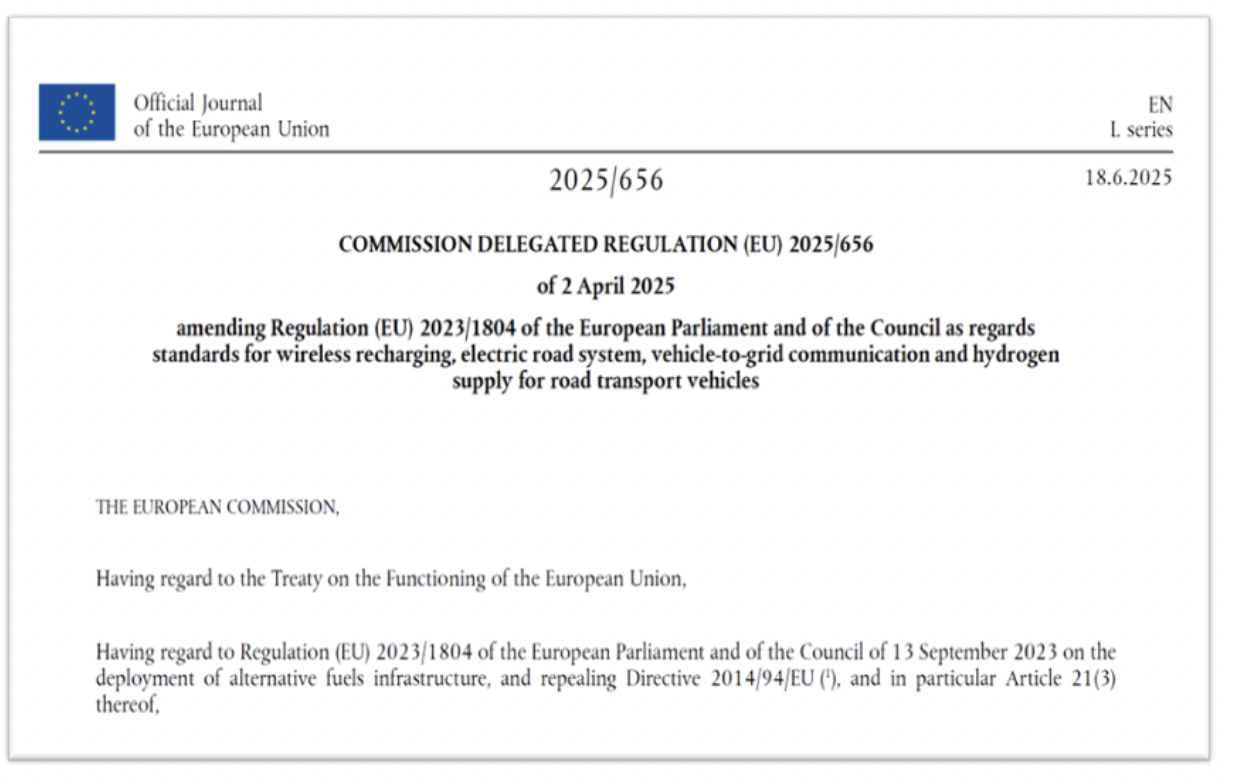
The EU published COMMISSION DELEGATED REGULATION (EU) 2025/656 in June 2025. This regulation is a supplement and amendment to REGULATION (EU) 2023/1804 regarding wireless charging, electric road systems, and hydrogen supply for road transport vehicles. Released in 2023, REGULATION (EU) 2023/1804, more commonly known as the Alternative Fuel Infrastructure Regulation (AFIR), is a key policy regulation introduced by the European Union to accelerate the transition to zero-emission transportation and address the inadequacy of alternative fuel (electricity, hydrogen, etc.) infrastructure. Its aim is to mandate member states to improve their charging and refueling infrastructure networks through legislation, alleviating user anxiety about range and refueling, and supporting the large-scale adoption of electric vehicles (EVs), hydrogen fuel cell vehicles (FCEVs), and heavy-duty electric trucks.
In short, the EU has released a revised version of the Alternative Fuel Infrastructure Regulation (AFIR), which has full legal force, is mandatory, and applies directly to all member states.
Important revisions include: After January 8, 2026, all charging stations that are publicly accessible and are newly installed or refurbished, including AC and DC charging stations, must at least comply with the requirements of EN ISO 15118-2:2016. After January 1, 2027, all charging stations in the public domain that are newly installed or refurbished, including AC and DC charging piles, must at least comply with EN ISO 15118-20:2022. If the charging station provides automatic authentication and authorization services, such as PNC (plug-and-charge), it must comply with both EN ISO 15118-2:2016 and standard EN ISO 15118-20:2022. After January 1, 2027, all charging points in private recharging points that are newly installed or refurbished, for Mode 2 AC charging points, must comply with EN IEC 61851-1:2019; for Mode 3 AC charging piles and Mode 4 DC charging piles, they must comply with EN ISO 15118-20:2022. In summary, all new or refurbished public DC charging stations installed after 2026 must comply with EN ISO 15118-2:2016. All new or refurbished DC charging stations and Mode 3 AC charging stations installed after 2027 must also comply with EN ISO 15118-20:2022.
Within the charging station family, only Mode 2 IC-CPDs are outside the scope of this directive. In China, these portable charging stations are called “vehicle-mounted chargers,” and in Europe, their power typically does not exceed 3.7kW. REGULATION (EU) 2025/656 explains that PWM (Pulse Width Modulation) is sufficient for Mode 2 AC charging stations, supporting ISO 15118-2 or 20, and does not bring any additional value to the end user.
For domestic charging station companies, this new regulation may create significant technological barriers. Initially, compliance with DIN 70121 was required, but soon after, support for ISO 15118 was mandated; support for both ISO 15118-2 and ISO 15118-20 was also required. Some charging pile companies looking to expand overseas were unfamiliar with these standards and needed to understand the differences between DIN SPEC 70121, ISO 15118-2, and ISO 15118-20, and the purpose of supporting them. Why are there so many standards for vehicle-charging pile communication in Europe?
The Evolution of the ISO 15118 Series Standards: From Transitional Solution to Global Benchmark
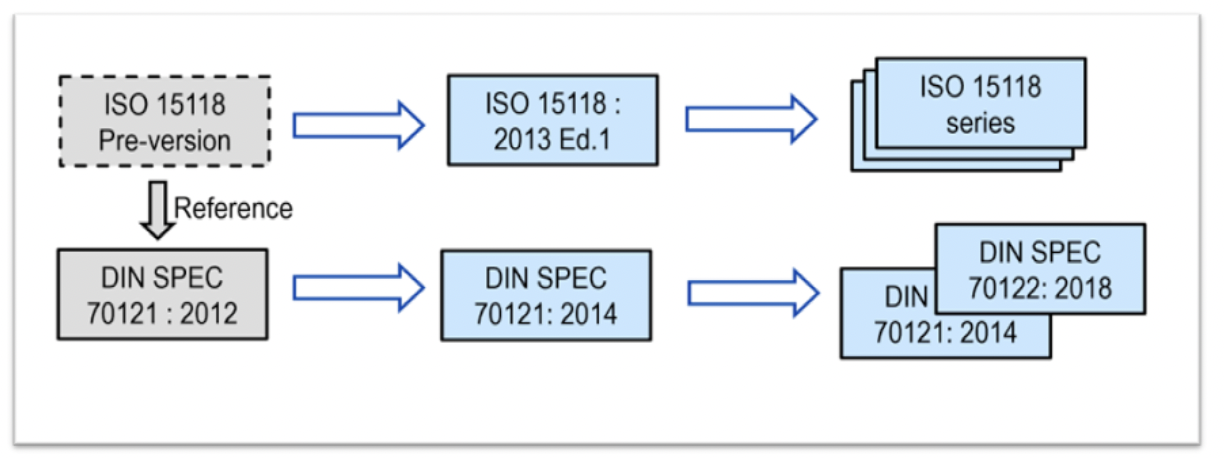
In early 2010, the joint working group of IEC Technical Committee 69 (TC69) and ISO Technical Committee 22 (TC22) began collaborating on the ISO 15118 series standards, hoping to solve the problem of unified communication between electric vehicles and charging piles. Because the working group considered a comprehensive range of issues and aimed for a large, compatible version, the preparation time for the ISO 15118 series standards was too long, and its official release was delayed.
But the market couldn’t wait. German automakers, in particular, are eager for their electric vehicles to achieve common charging infrastructure as soon as possible to gain a market advantage. Therefore, German industry stakeholders united and, within the framework of DIN, extracted relatively mature aspects from discussions of ISO 15118 to develop a German national standard that could be implemented immediately. DIN SPEC 70121 was published in 2012; updated in 2014; and its testing specification standard, DIN SPEC 70122:2018, was published in 2018.
The ISO 15118 standard was released late, with the first version officially published in 2013. Specific application layer standards and testing standards were subsequently released in 2014 and 2018. ISO 15118 is a large series of standards that has developed rapidly. The first generation of standards related to conductive charging includes the following five standards: ISO 15118-1 (General Requirements and Use Case Definitions), ISO 15118-2 (Application Layer Protocol Requirements), ISO 15118-3 (Physical Layer and Data Link Layer Requirements), ISO 15118-4 (Application Layer Test Specifications), and ISO 15118-5 (Physical Layer Test Specifications). DIN SPEC 70121:2014 can be seen as a simplified version of ISO 15118-2/3. DIN SPEC 70121 only supports DC charging, while ISO 15118-1 to 5 standards support both AC and DC charging simultaneously, and also support TLS encryption, plug-and-charge (PNC) functionality, and smart charging.
In 2022, the ISO 15118 series released its second-generation charging standard, namely ISO 15118-20:2022, mentioned above. Compared to ISO 15118-2, it also supports TLS 1.3 encryption, V2G (vehicle-to-grid), WPT (wireless charging), and ACD (automatic connection device) functions, and has corresponding test standards: 15118-21 Common Tests, 15118-23 DC Specific Tests, 15118-22 AC Specific Tests (not yet released), 15118-24 ACD Specific Tests (not yet released), and 15118-25 WPT Specific Tests (not yet released). DIN SPEC 70121 was originally created as a transitional solution to support the rapid development of the electric vehicle market before the release of ISO 15118. However, in actual communication choices between charging stations and vehicles, even if both the vehicle and the charging station support both DIN SPEC 70121 and ISO 15118, DIN SPEC 70121 still dominates in most scenarios. Besides the first-mover advantage of DIN SPEC 70121, the lack of high-level, complex use cases (TLS/PNC/V2G/WPT, etc.) is the most important reason.
Why does the new fuel alternative infrastructure regulation now require full support for ISO 15118-2 and ISO 15118-20?
The underlying logic of the EU’s mandatory promotion of the ISO 15118 series standards
The European Commission has industrial policy considerations.
The fuel alternative infrastructure (Directive 2014/94/EU on the deployment of alternative fuels infrastructure) was first published in 2014, but it was not a regulation at the time, only a directive.
Directives differ from mandatory regulations in that they only specify the results to be achieved, but do not clearly quantify the requirements, allowing member states to independently develop implementation methods.
For example, the 2014 fuel alternative infrastructure directive also included requirements for charging points, hydrogen refueling stations, and gas refueling stations, but only stated that they should have “appropriate coverage density,” without specifying numerical targets, leading to fragmentation and uneven development of infrastructure across the EU. Countries with well-developed and widespread electric vehicle (EV) systems are naturally more willing to invest, while those with slower EV development are progressing more slowly. In recent years, global EV development has been rapid (EV penetration in China has exceeded 50%), but in Europe, weak charging infrastructure and complex operations have resulted in a poor user experience for EV users, hindering the transition to zero-carbon transportation.
DIN SPEC 70121, as a transitional agreement, has consistently served as the mainstream charging standard, which is proof of this.
The European Commission recognized the need to accelerate the construction of new energy infrastructure; otherwise, it would not only be difficult to achieve the 2050 carbon reduction targets but also fall behind in the competition in the automotive and distributed energy industries. To reverse this situation, the EU upgraded Directive 2014/94/EU to regulation (REGULATION (EU) 2023/1804) in 2023, clearly quantifying the target: by 2025, a charging station with a total power of at least 400kW must be installed every 60 kilometers. This charging station must include at least one charging pile with a power of 150kW or more. By 2027: The total power requirement for charging stations per 60 kilometers will increase to 600kW, and must include at least one charging station with a power output of 150kW or higher.
The European Commission has industrial policy considerations in place.
The Directive on the Deployment of Alternative Fuel Infrastructure (Directive 2014/94/EU) was first issued in 2014, initially as a directive rather than a regulation.
Unlike mandatory requirements of regulations, directives specify the desired outcomes without clearly quantifying them, allowing member states to develop their own implementation methods.
For example, the 2014 Directive on Alternative Fuel Infrastructure also outlined requirements for charging points, hydrogen refueling stations, and CNG refueling stations, but only stated “appropriate coverage density” without specifying concrete figures. This led to fragmentation and uneven development of infrastructure across the EU. Countries with advanced and widespread electric vehicle development are naturally more willing to invest, while countries with slower electric vehicle development are progressing more slowly. In recent years, the global electric vehicle (EV) market has developed rapidly (EV penetration in China has exceeded 50%). However, in Europe, weak charging infrastructure and complex operations have resulted in a poor user experience for EV users, hindering the transition to zero-carbon transportation.
DIN SPEC 70121, as a transitional agreement, has consistently served as the mainstream charging standard, which is proof of this.
The European Commission recognized the need to accelerate the construction of new energy infrastructure; otherwise, it would not only be difficult to achieve the 2050 carbon reduction targets but also fall behind in the competition in the automotive and distributed energy industries. To reverse this situation, the EU upgraded Directive 2014/94/EU to regulation (REGULATION (EU) 2023/1804) in 2023, clearly quantifying the targets: By 2025: a charging station with a total power of at least 400kW must be installed every 60 kilometers. This charging station must include at least one charging pile of 150kW or higher. By 2027: the total power requirement for charging stations every 60 kilometers will increase to 600kW, and must include at least one charging pile of 150kW or higher.
Post time: Jan-08-2026
